by Jamie Pantastico | Jun 2, 2026 | Israel and Bible Prophecy |
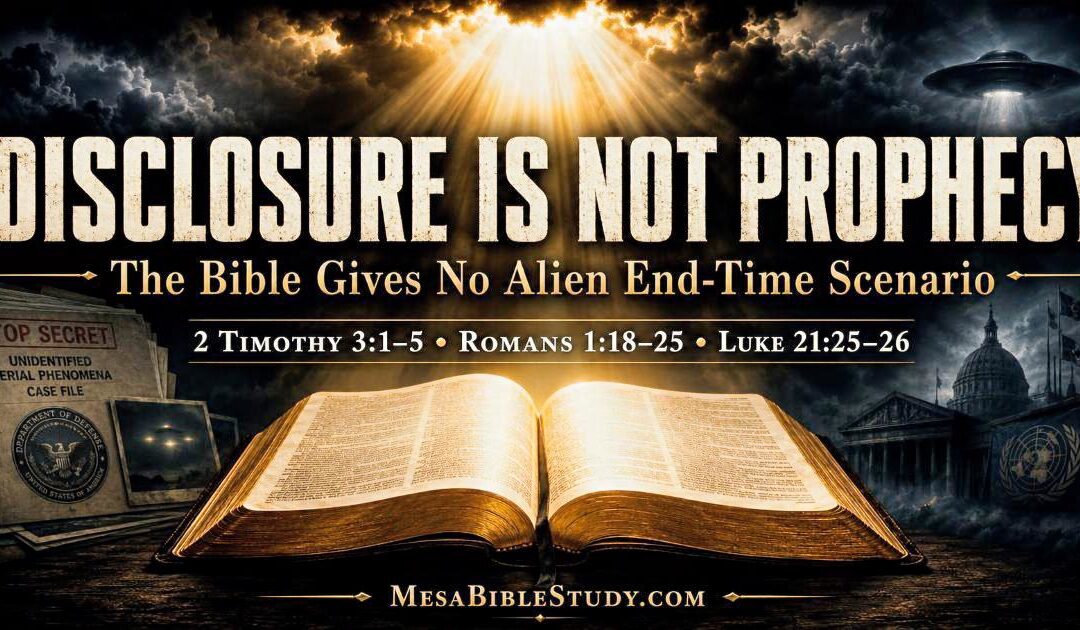
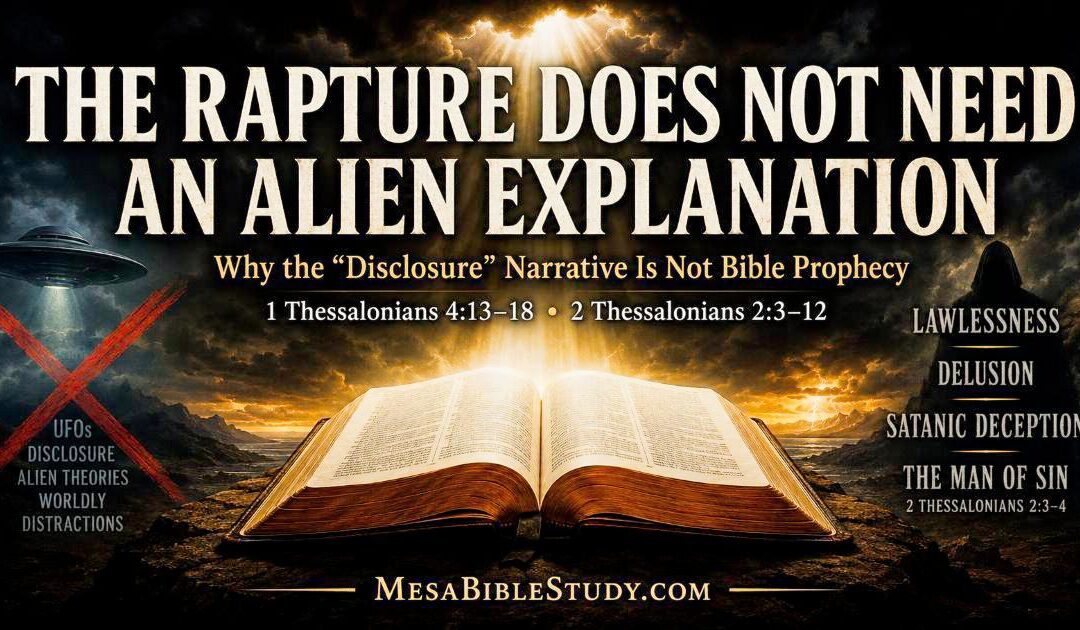
Why the “Aliens Explain the Missing Church” Theory Is Clickbait
Key Scriptures:
1 Thessalonians 4:13–18
1 Corinthians 15:51–52
2 Thessalonians 2:3–12
Introduction
A strange and dangerous idea has spread rapidly through modern prophecy circles:
“Alien disclosure is being prepared to explain away the rapture of the Church.”
You hear it in podcasts. You see it in videos. You read it in comment sections. Some connect it to UFO hearings. Others connect it to secret government programs, Project Blue Beam, “non-human intelligence,” or some coming false flag event.
The claim is simple: when the Body of Christ is caught up to meet the Lord in the air, the world will need an explanation for the disappearance of believers — and that explanation will be aliens.
It sounds dramatic.
It draws attention.
It gets clicks.
But there is one major problem:
The Bible never teaches it.
Paul never tells the Body of Christ that the world will explain the rapture through aliens. Peter never warns believers about extraterrestrial disclosure. John never shows the world being gathered under a UFO narrative after the Church is gone. Revelation does not present a world confused by missing Christians and then pacified by a science-fiction explanation.
That idea has to be imported into Scripture from the outside.
And once something has to be imported into Scripture, believers need to stop and ask:
Why are we giving it so much authority?
The Bible gives us a clear prophetic framework. After the removal of restraint (the body of Christ), the man of sin is revealed. Satan empowers deception. The world receives the lie. The Beast rises. The beast system takes over the planet. The false prophet deceives. The world worships the dragon and the Beast.
That is the biblical picture.
Not aliens.
Not extraterrestrial disclosure.
Not a science-fiction explanation for the rapture.
The rapture does not need an alien explanation because Scripture already tells us what the world will be given over to: lawlessness, delusion, satanic power, and the rise of the man of sin.
The Rapture Is a Revelation Given Through Paul
The catching away of the Body of Christ is revealed through the apostle Paul.
In 1 Thessalonians 4:13–18, Paul comforts believers concerning those who had died in Christ. He explains that the dead in Christ will rise first, and then those who are alive and remain will be caught up together with them to meet the Lord in the air.
This is not a message of fear.
It is a message of comfort.
Paul ends that passage by saying:
“Therefore comfort one another with these words.”
— 1 Thessalonians 4:18
In 1 Corinthians 15:51–52, Paul calls this a mystery which means secret:
“Behold, I tell you a mystery: We shall not all sleep, but we shall all be changed—
in a moment, in the twinkling of an eye, at the last trumpet.”
— 1 Corinthians 15:51–52
The rapture is not speculation. It is not science fiction. It is not a theory invented by prophecy teachers. It is a revealed truth given through Paul concerning the Body of Christ.
But here is what matters for this discussion:
When Paul reveals the catching away of the Body of Christ, he does not attach an alien deception to it.
He does not say the world will explain it through beings from another planet.
He does not say governments will create a false narrative to explain missing believers.
He does not say the Church should prepare people for an extraterrestrial cover story.
He says the Lord Himself will descend. The dead in Christ will rise. The living believers will be changed. And we will meet the Lord in the air.
That is what Scripture says.
Anything beyond that must be handled very carefully.
The Bible Does Not Say the World Will Need an Explanation
Much of the alien-disclosure theory rests on one assumption:
The world will need an explanation for the rapture.
But where does Scripture say that?
Where does Paul teach that unbelieving humanity will be sitting around, sincerely trying to understand what happened to the Body of Christ?
Where does Revelation show the nations confused by missing Christians and waiting for some government explanation?
Where does the Bible say the Antichrist system must explain the catching away before it can take control?
It does not.
That assumption has become popular because it sounds plausible to modern ears. But plausible is not the same as biblical.
The apostle Peter warned believers that the untaught and unstable will twist Paul’s letters. We are witnessing this in real time, unstable and untaught, making a mockery God’s word.
The world that rejects the truth of God is not neutral. It is already under deception. It is already spiritually blinded. It is already prepared to believe lies because it has rejected the truth.
Paul says:
“But even if our gospel is veiled, it is veiled to those who are perishing,
whose minds the god of this age has blinded…”
— 2 Corinthians 4:3–4
The unbelieving world does not need aliens to explain away the truth. The unbelieving world is already blinded to the truth.
That is why the gospel is so urgent.
The issue is not that the world lacks information. The issue is that the world rejects revelation.
The issue is not that mankind needs one more explanation. The issue is that mankind has already refused the explanation God has given.
The Mystery of Lawlessness Is Already at Work
Paul gives the biblical framework in 2 Thessalonians 2.
He speaks of the coming man of sin, the son of perdition, who will exalt himself above all that is called God or worshiped. He also states that something is presently restraining his full revelation.
Then Paul writes:
“For the mystery of lawlessness is already at work…”
— 2 Thessalonians 2:7
That statement is crucial.
Lawlessness is not waiting for alien disclosure.
The deception is not waiting for one dramatic UFO event.
The rebellion is already working. And has been since the tower of Babel.
The world is already being conditioned to reject God, reject creation, reject Christ, reject Scripture, reject Israel, reject the gospel of grace, and reject the authority of the Word of God.
The mystery of lawlessness is already at work in religion, government, education, culture, entertainment, technology, and false doctrine.
So when people say, “Disclosure is being prepared to explain away the rapture,” they are often missing the larger biblical picture.
The deception is much deeper than aliens.
The deception is the rejection of truth itself.
The Man of Sin Will Be Revealed — Not Aliens
Paul does not say that after the restrainer is removed, aliens will be revealed. That’s just stupid.
He says the lawless one will be revealed.
That is the biblical focus.
“And then the lawless one will be revealed…”
— 2 Thessalonians 2:8
The prophetic issue after the removal of restrainer is not extraterrestrial disclosure. It is the revealing of the man of sin.
That matters.
If the Bible says the world’s attention will be drawn toward the man of sin, then why are believers spending so much time trying to make aliens the center of the post-rapture narrative?
The Antichrist does not need aliens to take control of the world.
The Beast system does not need extraterrestrial beings to deceive the nations.
The false prophet does not need UFO disclosure to direct worship away from God.
Scripture already tells us the source of the deception:
“The coming of the lawless one is according to the working of Satan, with all power, signs, and lying wonders.”
— 2 Thessalonians 2:9
That is not science fiction.
That is satanic power.
That is the biblical category.
The Deception Is Satanic, Not Extraterrestrial
This is where believers must be very clear.
The Bible does warn about supernatural deception. But it identifies the source.
The source is not aliens.
The source is Satan.
Paul says the coming of the lawless one is “according to the working of Satan.” He speaks of “power, signs, and lying wonders.” He says this deception comes with “all unrighteous deception among those who perish.”
Why do they perish?
Paul tells us:
“because they did not receive the love of the truth, that they might be saved.”
— 2 Thessalonians 2:10
That is the issue.
Not aliens.
Not UFOs.
Not disclosure.
Truth.
The world rejected the truth. And what is the truth?
That Christ died for our sins, shed His blood and died on the cross, was buried and rose again the third day!
The gospel.
Then Paul continues:
“And for this reason God will send them strong delusion, that they should believe the lie.”
— 2 Thessalonians 2:11
The end-time delusion is connected to rejecting truth, not failing to understand where Christians went.
The deception is moral, spiritual, doctrinal, and satanic.
It is not a science-fiction cover story.
The “Alien Explanation” Narrative Distracts from the Real Warning
This is why the alien-disclosure narrative is so dangerous.
It pulls attention away from what Scripture actually says.
Instead of teaching people about the man of sin, lying signs and wonders, strong delusion, false worship, and rejection of the gospel, many prophecy teachers are now chasing UFO headlines.
Instead of rightly dividing the Word of truth, they are building prophecy frameworks around government leaks and internet speculation.
Instead of preaching Christ crucified, buried, resurrected and coming again, they are warning people about alien cover stories.
That is not discernment.
That is distraction.
And the father of lies does not care which distraction works, as long as it moves attention away from the truth.
If a believer spends more time talking about UFO disclosure than the gospel of grace, something is wrong.
If prophecy teaching becomes more focused on aliens than on the Beast, the false prophet, Israel, the Day of the Lord, and the coming judgment of God, something is wrong.
If the rapture is used as a platform for science-fiction speculation instead of comfort, hope, and sound doctrine, something is wrong.
The Rapture Is Comfort for the Church, Not Clickbait for Speculation
Paul did not reveal the catching away of the Body of Christ so believers could build sensational theories around it.
He revealed it to comfort the saints.
He revealed it to give hope. Our blessed hope.
He revealed it to remind believers that the Lord has not appointed the Body of Christ to wrath.
The rapture is not a marketing tool for prophecy channels.
It is not a gateway into UFO speculation.
It is not a mystery that needs help from modern conspiracy culture.
It is a blessed hope for the Church.
The Lord Himself will descend.
The dead in Christ will rise.
Living believers will be changed.
We will be caught up together to meet the Lord in the air.
And so shall we always be with the Lord.
That is enough. Praise God.
What Happens After the Rapture Is Already Revealed
The Bible does not leave us guessing about the prophetic direction of the world.
After the Church is removed and restraint is taken out of the way, the prophetic program concerning Israel and the nations resumes. The man of sin will be revealed. The seventieth week of Daniel will unfold. The Beast will rise. The false prophet will deceive. The nations will be drawn into rebellion. Israel will become the focal point of Satan’s rage. The world will move toward Armageddon and the return of the Lord Jesus Christ.
That is the prophetic framework.
Nothing in that framework requires aliens.
Nothing in that framework depends on UFO disclosure.
Nothing in that framework suggests that the Beast must use extraterrestrial beings to explain the missing Church.
The Beast system will not be looking for biblical truth.
The world will not be searching the Scriptures for answers.
The nations will not be asking, “Where did the Body of Christ go?”
The world that rejected the truth will be handed over to delusion.
Scripture is clear about the 7 years of tribulation— they will know God— the world will know God of heaven. But what will they do?
They will blaspheme God, they will not repent, mankind will be loyal to the Anti-Christ and continue to rebel.
The Bible is crystal clear about the spiritual condition of mankind during the seven years of Tribulation.
And nowhere does Scripture point us to aliens, UFO disclosure, Project Blue Beam, the Illuminati, or any other man-made theory being forced into Bible prophecy.
The issue during the Tribulation will not be confusion over extraterrestrial beings.
The issue will be mankind’s open rebellion against the one true God.
The world will know.
They will know the God of the Bible exists. They will know His judgments are being poured out. They will know He has power over the plagues. They will know they are accountable to Him.
And yet, in their delusion, hatred, pride, and wickedness, they will refuse to repent.
That is what Scripture says.
Mankind will blaspheme God. They will refuse to give Him glory. Instead, they will continue worshiping demons and idols. They will continue in murder, sorcery, sexual immorality, theft, and rebellion against the one true God.
This is not speculation.
This is the written Word of God.
Why This Matters
This matters because believers must not allow speculation to replace Scripture.
The last days are already filled with confusion. Paul warned of perilous times. Jesus warned of deception. Peter warned of false teachers. Paul warned of doctrines of demons. Revelation warns of the dragon, the Beast, the false prophet, lying signs, and global worship.
That is more than enough.
We do not need to add aliens to make Bible prophecy interesting.
We do not need to borrow from science fiction to make Scripture relevant.
We do not need government disclosure to validate what God has already revealed.
The Word of God is sufficient.
And the Church’s message has not changed.
The Message for This Present Age Is the Gospel of Grace
The greatest danger in all of this is not that people will believe in aliens.
The greatest danger is that people will be distracted from the gospel.
Disclosure is not the great explanation. It is another distraction from the gospel of grace.
The Body of Christ has been entrusted with the message of reconciliation.
“Now then, we are ambassadors for Christ…”
— 2 Corinthians 5:20
Each and everyone of us has this tremendous opportunity to share the good news with the lost world.
That’s why God leaves us here.
Not to decode government files.
Not to build prophecy charts around aliens.
Not to lead believers down rabbit trail.
But to share the good news:
Christ died for our sins.
He was buried.
He rose again the third day.
And by grace through faith alone in this simple message a person is saved.
That is the truth Satan hates.
That is the truth the world suppresses.
That is the truth the father of lies wants buried under fear, confusion, entertainment, speculation, and false doctrine.
Final Summary
The rapture does not need an alien explanation.
The Bible never teaches that the world will explain away the catching away of the Body of Christ through extraterrestrial disclosure. That narrative is not found in Paul, Peter, John, the prophets, or the book of Revelation.
Scripture gives us a different picture.
The mystery of lawlessness is already at work.
The restrainer will be removed.
The man of sin will be revealed.
His coming will be according to the working of Satan.
The world that rejected the truth will believe the lie.
The Beast will rise.
The false prophet will deceive.
The world will worship the dragon and the Beast.
That is the biblical warning.
So let the world talk about disclosure.
Let prophecy sensationalists chase every headline.
Let the wise of this world speculate.
The believer has something better.
We have the written Word of God.
We have the gospel of the grace of God.
We have the blessed hope.
And we have no need to explain Bible prophecy with science fiction.
The rapture does not need an alien explanation.
The Church does not need speculation.
The lost world needs the gospel of grace.
This post is part 1 of the series:
The Deception Is Not Aliens: What Jesus, Paul, and Peter Actually Warned About
The Bible never frames end-time deception around aliens, UFO disclosure, or extraterrestrial saviors. Scripture warns of false Christs, false prophets, false teachers, doctrines of demons, lying signs and wonders, strong delusion, the Beast, the false prophet, and a world that rejects the truth. This series examines the modern disclosure narrative through the written Word of God and brings the focus back to Christ, Scripture, and the gospel of grace.
Next in the series:
Part 2 — The Beast Will Not Need Aliens
Back to Series Main Page
by Jamie Pantastico | May 30, 2026 | Pauline Theology |
Part 6 – Retroactive Revelation Series
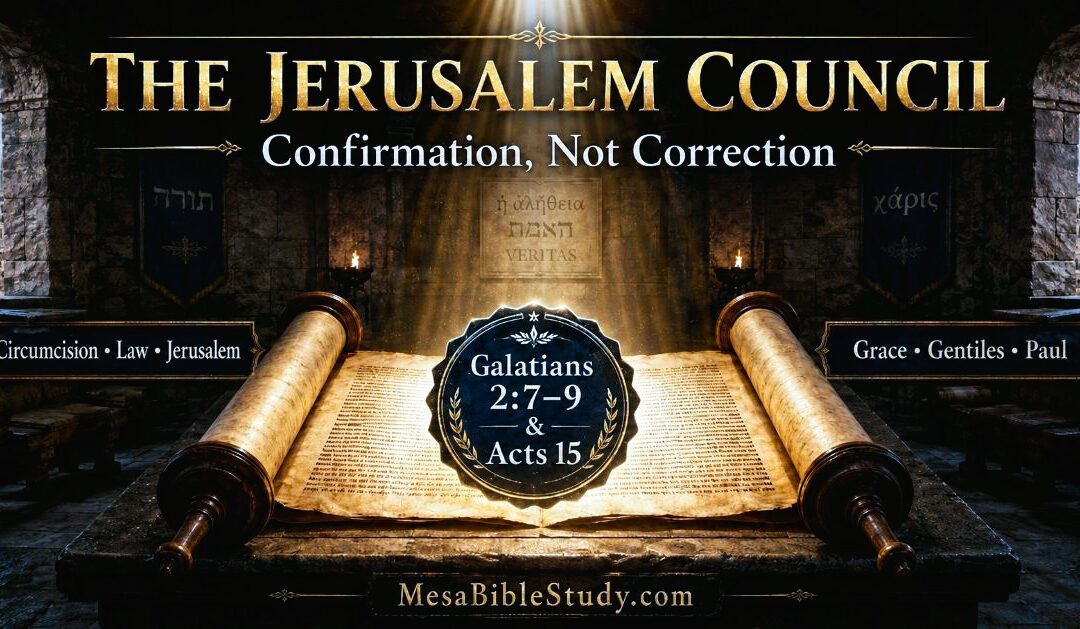
Why Acts 15 and Galatians 2 confirm Paul’s distinct apostleship
Acts 15 is one of the most important chapters in the New Testament for understanding Paul’s apostleship, the gospel of grace, and the relationship between Israel’s kingdom program and the Body of Christ.
It is also one of the most misunderstood.
Most read Acts 15 as though the Peter, James, John and the leadership of the Jerusalem church corrected Paul, approved him, absorbed him into their program, or confirmed that everyone had been preaching the same gospel all along.
But that is not what the text says.
Acts 15 does not erase Paul’s distinct message.
It confirms it.
Galatians 2 does not show Paul submitting his gospel to Jerusalem for approval.
It shows Paul going up by revelation, laying before them the gospel he preached among the Gentiles, and receiving formal recognition that his apostleship and message were distinct.
The Jerusalem Council was not the moment Paul learned the gospel from Peter.
It was the moment Jerusalem was forced to acknowledge what the risen Christ had already given to Paul.
A Necessary Clarification
Before going further, let this be stated plainly:
All salvation—from Abel to the end of time—is only possible because of the finished work of Jesus Christ:
- His death
- His shed blood
- His burial
- His resurrection
There is one Savior.
There is one cross.
There is one basis of salvation.
This study is not about two Saviors or two ultimate bases of redemption.
It is about what God revealed, when He revealed it, and through whom He revealed it.
Acts 15 and Galatians 2 are not about whether Christ saves.
They are about whether Gentiles were to be placed under Israel’s Law and whether Paul’s gospel stood independent of Peter, James, John and believers that made up the congregation of the Jerusalem church.
The Crisis That Forced the Council
Acts 15 begins with a doctrinal crisis:
Important: the events recorded in Acts 15 and Galatians to happened 20 years after Pentecost.
“And certain men came down from Judea and taught the brethren, ‘Unless you are circumcised according to the custom of Moses, you cannot be saved.’”
— Acts 15:1
Then again in verse 5, the language is stronger. The leaders of the Jerusalem Church were not simply suggesting, they were commanding Paul’s congregants.
Acts 15:5
‘But some of the sect of the Pharisees who believed rose up, saying, “It is necessary to circumcise them, and to command them to keep the law of Moses.”’
This was not a minor disagreement.
This was the central issue. Not much has changed since 51 AD. Most of Christendom has some demand or command in order for any person to be saved.
Must Gentiles come under circumcision and the Law of Moses to be saved?
That question only exists because Paul’s ministry was producing something the Jerusalem believers had not previously understood.
Gentiles were being saved apart from circumcision.
Gentiles were being saved apart from the Law.
Gentiles were being received apart from Israel’s covenant markers.
That was not how Israel’s program functioned.
That is why the controversy erupted.
If Peter and Paul had been preaching the exact same message from the beginning, Acts 15 would make no sense.
If Peter, James and John were preaching Paul’s gospel from Pentecost there would be no need for Acts 15 or Galatians 2.
There would have been no need for a council.
There would have been no dispute over circumcision.
There would have been no crisis over the Law.
Paul Did Not Go Up to Jerusalem to Learn His Gospel
Galatians 2 gives us Paul’s own explanation of this same event.
“Then after fourteen years I went up again to Jerusalem with Barnabas, and also took Titus with me. And I went up by revelation…”
— Galatians 2:1–2
Take note of the time— this is 14 years after Paul’s conversion in 37AD.
Paul did not go up because James, Peter and John summoned him.
He did not go up because he was unsure about his message.
He did not go up to have James, Peter and John correct him.
He went up by revelation.
That means the Lord Himself directed Paul to go.
Why?
Because the issue had to be settled publicly.
Paul continues:
“and communicated to them that gospel which I preach among the Gentiles…”
— Galatians 2:2
Notice Paul’s wording:
“that gospel which I preach among the Gentiles.”
Paul does not describe himself as merely repeating what Peter had already been preaching.
He lays before them the gospel committed to his Gentile ministry.
This is not Paul submitting to Jerusalem.
This is Paul setting the record straight.
The bottom-line is Paul went up to the Jerusalem church to tell the leadership— James, Peter, John and the elders how it was going to be moving forward.
Titus Became the Test Case
Paul then adds a crucial detail:
“Yet not even Titus who was with me, being a Greek, was compelled to be circumcised.”
— Galatians 2:3
Titus was a Gentile.
That made him the perfect test case.
If Gentiles had to come under circumcision and the Law, Titus would have been compelled to be circumcised.
But he was not.
Why?
Because Paul’s gospel did not place Gentiles under Israel’s covenant demands.
This was not a small concession.
It was a public confirmation that Paul’s gospel stood apart from the Law of Moses.
False Brethren Tried to Bring Believers Into Bondage
Paul explains the danger:
“And this occurred because of false brethren secretly brought in… to spy out our liberty which we have in Christ Jesus, that they might bring us into bondage.”
— Galatians 2:4
Paul calls the attempt to place Gentiles under the Law bondage.
He does not call it spiritual maturity.
He does not call it continuity.
He does not call it a deeper form of discipleship.
He calls it bondage.
Then he writes:
“to whom we did not yield submission even for an hour, that the truth of the gospel might continue with you.”
— Galatians 2:5
This is decisive.
Paul refused to yield because the truth of the gospel was at stake.
If Paul and Peter had been preaching the same message all along, why was Paul defending “the truth of the gospel” against men from Judea?
Because Paul’s gospel was being threatened by the addition of circumcision and Law.
Jerusalem Added Nothing to Paul
Paul then makes one of the strongest statements in the entire passage:
“But from those who seemed to be something—whatever they were, it makes no difference to me; God shows personal favoritism to no man—for those who seemed to be something added nothing to me.”
— Galatians 2:6
That is not the language of a man receiving correction.
That is not the language of a man learning the gospel from Jerusalem.
Paul says they added nothing to him.
Not one doctrine.
Not one requirement.
Not one correction.
Not one improvement to his gospel.
Why?
Because Paul had already received his gospel by revelation from Christ.
“For I neither received it from man, nor was I taught it, but it came through the revelation of Jesus Christ.”
— Galatians 1:12
Acts 15 did not give Paul his authority.
Christ had already given it.
They Saw the Gospel of the Uncircumcision Was Committed to Paul
Paul continues:
“But on the contrary (or, on the other hand), when they saw that the gospel for the uncircumcised had been committed to me, as the gospel for the circumcised was to Peter…”
— Galatians 2:7
This verse is often softened or blurred, but it should be read carefully.
Paul says:
- the gospel for the uncircumcised was committed to him
- the gospel for the circumcised was committed to Peter
That is distinction.
Not confusion.
Not competition.
Not contradiction.
But distinction.
Two apostolic ministries are being recognized.
Peter’s apostleship was connected with the circumcision.
Paul’s apostleship was connected with the uncircumcision.
The text does not say Peter and Paul were assigned the same message to the same people.
It says the opposite.
The Same God Worked Through Both Apostleships
Paul adds:
“for He who worked effectively in Peter for the apostleship to the circumcised also worked effectively in me toward the Gentiles.”
— Galatians 2:8
This is important.
Paul is not saying Peter was false.
He is not saying Peter’s ministry was illegitimate.
He is not saying God had not worked through Peter.
God worked effectively in Peter.
But toward whom?
The circumcision.
God also worked effectively in Paul.
Toward whom?
The Gentiles.
Same God.
Different apostleship’s.
Different audiences.
Different commissions.
God has made the distinction between Peter and Paul clear. When people refuse to acknowledge it, the issue is not that Scripture is unclear; the issue is that they are unwilling to let Scripture overturn tradition.
The Right Hand of Fellowship Confirmed the Distinction
Then Paul says:
“and when James, Cephas, and John, who seemed to be pillars, perceived the grace that had been given to me, they gave me and Barnabas the right hand of fellowship (the shook hands), that we should go to the Gentiles and they to the circumcised.”
— Galatians 2:9
This is not a merger.
This is not everyone agreeing to do the same work everywhere.
This is a formal recognition of distinction:
- Paul and Barnabas to the Gentiles
- James, Peter, and John to the circumcision
That is not tradition.
That is the inspired text.
If the Twelve had already been commissioned to all nations with the same gospel Paul preached, why do they agree to remain with the circumcision?
If Pentecost began the Body of Christ and Jew–Gentile equality was already revealed, why is there still a formal division of ministries in Galatians 2?
The answer is simple:
The mystery had not been previously revealed.
Paul’s apostleship was distinct.
The Jerusalem leaders recognized it.
Acts 15 Confirms Paul’s Gospel Was Not Corrected
Back in Acts 15, Peter stands and acknowledges that God had used him in connection with the Gentiles:
“Men and brethren, you know that a good while ago God chose among us, that by my mouth the Gentiles should hear the word of the gospel and believe.”
— Acts 15:7
Peter then says:
“So God, who knows the heart, acknowledged them by giving them the Holy Spirit, just as He did to us.”
— Acts 15:8
Then he asks:
“Now therefore, why do you test God by putting a yoke on the neck of the disciples which neither our fathers nor we were able to bear?”
— Acts 15:10
Peter acknowledges something crucial:
The Law was a yoke Israel herself could not bear.
Then he says:
“But we believe that through the grace of the Lord Jesus Christ we shall be saved in the same manner as they.”
— Acts 15:11
Many use this verse to erase all distinction between Peter and Paul.
But that is not what the verse does.
Peter is not redefining his entire earlier ministry as Paul’s gospel.
He is acknowledging that Gentiles are not to be placed under the yoke of the Law.
He is affirming grace.
That is important.
But Acts 15 does not erase Galatians 2.
It confirms that Paul’s ministry to the Gentiles was not to be placed under Jerusalem’s Law framework.
James Still Speaks From Israel’s Prophetic Framework
James then responds by appealing to the prophets:
“And with this the words of the prophets agree…”
— Acts 15:15
He quotes Amos concerning the rebuilding of David’s tabernacle and Gentiles seeking the Lord.
James is not expounding the mystery of the Body of Christ as Paul does in Ephesians 3.
He is showing that Gentile blessing does not contradict Israel’s prophetic Scriptures.
That is important to Bible study, and understanding the Bible is a progressive revelation.
The prophets did speak of Gentile blessing.
But they did not reveal the one Body of Christ, Jew–Gentile equality apart from Israel’s covenant structure, or the mystery hidden in God.
Paul later explains that distinction.
The Council’s Decision Protected Gentile Liberty
The conclusion of the council was clear:
Gentiles were not to be placed under circumcision and the Law of Moses.
James says:
“Therefore I judge that we should not trouble those from among the Gentiles who are turning to God.”
— Acts 15:19
The letter sent to the Gentiles says:
“For it seemed good to the Holy Spirit, and to us, to lay upon you no greater burden than these necessary things…”
— Acts 15:28
The council did not put Gentiles under the Law.
It did not require circumcision.
Or any other work.
It did not correct Paul’s gospel.
It confirmed that Paul’s Gentile converts were not to be brought under Israel’s covenant demands.
That is confirmation, not correction.
Why Acts 15 Does Not Prove Peter and Paul Preached the Same Message
Many argue that Acts 15 proves Peter and Paul preached the same gospel because both affirmed salvation by grace.
But that conclusion goes beyond the text.
Acts 15 proves:
- Gentiles were not required to be circumcised
- Gentiles were not placed under the Law of Moses
- Paul’s ministry was recognized
- Jerusalem did not add anything to Paul
- Peter acknowledged grace in relation to Gentile salvation
But Acts 15 does not prove:
- Peter preached 1 Corinthians 15:1–4 in Acts 2
- Peter revealed the one Body
- Peter preached Jew–Gentile equality in the Body of Christ
- Peter preached the abolition of the Law
- Peter preached the mystery hidden in God
- Paul received his gospel from Jerusalem
In fact, Galatians 2 proves the opposite.
Paul’s gospel stood.
Jerusalem added nothing.
The right hand of fellowship confirmed distinct ministries.
The Real Issue: Recognition of Paul’s Grace
Galatians 2:9 says the pillars perceived the grace that had been given to Paul.
That phrase matters.
They did not say:
“Paul, you are finally preaching what we have always preached.”
They perceived something given to him.
That fits perfectly with Paul’s repeated testimony:
“the dispensation of the grace of God which was given to me for you.”
— Ephesians 3:2
“how that by revelation He made known to me the mystery.”
— Ephesians 3:3
“according to the grace of God which was given to me, as a wise master builder I have laid the foundation.”
— 1 Corinthians 3:10
Peter Says Go to Paul for Salvation
Near the end of his tremendous ministry, the apostle Peter wrote these words:
“Therefore, beloved, looking forward to these things, be diligent to be found by Him in peace, without spot and blameless; and consider that the longsuffering of our Lord is salvation—as also our beloved brother Paul, according to the wisdom given to him, has written to you, as also in all his epistles, speaking in them of these things, in which are some things hard to understand, which untaught and unstable people twist to their own destruction, as they do also the rest of the Scriptures.”
— 2 Peter 3:14–16
This passage is often read too quickly. Or not read at all.
Peter is not merely giving a passing compliment to Paul. He is directing his readers to the writings of Paul in matters concerning salvation, the longsuffering of the Lord, and the things connected to God’s redemptive purpose.
Notice carefully what Peter says:
“as also our beloved brother Paul, according to the wisdom given to him, has written to you…”
That wisdom was given to Paul.
Peter does not say it was given to him.
He does not say it was given to John.
He does not say all the apostles had been teaching these things from the beginning.
He identifies Paul as the one writing according to wisdom specifically given to him.
That matters.
Peter then adds:
“as also in all his epistles, speaking in them of these things…”
Paul’s letters consistently speak of these matters — salvation, grace, the longsuffering of the Lord, the gospel, and the revelation of God’s present work.
This is exactly why Paul’s epistles are essential for understanding salvation today. If we want the full doctrinal explanation of the gospel of grace, the finished work of Christ, justification apart from the Law, the Body of Christ, and the mystery, we must go to Paul’s letters.
Not Acts 2.
Not Acts 3.
Not the Sermon on the Mount.
Paul’s letters give the doctrine for the Body of Christ.
Peter continues:
“in which are some things hard to understand…”
Why were Paul’s writings hard to understand?
Because from Abraham forward, God had been dealing primarily with Israel. The Jewish people were born into a world shaped by covenant, circumcision, Moses, the Law, temple worship, sacrifices, priesthood, feasts, and the promises made to the fathers.
Then Paul comes on the scene proclaiming that Israel’s God is now sending salvation to the Gentiles apart from circumcision, apart from temple worship, and apart from the Law.
That was staggering.
For Jewish hearers steeped in the Law and Israel’s covenant identity, Paul’s message was difficult to process. The idea that Gentiles could be saved and brought into equal standing in one Body, apart from becoming Jews or submitting to the Law of Moses, was not merely surprising — it was offensive to the natural Jewish mind.
That is why Paul’s letters were hard to understand.
Not because Paul was unclear.
But because the revelation given to Paul was new, profound, and contrary to what Israel had known for centuries under the Law.
Peter then warns:
“which untaught and unstable people twist to their own destruction…”
Peter does not say Paul’s writings are impossible to understand.
He says they are twisted by the untaught and unstable.
That is exactly what happens when people mishandle Paul’s doctrine of grace, force his revelation backward into Peter’s ministry, or mix Paul’s gospel with Israel’s kingdom program.
They twist Paul.
They do not rightly divide him.
And Peter says this twisting leads “to their own destruction.”
That is severe language. It is not a light warning. Peter is showing that mishandling Paul’s writings is spiritually dangerous, because Paul’s writings concern salvation, grace, and the revelation of truth God entrusted to him.
Then Peter adds:
“as they do also the rest of the Scriptures.”
This final phrase is crucial.
Peter places Paul’s writings alongside Scripture.
He acknowledges Paul’s letters as part of the written Word of God, and he warns that Paul’s writings can be twisted just like the rest of Scripture.
That means Paul must be handled carefully, honestly, and in the proper context.
Peter’s warning is just as relevant today as it was then.
If we want to understand salvation in this present age, the gospel of grace, the Body of Christ, and the mystery hidden in God, we must allow Paul to say what Paul says.
Peter points us there.
Paul explains it.
And Scripture demands that we not twist it.
The Jerusalem leaders recognized Paul’s grace.
They did not replace it.
They did not correct it.
They did not absorb it into Peter’s apostleship.
They acknowledged it.
Final Summary
Acts 15 and Galatians 2 do not weaken Paul’s distinct apostleship.
They confirm it.
Paul went up by revelation.
He communicated the gospel he preached among the Gentiles.
Titus was not compelled to be circumcised.
False brethren tried to bring believers into bondage.
Paul refused to yield for even an hour.
Jerusalem added nothing to him.
They saw the gospel of the uncircumcision had been committed to Paul.
They recognized Peter’s apostleship to the circumcision.
They gave Paul and Barnabas the right hand of fellowship to go to the Gentiles.
That is not correction.
That is confirmation.
Acts 15 does not prove Peter and Paul preached the same revealed message.
It proves that Jerusalem had to recognize what Christ had already revealed through Paul.
And once again, the biblical record preserves the distinction:
Peter to the circumcision.
Paul to the uncircumcision.
Prophecy and kingdom.
Mystery and grace.
Confirmation, not correction.
Explore the Series
← Previous | 📖 Series Home | Next →