by Jamie Pantastico | May 24, 2026 | Pauline Theology |
A Scriptural comparison that no cliché can survive
This post is Part 5 of 10 in the series: “Retroactive Revelation — Why Reading Paul Backward Into Scripture Fails.”
There is a phrase repeated so often in Christendom that many assume it must be true:
“Peter and Paul preached the same gospel.”
It sounds safe.
It sounds traditional.
It sounds like it protects the unity of Scripture.
But the real question is not whether the phrase sounds good.
The real question is:
Does Scripture actually say that?
When we compare Peter’s preaching in early Acts with Paul’s gospel and apostleship, the differences are not minor.
They are structural.
Peter preached Christ according to prophecy.
Paul preached Christ according to the mystery.
Peter preached to Israel.
Paul was raised up as the apostle of the Gentiles.
Peter called Israel to repent in connection with the promised kingdom.
Paul preached justification apart from the Law and the formation of the Body of Christ.
These are not man-made distinctions.
They are written plainly in the text.
A Necessary Clarification
Before examining the distinction between Peter and Paul, let this be stated clearly:
All salvation—from Abel to the end of time—is only possible because of the finished work of Jesus Christ:
- His death
- His shed blood
- His burial
- His resurrection
There is one Savior.
There is one cross.
There is one basis of salvation.
This study is not about two Saviors or two ultimate bases of redemption.
It is about what God revealed, when He revealed it, and to whom He revealed it.
Peter Preached the Cross as Israel’s Crime
In early Acts, Peter does not present the cross the way Paul later does.
Peter presents the crucifixion as Israel’s guilt.
At Pentecost, Peter says:
“Him, being delivered by the determined purpose and foreknowledge of God, you have taken by lawless hands, have crucified, and put to death.”
— Acts 2:23
Then in Acts 3:
“But you denied the Holy One and the Just, and asked for a murderer to be granted to you, and killed the Prince of life, whom God raised from the dead.”
— Acts 3:14–15
Peter is not yet preaching:
“Christ died for your sins according to the Scriptures.”
He is saying:
“You killed your Messiah.”
That is not Paul’s gospel as defined in 1 Corinthians 15.
Paul writes:
“For I delivered to you first of all that which I also received: that Christ died for our sins according to the Scriptures, and that He was buried, and that He rose again the third day according to the Scriptures.”
— 1 Corinthians 15:3–4
Peter’s early preaching identifies the cross as Israel’s national crime.
Paul’s gospel proclaims the cross as God’s finished work for sins.
That difference matters.
Peter Preached Jesus as Israel’s Messiah
Peter’s conclusion in Acts 2 is not:
“Christ died for your sins, was buried, and rose again.”
His conclusion is:
“Therefore let all the house of Israel know assuredly that God has made this Jesus, whom you crucified, both Lord and Christ.”
— Acts 2:36
That is the point of Peter’s sermon.
Jesus is the Christ.
Jesus is Israel’s Messiah.
The One Israel crucified has been raised and exalted by God.
That message is true.
It is inspired.
It is powerful.
But it is not the same revealed message Paul later calls the gospel by which you are saved in 1 Corinthians 15:1–4.
Peter is preaching Jesus as the promised Christ to Israel to Jews only.
Paul is preaching the death, burial, and resurrection of Christ for sins as the saving gospel to Jew and Gentile alike.
Peter’s Message Was Directed to Israel
Peter’s audience in Acts 2 is explicit.
“Men of Israel, hear these words…”
— Acts 2:22
Again:
“Therefore let all the house of Israel know assuredly…”
— Acts 2:36
In Acts 3, Peter says:
“Men of Israel, why do you marvel at this?”
— Acts 3:12
And later:
“You are sons of the prophets, and of the covenant which God made with our fathers.”
— Acts 3:25
Peter is addressing covenant Israel.
He speaks of:
- the fathers
- the prophets
- the covenant
- Israel’s Messiah
- Israel’s guilt
- Israel’s repentance
- Israel’s promised restoration
This is not the revelation of Jew and Gentile in one Body.
This is Israel’s prophetic program still in view.
Paul Was Sent to the Gentiles
Paul describes his calling differently.
“For I speak to you Gentiles; inasmuch as I am an apostle to the Gentiles, I magnify my ministry.”
— Romans 11:13
And in Galatians:
“But on the contrary, when they saw that the gospel for the uncircumcised had been committed to me, as the gospel for the circumcised was to Peter… they gave me and Barnabas the right hand of fellowship, that we should go to the Gentiles and they to the circumcised.”
— Galatians 2:7–9
That passage alone destroys the idea that Peter and Paul had the same ministry. Galatians 2:7–9 does not blur the distinction; it establishes it. Paul was entrusted with the gospel of the uncircumcision, while Peter was entrusted with the gospel of the circumcision. Yet from the time Paul wrote these words, men have worked to explain them away, doing exactly what Peter warned false teachers would do — twist Paul’s writings. And Scripture gives a sobering warning: those who twists Paul’s words do so “to their own destruction” (2 Peter 3:15–16).
Paul says there was a gospel committed to him concerning the uncircumcision, while Peter’s apostleship remained connected with the circumcision.
The agreement was not:
“We are all preaching the exact same thing to the exact same people.”
The agreement was:
Paul and Barnabas would go to the Gentiles.
Peter, James, and John would go to the circumcision.
That is distinction, not sameness.
Peter Required Water Baptism in His Message
Peter’s instruction in Acts 2 is well known:
“Repent, and let every one of you be baptized in the name of Jesus Christ for the remission of sins.”
— Acts 2:38
Water baptism is central to Peter’s response at Pentecost.
He does not separate it from the message.
But Paul later writes:
“For Christ did not send me to baptize, but to preach the gospel.”
— 1 Corinthians 1:17
That verse is devastating to the claim that Peter and Paul preached the same gospel in the same way.
If water baptism were part of Paul’s saving gospel, Paul could not say Christ did not send him to baptize.
Paul separates baptism from the gospel he was sent to preach.
Peter does not.
That is a biblical distinction.
Peter Continued in a Law-Oriented Jewish Framework
The early chapters of Acts show Jewish believers continuing in Jewish patterns.
They are still in Jerusalem.
They are still connected to the temple.
“So continuing daily with one accord in the temple…”
— Acts 2:46
Peter and John go up to the temple at the hour of prayer:
“Now Peter and John went up together to the temple at the hour of prayer, the ninth hour.”
— Acts 3:1
Years later, believing Jews are still zealous for the Law:
“You see, brother, how many myriads of Jews there are who have believed, and they are all zealous for the law.”
— Acts 21:20
That is not Paul’s doctrine for the Body of Christ.
Paul writes:
“For sin shall not have dominion over you, for you are not under law but under grace.”
— Romans 6:14
And:
“For Christ is the end of the law for righteousness to everyone who believes.”
— Romans 10:4
And:
“Having abolished in His flesh the enmity, that is, the law of commandments contained in ordinances…”
— Ephesians 2:15
Peter’s ministry in early Acts continues within a Jewish prophetic and Law-associated setting.
Paul reveals the believer’s standing apart from the Law in the Body of Christ.
Those are not identical administrations.
Only by “Retroactive Revelation” — reading what was revealed to Paul and through Paul backward in-time to the four Gospels and Acts 2 — can someone make Peter’s kingdom ministry and Paul’s revelation of the Body of Christ appear to be the same administration.
Peter Preached National Restoration
Peter’s second sermon is often overlooked.
He tells Israel:
“Repent therefore and be converted, that your sins may be blotted out, so that times of refreshing may come from the presence of the Lord, and that He may send Jesus Christ.”
— Acts 3:19–20
Peter connects Israel’s repentance with the sending of Jesus Christ and the times of refreshing.
He continues:
“whom heaven must receive until the times of restoration of all things, which God has spoken by the mouth of all His holy prophets since the world began.”
— Acts 3:21
That is prophecy.
Peter says these things were spoken by the prophets since the world began.
Paul says the mystery was kept secret since the world began.
Those are opposites. Peter points to what God had spoken by the prophets “since the world began.” Paul reveals what had been “kept secret since the world began.” One was declared. The other was hidden. One belonged to Israel’s prophetic program. The other was the mystery revealed through Paul. When we believe the words on the page, the distinction is unavoidable. But when men refuse that distinction, they twist Scripture to preserve their theology — and call it sound doctrine. Horrors indeed.
Peter’s message concerns what was spoken by the prophets.
Paul’s revelation concerns what had been hidden in God.
That is the difference between prophecy and mystery.
Paul Preached the Mystery Hidden From Ages
Paul writes:
“Now to Him who is able to establish you according to my gospel and the preaching of Jesus Christ, according to the revelation of the mystery kept secret since the world began.”
— Romans 16:25
And:
“the mystery which has been hidden from ages and from generations, but now has been revealed to His saints.”
— Colossians 1:26
And:
“which in other ages was not made known to the sons of men, as it has now been revealed by the Spirit to His holy apostles and prophets.”
— Ephesians 3:5
Peter’s message in Acts 3 is connected to what God spoke by the prophets since the world began.
Paul’s message is connected to what God kept secret since the world began.
Those cannot be the same revealed message.
One was spoken.
One was hidden.
One was prophecy.
One was mystery.
Peter Did Not Preach the One Body
Paul reveals that Jews and Gentiles are now joined together in one Body.
“that the Gentiles should be fellow heirs, of the same body, and partakers of His promise in Christ through the gospel.”
— Ephesians 3:6
He also writes:
“For He Himself is our peace, who has made both one, and has broken down the middle wall of separation.”
— Ephesians 2:14
And:
“that He might reconcile them both to God in one body through the cross.”
— Ephesians 2:16
Where is that in Acts 2?
Where is that in Acts 3?
Where does Peter preach Jew and Gentile equality in one Body?
He does not.
In fact, Acts 11:19 says:
“preaching the word to no one but the Jews only.”
— Acts 11:19
That is many years after Pentecost.
If Jew–Gentile equality in one Body had already been revealed, Acts 11:19 makes no sense.
But if the mystery had not yet been revealed, Acts 11:19 fits perfectly.
Peter Later Acknowledges Paul’s Unique Wisdom
Near the end of his ministry, Peter writes:
“and consider that the longsuffering of our Lord is salvation—as also our beloved brother Paul, according to the wisdom given to him, has written to you.”
— 2 Peter 3:15
Then Peter adds:
“as also in all his epistles, speaking in them of these things, in which are some things hard to understand, which untaught and unstable people twist to their own destruction, as they do also the rest of the Scriptures.”
— 2 Peter 3:16
Peter does not say:
“Paul is simply repeating what we all preached from the beginning.”
He says Paul wrote according to wisdom given to him.
And he warns that Paul’s writings are hard to understand and easily twisted.
That is exactly what happens when people force Paul’s revelation backward into Peter’s ministry.
The Usual Cliché Does Not Answer the Question
At this point, many will say:
“But salvation has always been by grace through faith.”
Yes.
But that does not answer the issue.
The question is not whether God saves by grace.
The question is:
What message was God revealing and requiring people to believe at that time?
Abraham believed God’s promise.
Peter believed Jesus was the Christ.
Paul preached Christ died for our sins, was buried, and rose again as the saving gospel.
Those are not identical messages.
They are distinct messages revealed at distinct times within God’s unfolding plan. The only way to make them the same is to take what Christ revealed to Paul later and force it backward into Abraham, the Gospels, and early Acts. That is the gross error of Retroactive Revelation — a man-made framework that twists Paul’s letters, blurs God’s order of revelation, and collapses distinctions Scripture plainly makes.
They are different stages of God’s progressive revelation.
Same God.
Same Savior.
Same ultimate basis of salvation.
Different revealed content.
Why the Same-Message Claim Fails
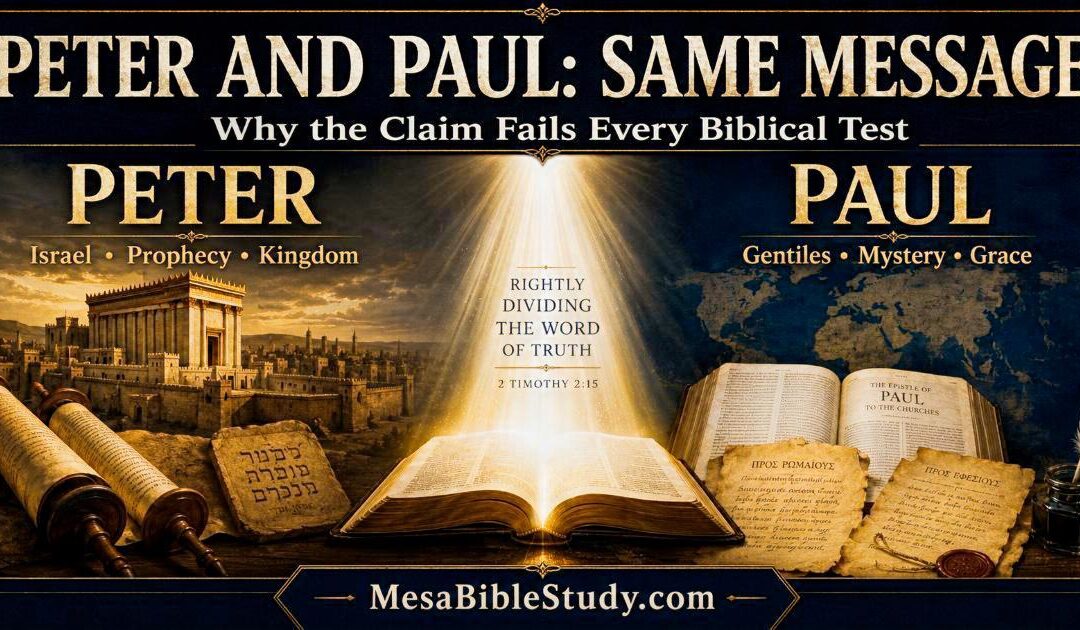
The claim that Peter and Paul preached the same message fails every biblical test.
It fails the audience test:
- Peter preached to Israel.
- Paul was sent to the Gentiles.
It fails the content test:
- Peter preached Jesus as Israel’s Christ— that Jesus was Israel’s promised Messiah.
- Paul preached Christ’s death for sins, burial, and resurrection as the saving gospel.
It fails the law test:
- Peter ministered in a Jewish Law-keeping framework.
- Paul preached salvation apart from the Law.
It fails the baptism test:
- Peter commanded baptism for remission.
- Paul said Christ did not send him to baptize.
It fails the prophecy/mystery test:
- Peter preached what was spoken since the world began.
- Paul preached what was kept secret since the world began.
It fails the Body test:
- Peter did not preach Jew and Gentile in one Body, the body of Christ.
- Paul revealed the one new man.
The claim does not survive the text.
Final Summary
Peter and Paul did not preach the same revealed message.
Peter preached Jesus as Israel’s Messiah according to prophecy.
Paul preached Christ according to the revelation of the mystery.
Peter called Israel to repentance in connection with the kingdom.
Paul preached justification apart from the Law and the formation of the Body of Christ.
Peter’s ministry was to the circumcision.
Paul’s ministry was to the uncircumcision.
This does not divide Scripture.
It rightly divides Scripture.
It does not diminish Peter.
It honors Peter’s ministry for what God gave him to preach.
It does not exalt Paul above Christ.
It honors Christ’s revelation to Paul for this present dispensation.
The Bible is not confused.
Tradition is.
And when Peter and Paul are allowed to say what they actually say, the distinction becomes impossible to ignore.
This matters beloved.
Explore the Series
← Previous | 📖 Series Home | Next →

by Jamie Pantastico | May 23, 2026 | Israel and Bible Prophecy |
A Biblical Response to the Claim That Christianity Is Anti-Zionist
There are times when silence is not humility. There are times when refusing to answer is not grace. And there are times when the people of God must open the Scriptures and ask the only question that truly matters:
What saith the Scriptures?
Not what does emotion say?
Not what does politics say?
Not what does bitterness say?
Not what does hatred say?
Not even, “What do I personally think?”
What has God said?
Recently, I read an article claiming that Christianity has always been an aggressively anti-Zionist religion. The argument was not merely critical of modern Israeli politics or government policy. It went much further than that. It spoke of the Jewish people in sweeping, hostile, and deeply troubling terms.
That grieved me.
Not because every action of the modern State of Israel must be defended. It does not. No earthly government is righteous in itself. No nation today is above sin, corruption, pride, or judgment. Israel’s government is not the gospel. The modern Israeli state is not the Savior. And no Jewish person is saved by ethnicity, covenant history, land, ancestry, or national identity.
Salvation is only through the Lord Jesus Christ.
But we must also say this with equal clarity:
God has not cast away His people Israel.
That is not my opinion. That is Scripture.
“I say then, has God cast away His people? Certainly not! For I also am an Israelite, of the seed of Abraham, of the tribe of Benjamin.”
— Romans 11:1
Paul does not leave the question open. He does not say, “Yes, God is finished with Israel.” He does not say, “The Church has replaced Israel.” He does not say, “The promises have been transferred away from the nation forever.”
He says:
Certainly not.
That should settle the matter for every Bible believer.
The Issue Is Not Politics First — It Is Scripture First
The Opposition’s Claim
The opposing view argues that Christianity itself is fundamentally anti-Zionist. In that view, support for Israel’s future restoration is not biblical faithfulness but a betrayal of the message of Christ. It claims that Christians who believe God still has promises for Israel are clinging to the same earthly, nationalistic expectation that caused many in Israel to reject Jesus.
What Saith the Scriptures?
Before going further, let me be clear.
This is not a call for blind political loyalty. This is not a defense of every decision made by Israel’s leaders. This is not a claim that Jewish people are saved apart from Christ. And this is not an excuse for hatred toward Arabs, Palestinians, Muslims, or anyone else.
The gospel of grace is for all.
“For there is no difference between Jew and Greek, for the same Lord over all is rich to all who call upon Him.”
— Romans 10:12
“For whoever calls on the name of the LORD shall be saved.”
— Romans 10:13
Christ died for our sins, was buried, and rose again the third day according to the Scriptures. Jew and Gentile alike need the same Savior. There is no salvation outside of Him.
“Nor is there salvation in any other, for there is no other name under heaven given among men by which we must be saved.”
— Acts 4:12
But when people use the failures, unbelief, or sins of Israel to claim that God is finished with Israel, they have gone beyond politics. They have entered into direct contradiction with the Word of God.
The question is not, “What do we think about the current headlines?”
The question is:
What has God promised?
And if God has promised it, then no unbelief, no failure, no rebellion, and no political confusion can make His Word void.
“For what if some did not believe? Will their unbelief make the faithfulness of God without effect? Certainly not!”
— Romans 3:3–4
That principle matters. Israel’s unbelief does not cancel God’s faithfulness.
Jesus Came to Israel as Her Promised Messiah
The Opposition’s Claim
The opposing view claims that Jesus rejected Israel’s national hopes and came to dismantle the very expectation of a restored kingdom. According to this view, the Jewish people wanted a political Messiah, but Jesus came only to establish a spiritual kingdom with no future national promises attached to Israel.
What Saith the Scriptures?
The Lord Jesus did not appear in a historical vacuum. He came according to promise. He came through Israel. He came as the Son of David, the Son of Abraham, and the rightful King of Israel.
The very first verse of Matthew’s Gospel introduces Him this way:
“The book of the genealogy of Jesus Christ, the Son of David, the Son of Abraham.”
— Matthew 1:1
That is not accidental. “Son of Abraham” connects Christ to the covenant promises. “Son of David” connects Him to the throne and kingdom promises.
The angel Gabriel told Mary:
“He will be great, and will be called the Son of the Highest; and the Lord God will give Him the throne of His father David.”
— Luke 1:32
And then Gabriel continued:
“And He will reign over the house of Jacob forever, and of His kingdom there will be no end.”
— Luke 1:33
Notice the wording.
The throne of David.
The house of Jacob.
A kingdom with no end.
That is not replacement language. That is fulfillment language.
Paul also writes:
“Now I say that Jesus Christ has become a servant to the circumcision for the truth of God, to confirm the promises made to the fathers.”
— Romans 15:8
That verse matters.
Jesus came “to the circumcision.” That means He came in connection with Israel. Why? “To confirm the promises made to the fathers.”
- Not to cancel them.
- Not to mock them.
- Not to spiritualize them away.
- Not to transfer them permanently to another people.
He came to confirm them.
Jesus Himself said:
“I was not sent except to the lost sheep of the house of Israel.”
— Matthew 15:24
Israel rejected her King. That is true.
“He came to His own, and His own did not receive Him.”
— John 1:11
But Israel’s rejection did not cancel God’s faithfulness.
Paul says:
“For the gifts and the calling of God are irrevocable.”
— Romans 11:29
That verse sits in the context of Israel’s future. God’s gifts and calling concerning Israel are not revoked because Israel is presently in unbelief.
Acts 1 Does Not Cancel Israel’s Kingdom Hope
The Opposition’s Claim
The opposing view argues that when the disciples asked Jesus, “Lord, will You at this time restore the kingdom to Israel?” they were still trapped in a fleshly, nationalist misunderstanding. According to this argument, Pentecost corrected that expectation, and Spirit-filled Christianity no longer looked for Israel’s restoration.
What Saith the Scriptures?
Some argue that when the disciples asked Jesus, “Lord, will You at this time restore the kingdom to Israel?” they were asking a foolish or carnal question.
But the text does not say that.
Before the disciples asked that question, Luke tells us what Jesus had been teaching them for forty days after His resurrection:
“To whom He also presented Himself alive after His suffering by many infallible proofs, being seen by them during forty days and speaking of the things pertaining to the kingdom of God.”
— Acts 1:3
The risen Lord spent forty days speaking to them about the kingdom of God. After that teaching, they asked:
“Lord, will You at this time restore the kingdom to Israel?”
— Acts 1:6
Now look carefully at the Lord’s answer:
“And He said to them, ‘It is not for you to know times or seasons which the Father has put in His own authority.’”
— Acts 1:7
Jesus did not say, “There will be no kingdom restored to Israel.”
He did not say, “You have misunderstood the prophets.”
He did not say, “That hope is now abolished.”
He corrected their concern about timing, not the reality of the promise.
That distinction is important.
The apostles were not wrong to believe that God would restore the kingdom to Israel. The Old Testament prophets had spoken repeatedly of Israel’s restoration, Israel’s land, Israel’s Messiah, and Israel’s future kingdom.
Jesus had also promised the apostles a future role connected to Israel.
“Assuredly I say to you, that in the regeneration, when the Son of Man sits on the throne of His glory, you who have followed Me will also sit on twelve thrones, judging the twelve tribes of Israel.”
— Matthew 19:28
That promise has not yet been fulfilled.
There are still twelve tribes of Israel in view. There are still twelve thrones in view. There is still the Son of Man sitting on the throne of His glory in view.
Jesus also said to Jerusalem:
“For I say to you, you shall see Me no more till you say, ‘Blessed is He who comes in the name of the LORD!’”
— Matthew 23:39
That statement contains judgment, but it also contains future hope. Jerusalem would not see Him again until a future day of recognition.
The disciples’ error in Acts 1 was not believing the promise. Their limitation was not knowing the timing.
The Father had reserved that timing in His own authority.
Peter Still Preached to Israel After Pentecost
The Opposition’s Claim
The opposing view claims that after Pentecost, the apostles abandoned any expectation of Israel’s national restoration. It argues that once the Holy Spirit came, the question of Israel’s kingdom disappeared because the Church had moved beyond Israel’s earthly promises.
What Saith the Scriptures?
The claim that Pentecost erased Israel’s kingdom hope does not fit the book of Acts.
After Pentecost, Peter still addresses Israel.
“Men of Israel, hear these words: Jesus of Nazareth, a Man attested by God to you…”
— Acts 2:22
Peter does not preach as though Israel has vanished from God’s dealings. He speaks directly to Israel and lays the responsibility for Christ’s rejection at the nation’s feet.
“Therefore let all the house of Israel know assuredly that God has made this Jesus, whom you crucified, both Lord and Christ.”
— Acts 2:36
Then in Acts 3, Peter again speaks to Israel:
“Men of Israel, why do you marvel at this?”
— Acts 3:12
Peter continues by identifying Israel’s covenant relationship:
“You are sons of the prophets, and of the covenant which God made with our fathers, saying to Abraham, ‘And in your seed all the families of the earth shall be blessed.’”
— Acts 3:25
That is after Pentecost.
Peter does not say, “You were sons of the prophets.”
He does not say, “You were sons of the covenant.”
He says, “You are.”
Then Peter connects Israel’s repentance with the return of Christ and the times of refreshing.
“Repent therefore and be converted, that your sins may be blotted out, so that times of refreshing may come from the presence of the Lord.”
— Acts 3:19
Then he continues:
“And that He may send Jesus Christ, who was preached to you before.”
— Acts 3:20
And then Peter says:
“Whom heaven must receive until the times of restoration of all things, which God has spoken by the mouth of all His holy prophets since the world began.”
— Acts 3:21
That is not anti-Israel theology. That is a kingdom proclamation being preached to Israel after Pentecost.
Peter does not say, “God is finished with you.”
He does not say, “Your promises are gone.”
He does not say, “The Church has replaced you.”
He calls Israel to repent.
Paul Did Not Teach That Israel Was Finished
The Opposition’s Claim
The opposing view argues that Paul abandoned Jewish identity and therefore dismantled any future theological significance for Israel. It often appeals to Philippians 3, where Paul counts his Jewish credentials as loss, to claim that Israel’s covenantal identity no longer matters in God’s plan.
What Saith the Scriptures?
Paul is often misused in this discussion. Some point to Philippians 3, where Paul counts his Jewish credentials as loss, and claim that Paul discarded Israel’s covenantal significance altogether.
But that is not what Paul was doing.
Paul was not saying God’s promises to Israel were worthless. He was saying his own fleshly credentials could not justify him before God.
There is a massive difference.
Paul wrote:
“Though I also might have confidence in the flesh. If anyone else thinks he may have confidence in the flesh, I more so.”
— Philippians 3:4
Then he listed his Jewish credentials:
“Circumcised the eighth day, of the stock of Israel, of the tribe of Benjamin, a Hebrew of the Hebrews…”
— Philippians 3:5
But then Paul says:
“But what things were gain to me, these I have counted loss for Christ.”
— Philippians 3:7
Paul was rejecting confidence in the flesh for righteousness before God.
He was not denying that God still had promises connected to Israel.
The same Paul who wrote Philippians 3 also wrote Romans 9–11. And there he speaks of Israel with deep grief and covenant clarity.
“I tell the truth in Christ, I am not lying, my conscience also bearing me witness in the Holy Spirit.”
— Romans 9:1
“That I have great sorrow and continual grief in my heart.”
— Romans 9:2
“For I could wish that I myself were accursed from Christ for my brethren, my countrymen according to the flesh.”
— Romans 9:3
Then Paul identifies Israel’s covenant privileges:
“Who are Israelites, to whom pertain the adoption, the glory, the covenants, the giving of the law, the service of God, and the promises.”
— Romans 9:4
Notice the word “pertain.”
Paul does not say, “To whom once pertained.”
He does not speak as though everything has been erased.
He identifies real covenantal privileges connected to Israel.
Then in Romans 10, Paul says:
“Brethren, my heart’s desire and prayer to God for Israel is that they may be saved.”
— Romans 10:1
Paul did not hate Israel. He prayed for Israel.
In Romans 9:3, Paul states:
“For I could wish that I myself were accursed and cut off from Christ for the sake of my brothers, my kinsmen according to the flesh.”
Then in Romans 11, Paul asks the question directly:
“I say then, has God cast away His people? Certainly not!”
— Romans 11:1
Later, Paul explains Israel’s present condition:
“Blindness in part has happened to Israel until the fullness of the Gentiles has come in.”
— Romans 11:25
Blindness has happened “in part.”
Not totally.
And it lasts “until.”
Not forever.
Then Paul says:
“And so all Israel will be saved.”
— Romans 11:26
That is future language. That is national language. That is covenant language. That is prophetic language.
Israel is presently in unbelief. But Israel’s present unbelief is not the end of Israel’s story.
Gentiles Are Partakers — Not Takers
The Opposition’s Claim
The opposing view claims that because Israel rejected Christ, Gentile believers now occupy the place Israel once held. In this framework, the Church becomes the true Israel, and the promises are reinterpreted spiritually in the Church rather than fulfilled literally to Israel.
What Saith the Scriptures?
One of the great errors of replacement theology is that it turns Gentile blessing into Gentile boasting.
But Paul warned against that very thing.
In Romans 11, Gentiles are compared to wild olive branches grafted in among the natural branches.
“And if some of the branches were broken off, and you, being a wild olive tree, were grafted in among them…”
— Romans 11:17
Then Paul says the Gentiles became partakers:
“And with them became a partaker of the root and fatness of the olive tree.”
— Romans 11:17
Partaking is not the same as taking over.
Paul immediately warns:
“Do not boast against the branches.”
— Romans 11:18
And then he adds:
“But if you do boast, remember that you do not support the root, but the root supports you.”
— Romans 11:18
That warning is needed today.
Gentile believers should not boast against Israel. We should not hate Israel. We should not speak as though God’s promises failed. We should not act as though Jewish unbelief makes Gentiles superior.
Paul also writes:
“For if the Gentiles have been partakers of their spiritual things, their duty is also to minister to them in material things.”
— Romans 15:27
Again, Gentiles are partakers.
Not takers.
Paul uses similar language in Ephesians:
“That the Gentiles should be fellow heirs, of the same body, and partakers of His promise in Christ through the gospel.”
— Ephesians 3:6
Gentiles are blessed in Christ. Gentiles are reconciled in one Body. Gentiles are saved by grace. But Gentile blessing does not require God to break His promises to Israel.
We are saved by grace.
And if we understand grace, we have no room for boasting.
The Church Does Not Replace Israel
The Opposition’s Claim
The opposing view teaches that the Church is now the fulfillment or replacement of Israel. Therefore, Israel no longer has a distinct future in God’s prophetic plan. Any future hope for Israel as a nation is considered a return to earthly thinking rather than spiritual Christianity.
What Saith the Scriptures?
The Body of Christ is a distinct work of God revealed through the Apostle Paul. Jew and Gentile are reconciled in one Body by the cross. In Christ, there is no spiritual superiority based on ethnicity.
But that does not mean Israel’s prophetic promises vanished.
Paul describes the Body of Christ as a mystery that was previously hidden and later revealed.
“If indeed you have heard of the dispensation of the grace of God which was given to me for you.”
— Ephesians 3:2
“How that by revelation He made known to me the mystery.”
— Ephesians 3:3
Then Paul explains:
“Which in other ages was not made known to the sons of men, as it has now been revealed by the Spirit to His holy apostles and prophets.”
— Ephesians 3:5
The Body of Christ is not simply a continuation of Israel’s prophetic program. It is the revelation of a mystery.
Paul also writes:
“According to the revelation of the mystery kept secret since the world began.”
— Romans 16:25
Israel’s kingdom promises were not kept secret since the world began. They were spoken by the prophets since the world began.
Peter says:
“Which God has spoken by the mouth of all His holy prophets since the world began.”
— Acts 3:21
Paul’s mystery was different.
It was “kept secret since the world began.”
That distinction matters.
The Church is not Israel.
Israel is not the Church.
Gentile believers do not become covenant thieves.
And Israel’s future restoration does not threaten the gospel of grace.
God can fulfill His heavenly purpose for the Body of Christ and still fulfill His earthly promises to Israel.
That is not contradiction. That is rightly dividing the Word of truth.
“Be diligent to present yourself approved to God, a worker who does not need to be ashamed, rightly dividing the word of truth.”
— 2 Timothy 2:15
Love for Israel Must Include the Gospel
The Opposition’s Claim
The opposing view often reacts against a shallow form of Christian Zionism that seems to support Israel politically while saying little about Israel’s need for Christ. It rightly sees a problem when Christians defend Israel but fail to preach the gospel to Jewish people.
What Saith the Scriptures?
Here we should be honest.
If someone claims to love Israel but never prays for Jewish people to be saved, something is wrong.
If someone supports Israel politically but never speaks of Christ crucified and risen, something is missing.
If someone treats Jewish people as already right with God apart from faith in Jesus Christ, that is not biblical love.
Standing with Scripture does not mean pretending Jewish people do not need Christ. They do.
A Jewish person without Christ is lost.
A Gentile without Christ is lost.
A religious person without Christ is lost.
A moral person without Christ is lost.
Every sinner needs the Savior.
Paul writes:
“Brethren, my heart’s desire and prayer to God for Israel is that they may be saved.”
— Romans 10:1
That should be the heart of every believer.
Not hatred.
Not arrogance.
Not political idolatry.
Not ethnic hostility.
Prayer.
Paul also says:
“For they being ignorant of God’s righteousness, and seeking to establish their own righteousness, have not submitted to the righteousness of God.”
— Romans 10:3
That is Israel’s problem in unbelief. It is not ethnicity. It is unbelief. It is rejection of God’s righteousness in Christ.
And Paul gives the answer:
“For Christ is the end of the law for righteousness to everyone who believes.”
— Romans 10:4
Jew and Gentile alike must come to God through Christ.
“For there is one God and one Mediator between God and men, the Man Christ Jesus.”
— 1 Timothy 2:5
Paul did not hate Israel because Israel was in unbelief. He grieved. He prayed. He preached Christ.
In Romans 9:3, Paul states:
“For I could wish that I myself were accursed and cut off from Christ for the sake of my brothers, my kinsmen according to the flesh.”
That is our pattern.
We Must Reject Hatred Without Rejecting God’s Promises
The Opposition’s Claim
The opposing view assumes that if someone believes God still has promises for Israel, then that person must be defending everything Israel does politically or militarily. It treats biblical support for Israel’s future restoration as though it were the same thing as unconditional approval of the modern Israeli government.
What Saith the Scriptures?
This is where believers must be careful.
We can reject antisemitism without worshiping the modern State of Israel.
We can reject political idolatry without rejecting biblical prophecy.
We can criticize government actions without despising Jewish people.
We can preach salvation in Christ alone without denying God’s covenant faithfulness.
We can love Palestinians, Arabs, Muslims, Jews, and all people without surrendering what Scripture says about Israel.
Paul warns Gentile believers directly:
“Do not boast against the branches.”
— Romans 11:18
He also warns:
“Do not be haughty, but fear.”
— Romans 11:20
That is strong language.
Gentile believers have no permission to boast over Israel. We also have no permission to hate Israel. But neither are we called to make an idol out of any earthly nation.
Our allegiance is first and finally to the Lord Jesus Christ.
“For our citizenship is in heaven, from which we also eagerly wait for the Savior, the Lord Jesus Christ.”
— Philippians 3:20
The Word of God gives us clarity where the world gives confusion.
God’s Promise to Israel Still Stands
The Opposition’s Claim
The opposing view says Israel’s promises have either been canceled, spiritually transferred, or fulfilled in the Church. In this view, the land, nation, throne, and kingdom promises no longer require a future fulfillment for Israel as Israel.
What Saith the Scriptures?
From Genesis onward, God made promises concerning Abraham, Isaac, Jacob, the land, the nation, the throne of David, and the future restoration of Israel.
Those promises are not fragile. They do not depend on Israel’s current righteousness. They depend on God’s faithfulness.
God said to Abram:
“I will make you a great nation; I will bless you and make your name great; and you shall be a blessing.”
— Genesis 12:2
Then God said:
“I will bless those who bless you, and I will curse him who curses you; and in you all the families of the earth shall be blessed.”
— Genesis 12:3
The land promise was not vague.
- “Lift your eyes now and look from the place where you are — northward, southward, eastward, and westward.”
— Genesis 13:14
Then God said:
“For all the land which you see I give to you and your descendants forever.”
— Genesis 13:15
God later made the land boundaries clear:
“To your descendants I have given this land, from the river of Egypt to the great river, the River Euphrates.”
— Genesis 15:18
God also called it an everlasting covenant:
“And I will establish My covenant between Me and you and your descendants after you in their generations, for an everlasting covenant.”
— Genesis 17:7
And He continued:
“Also I give to you and your descendants after you the land in which you are a stranger, all the land of Canaan, as an everlasting possession.”
— Genesis 17:8
The Psalms confirm this same promise:
“He remembers His covenant forever, the word which He commanded, for a thousand generations.”
— Psalm 105:8
“The covenant which He made with Abraham, and His oath to Isaac.”
— Psalm 105:9
“And confirmed it to Jacob for a statute, to Israel as an everlasting covenant.”
— Psalm 105:10
“Saying, ‘To you I will give the land of Canaan as the allotment of your inheritance.’”
— Psalm 105:11
The prophets also speak of Israel’s future restoration.
Jeremiah records the Lord’s promise:
“Behold, the days are coming, says the LORD, that I will make a new covenant with the house of Israel and with the house of Judah.”
— Jeremiah 31:31
That New Covenant is made “with the house of Israel and with the house of Judah.”
Then God ties Israel’s continued existence to the fixed order of creation:
“If those ordinances depart from before Me, says the LORD, then the seed of Israel shall also cease from being a nation before Me forever.”
— Jeremiah 31:36
Then He says:
“If heaven above can be measured, and the foundations of the earth searched out beneath, I will also cast off all the seed of Israel.”
— Jeremiah 31:37
In other words, Israel’s future is as secure as God’s control over creation.
Ezekiel also speaks of a future regathering:
“For I will take you from among the nations, gather you out of all countries, and bring you into your own land.”
— Ezekiel 36:24
Then God says:
“Then I will sprinkle clean water on you, and you shall be clean.”
— Ezekiel 36:25
That shows both physical restoration and future spiritual cleansing.
Ezekiel 37 continues:
“Surely I will take the children of Israel from among the nations, wherever they have gone, and will gather them from every side and bring them into their own land.”
— Ezekiel 37:21
Then God says:
“And I will make them one nation in the land, on the mountains of Israel.”
— Ezekiel 37:22
Zechariah also speaks of Israel’s future repentance:
“And I will pour on the house of David and on the inhabitants of Jerusalem the Spirit of grace and supplication.”
— Zechariah 12:10
Then the prophet says:
“Then they will look on Me whom they pierced.”
— Zechariah 12:10
That has not yet been fulfilled nationally.
Paul confirms this future in Romans 11:
“And so all Israel will be saved, as it is written: ‘The Deliverer will come out of Zion, and He will turn away ungodliness from Jacob.’”
— Romans 11:26
Then Paul says:
“For this is My covenant with them, when I take away their sins.”
— Romans 11:27
And then:
“For the gifts and the calling of God are irrevocable.”
— Romans 11:29
That is the whole point.
If God’s promises to Israel can fail, then how can we trust His promises to us?
If God can permanently cast away the people He foreknew, then what confidence would any believer have in His Word?
But God is faithful.
Israel has failed many times.
The Church has failed many times.
We have failed many times.
But God does not fail.
“God is not a man, that He should lie, nor a son of man, that He should repent.”
— Numbers 23:19
‘For when God made a promise to Abraham, because He could swear by no one greater, He swore by Himself, ‘
Hebrews 6:13
Christ Will Reign Over All the Earth
The Opposition’s Claim
The opposing view argues that Jesus rejected the idea of an earthly kingdom connected to Israel. It presents the kingdom of Christ as purely spiritual, universal, and detached from the promises God made to Israel through the prophets.
What Saith the Scriptures?
Jesus is not merely a political Messiah. He is not merely Israel’s King. He is King of kings and Lord of lords.
But we must not create a false choice.
He can be Israel’s promised Messiah and the Savior of the world.
He can fulfill the promises made to the fathers and bless the nations.
He can reign from Jerusalem and rule over all the earth.
He can restore Israel and judge the nations.
He can keep every word He has spoken.
The prophets repeatedly connect Messiah’s reign with Israel, Jerusalem, and the nations.
Isaiah writes:
“For unto us a Child is born, unto us a Son is given; and the government will be upon His shoulder.”
— Isaiah 9:6
Then Isaiah says:
“Upon the throne of David and over His kingdom, to order it and establish it with judgment and justice.”
— Isaiah 9:7
That is throne language. Davidic language. Kingdom language.
Daniel also saw a coming kingdom:
“Then to Him was given dominion and glory and a kingdom, that all peoples, nations, and languages should serve Him.”
— Daniel 7:14
Zechariah writes:
“And in that day His feet will stand on the Mount of Olives, which faces Jerusalem on the east.”
— Zechariah 14:4
Then he says:
“And the LORD shall be King over all the earth.”
— Zechariah 14:9
That is not merely inward or symbolic. The passage names Jerusalem, the Mount of Olives, and the Lord reigning over all the earth.
Revelation also declares:
“The kingdoms of this world have become the kingdoms of our Lord and of His Christ, and He shall reign forever and ever!”
— Revelation 11:15
And again:
“And He has on His robe and on His thigh a name written: KING OF KINGS AND LORD OF LORDS.”
— Revelation 19:16
The prophets did not present Israel’s restoration as a small thing. They connected it with the glory of God among the nations.
God’s purpose for Israel was never merely about Israel. Through Israel, God would bless the nations. Through Israel came the Messiah. Through Israel came the Scriptures. Through Israel came the covenants and promises. And through Israel’s future restoration, God will display His faithfulness before the world.
A Better Christian Response
The Opposition’s Claim
The opposing view sees Christian support for Israel as hateful, political, and unspiritual. But in reacting against political extremes, it often falls into another error: speaking against Israel and the Jewish people in ways that Scripture itself forbids.
What Saith the Scriptures?
So how should believers respond?
Not with hatred.
“Let all that you do be done with love.”
— 1 Corinthians 16:14
Not with racial contempt.
“For there is no partiality with God.”
— Romans 2:11
Not with conspiracy.
“Let no corrupt word proceed out of your mouth, but what is good for necessary edification.”
— Ephesians 4:29
Not with blind nationalism.
“For our citizenship is in heaven.”
— Philippians 3:20
Not with political worship.
“You shall worship the LORD your God, and Him only you shall serve.”
— Matthew 4:10
But with Scripture, prayer, humility, and truth.
We should say what Paul said:
“Has God cast away His people? Certainly not!”
— Romans 11:1
We should believe what Jesus confirmed:
“To confirm the promises made to the fathers.”
— Romans 15:8
We should remember what Peter preached:
“Repent therefore and be converted…”
— Acts 3:19
We should understand what Paul revealed:
“Blindness in part has happened to Israel until the fullness of the Gentiles has come in.”
— Romans 11:25
We should hold fast to the gospel:
“Christ died for our sins according to the Scriptures, and that He was buried, and that He rose again the third day according to the Scriptures.”
— 1 Corinthians 15:3–4
Jew and Gentile alike must be saved by grace through faith in the Lord Jesus Christ.
Final Summary
Christianity is not anti-Jewish.
Christianity is not ethnic hatred dressed in religious language.
Christianity is not a denial of God’s promises to Israel.
Biblical Christianity proclaims that Israel’s Messiah has come, that Israel rejected Him, that salvation has gone to the Gentiles, that God is now forming the Body of Christ by grace, and that God is not finished with Israel.
That is not politics.
That is Scripture.
And when the dust of human opinion settles, Scripture will still stand.
So the question remains:
What saith the Scriptures?
They say God is faithful.
“God is faithful, by whom you were called into the fellowship of His Son, Jesus Christ our Lord.”
— 1 Corinthians 1:9
They say Christ is the Savior.
“The Father has sent the Son as Savior of the world.”
— 1 John 4:14
They say Israel is presently blinded in part.
“Blindness in part has happened to Israel until the fullness of the Gentiles has come in.”
— Romans 11:25
They say Gentiles must not boast.
“Do not boast against the branches.”
— Romans 11:18
They say the gifts and calling of God are irrevocable.
“For the gifts and the calling of God are irrevocable.”
— Romans 11:29
They say all Israel will be saved.
“And so all Israel will be saved.”
— Romans 11:26
They say Jesus Christ will reign over all the earth.
“And the LORD shall be King over all the earth.”
— Zechariah 14:9
And because God has said it, we can stand firmly on it — with grace, with love, and without apology.
This response was not written to defend every action of the modern State of Israel, nor to suggest that Jewish people are saved apart from faith in Jesus Christ. Salvation is by grace alone, through faith alone, in Christ alone.
But Scripture is clear: God has not cast away His people. Gentiles are partakers, not takers. Israel’s blindness is partial and temporary. The gifts and calling of God are irrevocable.
As hostility toward Israel, Zionists, and the Jewish people continues to grow — even within Christendom — believers must be careful not to be carried away by the spirit of the age. We must stand where Scripture stands, speak with grace, reject hatred, and hold fast to the promises of God.
What saith the Scriptures? That is where every faithful answer must begin and end.
by Jamie Pantastico | May 21, 2026 | Pauline Theology |
Passage Breakdown
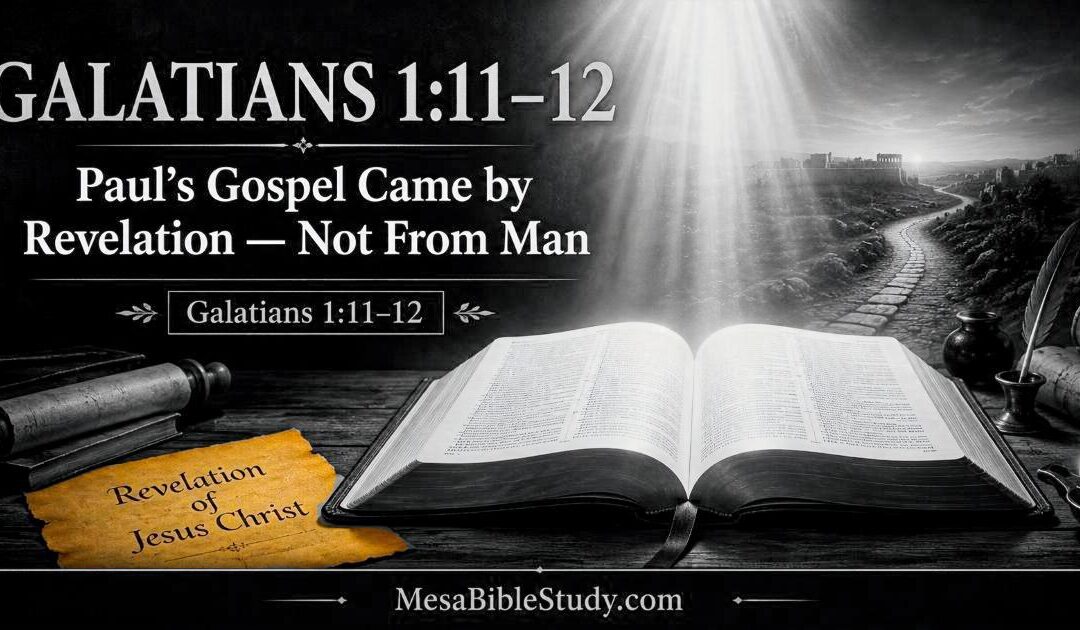
Galatians 1:11–12
11 But I make known to you, brethren, that the gospel which was preached by me is not according to man.
12 For I neither received it from man, nor was I taught it, but it came through the revelation of Jesus Christ.
Introduction
Galatians 1:11–12 is one of the clearest statements in Scripture concerning the origin of Paul’s gospel.
Paul did not claim that his message was a revised version of what Peter preached. He did not say he learned it from the twelve apostles. He did not say he was sent to Jerusalem to be trained by those who were apostles before him. Instead, Paul makes a direct and unmistakable claim: the gospel he preached was not according to man.
It came by revelation of Jesus Christ.
This matters because many believers have been taught to read Paul backward into Peter, the twelve, the earthly ministry of Christ, and early Acts. But Paul’s own testimony will not allow that. Galatians 1 demands that we read Scripture in time, allowing God’s revelation to unfold progressively and according to His own order.
Chapter Theme
The theme of Galatians is the defense of Paul’s apostleship and gospel against those who were troubling the churches by mixing law with grace.
Paul writes to establish that justification is by faith in Christ apart from the works of the law. But before he explains the doctrine fully, he first defends the divine origin of his gospel and apostleship.
If Paul’s apostleship is not from God, then his gospel could be dismissed.
But if Paul was called and commissioned directly by the risen Christ, then his message carries divine authority.
That is why Galatians 1 begins with Paul’s apostleship:
“Paul, an apostle (not from men nor through man, but through Jesus Christ and God the Father who raised Him from the dead)”
— Galatians 1:1
Paul’s apostleship was not earthly in origin. His gospel was not earthly in origin. Both came by divine revelation.
Background and Flow of the Passage
In Galatians 1:6–9, Paul strongly rebukes the Galatians for turning away from the grace of Christ to a different gospel. False teachers were troubling them and attempting to pervert the gospel of Christ.
Then, in Galatians 1:10, Paul makes clear that he was not trying to please men. His ministry was not built on human approval, religious popularity, or institutional recognition.
That leads directly into verses 11–12.
Paul now explains why his gospel must not be altered: it did not originate with man. It was not developed by religious tradition. It was not handed down to him by the apostles in Jerusalem.
It was revealed to him by Jesus Christ.
These verses become the foundation for the testimony that follows in Galatians 1:13–24, where Paul explains his former life in Judaism, his persecution of the church of God, his conversion, and the fact that he did not immediately go to Jerusalem to receive instruction from the apostles.
Paul is proving that his gospel came from Christ Himself.
Phrase-by-Phrase Breakdown
“But I make known to you, brethren…”
Paul begins with a formal declaration.
He is not offering an opinion. He is not giving a private interpretation. He is making something known with apostolic authority.
The word “brethren” also shows that Paul is addressing believers. These were saved people, but they were being confused and troubled by false teachers.
This is important. A believer can be genuinely saved and still become doctrinally confused if they do not understand God’s Word rightly divided.
Paul writes to correct them, restore them, and bring them back to the gospel of grace.
“That the gospel which was preached by me…”
Paul specifically identifies the gospel he preached.
He does not merely say “the gospel” in a vague or general way. He says, “the gospel which was preached by me.”
This agrees with Paul’s repeated language elsewhere:
“In the day when God will judge the secrets of men by Jesus Christ, according to my gospel.”
— Romans 2:16
“Now to Him who is able to establish you according to my gospel and the preaching of Jesus Christ…”
— Romans 16:25
“Remember that Jesus Christ, of the seed of David, was raised from the dead according to my gospel.”
— 2 Timothy 2:8
Paul’s gospel centered on the finished work of Christ: His death for our sins, His burial, and His resurrection.
“For I delivered to you first of all that which I also received: that Christ died for our sins according to the Scriptures,
and that He was buried, and that He rose again the third day according to the Scriptures.”
— 1 Corinthians 15:3–4
Paul preached salvation by grace through faith alone, apart from the works of the law.
That message was not given to Israel under the law through Moses. It was not the kingdom gospel preached during Christ’s earthly ministry. It was not the message of repentance to Israel in early Acts.
It was the gospel of grace committed to Paul by the risen and ascended Lord Jesus Christ.
“Is not according to man.”
This statement is decisive.
Paul’s gospel was not “according to man.” That means it did not originate from human reasoning, religious tradition, apostolic committee, rabbinical training, or Jerusalem authority.
Paul was not preaching a gospel that men developed.
He was not repeating what Gamaliel taught him.
He was not borrowing from the twelve.
He was not improving upon Judaism.
He was not combining kingdom truth with Gentile inclusion.
His gospel was divine in origin.
This is one of the major reasons Paul’s ministry must be understood distinctly. If Paul had received the same message the twelve were already preaching, Galatians 1:11–12 would make little sense. Paul’s argument depends on the fact that his gospel came to him independently by revelation.
“For I neither received it from man…”
Paul now explains what he means.
He did not receive his gospel from man.
That includes Peter, James, John, or any other apostle. Paul is not dishonoring them. He is simply making clear that they were not the source of his message.
This becomes even clearer later in the chapter:
“But I saw none of the other apostles except James, the Lord’s brother.”
— Galatians 1:19
And then:
“And I was unknown by face to the churches of Judea which were in Christ.”
— Galatians 1:22
Paul’s point is simple: his gospel did not come from Jerusalem.
He was not trained by the twelve after his conversion. He did not sit under Peter’s instruction in order to learn what to preach. The risen Christ Himself revealed Paul’s message to him.
“Nor was I taught it…”
Paul also says he was not taught his gospel.
This means his gospel was not the result of ordinary human instruction.
Paul had been highly educated in Judaism. He knew the Hebrew Scriptures. He had been zealous for the traditions of his fathers. But none of that produced the gospel of grace.
In fact, before Christ appeared to him, Paul was persecuting those who believed Jesus was the Christ.
“For you have heard of my former conduct in Judaism, how I persecuted the church of God beyond measure and tried to destroy it.”
— Galatians 1:13
Paul was not slowly educated into grace.
He was arrested by grace.
He was not persuaded by men.
He was confronted by the risen Christ.
“But it came through the revelation of Jesus Christ.”
This is the heart of the passage.
Paul’s gospel came through revelation.
The risen Lord Jesus Christ revealed it to him.
This is why Paul’s apostleship is unique. The twelve were called by Christ during His earthly ministry to Israel. Paul was called later by the risen and ascended Christ from heaven.
The twelve were connected with Israel’s kingdom program.
Paul was chosen as the apostle to the Gentiles.
The Lord said concerning Paul:
“Go, for he is a chosen vessel of Mine to bear My name before Gentiles, kings, and the children of Israel.”
— Acts 9:15
And then:
“For I will show him how many things he must suffer for My name’s sake.”
— Acts 9:16
Paul’s apostleship was not an afterthought. It was a divine calling.
He was a chosen vessel.
He was called to bear Christ’s name before Gentiles, kings, and the children of Israel.
This agrees with Romans 11:13:
“For I speak to you Gentiles; inasmuch as I am an apostle to the Gentiles, I magnify my ministry.”
Paul did not assign that ministry to himself. Christ gave it to him.
Doctrinal Summary
Galatians 1:11–12 teaches that Paul’s gospel was divine in origin, distinct in revelation, and authoritative for the Body of Christ.
Paul did not receive his gospel from Peter or the twelve. He was not taught it in Jerusalem. He did not learn it from men. He received it by revelation of Jesus Christ.
This does not mean Peter and the twelve preached a false message. It means God had more revelation to give, and He chose Paul as the vessel through whom He would reveal the gospel of grace and the doctrine concerning the Body of Christ.
Peter and the twelve were commissioned in connection with Israel, the kingdom, and the promises made to the fathers.
Paul was called later, after Israel’s continued rejection, to preach Christ according to the revelation of the mystery.
“Now to Him who is able to establish you according to my gospel and the preaching of Jesus Christ, according to the revelation of the mystery kept secret since the world began.”
— Romans 16:25
This is why rightly dividing the Word matters.
If we collapse Paul’s gospel into Peter’s message, we blur God’s distinct revelation through Paul. If we read Paul backward into the earthly ministry of Christ or early Acts, we confuse prophecy with mystery, Israel with the Body of Christ, and law with grace.
Galatians 1:11–12 demands that we let Paul say what he says.
His gospel came by revelation of Jesus Christ.
Final Summary
Galatians 1:11–12 is a foundational passage for understanding Paul’s distinct apostleship and message.
Paul’s gospel was not according to man. He did not receive it from man. He was not taught it by man. It came through the revelation of Jesus Christ.
This means the gospel of grace was not handed down to Paul by Peter and the twelve. It was revealed directly to Paul by the risen Lord.
That truth helps believers read Scripture in time and understand why Paul’s epistles are the doctrinal foundation for the Body of Christ today.
Paul was a chosen vessel. He was called by Christ. He was sent to the Gentiles. And through him, the Lord revealed the gospel and doctrine that establishes believers in this present age of grace.
Companion Teaching Post
Galatians 1:11–12 clearly shows that Paul’s gospel was not received from man, nor taught by man, but came through the revelation of Jesus Christ.
For a fuller study on the timeline leading to Paul’s unique apostleship — including Christ’s earthly ministry to Israel, Peter’s message in early Acts, and Paul’s divine calling in Acts 9 — read the companion teaching post:
Read Next:
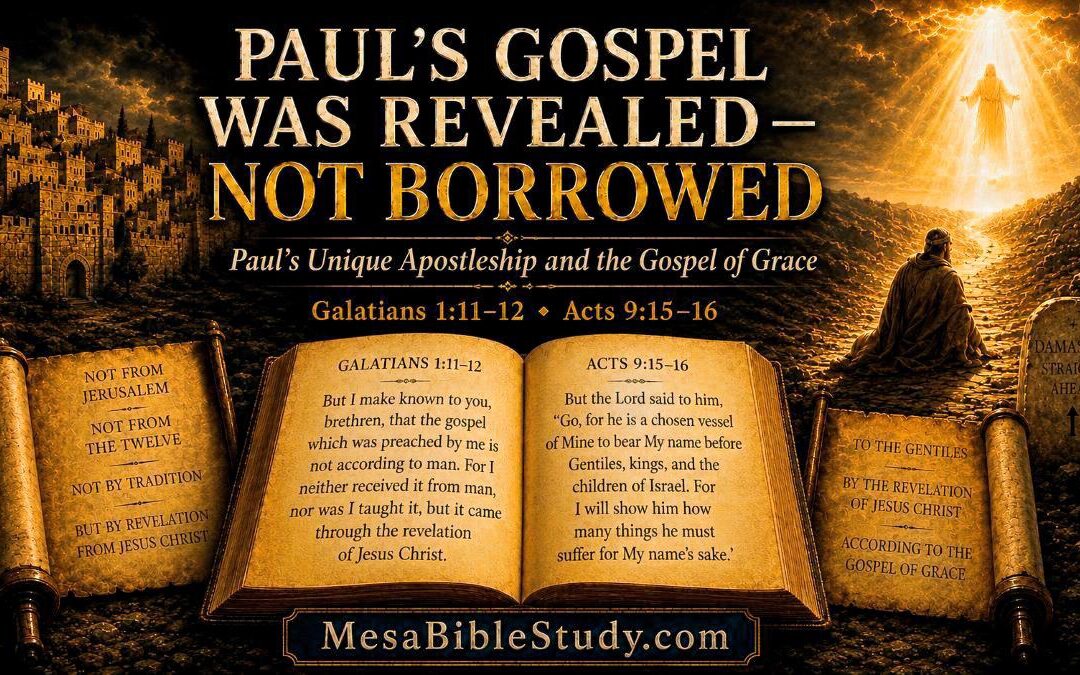
Paul’s Gospel Was Revealed — Not Borrowed

by Jamie Pantastico | May 10, 2026 | Devotionals |
“Her children rise up and call her blessed;
Her husband also, and he praises her:”
— Proverbs 31:28
A Special Mother’s Day Dedication
Today, I want to make a special dedication to two mothers whom I thank God for deeply.
First, I want to honor my beloved wife of 30 years, who is now with the Lord Jesus Christ.
She was a God-fearing woman, full of faith, love, strength, and grace. Her life was a testimony of quiet faithfulness, and her children truly rise up and call her blessed. Though she is now in the presence of the Lord, her love, prayers, example, and faith continue to bear fruit in the lives of those she touched.
I thank God for her. I continue to praise and thank God for the years He gave us together, for the family He built through her, and for the blessing she was and still is to all of us.
Second, I want to honor my mother, who is still with us.
My mom has endured much for so long, yet she remains faithful. Her perseverance, strength, and continued trust in the Lord are a blessing and an encouragement. Through many seasons, she has kept going by the grace of God, and today I thank the Lord for her life, her endurance, and her faithfulness.
On this Mother’s Day, I give thanks to God for both of these women.
One is now with the Lord Jesus.
One remains with us.
Both are deeply loved.
Both are gifts from God.
And both are worthy of honor.
“Her children rise up and call her blessed;
Her husband also, and he praises her:”
— Proverbs 31:28
🕊️
A Mother’s Day Reflection on Proverbs 31:28
Mother’s Day gives us an opportunity to pause and honor one of the most precious gifts God has placed in the home: a faithful, loving, self-sacrificing mother.
Proverbs 31:28 says, “Her children rise up and call her blessed.” That is a powerful statement. It is not simply describing a woman who was admired in public or praised by strangers. It is describing a woman whose faithfulness was recognized by those who knew her best.
Her own children rose up and called her blessed.
That matters.
Because children see the unseen things. They see the long days, the quiet sacrifices, the tears, the prayers, the patience, the correction, the meals, the laundry, the encouragement, the sleepless nights, and the steady love that keeps showing up again and again.
A faithful mother may not always feel noticed. She may not always feel appreciated. She may wonder if the daily labor matters. But Scripture reminds us that God sees what others may overlook.
A Mother’s Labor Is Often Hidden, but Never Forgotten by God
Much of a mother’s work is done quietly.
It is done in kitchens, bedrooms, hospital rooms, car rides, late-night conversations, early-morning routines, and countless ordinary moments that may never be recorded anywhere on earth.
But they are not forgotten by God.
The Lord sees every act of love done in faith. He sees the mother who prays when no one else knows. He sees the mother who keeps going when she is weary. He sees the mother who carries burdens in silence. He sees the mother who teaches her children truth, even when the world is pulling them in another direction.
A godly mother’s influence often reaches far beyond what she can see in the moment.
Her words may come back years later.
Her prayers may bear fruit long after they were prayed.
Her example may become a testimony her children do not fully appreciate until they are older.
That is why Proverbs 31:28 is so beautiful. There comes a time when the children rise up and recognize the blessing that was right in front of them.
“Her Children Rise Up”
The phrase “rise up” carries the idea of standing to honor her.
This is more than a casual compliment. It is recognition. It is gratitude. It is honor given where honor is due.
For many mothers, this honor may not come immediately. Children do not always understand the weight their mothers carry. They do not always appreciate discipline, sacrifice, or the daily faithfulness required to nurture a home.
But maturity often brings perspective.
As children grow older, they begin to see what they could not see before. They begin to understand the cost of love. They begin to recognize the strength, wisdom, patience, and grace that shaped them.
And then, by God’s grace, they rise up and call her blessed.
“And Call Her Blessed”
To call a mother blessed is to recognize that she has been a blessing.
It does not mean she was perfect. No mother is. Every mother needs grace, just as every child does.
But Proverbs 31 is not holding up sinless perfection. It is honoring faithful character. It is honoring a woman who feared the Lord, served her household, used wisdom, worked diligently, and poured herself out for the good of others.
A blessed mother is not blessed because life was easy.
She is blessed because God was faithful.
She is blessed because her labor mattered.
She is blessed because her influence endured.
She is blessed because the Lord used her love, instruction, correction, and care to shape lives.
The Greatest Gift a Mother Can Give
The greatest gift a mother can give her children is not wealth, comfort, popularity, or success.
The greatest gift is pointing them to the Lord.
A mother who teaches her children to fear God, trust His Word, and rest in His grace gives them something this world can never provide.
Proverbs 31:30 says:
“Charm is deceitful and beauty is passing,
But a woman who fears the LORD, she shall be praised.”
— Proverbs 31:30
That is the heart of the passage.
The woman in Proverbs 31 is not praised merely because she was busy, capable, or productive. She is praised because she feared the Lord.
Her strength flowed from her faith.
Her wisdom flowed from her reverence for God.
Her love flowed from something deeper than human ability.
That is what makes a godly mother so precious. She is not simply raising children for this life. She is pointing them to eternal truth.
For the Mother Who Feels Weary Today
Mother’s Day can be joyful, but it can also be emotional.
Some mothers feel appreciated today. Others feel forgotten.
Some are surrounded by children and grandchildren. Others are grieving distance, loss, conflict, or silence.
Some are rejoicing. Others are carrying pain no one sees.
If you are a weary mother today, be encouraged: your labor in the Lord is not wasted.
God sees your faithfulness.
God knows your tears.
God hears your prayers.
God remembers what others forget.
Even when appreciation is delayed, even when gratitude is not spoken, even when the fruit is not yet visible, the Lord is faithful.
You may not see today what God is doing through your life, but do not measure your worth by one day, one response, or one season.
A mother’s influence is often like seed planted deep in the soil. It may take time to appear, but God is able to bring forth fruit in His time.
For the Children: Rise Up and Call Her Blessed
Proverbs 31:28 is also a reminder to children.
Honor should not be postponed.
Gratitude should not be assumed.
Love should not remain unspoken.
If your mother is still with you, thank God for her. Tell her what she means to you. Honor her with your words. Acknowledge the sacrifices she made. Thank her for the prayers, the patience, the correction, the comfort, and the love.
If your mother is no longer here, thank God for the good she poured into your life. Remember the ways the Lord used her. Honor her memory by walking in truth, gratitude, and faith.
If your relationship with your mother is painful or complicated, Proverbs 31:28 can still remind you that honor is precious in God’s sight. Sometimes honor is expressed with gratitude. Sometimes it is expressed through forgiveness. Sometimes it is expressed by refusing bitterness and entrusting the pain to the Lord.
A Mother’s Faithfulness Points Us to God’s Grace
No mother can carry the weight of perfection. That burden belongs to no one but Christ.
Mothers need grace.
Children need grace.
Families need grace.
And that is why the gospel matters even on Mother’s Day.
The deepest hope for every home is not human strength, but the grace of God. Christ died for our sins, was buried, and rose again the third day according to the Scriptures (1 Corinthians 15:1-4).
Through Christ alone by faith alone, believers have forgiveness, peace with God, and eternal life.
A faithful mother may bless her children deeply, but even the best mother can only point her children to the Savior.
Christ alone saves.
Christ alone gives eternal life.
Christ alone is the sure foundation for every weary heart and every broken home.
Final Encouragement
Today, we honor mothers.
We honor the mothers who are still serving.
We honor the mothers who are tired.
We honor the mothers who are grieving.
We honor the mothers whose children now rise up and call them blessed.
We honor the mothers who may not hear those words today, but whose faithfulness is fully known by God.
And we give thanks to the Lord for every mother who has loved, prayed, sacrificed, taught, corrected, encouraged, and endured.
“Her children rise up and call her blessed;
Her husband also, and he praises her.”
— Proverbs 31:28
May every mother be encouraged today.
Your labor matters.
Your prayers matter.
Your love matters.
And most of all, God sees.