The Covenant with Abraham, the Oath to Isaac, and God’s Unchanging Promises to Israel
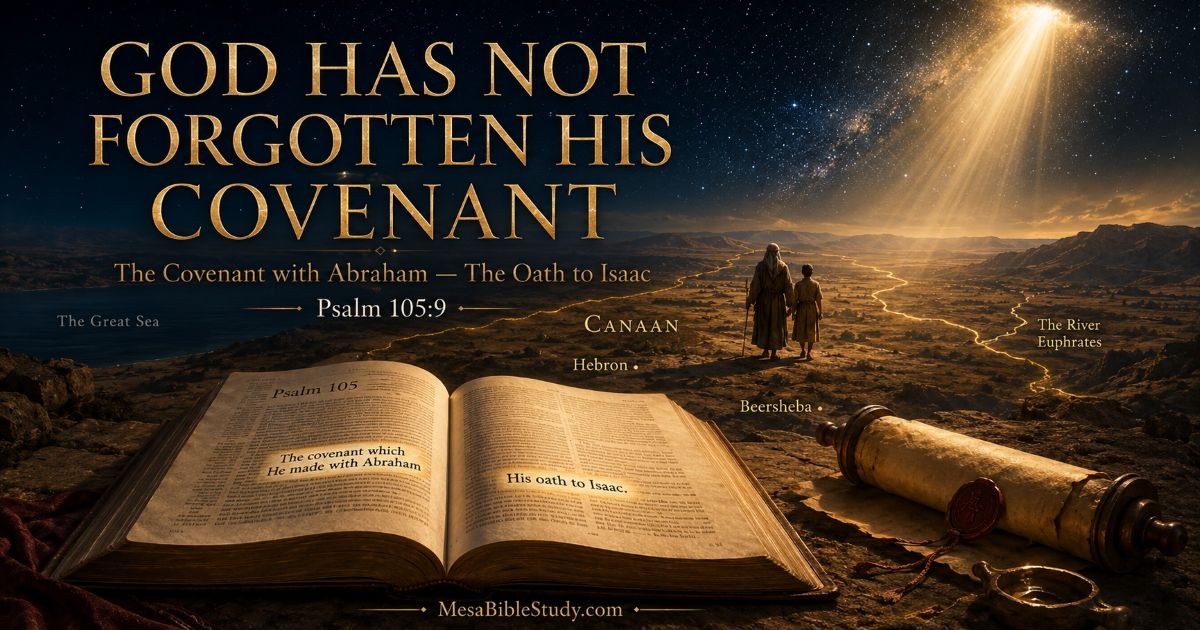
“The covenant which He made with Abraham,
And His oath to Isaac,”
—Psalm 105:9
Introduction
Psalm 105:9 is a short verse, but its doctrinal significance reaches across the entire biblical record.
The psalmist is not speaking about a vague promise made to humanity in general. He is identifying a specific covenant that God made with a specific man and then solemnly reaffirmed to a specific son:
- The covenant was made with Abraham.
- The oath was reaffirmed to Isaac.
- It was later confirmed to Jacob.
- It became an everlasting covenant with Israel.
- It included the land of Canaan as their inheritance.
The language is historical, national, covenantal, and unmistakably connected to Israel.
Psalm 105 does not present Israel’s preservation as the result of Israel’s faithfulness. It presents Israel’s preservation as the result of God’s faithfulness to His own word.
Men may forget their promises. Nations may violate their agreements. Generations may pass away. But God remembers the covenant He made.
Psalm 105:9 declares that Israel’s covenantal foundation rests not upon human merit, political circumstances, or national strength, but upon the promise and oath of God Himself.
Background, Setting, and Purpose
Psalm 105 is a historical psalm of praise celebrating the covenant faithfulness of the LORD toward Israel.
The opening verses call upon the people to:
- Give thanks to the LORD.
- Call upon His name.
- Make His deeds known among the nations.
- Remember His marvelous works.
- Seek the LORD continually.
The psalm then traces God’s dealings with Israel from Abraham through the patriarchs, Joseph, Egypt, the Exodus, the wilderness, and Israel’s entrance into the land.
The purpose is not merely to rehearse Israel’s history. It is to demonstrate that Israel’s history is the record of God acting in faithfulness to His covenant.
The psalm emphasizes what God did:
- He made the covenant.
- He protected the patriarchs.
- He sent Joseph ahead of them.
- He brought Israel into Egypt.
- He raised up Moses and Aaron.
- He judged Egypt.
- He delivered His people.
- He provided for them in the wilderness.
- He gave them the lands of the Gentiles.
The chapter concludes by explaining why God did these things:
“That they might observe His statutes
And keep His laws.
Praise the LORD!”
—Psalm 105:45
Israel’s deliverance and possession of the land were rooted in the covenant God made with Abraham.
Psalm 105:9 stands near the beginning of this historical account because everything that follows rests upon that covenantal foundation.
Chapter Theme
The LORD Remembers and Performs His Covenant with Israel
The central theme of Psalm 105 is the unwavering faithfulness of God to the covenant He made with Abraham, Isaac, Jacob, and the nation of Israel.
The chapter may be followed through several movements:
Psalm 105:1–6 — A Call to Remember
Israel is commanded to praise the LORD, proclaim His works, seek Him, and remember what He has done.
Psalm 105:7–11 — The Covenant Remembered
The psalmist identifies the covenant with Abraham, the oath to Isaac, its confirmation to Jacob, and the promise of the land of Canaan.
Psalm 105:12–15 — The Patriarchs Protected
Though the patriarchs were few and vulnerable, God protected them as they moved among foreign nations.
Psalm 105:16–22 — Joseph Sent Ahead
Joseph’s suffering and elevation in Egypt were used by God to preserve the covenant family.
Psalm 105:23–38 — Israel Delivered from Egypt
God judged Egypt and brought His people out with silver and gold.
Psalm 105:39–44 — Israel Sustained and Given the Land
God provided the cloud, fire, quail, manna, and water before giving Israel the lands of the nations.
Psalm 105 is therefore not merely a history of Israel. It is a testimony that God directed Israel’s history according to His covenant promise
Immediate Context
Psalm 105:9 must be read together with the verses immediately surrounding it:
“He remembers His covenant forever,
The word which He commanded, for a thousand generations,
The covenant which He made with Abraham,
And His oath to Isaac,
And confirmed it to Jacob for a statute,
To Israel as an everlasting covenant,
Saying, ‘To you I will give the land of Canaan
As the allotment of your inheritance.’”
—Psalm 105:8–11 NKJV
The sequence is explicit:
Abraham → Isaac → Jacob → Israel → the land of Canaan
The covenant is not left undefined.
Verse 11 identifies one of its central provisions:
“To you I will give the land of Canaan.”
The context does not allow us to detach the covenant from its historical recipients or spiritualize the land into something the passage never says.
God made the covenant with Abraham. He swore it to Isaac. He confirmed it to Jacob. He established it with Israel. He promised them the land of Canaan.
The identity of the recipients remains consistent throughout the passage.
Phrase-by-Phrase Breakdown
“The covenant”
A covenant is a binding commitment established between parties.
However, the covenant described here was not a negotiated agreement between equals. Abraham did not approach God with proposed terms. God sovereignly initiated the covenant, declared its promises, and bound Himself to fulfill them.
The foundation of the covenant was not Abraham’s strength, wisdom, or righteousness. Its foundation was the character and word of God.
The covenant included several interconnected promises:
- Abraham would become a great nation.
- Abraham’s name would be made great.
- Those who blessed him would be blessed.
- Those who cursed him would be cursed.
- All the families of the earth would be blessed through him.
- Abraham’s descendants would receive a specific land.
- The covenant would continue through Isaac and Jacob.
These promises appear throughout Genesis 12, 13, 15, 17, 22, 26, and 28.
The covenant contained a spiritual blessing that would eventually reach the nations, but it cannot be reduced to spiritual blessing alone. It also contained identifiable national, genealogical, and territorial promises.
God promised Abraham a nation, descendants, and land.
“Which He made”
God made the covenant.
The covenant did not originate with Abraham, Isaac, Jacob, Moses, David, the prophets, or the nation of Israel. It originated with God.
Genesis 15 presents one of the most significant covenant ceremonies in Scripture.
Animals were divided, but Abraham did not walk between the pieces. Abraham was placed into a deep sleep, and the visible representation of God passed between them.
This demonstrated that the ultimate responsibility for the covenant’s fulfillment rested upon God.
The fulfillment of the covenant would not depend upon Abraham’s descendants maintaining uninterrupted obedience. Israel’s disobedience would bring discipline, judgment, dispersion, and temporary removal from the land, but it would not cause God to become unfaithful to His oath.
God’s word does not become void because men fail.
The covenant may involve human responsibility, but its ultimate fulfillment rests upon divine faithfulness.
“With Abraham”
The identity of Abraham is essential to the meaning of the verse.
God called Abram out of his country and family and instructed him to go to a land that God would show him.
God then declared:
“I will make you a great nation;
I will bless you
And make your name great;
And you shall be a blessing.”
—Genesis 12:2
The repeated words “I will” reveal the divine initiative behind the covenant.
God later promised Abraham:
“For all the land which you see I give to you and your descendants forever.”
—Genesis 13:15
In Genesis 15:18, God identified the geographical scope of the land promise:
“To your descendants I have given this land, from the river of Egypt to the great river, the River Euphrates.”
The promise was made to Abraham and his physical descendants through the covenant line.
Abraham certainly became the father of all who believe in the sense explained by Paul in Romans 4. Gentile believers share Abraham’s example of justification by faith.
But participation in the blessing of justification does not transfer Israel’s national identity, covenants, or territorial inheritance to the Body of Christ.
Spiritual blessing through Abraham does not erase the promises God made to Abraham’s physical descendants
“And”
The word “and” connects God’s covenant with Abraham to His oath to Isaac.
These are not contradictory or competing promises. God was reaffirming the same covenantal purpose through the chosen line.
The promise did not end with Abraham’s death.
It passed according to God’s declared purpose through:
Abraham → Isaac → Jacob → Israel
Each generation received divine confirmation that God had not forgotten what He had promised.
The covenant’s continuation did not depend upon Abraham remaining physically alive. Its continuation depended upon the living God who had spoken it.
“His oath”
An oath is a solemn confirmation of a promise.
God’s oath demonstrates the certainty and immutability of His purpose.
Hebrews explains that when God made His promise to Abraham, He swore by Himself because He could swear by no one greater:
“Thus God, determining to show more abundantly to the heirs of promise the immutability of His counsel, confirmed it by an oath.”
—Hebrews 6:17
God did not swear an oath because His word was unreliable. His word is always true.
The oath was given as additional confirmation so that the heirs of promise would understand that His purpose could not be changed.
Human beings may break their word because they are dishonest, weak, forgetful, or unable to control future circumstances.
None of those limitations apply to God.
God cannot lie.
God cannot be overpowered.
God cannot forget.
God cannot cease to be faithful.
When God confirms His word with an oath, the fulfillment of that word is as certain as God’s own character.
“To Isaac”
God specifically reaffirmed the covenant to Isaac.
This distinction matters because Abraham had more than one son. Ishmael was Abraham’s physical son and received blessings from God, but God specifically identified Isaac as the son through whom the covenant line would continue.
God told Abraham:
“My covenant I will establish with Isaac.”
—Genesis 17:21
This did not mean that God had no concern for Ishmael. God promised to bless Ishmael and make him fruitful.
However, blessing Ishmael was not the same as establishing the covenant through Ishmael.
The covenant line was determined by God:
- Not merely through Abraham’s physical ability.
- Not through human planning.
- Not through cultural custom.
- Not through the preference of men.
- But through the son God had promised.
After Abraham’s death, the LORD appeared to Isaac and reaffirmed the covenant:
“Dwell in this land, and I will be with you and bless you; for to you and your descendants I give all these lands.”
—Genesis 26:3
God then repeated the promises involving descendants, land, and blessing to the nations.
Psalm 105:9 looks back upon that divine reaffirmation and describes it as God’s oath to Isaac.
The covenant did not become less literal when it passed from Abraham to Isaac. The descendants remained physical descendants, and the land remained an identifiable land.
What This Verse Does Not Mean
It does not mean that every physical descendant of Abraham is automatically saved
Physical descent did not guarantee personal justification or eternal life.
Salvation has never been earned through ethnicity, genealogy, religious privilege, or works of the Law.
The covenant established Israel’s national and historical position in God’s prophetic purpose. It did not eliminate the need for personal faith.
Israel possessed covenant privileges, but individual Israelites were still responsible to believe God.
It does not mean that Israel’s disobedience was insignificant
God’s unconditional covenant faithfulness did not remove Israel’s responsibility to obey Him.
Israel’s rebellion brought severe consequences:
- Judgment
- Captivity
- Dispersion
- Foreign domination
- Temporary removal from the land
- National blindness
God repeatedly disciplined Israel because of unbelief and disobedience.
However, divine discipline is not the same as divine abandonment.
God’s judgment upon Israel did not cancel His covenant with Abraham.
It does not mean that the Church replaced Israel
Psalm 105 does not identify the covenant as being made with a future predominantly Gentile church.
It names the recipients:
- Abraham
- Isaac
- Jacob
- Israel
It also names the inheritance:
- The land of Canaan
The Body of Christ is blessed with all spiritual blessings in heavenly places according to the revelation given through Paul. Israel was promised a national inheritance connected to the earth and the land God swore to Abraham.
These truths should not be confused or collapsed into one another.
The Body of Christ does not need to become Israel in order to be blessed, and Israel does not need to surrender its identity for God’s promises to the Church to remain secure.
God is faithful to both according to His revealed purposes.
It does not mean that the land promise may be spiritualized away
The immediate context identifies the land as “the land of Canaan.”
Canaan was not a metaphor for heaven, salvation, the Church, or a general experience of spiritual blessing.
It was an identifiable geographical land promised to Abraham’s descendants through Isaac and Jacob.
The covenant certainly contains truths with profound spiritual significance, but spiritual significance does not erase historical meaning.
A promise may carry theological implications without losing its original recipients and stated content.
It does not mean that modern political events determine whether God’s covenant remains valid
Governments may recognize or reject Israel.
International institutions may approve or condemn Israel.
Nations may dispute borders, land, history, and identity.
None of these political decisions can amend, annul, or overturn an oath made by God.
The legitimacy of God’s covenant does not rest upon a vote by the United Nations, the policies of a government, or the approval of the nations.
God’s word stands because God spoke it.
What This Verse Does Mean
God established a real covenant with Abraham
The covenant was not merely an inspirational idea or temporary religious arrangement.
God bound Himself by His own word to fulfill specific promises involving Abraham, his descendants, the nation that would come from him, and the land they would inherit.
God reaffirmed the covenant to Isaac
God deliberately continued the covenant through Isaac, the promised son.
The covenant line was not determined by human custom or natural priority. It was determined by God’s sovereign declaration.
God’s covenant purpose continued through Jacob and Israel
The following verse confirms the same covenant to Jacob and identifies it as an everlasting covenant with Israel.
This removes any legitimate basis for separating Psalm 105:9 from Israel’s national covenantal identity.
The land of Canaan was part of the covenant
Psalm 105:11 explains the content of the promise:
“To you I will give the land of Canaan as the allotment of your inheritance.”
The land promise is not an incidental detail. It is explicitly included in the covenant remembered throughout the chapter.
God’s faithfulness is the controlling truth of the passage
Psalm 105 does not glorify Abraham, Isaac, Jacob, Joseph, Moses, or Israel.
It glorifies the LORD who remained faithful through every generation.
The patriarchs were weak.
Joseph was imprisoned.
Israel was enslaved.
Egypt was powerful.
The wilderness was barren.
The nations possessed the land.
Yet none of those circumstances prevented God from advancing His covenant purpose.
The chapter is a declaration that obstacles cannot nullify what God has sworn.
God’s covenant with Israel has not been transferred or cancelled
The covenant was confirmed to Israel as an everlasting covenant.
Israel’s present condition of partial blindness does not mean that God has rejected the nation permanently.
Paul writes:
“For the gifts and the calling of God are irrevocable.”
—Romans 11:29
Israel is presently an enemy concerning the gospel, but remains beloved for the sake of the fathers.
The “fathers” include Abraham, Isaac, and Jacob—the very men named in Psalm 105.
God’s future restoration of Israel will not be an act of divine improvisation. It will be the fulfillment of the covenant He has remembered throughout every generation.
Cross-References for Going Deeper
Genesis 12:1–3
God calls Abram and promises to make him a great nation, bless him, make his name great, bless them that bless you, curse them the curse you, and bless the families of the earth through him.
Genesis 13:14–17
God promises Abraham and his descendants the land he can see and tells him to walk through it.
Genesis 15:7–21
God formally confirms the covenant and defines the land promised to Abraham’s descendants.
Genesis 17:7–8
God describes His covenant as everlasting and promises the land of Canaan as an everlasting possession.
Genesis 17:19–21
God declares that the covenant will be established through Isaac while also promising to bless Ishmael.
Genesis 22:15–18
God confirms His promise to Abraham with an oath after Abraham demonstrates his faith.
Genesis 26:2–5
God appears to Isaac and reaffirms the promises concerning the land, descendants, and blessing.
Genesis 28:13–15
God confirms the covenant to Jacob, promising him the land and assuring him that He will not leave him until He has fulfilled His word.
Exodus 2:23–25
God hears Israel’s groaning in Egypt and remembers His covenant with Abraham, Isaac, and Jacob.
Leviticus 26:40–45
God declares that even after Israel’s disobedience and dispersion, He will remember His covenant and will not utterly cast them away.
Psalm 105:8–11
The covenant with Abraham, oath to Isaac, confirmation to Jacob, everlasting covenant with Israel, and promise of Canaan are presented as one continuous covenantal purpose.
Jeremiah 31:35–37
God ties Israel’s continued national existence to the fixed order of the sun, moon, stars, and heavens.
Ezekiel 36:22–28
God promises to restore Israel, cleanse them, give them a new heart, and bring them into the land—not because of their righteousness, but for the sake of His holy name.
Romans 9:6–13
Paul distinguishes the covenant line through Isaac and Jacob according to God’s purpose.
Romans 11:25–29
Israel’s present blindness is partial and temporary. The nation remains beloved for the sake of the fathers because God’s gifts and calling are irrevocable.
Hebrews 6:13–18
God confirmed His promise with an oath, demonstrating the immutability of His counsel and the impossibility of God lying.
Doctrinal Summary
Psalm 105:9 teaches that God established a covenant with Abraham and solemnly reaffirmed it to Isaac.
That covenant was subsequently confirmed to Jacob and established with Israel as an everlasting covenant. It included the promise of the land of Canaan as Israel’s inheritance.
The covenant did not originate with Israel and does not ultimately rest upon Israel’s ability to preserve it. It originated with God and rests upon His character, word, and oath.
Israel’s disobedience brought discipline, dispersion, and temporary national blindness, but it did not make God’s covenant void.
The Body of Christ has not replaced Israel, inherited Israel’s national identity, or absorbed Israel’s land promises. God’s revelation concerning the Body of Christ does not cancel His previously declared covenant with Israel.
God will fulfill His purpose for Israel because:
- He made the covenant.
- He confirmed it with an oath.
- He cannot lie.
- His calling is irrevocable.
- His faithfulness is not determined by human failure.
Psalm 105:9 is therefore more than a historical reference. It is a declaration concerning the reliability of God Himself.
To deny the covenant God made with Abraham and swore to Isaac is not merely to dispute an interpretation of history. It is to question whether God means what He says.
Final Summary
Psalm 105:9 directs our attention away from Israel’s performance and toward God’s promise.
The covenant was made with Abraham.
The oath was sworn to Isaac.
The promise was confirmed to Jacob.
The everlasting covenant was established with Israel.
The land of Canaan was named as their inheritance.
Israel has failed many times, but God has never ceased to be faithful.
Nations may oppose His purpose. The world may reject His word. The descendants of Abraham may experience judgment because of unbelief. But none of these things can force God to violate His oath.
The covenant remains certain because the God who made it remains faithful.
God has not forgotten Abraham.
God has not revoked His oath to Isaac.
God has not abandoned Jacob.
God has not finished with Israel.
What God promised, He will perform.
Take God at His word.