Part 9 — RETROACTIVE REVELATION SERIES
Why Paul’s repeated personal language cannot be ignored
There is a phrase in Paul’s letters that much of Christendom reads too quickly:
“My gospel.”
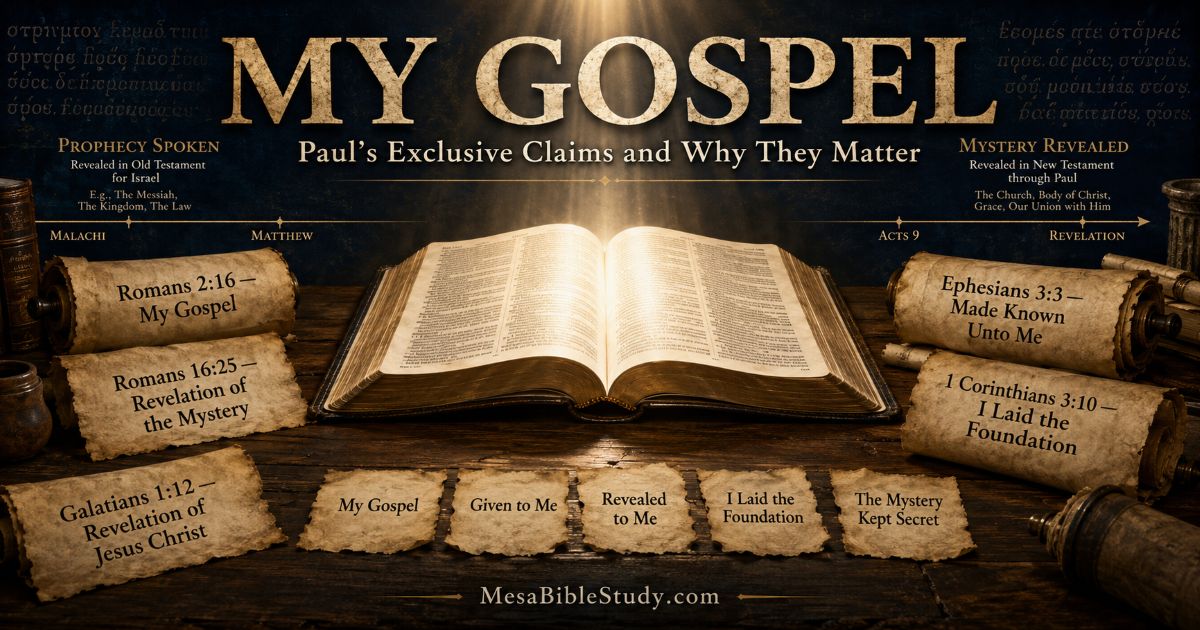
Paul uses language that no other apostle uses. He does not merely say “the gospel.” He says “my gospel.” He speaks of the gospel preached by him, revelation given to him, the dispensation committed to him, the mystery made known to him, the foundation laid by him, and the wisdom given to him.
That language matters.
Paul does not present his gospel as something he received from Peter. He does not present his ministry as an extension of the Twelve. He does not present the mystery as something already known at Pentecost. He says his gospel came by revelation from Jesus Christ.
If Peter had already preached Paul’s gospel in Acts 2, then Paul’s repeated exclusive claims become very difficult to explain. But if Christ revealed something distinct through Paul — the gospel of grace, the mystery, the Body of Christ, Jew–Gentile equality, and the dispensation of grace — then Paul’s language makes perfect sense.
These exclusive claims are not incidental. They are intentional. They appear repeatedly across Paul’s letters, and they form a consistent pattern that must be taken seriously if we are going to rightly divide the Word of truth.
A Necessary Clarification
Before going further, let this be stated clearly.
All salvation — from Abel to the end of time — is only possible because of the finished work of Jesus Christ: His death, His shed blood, His burial, and His resurrection. There is one Savior. There is one cross. There is one sacrifice. There is one ultimate basis of redemption.
This study is not teaching two Saviors, two crosses, or two ultimate ways of salvation. The issue is not the basis of salvation. The issue is the timing and content of revelation.
When did God reveal the gospel of grace?
When did God reveal the Body of Christ?
When did God reveal Jew–Gentile equality in one Body?
When did God reveal the mystery hidden in Himself?
Paul says that revelation was given to him. That matters. Scripture is progressive. God reveals truth in stages. Ignoring the order of that revelation leads to confusion. Recognizing it leads to clarity.
Paul’s Staggering Phrase: “My Gospel”
Paul writes:
“In the day when God shall judge the secrets of men by Jesus Christ according to my gospel.”
— Romans 2:16
That is a staggering statement. Paul says the secrets of men will be judged by Jesus Christ according to my gospel. He does not say according to Peter’s Pentecost sermon. He does not say according to the Sermon on the Mount. He does not say according to Israel’s kingdom proclamation. He says “according to my gospel.”
This does not mean Paul invented the gospel. It does not mean Paul is the Savior. It means Paul was entrusted with a specific gospel message by direct revelation from Jesus Christ. Paul speaks this way because something was committed to him. The risen Christ gave him a message for this present age, and Paul repeatedly identifies that message as his own by divine entrustment.
This is not the language of a man who is simply repeating what the Twelve already preached. It is the language of a man who received a distinct commission and a distinct revelation.
“My Gospel” and the Mystery Kept Secret
Paul writes again:
“Now to him that is of power to stablish you according to my gospel, and the preaching of Jesus Christ, according to the revelation of the mystery, which was kept secret since the world began.”
— Romans 16:25
This verse is one of the clearest statements in the entire New Testament. Paul says believers are established according to my gospel, the preaching of Jesus Christ, according to the revelation of the mystery, which was kept secret since the world began.
That means Paul’s gospel is not merely a general message about Jesus. It is the preaching of Jesus Christ according to the revelation of the mystery. That mystery was not spoken since the world began. It was kept secret since the world began.
That distinction is essential.
Peter in Acts 3 speaks of what God had spoken by the mouth of all His holy prophets since the world began. Paul in Romans 16 speaks of what had been kept secret since the world began. Those are not the same category. Peter’s ministry is connected to prophecy. Paul’s gospel is connected to the mystery.
If the mystery was kept secret, then it cannot be treated as something already operating and publicly known in Acts 2. The language of “kept secret” and “now revealed” demands a clear chronological distinction.
Paul Did Not Receive His Gospel From Peter
Paul writes:
“But I certify you, brethren, that the gospel which was preached of me is not after man. For I neither received it of man, neither was I taught it, but by the revelation of Jesus Christ.”
— Galatians 1:11–12
This passage leaves no room for confusion. Paul says the gospel he preached was not after man, not received from man, not taught by man, but received by revelation of Jesus Christ.
That means Paul did not get his gospel from Peter. He did not learn it from the Twelve. He did not receive it from the Jerusalem assembly. He did not inherit it from Acts 2. He received it by direct revelation from Jesus Christ.
If Paul was merely repeating what Peter already preached, Galatians 1:11–12 becomes almost impossible to explain. Why would Paul insist that he did not receive his gospel from man if Peter had already preached the same message publicly at Pentecost? Why would Paul emphasize revelation if he was simply passing along what the Twelve already knew? Why would Paul defend the independence of his gospel if it was the same message already established in Jerusalem?
Paul’s own testimony is clear. His gospel came by revelation. That claim is foundational to understanding his apostleship and the content of the message he was given.
The Dispensation of Grace Was Given to Paul
Paul writes:
“For this cause I Paul, the prisoner of Jesus Christ for you Gentiles, If ye have heard of the dispensation of the grace of God which is given me to you-ward.”
— Ephesians 3:1–2
Notice the language: “given me to you-ward.” Paul does not say this dispensation was given to Peter at Pentecost. He does not say it was given to the Twelve in Acts 2. He says it was given to him for the Gentiles.
Then he explains how:
“How that by revelation he made known unto me the mystery…”
— Ephesians 3:3
Again, the language is specific. The mystery was made known to Paul by revelation. And Who revealed it to Paul, the ascended glorified Lord Jesus. This is not vague. This is not tradition. This is Paul’s own explanation of his apostleship. The dispensation of the grace of God was entrusted to him, and the content of that dispensation is the mystery of Christ.
Paul Says the Mystery Was Not Made Known Before
Paul continues:
“Which in other ages was not made known unto the sons of men, as it is now revealed…”
— Ephesians 3:5
This verse is devastating to retroactive revelation. Paul does not say the mystery was known but unclear. He does not say it was preached in seed form. He does not say Peter had already revealed it at Pentecost. He says it “was not made known.”
That must be allowed to mean what it says. If the mystery was not made known in other ages, then it cannot be read backward into Acts 2. If it was not made known, then Peter was not preaching it. If it was not made known, then the Twelve were not proclaiming it. If it was not made known, then the Body of Christ cannot be placed before the revelation of the Body without importing later truth into an earlier passage.
That is the problem with retroactive revelation. It takes what Paul says was not made known and treats it as though it was already operating.
Paul Defines the Mystery as Jew–Gentile Equality in One Body
Paul defines the mystery:
“That the Gentiles should be fellowheirs, and of the same body, and partakers of his promise in Christ by the gospel.”
— Ephesians 3:6
This is not merely Gentiles being blessed. Gentile blessing was not a mystery. The Old Testament spoke of Gentile blessing. The prophets spoke of nations coming to Israel’s light. The mystery is not that Gentiles could be blessed. The mystery is that Gentiles would be fellow heirs, of the same Body, and partakers in Christ through the gospel.
That is Jew–Gentile equality in one Body. That is the Body of Christ. That is the one new man. And Paul says this mystery was not made known in other ages. Therefore, the Body of Christ cannot be responsibly placed in Acts 2 unless Scripture says it was revealed there. It does not.
Paul Says the Mystery Was Hidden in God
Paul writes:
“And to make all men see what is the fellowship of the mystery, which from the beginning of the world hath been hid in God…”
— Ephesians 3:9
This is precise language. Paul does not say the mystery was hidden in the Old Testament. He does not say it was hidden in Joel. He does not say it was hidden in Peter’s Pentecost sermon. He says it was “hid in God.”
That means the mystery (secret) was not available for discovery in earlier Scripture. It was not sitting openly in prophecy waiting to be decoded. It was hidden in God until God revealed it. That destroys the idea that the Body of Christ can be read backward into Acts 2.
Paul Says the Mystery Was Hidden From Ages and Generations
Paul writes:
“Whereof I am made a minister, according to the dispensation of God which is given to me for you, to fulfil the word of God; Even the mystery which hath been hid from ages and from generations, but now is made manifest to his saints.”
— Colossians 1:25–26
Again, Paul speaks of a dispensation given to him, for the saints, to fulfill the Word of God, the mystery hidden from ages and generations, and now made manifest. This is not ordinary language. Paul is describing a revelation entrusted to him. The mystery (secret) had been hidden. Now it was made manifest.
That sequence matters. Hidden. Then revealed. Not hidden while already functioning as revealed doctrine. Not known under another name. Not preached by Peter before Paul. Hidden, then revealed.
Paul Says He Laid the Foundation
Paul writes:
“According to the grace of God which is given unto me, as a wise masterbuilder, I have laid the foundation…”
— 1 Corinthians 3:10
This verse is monumental. Paul does not say Peter laid the foundation for the Body of Christ. He does not say the Twelve laid the foundation. He does not say Pentecost laid the foundation. He says, “I have laid the foundation.” It is crucial to always know the time element. Paul came on the scene many years after Pentecost (Acts 9).
The foundation is Jesus Christ. Not another Christ. Not another Savior. Not another cross. But Jesus Christ according to the revelation of the mystery entrusted to Paul. Paul laid the doctrinal foundation for the Body of Christ as the wise master builder.
That language matters. It fits perfectly with “my gospel,” “given to me,” “revealed to me,” “dispensation given to me,” and “mystery made known to me.” Paul’s testimony is consistent.
Peter Acknowledges the Wisdom Given to Paul
Peter writes near the end of his ministry:
“And consider that the longsuffering of our Lord is salvation—as also our beloved brother Paul, according to the wisdom given to him, has written to you, as also in all his epistles, speaking in them of these things…”
— 2 Peter 3:15–16
This passage is often read too quickly. Peter is speaking about salvation and the longsuffering of the Lord. And when he speaks of these things, he points his readers to Paul. He does not say, “Go back to my sermon at Pentecost.” He does not say, “Go back to Acts 3.” He does not say, “Go back to the Sermon on the Mount.” He points to Paul’s writings.
Peter says Paul wrote according to wisdom given to him. Not wisdom given to Peter. Not wisdom given to John. Not wisdom given equally to all the apostles from the beginning. Wisdom given to Paul. Then Peter warns that some twist Paul’s writings to their own destruction, as they do also the rest of the Scriptures.
That means Peter recognizes Paul’s writings as Scripture. It also means Paul’s writings must be handled carefully and not twisted. One of the most common ways Paul is twisted is by forcing his revelation backward into Peter’s ministry. Peter does not erase Paul’s distinction. He confirms it.
No Other Apostle Uses Paul’s Language
This point must not be ignored. Peter never says “my gospel.” John never says “my gospel.” James never says “my gospel.” No other apostle says the dispensation of grace was given to me, the mystery was revealed to me, I laid the foundation, I am the apostle of the Gentiles, or God will judge according to my gospel.
Paul speaks this way because his apostleship was unique. He was not one of the Twelve. He was not sent under the same commission as Peter. He was not carrying forward the same ministry to Israel. He was raised up by the risen Christ with a distinct apostleship to the Gentiles.
Paul writes:
“For I speak to you Gentiles, inasmuch as I am the apostle of the Gentiles…”
— Romans 11:13
That is not a minor detail. It is central to understanding the present dispensation.
Galatians 2 Confirms Paul’s Distinct Gospel and Apostleship
Paul writes:
“But contrariwise, when they saw that the gospel of the uncircumcision was committed unto me, as the gospel of the circumcision was unto Peter; For he that wrought effectually in Peter to the apostleship of the circumcision, the same was mighty in me toward the Gentiles: And when James, Cephas, and John, who seemed to be pillars, perceived the grace that was given unto me, they gave to me and Barnabas the right hands of fellowship…”
— Galatians 2:7–9
This is not vague. Paul says the gospel of the uncircumcision was committed to him. The gospel of the circumcision was committed to Peter. Peter had an apostleship to the circumcision. Paul had an apostleship to the Gentiles. James, Cephas, and John perceived the grace given to Paul and gave him the right hand of fellowship. They did not correct him. They did not teach him his gospel. They did not absorb him into their commission. They recognized the grace given to him. That confirms Paul’s distinct apostleship.
If Paul Was Repeating Peter, Why Say “My Gospel”
If Peter preached Paul’s gospel in Acts 2, then Paul’s repeated language becomes difficult to explain. Why does Paul say “my gospel”? Why does Paul say his gospel was not received from man? Why does Paul say he was not taught it? Why does Paul say it came by revelation? Why does Paul say the dispensation of grace was given to him? Why does Paul say the mystery was made known to him? Why does Paul say the mystery was not made known in other ages? Why does Paul say the mystery was hidden in God? Why does Paul say he laid the foundation? Why does Peter later point readers to Paul’s writings concerning salvation?
These questions matter. They cannot be answered by simply saying, “Peter and Paul preached the same gospel.” That statement collapses under the weight of Paul’s own words.
Why This Matters
This is not an academic debate. If Paul’s exclusive claims are ignored, the gospel becomes blurred. Law and grace get mixed. Israel and the Church get mixed. Prophecy and mystery get mixed. Kingdom doctrine and Body doctrine get mixed. Peter’s ministry to Israel gets blended with Paul’s apostleship to the Gentiles. And the doctrine for believers today becomes obscured.
That matters because the doctrine for the Body of Christ — grace-age believers today — is found in Paul’s letters. Paul is the apostle of the Gentiles. Paul received the dispensation of the grace of God. Paul reveals the mystery. Paul explains the one Body. Paul lays out the believer’s position, walk, warfare, assurance, liberty, and hope in this present age.
That does not mean the rest of Scripture is unimportant. All Scripture is inspired and profitable. But all Scripture is not written directly to the same people under the same program. Genesis is profitable. Matthew is profitable. Acts is profitable. Hebrews through Revelation are profitable. But the doctrine that establishes the Body of Christ today is found in Paul’s epistles.
When Paul is blurred, doctrine is blurred. When doctrine is blurred, the gospel is blurred. When the gospel is blurred, assurance is weakened. And when assurance is weakened, believers are left striving for what Christ has already accomplished. That is why Paul’s exclusive claims matter.
Final Summary
Paul’s repeated exclusive language cannot be ignored. He says “my gospel,” “given to me,” “revealed to me,” “committed to me,” “dispensation given to me,” and “I laid the foundation.” No other apostle speaks this way.
Paul did not receive his gospel from Peter. He did not learn it from the Twelve. He did not inherit it from Acts 2. He received it by revelation from Jesus Christ. Paul connects his gospel to the mystery kept secret since the world began. He says the mystery was not made known in other ages. He says it was hidden in God. He says it was hidden from ages and generations, but now revealed. He defines that mystery as Gentiles being fellow heirs, of the same Body, and partakers in Christ through the gospel.
Peter later acknowledges the wisdom given to Paul and points readers to Paul’s writings concerning salvation. That is not accidental. That is Scripture confirming Paul’s unique apostleship. If Paul was merely repeating Peter, his language makes no sense. But if Christ revealed the mystery through Paul, then every phrase fits perfectly.
That is why Paul says “my gospel.” And that is why Paul’s exclusive claims matter.
Continue the Retroactive Revelation Series
Paul’s exclusive claims cannot be ignored.
If this study helped clarify why Paul repeatedly says “my gospel,” continue with the full Retroactive Revelation Series.
Have questions or comments? Leave them below. They will be seen, and I will respond.
Previous Study:
Paul the Master Builder: Why 1 Corinthians 3:10 Matters
Next Study:
Retroactive Revelation Is Not a Biblical Hermeneutic