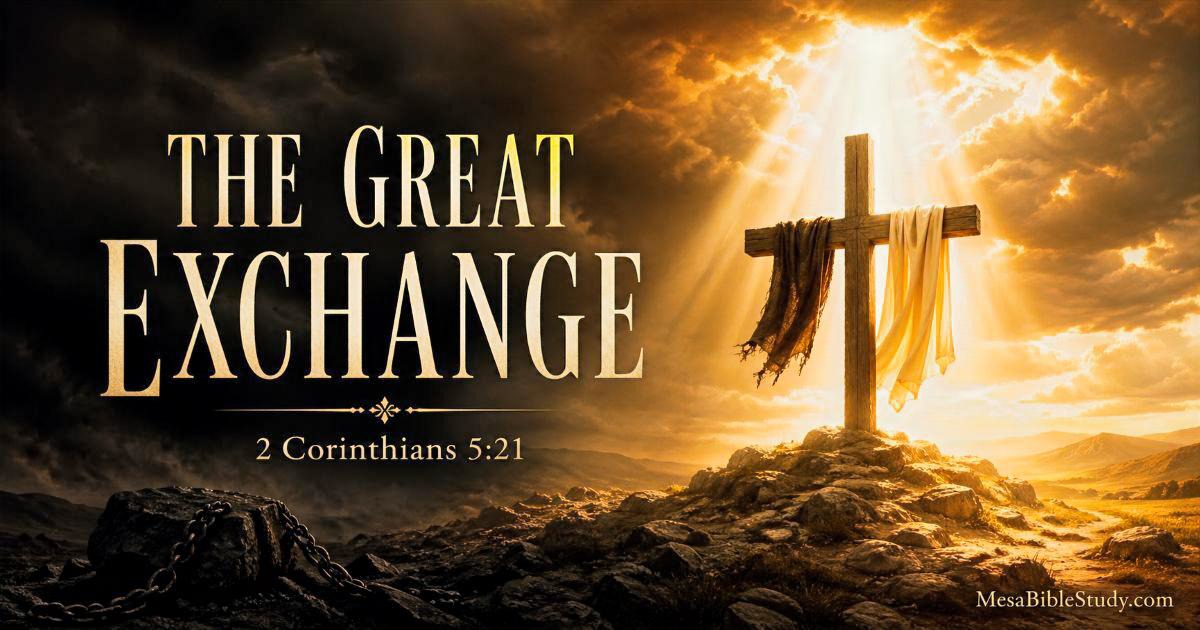
And We Did Nothing to Earn It, Nor Do We Deserve It
“For He made Him who knew no sin to be sin for us, that we might become the righteousness of God in Him.”
2 Corinthians 5:21
There are verses in Scripture that say more in one sentence than men could explain in a thousand books.
Second Corinthians 5:21 is one of those verses.
In just 23 words, the apostle Paul gives one of the clearest explanations in the Bible of how God reconciled sinners to Himself. No seminary degree is needed. No theological system needs to be forced into the verse. No religious tradition needs to be added to it.
The verse says what it says.
God did something for sinners that sinners could never do for themselves.
Paul writes:
“For He made Him who knew no sin to be sin for us, that we might become the righteousness of God in Him.”
In this one verse, Paul clearly and simply explains the doctrine of substitution and imputation.
Christ took what belonged to us.
And by grace, through faith, we receive what belongs to Him.
“For He made Him…”
The first thing we must see is that salvation begins with God.
“For He made Him…”
This was God’s doing.
Salvation is not man climbing his way up to God. Salvation is God coming down to man.
Before the foundation of the world, before one star was placed in the heavens, before one planet was formed, before man ever sinned in the garden, God already knew what would be required to redeem lost sinners.
The Father sent the Son.
The Son willingly came.
The Holy Spirit bears witness to the finished work of Christ and seals those who believe.
This was not a desperate reaction by God after man sinned. This was the eternal purpose of God, accomplished through the Lord Jesus Christ.
How foolish it is for man to think he can add something from his own flesh to what God has already accomplished through His Son.
Man did not initiate reconciliation.
Man did not earn reconciliation.
Man did not deserve reconciliation.
God did it.
“Who knew no sin…”
Paul then tells us who Christ is:
“who knew no sin…”
The Lord Jesus Christ was completely sinless.
He was not merely a good man.
He was not merely a moral teacher.
He was not merely an example of righteousness.
He was, and is, God manifest in the flesh.
He never once sinned in thought, word, or deed. He never transgressed the law. He was holy, harmless, undefiled, and separate from sinners.
Peter wrote:
“Who committed no sin,
Nor was deceit found in His mouth.”
1 Peter 2:22
The Lord Jesus Christ had no sin of His own.
That is why He could bear ours.
A sinner cannot redeem sinners. A guilty man cannot pay the debt of another guilty man. But Christ, the sinless Son of God, could stand in the place of the guilty because He Himself was without sin.
“To be sin for us…”
Then comes one of the most staggering statements in all of Scripture:
“to be sin for us…”
Jesus was not made a sinner.
He did not become morally corrupt.
He did not cease to be holy.
But at the cross, He was treated as though He were guilty of all sin.
He became the sin offering.
He bore the full weight of sin.
He stood in our place.
This is substitution.
The innocent One stood in the place of the guilty.
The sinless One bore the judgment that sinners deserved.
Isaiah wrote:
“All we like sheep have gone astray;
We have turned, every one, to his own way;
And the LORD has laid on Him the iniquity of us all.”
Isaiah 53:6
And again:
“Because He had done no violence,
Nor was any deceit in His mouth.”
Isaiah 53:9
Christ had no sin, yet our sin was laid upon Him.
At the cross, the old Adam was judged. Sin was condemned. The curse was answered. The law’s righteous demand was satisfied. Death was defeated. Redemption was accomplished.
His precious blood was payment in full.
Not partial payment.
Not a down payment.
Not a conditional payment that waits for man to finish the work.
Payment in full.
“For us…”
Do not miss those two words:
“for us.”
Christ did not die for Himself.
He died for sinners.
He died for the ungodly.
He died for those who could not save themselves.
Paul writes:
“For when we were still without strength, in due time Christ died for the ungodly.”
Romans 5:6
That is what man does not want to admit.
We were without strength.
Not weak but still able.
Not sick but still capable.
Without strength.
Unable to save ourselves. Unable to make ourselves righteous. Unable to cleanse our own record. Unable to undo the damage of sin. Unable to offer God anything acceptable from our flesh.
And while we were in that helpless condition, Christ died for us.
That is grace.
“That we might become the righteousness of God in Him”
Now Paul gives the great exchange:
“that we might become the righteousness of God in Him.”
This is imputation.
Our sin was charged to Christ.
His righteousness is credited to us.
We do not become righteous before God by turning over a new leaf.
We do not become righteous before God by joining a church.
We do not become righteous before God by water baptism.
We do not become righteous before God by tithing, confessing, promising, performing, reforming, or trying harder.
We become the righteousness of God in Him.
That means the righteousness is not ours by nature.
It is not ours by effort.
It is not ours by religious achievement.
It is Christ’s righteousness imputed to us by grace through faith.
Paul writes:
“For in it the righteousness of God is revealed from faith to faith; as it is written, ‘The just shall live by faith.’”
Romans 1:17
And again:
“But now the righteousness of God apart from the law is revealed, being witnessed by the Law and the Prophets.”
Romans 3:21
The righteousness God requires is the righteousness God provides.
That is the heart of the gospel of grace.
God Was in Christ Reconciling the World to Himself
The verse before 2 Corinthians 5:21 makes this even clearer:
“That is, that God was in Christ reconciling the world to Himself, not imputing their trespasses to them…”
2 Corinthians 5:19
That is mind-boggling.
God was in Christ reconciling the world to Himself.
Not imputing their trespasses to them.
Religion says, “Clean up your life so God can save you.”
But Scripture says God was in Christ reconciling the world to Himself.
Religion says, “Turn from all your sins so God can accept you.”
But Scripture says Christ was made sin for us.
Religion says, “Do your part.”
But Scripture says God did it.
This is why the gospel of grace is offensive to so many people. It leaves no room for boasting. It strips man of every religious badge, every moral credential, and every fleshly claim before God.
Man wants to contribute.
Man wants to help pay.
Man wants to point to something he has done.
But God will not share the glory of salvation with the flesh.
Faith Is Not a Work
All God asks the sinner to do today is believe the gospel.
Not work.
Not perform.
Not promise.
Not clean himself up first.
Believe.
Paul defines the gospel plainly:
“Moreover, brethren, I declare to you the gospel which I preached to you, which also you received and in which you stand,
by which also you are saved, if you hold fast that word which I preached to you—unless you believed in vain.
For I delivered to you first of all that which I also received: that Christ died for our sins according to the Scriptures,
and that He was buried, and that He rose again the third day according to the Scriptures.”
1 Corinthians 15:1–4
That is the gospel that saves.
Christ died for our sins.
He was buried.
He rose again the third day.
And the moment a sinner believes that gospel, God saves them by His grace.
Only then does real change begin.
Only then does the believer become a new creation.
Only then does the Holy Spirit indwell the believer.
Only then is a person equipped to walk in newness of life.
We do not turn from ungodliness in order to receive the Spirit.
We receive the Spirit by faith, and then by God’s grace we are taught to deny ungodliness.
The order matters.
Grace saves first.
Then grace teaches.
The Great Exchange
Paul says:
“But of Him you are in Christ Jesus, who became for us wisdom from God—and righteousness and sanctification and redemption.”
1 Corinthians 1:30
Christ is our righteousness.
Christ is our sanctification.
Christ is our redemption.
That means the believer stands before God in Christ, not in Adam.
Accepted in Christ.
Complete in Christ.
Forgiven in Christ.
Righteous in Christ.
Not because we earned it.
Not because we deserve it.
Not because we finally became worthy.
But because God made Him who knew no sin to be sin for us, that we might become the righteousness of God in Him.
Final Summary
Beloved, this is the heart of the gospel of grace.
God did not wait for sinners to become righteous before reconciling them.
God did not ask man to climb out of death by his own strength.
God did not place salvation at the end of a religious obstacle course.
God was in Christ, reconciling the world to Himself.
The sinless Son of God took our place.
He bore our sin.
He satisfied God’s justice.
He shed His blood.
He died.
He was buried.
He rose again.
And now righteousness is freely given to all who believe.
That is substitution.
That is imputation.
That is grace.
That is the gospel.
“For He made Him who knew no sin to be sin for us, that we might become the righteousness of God in Him.”
2 Corinthians 5:21