The Verse That Reveals Paul’s Foundational Role in the Body of Christ
There are verses in Paul’s letters so clear and monumental that 95% of Christendom avoids. 1 Corinthians 3:10 is one of them.
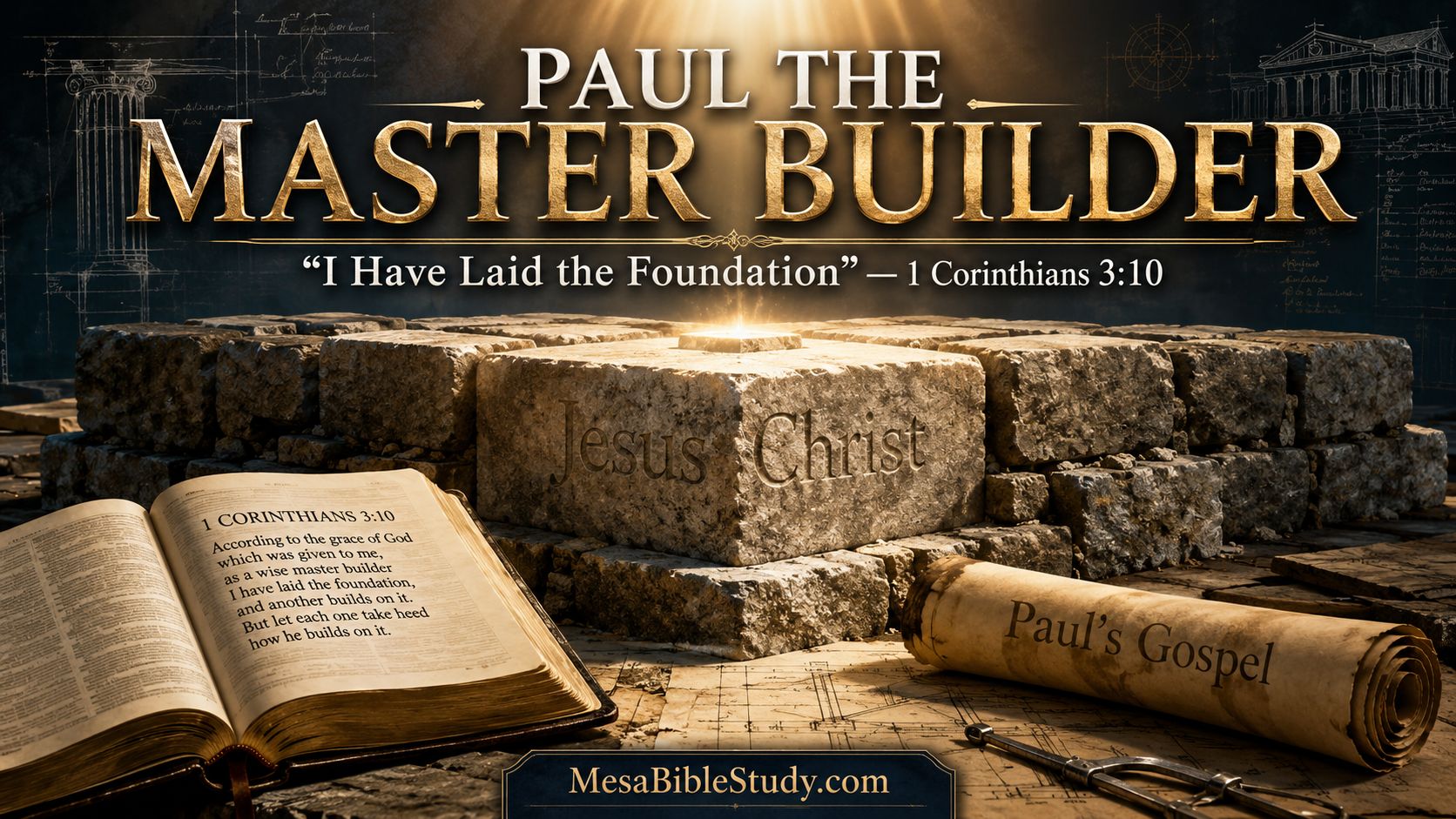
“According to the grace of God which was given to me, as a wise master builder I have laid the foundation, and another builds on it. But let each one take heed how he builds on it.”
— 1 Corinthians 3:10
Paul does not say he built on a foundation laid by Peter or the Twelve. He says, “I have laid the foundation.” This creates a serious challenge for any framework that places the beginning of the Body of Christ at Pentecost in Acts 2. Paul is telling the truth, Holy Spirit inspired of course: he is the wise master builder for the present dispensation.
A Necessary Clarification
All salvation—from Abel onward—rests on one Savior and one finished work: Christ’s death, shed blood, burial, and resurrection. This is not about two ways of salvation. It is about what God revealed, when He revealed it, and through whom. Paul was entrusted with the revelation of Christ according to the mystery—the doctrinal foundation for the Body of Christ.
This post is not about whether a person is saved based on when they believe the Body of Christ, the Church, began. Salvation has always been by grace through faith in the gospel, period. Rather, this post and the entire series aim to clearly demonstrate from Scripture the vital distinction between Peter’s ministry and audience and Paul’s ministry and audience. Mixing the two through “retroactive revelation” does violence to what God has so clearly revealed in His Word.
The result is confusion.
First and foremost, the gospel that saves today has been obscured.
This is why the battle has continued across Christendom for nearly 1,900 years: Is salvation received by believing the gospel plus works, ordinances, law-keeping, repentance as a work, water baptism, perseverance, confession, surrender, or religious performance? Or is salvation received by grace through faith alone in the finished work of Christ, apart from works?
That confusion did not come from Paul.
Paul is clear.
The confusion comes from mixing, blending, and flattening the distinct ministries of Peter and Paul. Once Peter’s kingdom message to Israel is merged with Paul’s gospel of grace to the Body of Christ, the gospel itself becomes blurred. Law and grace get mixed. Israel and the Church get mixed. Kingdom doctrine and Body doctrine get mixed. The result is division, uncertainty, and endless theological debate.
And if we do not get the gospel right — including when the gospel that saves today was revealed — then we will not get doctrine right either.
That matters because sound doctrine is not academic. It is how the believer learns to stand, walk, fight, and live according to God’s will in this present age.
Paul teaches that the believer does not fight for victory, hoping to attain it through effort, religion, or performance. The believer fights from victory, already complete in Christ, already accepted in the Beloved, already blessed with all spiritual blessings, already sealed by the Holy Spirit, and already seated with Christ in the heavenly places.
That is why Paul matters.
When Paul is blurred, the gospel is blurred.
When the gospel is blurred, assurance is weakened.
When assurance is weakened, the believer is left striving for what Christ has already accomplished.
But when Paul’s gospel is allowed to stand where God placed it, the believer sees clearly:
Christ has finished the work.
Grace is sufficient.
The victory is already ours in Him.
The Context in 1 Corinthians 1–3
The opening chapters of 1 Corinthians address divisions, worldly wisdom, and spiritual immaturity. The Corinthians were saying, “I am of Paul,” “I am of Apollos,” or “I am of Cephas” (1 Corinthians 1:12). Paul corrects the divisions while clarifying his unique role: others may water or build, but he laid the foundation. Not Apollos, Not Peter, but Paul laid the foundation for the Church which is His body, the body of Christ.
Knowing the timeline is crucial. Without understanding the progression of God’s revelation, it is impossible to make proper distinctions. Paul did not appear on the scene until around 37 AD, and he did not begin his ministry to the Gentiles until about 40 AD—bringing completely new revelations. This means it was approximately ten years after Pentecost before Paul received these truths that form the foundation for the Body of Christ, the Church today.
What most of Christendom has done for the past 1,900 years is exactly what Paul was correcting in 1 Corinthians chapter 1. Instead of recognizing Paul’s divinely commissioned foundational role for the Body of Christ, many continue to prioritize Peter’s ministry, effectively saying, “I am of Cephas.” They take Paul’s much later revelations and retroactively force them into Peter’s ministry—rebelling not only against the Holy Spirit but also against Peter’s own admonition in 2 Peter 3:14–16, which directs us to Paul’s letters for the truths pertaining to salvation in this present age.
‘Therefore, beloved, looking forward to these things, be diligent to be found by Him in peace, without spot and blameless; and consider that the longsuffering of our Lord is salvation—as also our beloved brother Paul, according to the wisdom given to him, has written to you, as also in all his epistles, speaking in them of these things, in which are some things hard to understand, which untaught and unstable people twist to their own destruction, as they do also the rest of the Scriptures.’
Paul emphasizes that Christ did not send him to baptize but to preach the gospel (1 Corinthians 1:17)—a clear distinction from Peter’s message in Acts 2:38. For Paul, the message of the cross is the power of God (1 Corinthians 1:18, Romans 1:16).
Hidden Wisdom and the Mystery
In chapter 2, Paul describes his message as “the wisdom of God in a mystery, the hidden wisdom which God ordained before the ages for our glory” (1 Corinthians 2:7). This aligns with Romans 16:25 and Colossians 1:26—the mystery kept secret since the world began but now revealed. This is the context for Paul’s Holy Spirit inspired claim in 3:10.
The Master Builder and the Foundation
The Greek word for “master builder” (architektōn) means architect or chief builder—the one who designs and lays the structural foundation. Paul says, “According to the grace of God which was given to me…” (echoing Ephesians 3:2–3), “I have laid the foundation.”
Paul does NOT say he is the foundation, he makes clear—the foundation is Jesus Christ (1 Corinthians 3:11), but specifically Jesus Christ according to the revelation of the mystery. Paul writes: “Now to Him who is able to establish you according to my gospel and the preaching of Jesus Christ, according to the revelation of the mystery kept secret since the world began” (Romans 16:25).
Peter preached Christ according to prophecy (Acts 3:21—“which God has spoken by the mouth of all His holy prophets since the world began”). Paul preaches Christ according to the mystery. The distinction is decisive.
Others Must Build Carefully
A clear warning to all. “And another builds on it. But let each one take heed how he builds on it” (1 Corinthians 3:10). Teachers, pastors, and churches today must build on Paul’s foundation. Mixing Law and grace, forcing Paul’s letters into the four gospels and the early chapters of Acts, or blending Peter’s kingdom message with Paul’s mystery creates an unstable building.
Why This Matters
The Body of Christ is the “one new man” (Ephesians 2:15–16), the church over which Christ is Head (Ephesians 1:22–23), made up of Jews and Gentiles as fellow heirs (Ephesians 3:6). This truth was revealed to Paul alone and dispensened through Paul alone.
No other apostle claims what Paul does: “my gospel” (Romans 2:16; 16:25), the dispensation given to him (Ephesians 3:2), or laying the foundation as master builder. Even Peter later acknowledged the wisdom given to Paul and admonished readers to go to Paul for things about salvation. And warned that his epistles contain things hard to understand which the untaught twist (2 Peter 3:15–16).
The Problem With Ignoring Paul’s Foundation
To repeat because it is important. Ignoring this leads to confusion: the Church under Israel’s program, the Sermon on the Mount as Church doctrine, water baptism mixed with Paul’s gospel, and Law blended with grace. Paul’s warning stands: “Let each one take heed how he builds on it.”
Final Summary
1 Corinthians 3:10 is monumental.
Paul says that, according to the grace of God given to him, he laid the foundation as a wise master builder. He does not say he built on Peter’s foundation. He does not say the Twelve laid the foundation for the Body of Christ. He says plainly:
“I have laid the foundation.”
That foundation is Jesus Christ — not another Christ, not another Savior, but Jesus Christ according to the mystery revealed to Paul and dispensed through his apostleship.
Peter had a genuine, God-ordained ministry to Israel. The Twelve had a real commission. Israel has real promises that will be fulfilled in God’s appointed time.
But Paul was given the foundational revelation for the Body of Christ.
That is why 1 Corinthians 3:10 matters.
And that is why retroactive revelation fails.
Explore the Series
← Previous | 📖 Series Home | Next →