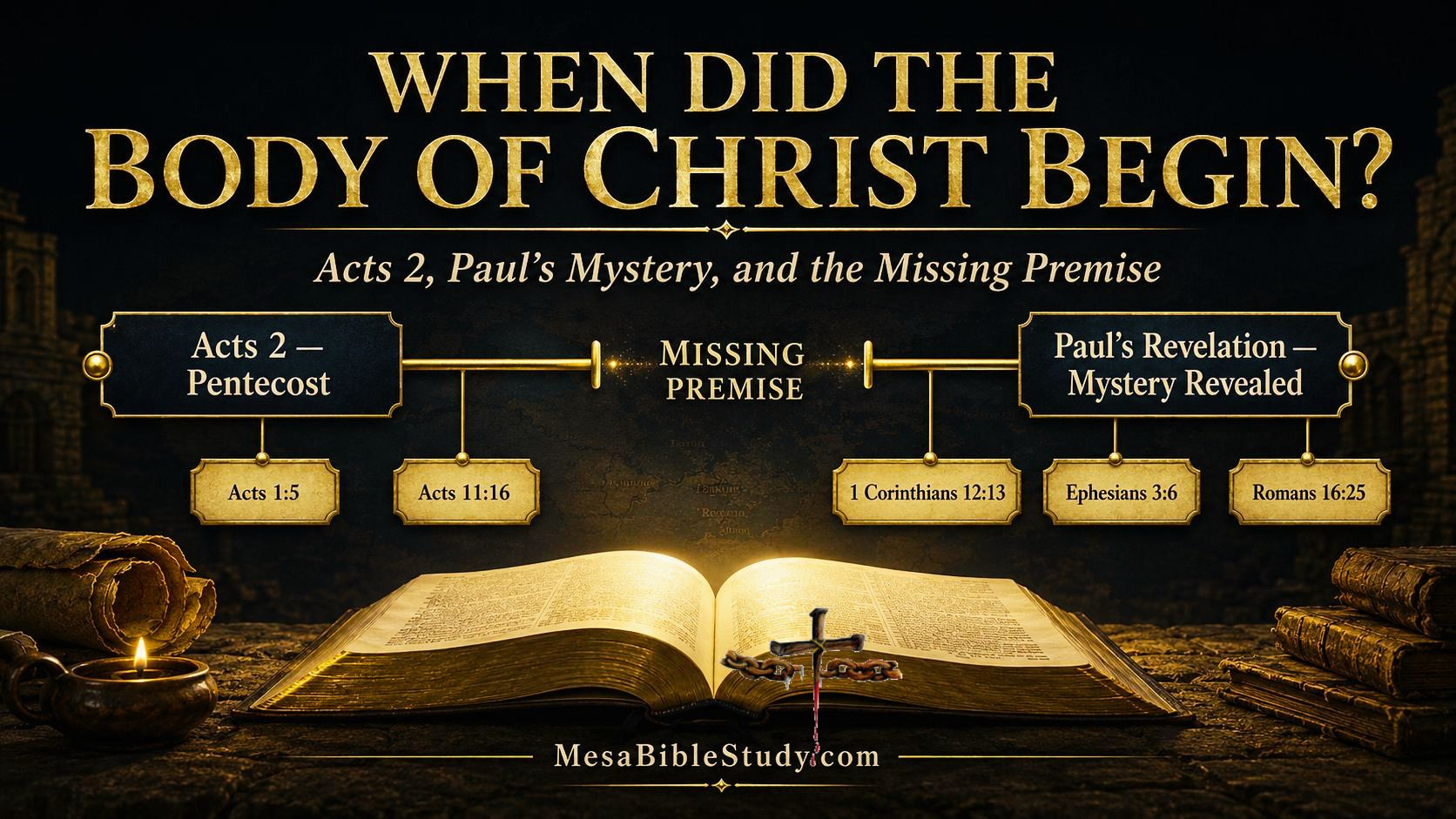
Was the Body of Christ Revealed Before Paul?
There’s a question that sounds simple until you actually try to answer it from Scripture instead of from tradition:
Did God reveal the gospel of grace, the one Body, Jew–Gentile equality, and salvation by grace through faith alone apart from the Law — before Paul, or through Paul?
Ask this to most pastors, scholars, or seminary professors, and you won’t get a yes or no. You’ll get a lecture on covenant continuity, or a reminder that “salvation has always been by faith,” or the assertion that Pentecost was “the birthday of the Church” — followed by nothing that actually engages the question. That evasiveness is itself worth noticing. The question has a textual answer. Most people just don’t want to say it out loud, because saying it exposes a contradiction sitting at the foundation of how Acts 2 gets taught.
The Standard Acts – 2 Claim
Evangelical Christendom broadly teaches that the Church — the Body of Christ, in which “there is neither Jew nor Greek” (Galatians 3:28) — began on the Day of Pentecost in Acts 2. The argument usually runs through three texts:
- Acts 1:5 — Jesus tells the apostles they will be “baptized with the Holy Ghost not many days hence.”
- Acts 11:16 — Peter later recalls that promise after the Holy Spirit falls on Cornelius’s household.
- 1 Corinthians 12:13 — “For by one Spirit are we all baptized into one body.”
The reasoning: Spirit baptism equals incorporation into the Body. Spirit baptism began at Pentecost. Therefore the Body began at Pentecost. Whatever Paul reveals later about the Body’s nature is treated as clarification of something already in motion since Acts 2 — not the introduction of something new.
The Problem: The Key Connection Is Assumed, Not Proven
Here is the pressure point the whole argument rests on, and it rarely gets examined:
Acts 1:5 and Acts 11:16 say “baptized with the Holy Ghost.” First Corinthians 12:13 says “baptized into one Body.” Those are not automatically the same statement.
Go back and read Acts 2, Acts 10, and Acts 11 on their own terms, without importing Paul’s later vocabulary into them:
- Nowhere in Acts 2 does Peter explain the formation of the Body of Christ. He explains Pentecost in light of the prophet Joel — a fulfillment of what Israel had already been promised.
- Nowhere in Acts 10–11 does Peter announce a mystery hidden in God. He defends the fact that God has extended repentance to Gentiles.
- The Jerusalem church’s own summary of the event, in Acts 11:18, is: “Then hath God also to the Gentiles granted repentance unto life.” That is not the language of Ephesians 2 — “one new man,” “fellow heirs,” “of the same body.” It’s the language of extended access to existing promises, not the creation of a new, undifferentiated entity in which the old categories are abolished.
Nowhere in Acts 1, 2, 10, or 11 do you find body-of-Christ language, one-new-man language, or mystery language. That vocabulary belongs to Paul, and Paul is explicit about where it came from.
Paul’s Own Testimony About the Mystery
This isn’t a matter of interpretation. Paul states it directly, repeatedly, in his own words:
“The gospel which was preached of me is not after man. For I neither received it of man, neither was I taught it, but by the revelation of Jesus Christ.” — Galatians 1:11–12
“How that by revelation he made known unto me the mystery… which in other ages was not made known unto the sons of men.”
— Ephesians 3:3, 5
“The mystery which hath been hid from ages and generations, but now is made manifest to his saints.” — Colossians 1:26
‘Now to Him who is able to establish you according to my gospel and the preaching of Jesus Christ, according to the revelation of the mystery kept secret since the world began ‘
— Romans 16:25
That is not soft language. It doesn’t say the implications were hidden while the reality already existed. It says the mystery itself was hidden in God, kept secret since the world began, not made known, and only then revealed — to Paul, by direct revelation, not by instruction from the other apostles.
If the Mystery was Hidden, the Body of Christ Cannot Be Read Backwards into Acts
Here is where the standard position runs into a contradiction it never actually resolves:
A system cannot say, “Yes, the mystery was genuinely unrevealed until Paul,” and then still place the Body it defines before that revelation — unless Scripture itself says the reality existed before its unveiling.
It doesn’t. Nowhere does Scripture say:
- The Body of Christ began in Acts 2.
- Pentecost created the one new man.
- Peter revealed the mystery.
- The mechanism of the Body was functioning before the mystery was made known.
Every one of those is a theological conclusion imposed on the text, not a statement the text makes. The actual chain holding the Acts-2 position together is an inference: Acts 1:5 → Acts 11:16 → 1 Corinthians 12:13, treated as one continuous, unbroken operation across two different authors, two different audiences, and two different vocabularies. That chain is a theological construction. It is not proof.
Galatians 2, Acts 15, and Acts 11 Confirm the Distinction
If Peter and Paul were proclaiming the identical message from the start, two things in Scripture become very hard to explain:
Galatians 2:7–9. The Jerusalem pillars — Peter, James, and John — don’t correct Paul’s gospel or fold it into their own. They recognize it as distinct and give him the right hand of fellowship on that basis: “the gospel of the uncircumcision was committed unto me, as the gospel of the circumcision was unto Peter.” Two named, distinct commissions, acknowledged in writing by the apostles themselves.
Acts 15. If Jew-Gentile equality in one Body, apart from the Law, was already settled doctrine since Pentecost, the Jerusalem council has no reason to exist. But the council doesn’t land on “there is neither Jew nor Greek.” It lands on a modified list of restrictions for Gentile believers — abstain from idol meat, fornication, strangled things, and blood (Acts 15:20). That’s an accommodation within an ongoing distinction, not the “one new man” of Ephesians 2:14–15.
And Acts 11:19 — written well after Pentecost — records believers scattered by persecution “preaching the word to none but unto the Jews only.” It’s crucial to note they are preaching from the Old Testament. That’s not what you’d expect to find if the mystery had already been revealed and was already operative since Acts 2.
The Question Acts-2 Theology Still Has Not Answered
Where is the verse that says the Body of Christ existed before the revelation of the Body of Christ was given?
Where is the verse that says Jew-Gentile equality in one Body was true before God revealed it?
Where is the verse that says what was “hidden in God” was already operating publicly at Pentecost?
There isn’t one. What exists instead is an inference chain, asserted with enough confidence and repeated often enough that it now passes for settled fact. But repetition isn’t exegesis, and a system can be old, widely held, and still wrong.
Paul’s own testimony is not ambiguous:
Hidden. Not made known. Kept secret. Then revealed.
That sequence, taken at face value (by faith), is the answer.
Continue the Retroactive Revelation Series
If this study helped clarify the missing premise behind Acts-2 theology, continue with the full Retroactive Revelation Series.
Start here:
The One Question No Acts-2 Theologian Can Answer
Related study:
Why Acts 2 Cannot Be the Beginning of the Body of Christ
Series hub:
Retroactive Revelation — Why Reading Paul Backward Into Scripture Fails