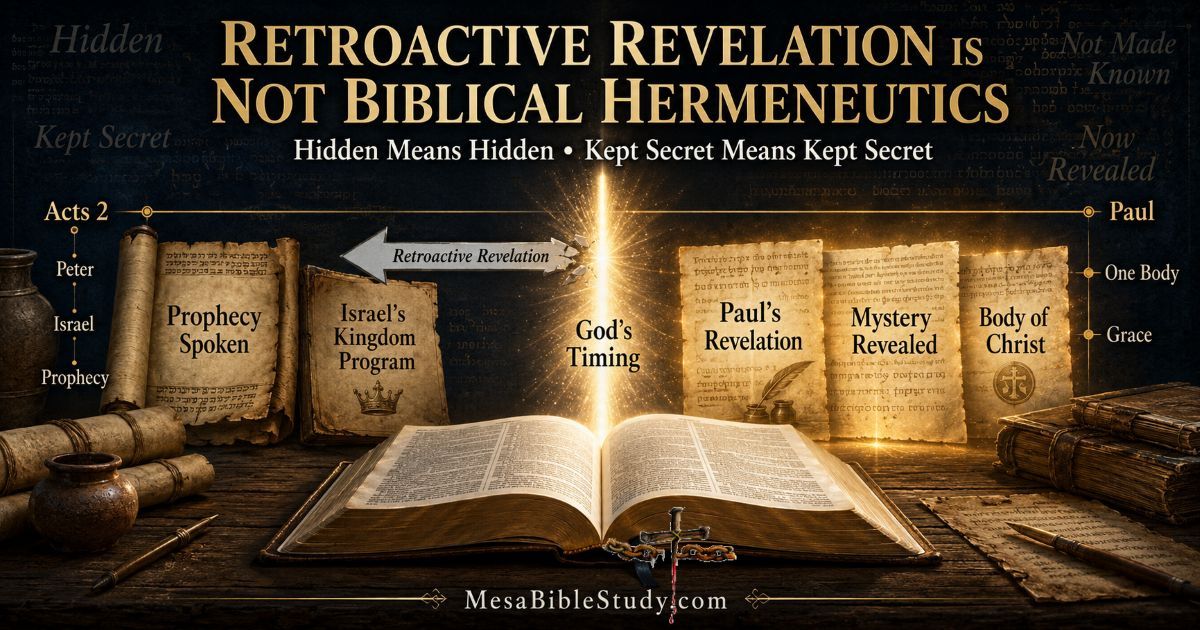
Why reading Paul backward into earlier Scripture undermines the very timeline God revealed
There is a way of reading Scripture that sounds scholarly, balanced, and traditional—but it creates deep confusion.
It goes something like this:
“Yes, Paul received clearer revelation, but the same truth was already present before him.”
That sounds reasonable at first. But the problem is simple: Paul says the mystery was not made known.
He does not say it was unclear.
He does not say it was dimly understood.
He does not say it was hidden in plain sight.
He says it was:
- hidden
- kept secret
- not made known
- revealed to him
- given to him
- committed to him
That means we cannot take what Christ later revealed through Paul and force it backward into Matthew, Acts 2, Peter’s ministry, Israel’s covenants, or the Old Testament prophets.
That is not sound Bible study.
That is not rightly dividing the Word.
That is retroactive revelation—and it is not a biblical hermeneutic.
A Necessary Clarification
Before going further, let this be stated clearly:
All salvation—from Abel to the end of time—is only possible because of the finished work of Jesus Christ:
His death, His shed blood, His burial, and His resurrection (1 Corinthians 15:1-4).
There is one Savior.
There is one cross.
There is one basis of salvation.
This study is not about two Saviors or two ultimate bases of redemption. It is about what God revealed, when He revealed it, and through whom He revealed it.
The issue is not whether Christ’s cross saves every redeemed soul. It does.
The issue is whether the full doctrinal revelation of the gospel of grace, the Body of Christ, Jew–Gentile equality, and the mystery was known before Paul.
Paul says it was not.
What Is Retroactive Revelation?
Retroactive revelation is the practice of taking truth revealed later in Scripture and reading it backward into earlier passages as if those earlier audiences already knew it.
For example, retroactive revelation says:
- Peter was preaching Paul’s gospel in Acts 2.
- The Body of Christ began at Pentecost.
- The mystery was already present before Paul.
- Old Testament saints understood Christ’s death, burial, and resurrection as Paul later defines it.
- Matthew, Acts 2, and Paul all present the same revealed message.
But this approach ignores one essential fact: God reveals truth in time.
The Bible is not a flat document where every doctrine is fully revealed from Genesis onward. Scripture is a progressive revelation. And Paul’s own letters insist that certain truths were deliberately hidden until the appointed time.
Why Revelation Timing Matters
No serious Bible student denies progressive revelation.
Abraham did not have Moses’ Law.
Moses did not have David’s covenant.
David did not have Isaiah’s full prophetic vision.
The prophets did not have Paul’s revelation of the mystery.
God revealed truth progressively. That means timing matters.
When we ask what someone believed, preached, or understood, we must ask:
- What had God revealed at that point?
- What had God not yet revealed?
- Who was being addressed?
- What program was in view?
- What message was being proclaimed?
Ignoring those questions produces confusion.
Paul Says the Mystery Was Hidden
Paul writes:
“Now to Him who is able to establish you according to my gospel and the preaching of Jesus Christ, according to the revelation of the mystery kept secret since the world began.”
— Romans 16:25
That verse alone creates a serious problem for retroactive revelation.
Paul’s gospel involves the preaching of Jesus Christ according to the revelation of the mystery. And that mystery was kept secret since the world began.
Not spoken since the world began.
Not partially revealed since the world began.
Not hidden in plain sight since the world began.
Kept secret.
That must be allowed to mean what it says.
Paul Says the Mystery Was Not Made Known
Paul writes again:
“which in other ages was not made known to the sons of men, as it has now been revealed by the Spirit to His holy apostles and prophets.”
— Ephesians 3:5
This verse does not say the mystery was poorly understood.
It does not say the mystery was present but undeveloped.
It says the mystery was not made known.
That is a direct statement about revelation timing. If something was not made known, then it cannot be preached, believed, or understood as revealed doctrine in earlier ages.
Retroactive revelation forces the verse to mean the opposite of what it says.
Paul Says the Mystery Was Hidden in God
Paul continues:
“and to make all see what is the fellowship of the mystery, which from the beginning of the ages has been hidden in God…”
— Ephesians 3:9
This is even more precise.
Paul does not say the mystery was hidden in the Old Testament.
He does not say it was hidden in prophecy.
He does not say it was hidden in types and shadows waiting for someone to decode it.
He says it was “hidden in God.”
That means the mystery was not available for discovery through earlier revelation. It was not concealed in prophetic language for later theologians to uncover. It was hidden in God until God chose to reveal it.
That destroys retroactive interpretation.
Paul Says the Mystery Was Hidden From Ages and Generations
Paul writes:
“the mystery which has been hidden from ages and from generations, but now has been revealed to His saints.”
— Colossians 1:26
Again the sequence is clear:
- hidden from ages
- hidden from generations
- now revealed
That is chronology.
That is timing.
That is progressive revelation.
Retroactive revelation reverses Paul’s order and says:
- it was already there
- it was already known
- it was already operating
- Paul merely clarified it
But Paul says: hidden → now revealed.
Those are not the same.
Peter Preached What Was Spoken Since the World Began
This contrast is one of the clearest in Scripture.
Peter says in Acts 3:
“whom heaven must receive until the times of restoration of all things, which God has spoken by the mouth of all His holy prophets since the world began.”
— Acts 3:21
Peter’s message concerns what God had spoken by the prophets since the world began.
Paul’s message concerns what God had kept secret since the world began.
Peter: spoken since the world began.
Paul: kept secret since the world began.
Those are not the same category.
Peter’s ministry in Acts 3 is prophecy.
Paul’s revelation is mystery.
If we collapse those categories, we erase one of the clearest distinctions in the New Testament.
Retroactive Revelation Turns “Hidden” Into “Known”
This is the central problem.
Retroactive revelation takes Paul’s words and changes their function.
Paul says: hidden
Retroactive revelation says: known, but unclear
Paul says: not made known
Retroactive revelation says: partially made known
Paul says: kept secret
Retroactive revelation says: present in seed form
Paul says: revealed to me
Retroactive revelation says: already preached by Peter
That is not interpretation.
That is contradiction.
The issue is not whether someone can create a theological explanation for it. The issue is whether that explanation allows Paul’s words to retain their plain meaning.
Retroactive Revelation Confuses Peter’s Message
When Paul is read backward into Peter, Peter’s message gets distorted.
Peter preached Jesus as Israel’s Messiah:
“Therefore let all the house of Israel know assuredly that God has made this Jesus, whom you crucified, both Lord and Christ.”
— Acts 2:36
Peter called Israel to repentance in connection with promised restoration:
“Repent therefore and be converted… that He may send Jesus Christ.”
— Acts 3:19–20
Peter preached what the prophets had spoken:
“spoken by the mouth of all His holy prophets since the world began.”
— Acts 3:21
But retroactive revelation turns Peter into Paul before Paul is even raised up.
It makes Peter preach what Peter never says.
It makes Acts 2 teach what Acts 2 never states.
It makes Pentecost the beginning of a Body Peter never defines.
That is not respecting Peter.
It is rewriting him.
Retroactive Revelation Confuses Paul’s Message
The same error also distorts Paul.
Paul becomes merely an explainer of what was already known. His repeated phrases lose their force:
Personally, I have had conversations with many Pastors and theologians that believe just this, that Paul comes on the scene to explain to the body of Christ, the Lord’s earthly ministry and the early chapters of Acts. Horror’s!
- my gospel
- given to me
- revealed to me
- the dispensation given to me
- the mystery hidden in God
- I laid the foundation
If Peter already preached Paul’s gospel, why does Paul say he received it by revelation?
If the Body began at Pentecost, why does Paul define it as the mystery not made known in other ages?
If the foundation was laid in Acts 2, why does Paul say,
“as a wise master builder I have laid the foundation”?
— 1 Corinthians 3:10
Retroactive revelation does not magnify Paul’s ministry.
It diminishes it.
It turns Paul’s exclusive claims into exaggerations.
The Greatest Tragedy: Retroactive Revelation Obscures the Gospel
This is not an academic issue only. It affects the clarity of the gospel today.
When Paul is mixed with Peter, many begin to mix:
- faith and works
- grace and Law
- water baptism and salvation
- kingdom commandments and Body doctrine
- Israel’s covenants and the Church’s standing
- discipleship demands and the gospel of grace
The result is confusion.
Most of Christendom says salvation is by grace through faith in the death, burial, and resurrection of Christ — Paul’s gospel as defined in 1 Corinthians 15:1–4 and explained in Ephesians 2:8–9 — but then adds conditions that belong to another context: water baptism, law-keeping, perseverance, confession, surrender, or religious performance.
That is what happens when Peter and Paul are blended.
Peter’s kingdom message to Israel and Paul’s gospel of grace to the Body of Christ cannot be mixed into one saving message for today. Once they are mixed, the gospel is no longer clear. Grace is no longer grace. Faith is no longer faith. The finished work of Christ is no longer treated as sufficient.
That is the single greatest tragedy of retroactive revelation.
It does not merely confuse doctrine. It obscures the gospel that saves today.
You cannot mix Peter and Paul for salvation. It is impossible. Peter preached a real, God-given kingdom message to Israel. Paul preached the gospel of grace revealed to him by the risen Christ for this present age. When those messages are flattened into one, the result is not clarity but confusion — and eternal consequences are at stake.
Peter himself makes this point near the end of his ministry. When speaking of the longsuffering of the Lord and salvation, Peter does not point his readers back to his sermon at Pentecost as the final doctrinal explanation. He does not send them back to Acts 2. He points them to Paul’s writings:
“Therefore, beloved, looking forward to these things, be diligent to be found by Him in peace, without spot and blameless; and consider that the longsuffering of our Lord is salvation—as also our beloved brother Paul, according to the wisdom given to him, has written to you, as also in all his epistles, speaking in them of these things, in which are some things hard to understand, which untaught and unstable people twist to their own destruction, as they do also the rest of the Scriptures.”
That passage should stop every Bible student in their tracks.
Peter says the longsuffering of the Lord is salvation — and then directs his readers to Paul, according to the wisdom given to him. Peter does not erase Paul’s distinct ministry. He confirms it. He warns that Paul’s writings can be twisted by the untaught and unstable, and he says they do so to their own destruction.
That is exactly what retroactive revelation does.
It twists Paul by forcing his gospel, his mystery, and his doctrine for the Body of Christ backward into Peter’s ministry, Acts 2, and Israel’s prophetic program.
For salvation today, we must go where Peter points us.
We must go to Paul’s epistles.
That is where the gospel of grace is defined, explained, defended, and established for the Body of Christ.
For salvation today, Peter points us to Paul — and Paul points us to Christ’s finished work.
Sadly, most of Christendom are told they are not under Law, but then they are placed under kingdom instructions.
They are told Paul’s gospel saves, but then Peter’s Pentecost message is treated as the same commission.
That confusion is everywhere in Christendom. And much of it begins with reading Paul backward into Scripture where his revelation had not yet been given.
All Scripture Is For Us — But Not All Scripture Is To Us
This distinction is essential.
To reject retroactive revelation is not to reject the Gospels.
It is not to ignore Peter.
It is not to throw away Hebrews, James, or Revelation.
All Scripture is inspired.
All Scripture is profitable.
Paul writes:
“All Scripture is given by inspiration of God, and is profitable for doctrine, for reproof, for correction, for instruction in righteousness.”
— 2 Timothy 3:16
But profitable does not mean directly addressed to the same audience under the same program.
Genesis is profitable.
Leviticus is profitable.
Matthew is profitable.
Acts is profitable.
James is profitable.
Revelation is profitable.
Paul writes:
‘For whatever things were written before were written for our learning, that we through the patience and comfort of the Scriptures might have hope.’
Romans 15:4
“Things that were written before…,”.
Before what? Before what was revealed to the apostle of the Gentiles, Paul. What came before Paul, is for our learning, and must be studied no different than Paul’s epistles.
But we do not flatten all Scripture into the same instruction for the same people at the same time.
We read every passage in context. We ask:
- Who is speaking?
- To whom?
- Under what circumstances?
- Under what program?
- Before or after Paul’s revelation?
That is not rejecting Scripture.
That is honoring Scripture.
Right Division Protects the Whole Bible
Rightly dividing the Word does not divide the Bible into pieces that no longer matter. It preserves the Bible’s order.
It protects:
- Israel’s promises
- the Church’s identity
- Peter’s ministry
- Paul’s apostleship
- the kingdom program
- the mystery program
- prophecy
- grace
When distinctions are honored, Scripture becomes clearer, not smaller.
The Gospels shine as the record of Israel’s King among His people.
Acts is the record of transition.
Paul’s letters become the doctrinal foundation for the Body of Christ.
Hebrews through Revelation retain their prophetic and Jewish context.
Israel remains Israel.
The Body remains the Body.
Prophecy remains prophecy.
Mystery remains mystery.
That is clarity.
The Question Retroactive Revelation Cannot Answer
The question remains the same:
Did God reveal the mystery before Paul—or through Paul?
If before Paul, then where?
Where was the one Body preached?
Where was Jew–Gentile equality revealed?
Where was the abolition of the middle wall proclaimed?
Where was Christ preached according to the mystery?
Where was the gospel of grace defined as Paul defines it?
Where was the dispensation of grace announced before Paul?
Not inferred.
Not assumed.
Not read backward.
Where is it plainly revealed?
Paul says it was not.
That should settle the matter.
Final Summary
Retroactive revelation is not a biblical hermeneutic because it reverses the order of revelation.
It takes truth God revealed later and forces it backward into places where God had not yet revealed it.
It makes hidden mean known.
It makes kept secret mean partially revealed.
It makes not made known mean already operating.
It makes Paul’s revelation merely explanatory instead of truly revelatory.
But Scripture is clear.
Peter preached what was spoken since the world began.
Paul preached what was kept secret since the world began.
Peter preached Christ according to prophecy.
Paul preached Christ according to the mystery.
Peter ministered to the circumcision.
Paul was sent to the Gentiles.
Peter proclaimed Israel’s Messiah.
Paul revealed the Body of Christ.
This is not division for division’s sake.
It is the only way to let every passage stand where God placed it.
Retroactive revelation fails because it refuses to let revelation unfold in time.
But when Scripture is read in-time, the confusion disappears.
The Bible becomes clear.
Paul’s apostleship is honored.
Israel’s promises are preserved.
The Body of Christ is rightly understood.
And Christ is magnified according to the revelation God gave in its proper time.
‘“The secret things belong to the Lord our God, but those things which are revealed belong to us and to our children forever, that we may do all the words of this law.’
Deuteronomy 29:29
Continue the Retroactive Revelation Series
Retroactive revelation fails because it reverses the order of revelation God gave.
If this study helped clarify why Paul cannot be read backward into Acts 2, continue with the full Retroactive Revelation Series.
Previous Study:
“My Gospel”: Paul’s Exclusive Claims and Why They Matter
Related Study:
When Did the Body of Christ Begin? “The Missing Premise”
Start the Series:
The One Question No Acts-2 Theologian Can Answer
Back to Series Hub:
Retroactive Revelation — Why Reading Paul Backward Into Scripture Fails