by Jamie Pantastico | Oct 7, 2025 | Israel and Bible Prophecy |
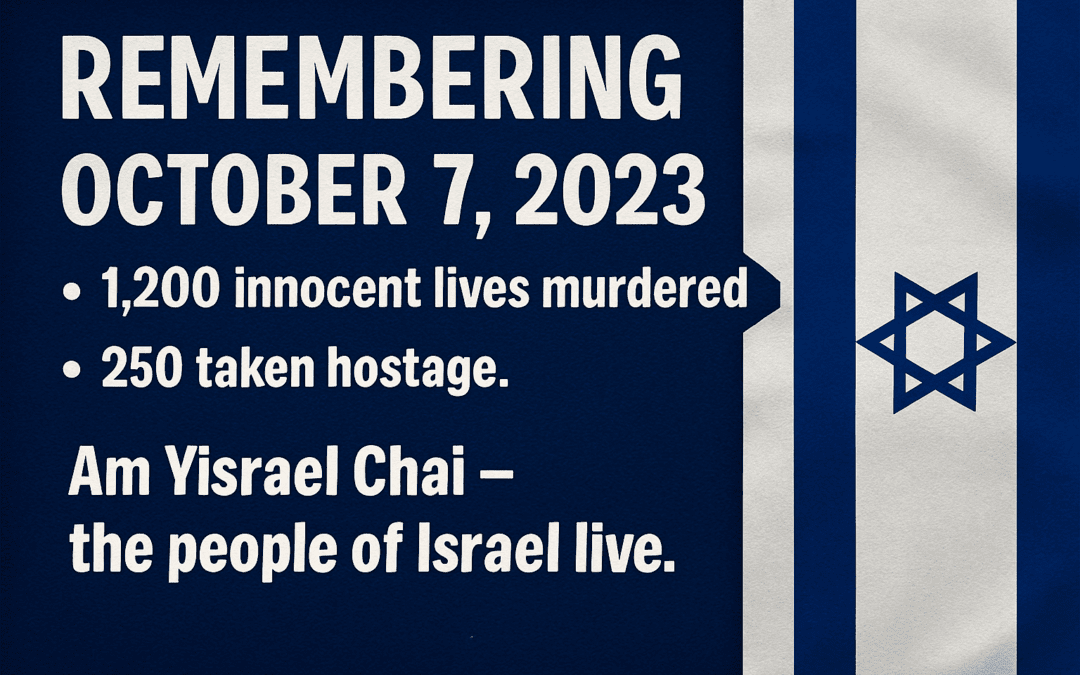
Remembering October 7, 2023
Two years ago today, on October 7, 2023, the world was shaken by horrific evil. In one day of terror, 1,200 innocent lives were brutally murdered. Another 250 men, women, families, and even babies were taken hostage — many of whom tragically died in captivity.
The pain of that day remains fresh, not only for Israel but for all who stand with God’s covenant people. Yet even in the face of unspeakable savagery and evil, the Jewish people have shown what history has always proven true: unyielding courage and resilience.
As believers, we cannot look away. Scripture tells us to “pray for the peace of Jerusalem” (Psalm 122:6), and to weep with those who weep (Romans 12:15). Today, we remember the fallen, and we lift up our voices in prayer for:
- The safe return of every hostage still in captivity.
- The comfort of families still grieving unimaginable loss.
- The protection and peace of the nation of Israel.
God’s covenant with Israel remains unbroken, and His promises stand forever (Genesis 12:1–3; Romans 11:1–2, 29). One day, true and lasting peace will come—not through the hands of men, but through the Prince of Peace, the Lord Jesus Christ.
Am Yisrael Chai — the people of Israel live.
by Jamie Pantastico | Oct 7, 2025 | Devotionals |
Devotional: Our Starting Line Is Victory
Ephesians 2:4–6 – “But God, who is rich in mercy, because of His great love with which He loved us, even when we were dead in trespasses, made us alive together with Christ (by grace you have been saved), and raised us up together, and made us sit together in the heavenly places in Christ Jesus.”
Context & Connection
The Christian walk is not without battles. In fact, it’s often a life of constant conflict—against our flesh, the world, and spiritual forces of darkness. But the apostle Paul anchors us in a truth far greater than our struggles: our position in Christ. From the moment we believed the gospel, God placed us in a position of victory.
We don’t fight for victory—we fight from it
Phrase by Phrase Breakdown
- “But God, who is rich in mercy” – Our story doesn’t begin with our sin, it begins with His mercy. His love moved toward us when we were dead and helpless.
- “made us alive together with Christ” – Salvation is not self-improvement; it’s resurrection life. We are a new creation in Christ (2 Corinthians 5:17).
- “raised us up together” – Just as Christ rose from the dead, so we are raised with Him. His victory is our victory.
- “made us sit together in the heavenly places” – This is not future tense but present reality. Right now, we are seated with Christ, secure in His triumph.
Devotional Insight
When trials come—and they will—it’s natural to wonder, “Where is God in all of this?” In our flesh, it doesn’t feel normal to rejoice when life is hard. But our identity isn’t in the flesh. We are new creations in Christ.
This means our starting line is victory. We don’t fight for victory—we fight from it. The resurrection power of Christ secures our place, even in the storm. And by the Holy Spirit, we can rejoice with unshakable confidence that in all these things—not apart from them, but in the very midst of them—we are more than conquerors through Him who loved us (Romans 8:37).
Encouragement for Today
You may be walking through a storm, or one may be just over the horizon. Remember this truth: your position is already secured. You are alive in Christ, raised with Him, and seated in heavenly places. That means your starting line is victory.
📖 Reading Plan:
- Romans 8:37 – In all these things we are more than conquerors.
- 2 Corinthians 5:17 – If anyone is in Christ, he is a new creation.
- John 16:33 – In the world you will have tribulation, but Christ has overcome the world

by Jamie Pantastico | Oct 5, 2025 | Verse-by-Verse Bible Studies |
The Only Thing You Must Believe
Every Sunday we refocus on the gospel—the one message that saves. Today, let’s look at what God actually says a person must believe to be saved… and contrast that with what men have added.
Why We Need Salvation
All of humanity is under sin’s power. We die physically because of sin, but spiritually, we are dead and separated from God. (Genesis 2:17; Ezekiel 18:4; Isaiah 59:2)
Because of that, every human being is eternally lost apart from Christ.
God declares all mankind sinners (Romans 3:23), and the wages of sin is death (Romans 6:23).
But God…
He sent His only Son, Jesus Christ, to die in our place, shedding His blood to pay for our sins. He was buried and rose again—never to die again. (1 Corinthians 15:1–4)
What Must You Believe to Be Saved?
From your How to Get Saved page:
- Believe that you’re a sinner.
- Believe by faith that God sent His Son, Jesus, to die in your place, was buried, and rose again.
That’s it. That’s all.
“By grace you have been saved through faith, and that not of yourselves; it is the gift of God, not of works, lest anyone should boast.” — Ephesians 2:8–9
“If you confess with your mouth the Lord Jesus and believe in your heart that God has raised Him from the dead, you will be saved.” — Romans 10:9
“With the heart one believes unto righteousness, and with the mouth confession is made unto salvation.” — Romans 10:10
The moment someone truly believes that gospel—they are saved. Instantly. Sealed by the Holy Spirit. Indwelt. Made a member of Christ’s Body. Blessed with every spiritual blessing in the heavens.
What God Doesn’t Require (Though Many Claim He Does)
Notice carefully: nowhere in those clear passages does God say you must repent, be baptized, live a holy life, perform good works, or keep commandments in order to be saved. Those things are fruits and results—but not conditions for being saved.
Men have added those burdens to the good news, twisting the simplicity of the gospel into a checklist. That’s not God’s design.
The End of All Human Hope
There is only one gospel that saves. It is the gospel of the grace of God—Jesus died, was buried, and rose again, and salvation is received by faith alone (1 Corinthians 15:1–4).
And here’s the ultimate point:
📖 “In the day when God shall judge the secrets of men by Jesus Christ according to my gospel.” — Romans 2:16
From Cain until the last human being, all mankind will be judged according to Paul’s gospel.
So today, believe—not in your works, not in your effort, not in religion—but in Jesus Christ and the gospel “Good News” He freely gave.
by Jamie Pantastico | Oct 4, 2025 | Devotionals |
It is because of our faith in the finished work of the cross we overcome the world.
“For whatever is born of God overcomes the world. And this is the victory that has overcome the world—our faith.”
—1 John 5:4
Born from Above
The apostle John reminds us that the believer’s identity begins with new birth. To be “born of God” is to receive life from Him through faith in Christ (John 3:3). This new life gives us the ability to resist the pull of the world and its systems, which stand opposed to God.
Overcoming the World
The word “overcome” comes from the Greek nikao, meaning to conquer or prevail. The believer’s victory is not through strength of will, wealth, or influence—but through spiritual life in Christ. By His Spirit within us, we are no longer enslaved to sin, fear, or the world’s values.
The Victory of Faith
John makes it plain: “This is the victory… our faith.” Faith is the channel through which God’s power flows. Faith lays hold of Christ’s finished work on the cross and the reality of His resurrection. It doesn’t deny hardship but trusts God in the midst of it, knowing that Christ has already overcome the world (John 16:33).
‘These things I have spoken to you, that in Me you may have peace. In the world you will have tribulation; but be of good cheer, I have overcome the world.”’
John 16:33
Encouragement for Today
You may feel overwhelmed by the trials of life, but in Christ you are already an overcomer. Your victory is not about what you see or feel—it’s rooted in your faith in Him. When doubts arise, remember: your faith connects you to the One who has already conquered sin, death, and the world.
Walk in that victory today.
📖 Reading Plan:
- John 16:33 – Christ has overcome the world.
- Romans 8:37 – We are more than conquerors through Him.
- Revelation 12:11 – Believers overcome by the blood of the Lamb and the word of their testimony.

by Jamie Pantastico | Oct 4, 2025 | Israel and Bible Prophecy |
📖 8 Part Series: Why Israel Matters — God’s Chosen People in Scripture, Prophecy, and Eternity
Introduction
Why is it so difficult for pastors and theologians to answer a simple question? Why are the Jews the chosen people? Too often, the word “chosen” is blurred into something vague. Some say it is applied to many groups in Scripture and therefore hard to define. But God’s Word is not unclear. The Bible gives a direct answer: Israel is chosen because God Himself created a new race of people for Himself, beginning with Abraham and Sarah, and set them apart from all other nations of the world.
Two Types of “Chosen”
Before going further, we need to clarify the word chosen.
- God’s chosen people (Israel): A new nation created by God through Abraham and Sarah, separated from the Gentile world to be His covenant people.
- The chosen in Christ (the Church): Believers in this present age of grace, chosen before the foundation of the world (Ephesians 1:4) to be holy and blameless in Him.
Same God. Same love for all mankind. But a clear distinction in purpose and calling. Confusing these truths is at the heart of much false teaching in Christendom.
God Created and Separated Israel
When God called Abraham in Genesis 12, He was not merely selecting a man; He was creating a people set apart for Himself.
Genesis 12:1–3
“Now the Lord had said to Abram: ‘Get out of your country, from your family and from your father’s house, to a land that I will show you.
I will make you a great nation; I will bless you and make your name great; and you shall be a blessing.
I will bless those who bless you, and I will curse him who curses you; and in you all the families of the earth shall be blessed.’”
From the very beginning, Israel’s identity was defined by separation. God separated Abraham from his land, family, and pagan surroundings. This pattern of separation continues throughout the Old Testament as Israel is commanded to remain distinct from Gentile nations (Leviticus 20:26; Deuteronomy 7:6).
Even Paul later points back to this truth:
Ephesians 2:11–13
“Therefore remember that you, once Gentiles in the flesh—who are called Uncircumcision by what is called the Circumcision made in the flesh by hands—
that at that time you were without Christ, being aliens from the commonwealth of Israel and strangers from the covenants of promise, having no hope and without God in the world.
But now in Christ Jesus you who once were far off have been brought near by the blood of Christ.”
For centuries, Israel was separated from the Gentile world by God’s command. Only through Paul’s revelation of the mystery do we learn that, in Christ, the dividing wall has been broken down.
Why Did God Choose Israel?
The Bible answers directly:
- Not because of Israel’s greatness.
- Not because of their strength.
- But because of God’s love and His covenant promise to Abraham.
Deuteronomy 7:6–8
“For you are a holy people to the Lord your God; the Lord your God has chosen you to be a people for Himself, a special treasure above all the peoples on the face of the earth.
The Lord did not set His love on you nor choose you because you were more in number than any other people, for you were the least of all peoples;
but because the Lord loves you, and because He would keep the oath which He swore to your fathers…”
God’s choosing of Israel was an act of sovereign love and faithfulness.
Believers Chosen Today — By the Gospel of Grace
Here is where the distinction must be clear. Israel was chosen as a nation, separated from the Gentiles. But today — for almost 2,000 years — believers are chosen in a different way: through the gospel of the grace of God revealed to Paul.
Ephesians 3:6
“that the Gentiles should be fellow heirs, of the same body, and partakers of His promise in Christ through the gospel.”
Ephesians 2:13
“But now in Christ Jesus you who once were far off have been brought near by the blood of Christ.”
Believers today are chosen not by nationality or covenant lineage, but by faith in Christ and His finished work at the cross. We are part of the one body, the Church, a mystery hidden in ages past but revealed through Paul.
The Tragic Twisting of “Chosen”
Throughout church history, false teachers blurred the distinction between Israel and the Church. The so-called “church fathers” introduced ideas like Replacement Theology and Amillennialism — doctrines that claimed the Church had permanently replaced Israel in God’s plan. This distortion laid the groundwork for centuries of antisemitism, culminating in horrific events like the Holocaust.
Today, hatred toward Israel is once again on the rise globally. But this hatred is not merely political — it is spiritual. The enemy has always targeted God’s chosen people because through them came the promises, the covenants, and ultimately the Messiah (Romans 9:4–5).
Takeaway
Israel is chosen because God created them, separated them, and covenanted Himself to them. Their chosenness is not about superiority, but about God’s eternal purpose — to bring forth His Word, His promises, and His Son into the world.
Believers today are chosen not through Abraham’s covenant but through the gospel of grace. By faith in Christ, both Jew and Gentile are brought near, reconciled into one body.
As long as these truths remain blurred, confusion and antisemitism will flourish. But Scripture is clear: Israel remains God’s covenant people, and believers today are chosen in Christ through the gospel of grace.