
by Jamie Pantastico | Jul 27, 2026 | Devotionals |
Faith Under Pressure Series — Part 18
‘When my father and my mother forsake me, Then the Lord will take care of me.’
Psalms 27:10
Context & Connection
In Part 17, David prayed one of the most honest prayers in Psalm 27: “Do not reject me… Do not forsake or abandon me.” Now in verse 10, he addresses one of the deepest human wounds — abandonment.
He says, “Even if my father and mother abandoned me, the LORD will take care of me.”
The key truth in Part 18 is this: When human support fails, the Lord receives His own. Human love may fail. People may leave. But the Lord takes in His people.
Even If My Father and Mother Abandoned Me
Father and mother represent some of the closest human relationships in life. They are the ones who should protect, nurture, and receive their child. By speaking of them abandoning him, David uses the strongest earthly picture of rejection.
He is saying: Even if the closest human support fails… even if those who should receive me turn away… the Lord will take me in. This is faith under pressure speaking into one of the deepest wounds a human heart can know.
The Pain of Abandonment
Abandonment reaches deep into the heart. It can make a person feel unwanted, forgotten, rejected, unseen, and alone. Pressure is heavy enough by itself. When it is mixed with rejection or loneliness, the burden can feel almost unbearable.
David does not ignore that pain. He names it. Scripture does not treat abandonment lightly. The Lord knows the ache of rejection and the pain of being left.
The LORD Would Take Me In
David does not merely say the Lord notices him or feels sorry for him. He says the Lord takes him in. This is the language of reception, care, belonging, and personal attention.
The Lord does not leave His own outside. He does not turn away the heart that seeks Him. When human support fails, the Lord receives His own. That is strong comfort. The Lord Himself becomes the refuge of the rejected.
When Human Support Fails
Human support is a gift from God, but it is not ultimate. People can fail, leave, misunderstand, grow weary, or be unable to carry the burden with us. Sometimes abandonment is intentional. Sometimes it comes through weakness.
But Psalm 27:10 gives a greater truth: the Lord’s care is not fragile. His faithfulness is not limited by human failure. His nearness is not dependent on whether people stay.
Rejection Does Not Define the Believer
One of the cruelest effects of abandonment is that it tempts the heart to form an identity around rejection: “I am unwanted… I am forgotten… I am alone.”
Psalm 27:10 speaks a better word. Human rejection does not define the believer. The Lord’s reception does. If the Lord takes you in, then rejection does not get the final word. David’s confidence is not in whether every earthly relationship remains steady. His confidence is in the Lord who receives His own.
The LORD’s Care Is Personal
David’s words are deeply personal: “the LORD will take care of me.” This is not distant theology. David believes (faith) the Lord sees him, knows him, and will receive him. The Lord’s care is greater than the failure of human support.
He knows the wound. He knows the grief. He knows the places where people failed. And He receives His own.
The LORD Does Not Abandon His Own
People may fail, but the Lord is faithful. People may forsake, but the Lord remains. For believers today, this truth is made even more precious in Christ. Those who have trusted Him are saved by grace and accepted in Him.
The believer’s standing is not based on human approval or whether others understand us. It is based on Christ. In Him, the believer is not abandoned. In Him, the believer is received.
Abandonment and Faith Under Pressure
Few things test faith like abandonment. It is one thing to face pressure with support around you. It is another to face pressure when you feel alone.
David does not say the pain is imaginary. He does not pretend abandonment does not hurt. He simply brings a greater truth into the pain: “the LORD will take care of me.” Faith under pressure does not deny the wound. Faith brings the wound into the care of the Lord.
What This Means
Psalm 27:10 teaches us that the Lord’s care is greater than human failure. David speaks of the deepest earthly abandonment, then answers it with the greater faithfulness of God. Human abandonment is not ultimate. Human rejection is not final. The Lord receives His own. When human support fails, the believer is not left alone.
A Word of Encouragement
If you know the pain of abandonment — if someone who should have stayed left, or someone who should have cared failed you — hear David’s words:
“Even if my father and mother abandoned me, the LORD will take care of me.”
The Lord has not abandoned you. The Lord has not forgotten you. Human support may fail, but the Lord receives His people. You are not defined by who left. You are held by the Lord who takes in His own.
For Further Study
Read Psalm 27:10 slowly. Notice the contrast: human abandonment and divine reception. Ask yourself: Am I allowing the failure of people to define me, or am I resting in the Lord who receives His own?
Faith Under Pressure Series
Previous in the Series:
Part 17 — Do Not Reject Me
Next in the Series:
Part 19 — Teach Me How You Want Me to Live
Back to Series Page:
Faith Under Pressure — A Psalm 27 Devotional Series

by Jamie Pantastico | Jul 26, 2026 | Devotionals |
Faith Under Pressure — Part 17
Psalm 27:9
“Do not reject me. Do not push your servant away in anger. You are my deliverer. Do not forsake or abandon me, O God who vindicates me.”
Context & Connection
In Part 15, David cried out for the Lord to hear him and have mercy. In Part 16, he responded to the Lord’s invitation to seek His face. Now in Psalm 27:9, the prayer becomes even more urgent and honest: “Do not reject me.”
David has already declared the Lord as his light, salvation, protection, shelter, and firm footing. He has spoken of confidence, worship, and joy. Yet here he pleads, “Do not reject me.”
The key truth in Part 17 is this: The Lord is not offended by the desperate cries of His people. Faith under pressure does not always sound strong. Sometimes it sounds like, “Lord, do not leave me.”
Do Not Reject Me
David’s cry is raw and honest. He is not trying to sound polished or composed. He brings his fear and desperation straight to the Lord.
Many believers think they must wait until their emotions are settled before praying. David teaches the opposite. Faith does not wait for the heart to feel calm. Faith comes honestly and says, “Do not reject me.”
Do Not Push Your Servant Away in Anger
David continues, “Do not push your servant away in anger.” He knows he belongs to the Lord. He desires the Lord. He seeks the Lord. Yet the pressure is so intense that he fears being pushed away.
This is the language of deep spiritual and emotional strain. David does not run from the Lord with his fear. He runs to the Lord with it. That is a mark of real faith.
You Are My Deliverer
In the middle of his plea, David declares, “You are my deliverer.” This is crucial. His prayer is not despair without truth. Even while he cries, he remembers who the Lord is.
Even while he pleads, he anchors the plea in God’s character. His cry is desperate, but it is not faithless. It is desperate faith.
Faith Can Be Honest and Still Be Faith
This is one of the most important lessons in Psalm 27. Faith can be honest and still be faith. A pressured believer may say, “Lord, I am afraid… Lord, I feel weak… Lord, do not leave me.”
Those prayers are not unbelief when they are brought to the Lord in dependence. David’s cry is not the absence of faith. It is faith refusing to go anywhere else. He brings the whole burden to the Lord.
Do Not Forsake or Abandon Me
David prays, “Do not forsake or abandon me.” His deepest concern is not merely the enemy or the pressure. It is separation from the Lord’s presence and help.
David does not merely need circumstances to change. He needs the Lord. That is why he cries out so urgently.
The LORD Is Not Offended by Desperate Cries
The Lord is not fragile. He is not shocked by tears. He is not surprised by weakness. He is not offended when His people cry out in desperation. He already knows the burden. He already sees the pressure.
David’s prayer is raw, but it is directed to the Lord. It is full of need, but it is still faith. The Lord receives the honest cries of His own.
Pressure Can Make the Heart Feel Abandoned
When trials last long, the heart can begin to feel abandoned. Painful questions rise: Where is the Lord? Why has He not answered yet? Why does the pressure remain?
David’s prayer shows that such anguish can be brought before God. He does not suppress it. He prays it. The pressured believer does not need to hide this kind of fear from the Lord.
O God Who Vindicates Me
David ends by saying, “O God who vindicates me.” He is not only asking God not to leave him. He is confessing that God is the One who upholds and defends him. Vindication comes from the Lord, not from circumstances or human approval.
The Believer’s Security in Christ
For believers today, we bring this honest prayer into the light of Christ’s finished work. Those who have trusted Him are saved by grace, accepted in Christ, and sealed in Him. There may be times when the heart feels alone or God feels distant, but our security does not rest in feelings. It rests in Christ. The One who saved us will not cast us away.
What This Means
Psalm 27:9 teaches us that faith under pressure can speak honestly from anguish. David says, “Do not reject me… Do not forsake or abandon me,” yet he also says, “You are my deliverer… O God who vindicates me.”
That is the pattern of honest faith. It brings fear and desperation to God while remembering who God is. The believer does not have to hide desperate prayers from the Lord.
A Word of Encouragement
If you feel abandoned or the pressure has lasted so long that your heart is tired, bring that honestly to the Lord. You do not have to pretend or polish your cry.
David said, “Do not reject me… Do not forsake or abandon me.” The Lord preserved those words in Scripture for our comfort. The Lord is not offended by the desperate cries of His people. Cry out to Him. He is still your deliverer. He is still faithful. He is still near to His own.
For Further Study
Read Psalm 27:7–9 slowly. Notice the movement of David’s prayer:
Hear me.
Have mercy.
Answer me.
I seek You.
Do not reject me.
Do not abandon me.
Ask yourself: Am I bringing my deepest fears honestly before the Lord, or am I trying to hide them?
Leave your comments, and thoughts below.
Faith Under Pressure Series
Previous in the Series:
Part 16 — Seek My Face
Next in the Series:
Part 18 — My Father and Mother Abandoned Me
Back to Series Page:
Faith Under Pressure — A Psalm 27 Devotional Series
by Jamie Pantastico | Jul 26, 2026 | Verse-by-Verse Bible Studies |
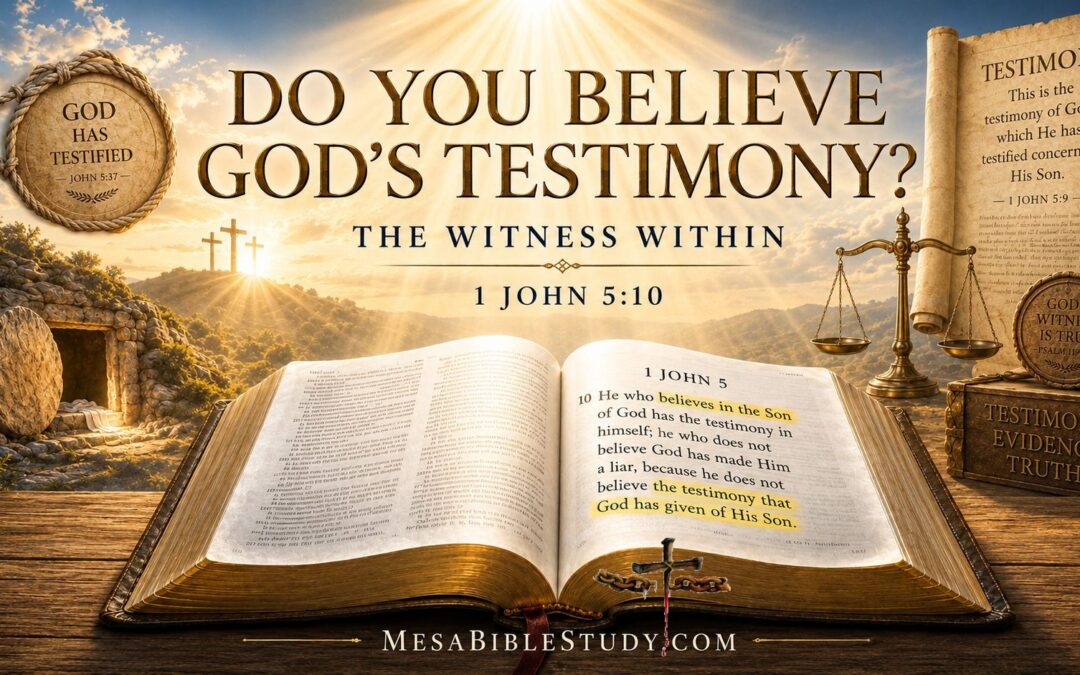
1 John 5:10 Explained — Believe God’s Testimony
1 John 5:10
“He who believes in the Son of God has the witness in himself; he who does not believe God has made Him a liar, because he has not believed the testimony that God has given of His Son.
Introduction
First John 5:10 presents one of Scripture’s clearest contrasts between believing God and rejecting God’s testimony concerning His Son.
John does not describe faith as a vague belief in God, a general respect for Jesus, or an emotional religious experience. The issue is specific: Will a person believe the testimony God has given concerning His Son?
The person who believes in the Son of God has God’s witness within him. The person who refuses to believe God’s testimony does something far more serious than merely disagreeing with Christian doctrine. By rejecting what God has declared concerning His Son, that person treats God as though He were a liar.
The dividing line is therefore not religious sincerity, moral effort, church membership, or intellectual curiosity. The dividing line is whether a person believes God’s testimony concerning Jesus Christ.
Background, Setting, and Purpose
Who Wrote 1 John?
The apostle John wrote this epistle. He was one of the twelve apostles, an eyewitness of the earthly ministry, death, and resurrection of Jesus Christ.
John begins the letter by emphasizing that his testimony was not based on rumor, philosophical speculation, or secondhand tradition:
“That which was from the beginning, which we have heard, which we have seen with our eyes, which we have looked upon, and our hands have handled, concerning the Word of life.”
— 1 John 1:1
John had personally heard, seen, and touched the incarnate Son of God. His testimony concerning Christ was grounded in eyewitness reality.
To Whom Was It Written?
First John was written to Jewish believers who were being confronted by false teachers and deceivers. These teachers claimed spiritual knowledge while denying fundamental truths concerning the identity and work of Jesus Christ.
Some had separated themselves from the believing community:
“They went out from us, but they were not of us.”
— 1 John 2:19
John wrote to reassure genuine believers, expose false teaching, and reaffirm the truth concerning Jesus Christ.
When Was It Written?
First John was likely written near the end of the first century, during the later years of John’s ministry.
By that time, false doctrines concerning the person of Christ were spreading. Some denied that Jesus was truly the Christ. Others attempted to separate the divine Christ from the historical man Jesus.
John answered these errors by repeatedly emphasizing that Jesus Christ is the Son of God who truly came in the flesh.
Why Was It Written?
John states one of his central purposes near the conclusion of the letter:
“These things I have written to you who believe in the name of the Son of God, that you may know that you have eternal life.”
— 1 John 5:13
First John was written so that believers could possess assurance concerning eternal life and recognize the difference between truth and deception.
That assurance rests not upon human performance, changing emotions, or personal worthiness, but upon the testimony God has given concerning His Son.
Chapter Theme
The central theme of 1 John 5 is that faith in Jesus Christ, the Son of God, is the dividing line between life and death, truth and error, and belief and unbelief.
John begins the chapter by declaring:
“Whoever believes that Jesus is the Christ is born of God.”
— 1 John 5:1
He then identifies the victory that overcomes the world:
“And this is the victory that has overcome the world—our faith.”
— 1 John 5:4
John’s emphasis is not upon faith as an independent spiritual power. The value of faith is found in its object:
“Who is he who overcomes the world, but he who believes that Jesus is the Son of God?”
— 1 John 5:5
The chapter then moves from the believer’s faith to God’s testimony. Jesus Christ is not merely someone Christians have chosen to admire. God Himself has testified concerning His Son.
First John 5:10 stands at the center of that argument.
The Immediate Context
Immediately before verse 10, John contrasts human testimony with God’s testimony:
“If we receive the witness of men, the witness of God is greater; for this is the witness of God which He has testified of His Son.”
— 1 John 5:9
People regularly accept human testimony in courts, contracts, historical records, and ordinary conversation. Yet God’s testimony is infinitely greater because God cannot lie.
God has testified concerning His Son through the prophets, the earthly ministry of Christ, His miracles, His baptism, His resurrection, the Holy Spirit, and the apostolic witness.
The question is therefore not whether sufficient testimony has been given. The question is whether that testimony will be believed.
Verse 10 describes the response of two groups:
- The person who believes in the Son of God.
- The person who does not believe God.
The consequences of those responses could not be more different.
Phrase-by-Phrase Breakdown
1. “He who believes”
John begins with personal faith.
The expression “he who believes” describes an individual response to God’s testimony. No one is saved because of another person’s faith. Family background, religious heritage, or association with believers cannot replace personal belief.
Biblical faith is not merely acknowledging that Jesus existed. It is believing what God has revealed concerning Him.
Faith accepts God’s testimony as true.
This does not mean that faith is a work by which a person earns salvation. Faith is the opposite of earning. It is the empty hand that receives what God has provided through His Son.
The object of faith is not faith itself. The object of faith is Jesus Christ.
2. “In the Son of God”
John does not merely say that a person must believe “in God.” He specifically identifies the object of saving faith as the Son of God.
Many people claim to believe in God while rejecting God’s testimony concerning Jesus Christ. John does not allow that distinction.
To reject the Son is to reject the Father who sent Him:
“Whoever denies the Son does not have the Father either; he who acknowledges the Son has the Father also.”
— 1 John 2:23
God cannot be honored while His Son is rejected.
Jesus is not presented as one religious teacher among many. He is the Son of God, the promised Christ, and the One in whom eternal life is found.
John had already stated:
“And we have seen and testify that the Father has sent the Son as Savior of the world.”
— 1 John 4:14
Believing in the Son means accepting God’s testimony concerning who Jesus is and what God has accomplished through Him.
3. “Has the witness in himself”
The person who believes in the Son of God “has the witness in himself.”
John is describing an internal confirmation produced by receiving God’s testimony. What was externally proclaimed concerning the Son is received internally by faith.
This witness is not a private revelation that replaces Scripture. It is not an uncontrolled emotional impression, an audible voice, or an experience that allows a person to disregard the written Word of God.
The internal witness agrees with the external testimony God has already given.
The believer does not create this testimony. He receives it.
The Holy Spirit confirms the truth of God within the believer and produces assurance that the testimony concerning Christ is true. The believer has passed from hearing the testimony to personally possessing the life of which the testimony speaks.
This agrees with Paul’s statement:
“The Spirit Himself bears witness with our spirit that we are children of God.”
— Romans 8:16
The witness within is inseparably connected to faith in Christ and the truth God has revealed in His Word.
4. “He who does not believe God”
John now turns from the believer to the unbeliever.
Notice the wording carefully. John does not merely say, “He who does not believe in Jesus.” He says, “He who does not believe God.”
This is because the testimony concerning Jesus Christ originated with God.
Unbelief is not presented as a neutral position. It is a rejection of God’s own declaration concerning His Son.
A person may claim to respect God while denying that Jesus is the Son of God. John says that such a person does not truly believe God, because God has testified concerning His Son.
The issue is not whether someone possesses every possible answer to every theological question. The issue is whether he believes the testimony God has clearly given.
5. “Has made Him a liar”
No human being can actually cause God to become a liar. God is true and cannot lie.
John’s meaning is that the unbeliever treats God as though God’s testimony were false.
When God declares that Jesus is His Son and a person rejects that declaration, the person is effectively accusing God of giving false testimony.
This demonstrates the seriousness of unbelief.
Unbelief is often portrayed as an innocent lack of information or a harmless personal preference. Although people may have genuine questions, persistent rejection of God’s revealed testimony is not morally neutral.
It contradicts the God who cannot lie.
John uses similarly forceful language earlier in the epistle:
“He who says, ‘I know Him,’ and does not keep His commandments, is a liar, and the truth is not in him.”
— 1 John 2:4
“Who is a liar but he who denies that Jesus is the Christ?”
— 1 John 2:22
Truth and falsehood meet at the person of Jesus Christ. What someone believes concerning the Son reveals whether he is receiving or rejecting God’s testimony.
6. “Because he has not believed”
John identifies the reason the unbeliever treats God as a liar: he has not believed.
The condemnation described in this verse is not based upon a failure to perform sufficient religious works. It is connected directly to unbelief.
God has spoken. God has testified. God has revealed His Son.
The unbeliever refuses to receive that testimony.
This agrees with the words of Jesus:
“He who believes in Him is not condemned; but he who does not believe is condemned already, because he has not believed in the name of the only begotten Son of God.”
— John 3:18
The fundamental issue is unbelief in the Son whom God has given.
7. “The testimony”
The word “testimony” carries the idea of witness or evidence given concerning a matter.
Christian faith is not presented as belief without testimony. God has provided testimony concerning His Son.
The Father testified concerning Christ at His baptism:
“This is My beloved Son, in whom I am well pleased.”
— Matthew 3:17
The works of Christ testified concerning Him:
“The very works that I do—bear witness of Me, that the Father has sent Me.”
— John 5:36
The Scriptures testified concerning Him:
“You search the Scriptures, for in them you think you have eternal life; and these are they which testify of Me.”
— John 5:39
The apostles testified concerning His resurrection:
“This Jesus God has raised up, of which we are all witnesses.”
— Acts 2:32
The gospel is therefore not human speculation. It is the proclamation of what God has revealed and accomplished through Jesus Christ.
8. “That God has given”
The testimony comes from God.
John is not asking his readers to place ultimate confidence in human religious authorities. The authority behind the testimony is God Himself.
God took the initiative.
God sent His Son.
God testified concerning His Son.
God raised Him from the dead.
God offers eternal life through Him.
Faith responds to what God has already done and declared.
The words “has given” also anticipate the following verse:
“And this is the testimony: that God has given us eternal life, and this life is in His Son.”
— 1 John 5:11
Eternal life is not earned, purchased, or achieved. It is given by God and found in His Son.
9. “Of His Son”
The entire testimony centers upon God’s Son.
Christianity is not ultimately centered upon a moral system, political program, religious institution, or human philosophy. It is centered upon the person and work of Jesus Christ.
God’s testimony is not merely that Jesus was a prophet, martyr, example, or reformer. He is God’s Son.
John wrote:
“And we know that the Son of God has come and has given us an understanding, that we may know Him who is true.”
— 1 John 5:20
The Son reveals the Father. The Son provides eternal life. The Son is the object of faith.
A person cannot separate eternal life from Jesus Christ because God has placed that life in His Son.
What This Verse Does Not Mean
It Does Not Mean That Personal Feelings Determine Truth
The “witness in himself” is not a license to make subjective feelings equal to divine revelation.
A person cannot claim that an inner impression from God contradicts the written Word of God. The internal witness confirms the testimony God has already revealed concerning His Son.
Truth remains grounded in God’s Word, not in human emotion.
It Does Not Mean That Faith Is Merely Intellectual Agreement
Believing in the Son involves more than admitting that certain historical facts are true.
Demons recognize realities concerning God, yet they do not possess saving faith.
Biblical faith receives God’s testimony and rests in His Son as the One through whom God gives eternal life.
It Does Not Mean That God Becomes a Liar
God cannot lie:
“In hope of eternal life which God, who cannot lie, promised before time began.”
— Titus 1:2
The unbeliever does not change God’s character. He treats God as though His testimony were untrue.
God remains true regardless of whether human beings believe Him.
It Does Not Mean That Sincerity Makes Every Belief Acceptable
A person can be sincere and still reject the testimony God has given concerning His Son.
Sincerity cannot transform falsehood into truth. The issue is not merely whether someone believes strongly, but whether he believes what God has revealed concerning Jesus Christ.
What This Verse Does Mean
First John 5:10 teaches that God has given a definite and authoritative testimony concerning His Son.
The person who believes (faith) in the Son receives that testimony and possesses its internal witness. The person who refuses to believe rejects God’s testimony and treats the truthful God as though He had spoken falsely.
There is no neutral territory in John’s argument.
God has testified that eternal life is found in His Son. To receive the Son is to receive life. To reject the Son is to reject the life God has provided.
The following verses make the conclusion unmistakable:
“And this is the testimony: that God has given us eternal life, and this life is in His Son. He who has the Son has life; he who does not have the Son of God does not have life.”
— 1 John 5:11–12
The contrast is absolute:
- The Son and life.
- No Son and no life.
- Believing God’s testimony.
- Rejecting God’s testimony.
- Receiving God as true.
- Treating God as though He were a liar.
Eternal life is not found in religion generally. It is found in God’s Son.
Cross-References for Going Deeper
John 3:16
“For God so loved the world that He gave His only begotten Son, that whoever believes in Him should not perish but have everlasting life.”
God gave His Son so that eternal life could be received through faith in Him.
John 3:36
“He who believes in the Son has everlasting life; and he who does not believe the Son shall not see life.”
The contrast between belief and unbelief is directly connected to the possession of eternal life.
John 5:24
“He who hears My word and believes in Him who sent Me has everlasting life.”
The believer possesses eternal life as a present reality.
John 20:31
“But these are written that you may believe that Jesus is the Christ, the Son of God.”
John’s written testimony was intended to lead people to faith in Jesus Christ.
Romans 3:4
“Indeed, let God be true but every man a liar.”
Human unbelief can never overturn the truthfulness of God.
1 Corinthians 15:1–4
Paul identifies the gospel by which believers are saved: Christ died for our sins, was buried, and rose again the third day according to the Scriptures.
God’s testimony concerning His Son includes the completed work through which salvation is now proclaimed.
Ephesians 1:13
“In Him you also trusted, after you heard the word of truth, the gospel of your salvation.”
The believer hears the truth, believes the gospel, and is sealed with the Holy Spirit of promise.
Titus 1:2
“God, who cannot lie.”
The assurance of eternal life rests upon the unchanging character of the God who gave the promise.
Doctrinal Summary
First John 5:10 teaches that faith in the Son of God is a response to God’s own testimony.
God has testified concerning Jesus Christ. He has declared that Jesus is His Son and that eternal life is found in Him.
The person who believes receives God’s testimony as true and possesses the witness of that testimony within himself. The person who refuses to believe does not merely reject a human religious claim. He contradicts God’s testimony and treats God as though He were a liar.
The verse establishes several important truths:
- God is the source of the testimony.
- Jesus Christ is the subject of the testimony.
- Faith receives the testimony.
- Unbelief rejects the testimony.
- Eternal life is found in the Son.
- Assurance rests upon God’s truthfulness, not human performance.
For believers living in the present dispensation of grace, the saving work of the Son is proclaimed plainly in Paul’s gospel:
“Christ died for our sins according to the Scriptures, and that He was buried, and that He rose again the third day according to the Scriptures.”
— 1 Corinthians 15:3–4
Salvation is not obtained through religious works, law-keeping, ceremonies, or human merit. It is received by trusting, believing—faith in the gospel of the grace of God and resting in the finished work of Jesus Christ.
Final Summary
First John 5:10 confronts every reader with a direct question: Will you believe the testimony God has given concerning His Son?
The believer receives that testimony and has the witness within himself. The unbeliever rejects God’s testimony and, by doing so, treats God as though He were a liar.
God has not left humanity without testimony. He sent His Son, testified concerning Him, raised Him from the dead, and declared that eternal life is found in Him.
The issue is not whether God has spoken clearly.
The issue is whether His testimony will be believed.
God is true.
His testimony is certain.
His Son is sufficient.
And eternal life is found in Him.
by Jamie Pantastico | Jul 24, 2026 | Pauline Theology |
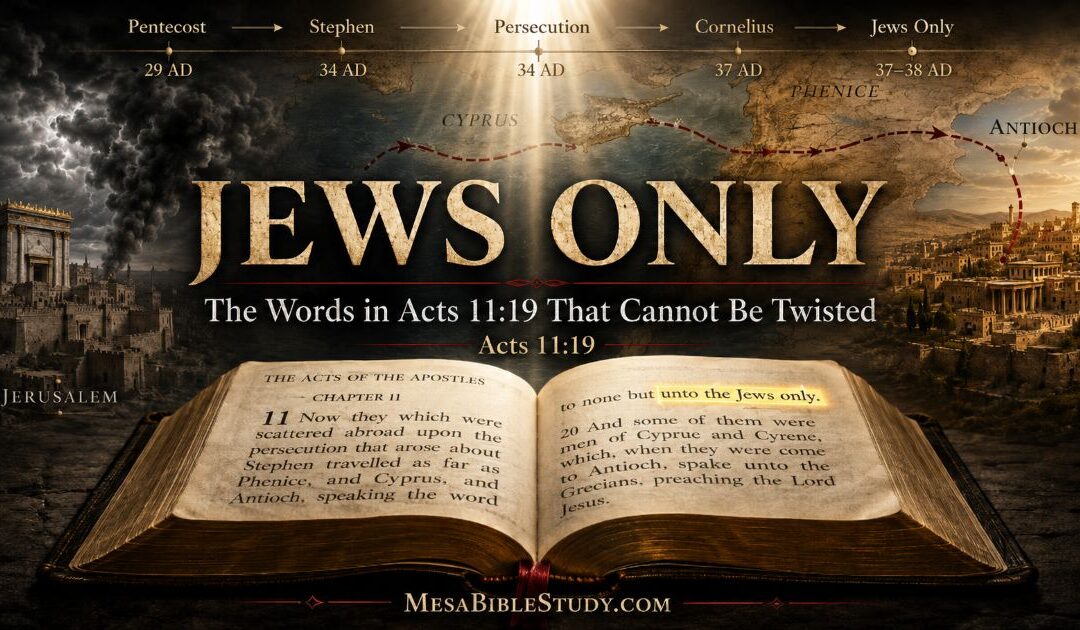
Years After Pentecost, the Word was Preached to Jews Only
“Now they which were scattered abroad upon the persecution that arose about Stephen travelled as far as Phenice, and Cyprus, and Antioch, preaching the word to none but unto the Jews only.”
— Acts 11:19, KJV
There are verses in Scripture that theological systems repeatedly attempt to explain away because allowing the verse to mean exactly what it says would collapse the system.
Acts 11:19 is one of those verses.
The language is not complicated.
The grammar is not mysterious.
The audience is not hidden.
Luke tells us exactly who these believers were, why they had been scattered, what they were doing, and whom they were preaching to:
“To none but unto the Jews only.”
Not mainly to Jews.
Not to Jews first and Gentiles second.
Not to every nation without distinction.
To none but the Jews.
Only.
And this was not happening the day after Pentecost. This was years later. Seven years later!
Stephen had already been stoned to death (Acts 7). Saul had already persecuted the Jerusalem assembly (Acts 8). The believers had already been scattered (Acts 8). Saul had encountered the risen Christ (Acts 9). Peter had already gone to the house of Cornelius (Acts 10).
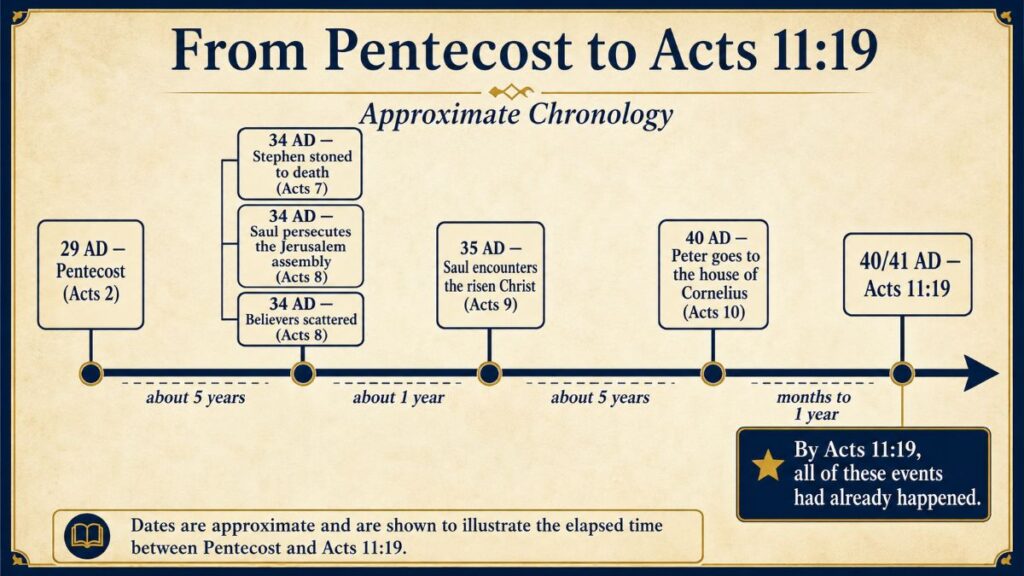
Yet Acts 11:19 still describes Jewish believers preaching the word exclusively to other Jews.
That fact cannot be exegetically reconciled with the claim that the Body of Christ, with its full Jew-Gentile equality, had already begun and been clearly revealed in Acts 2.
The chronology will not allow it.
The words will not allow it.
And the verse should not be twisted until it says something it never said.
The only way anyone can teach that the Body of Christ began at Pentecost is by forcing truth that was hidden in God—and revealed exclusively to Paul approximately seven years later—backward into Acts 2. This is retroactive revelation, and it directly contradicts the progressive order in which God deliberately unfolded His plan of redemption.
Sometimes man thinks that he is so smart, that he has figured out the unsearchable judgements and ways of God. But what they are really doing is calling God a liar — because they will not believe what He has so clearly said.
‘He who believes in the Son of God has the witness in himself; he who does not believe God has made Him a liar, because he has not believed the testimony that God has given of His Son.’
I John 5:10
Praise God for His unsearchable ways!
‘Oh, the depth of the riches both of the wisdom and knowledge of God! How unsearchable are His judgments and His ways past finding out!’
Romans 11:33
Timing Is Crucial
Biblical doctrine does not exist in a historical vacuum.
God revealed His purposes progressively. What God made known through Paul cannot be assumed to have been understood by every believer before Paul’s revelation was given and communicated.
Acts 11 takes place approximately seven or eight years after Pentecost, depending on the precise chronology.
That means a great deal has happened since Acts 2.
At Pentecost, Peter addressed:
“Ye men of Judaea, and all ye that dwell at Jerusalem.”
— Acts 2:14
He called upon:
“Ye men of Israel.”
— Acts 2:22
He spoke of David, Israel’s Messiah, Israel’s promises, and the hope of Christ sitting upon David’s throne.
His conclusion was directed to:
“All the house of Israel.”
— Acts 2:36
Nothing in Acts 2 revealed the mystery of Jew and Gentile being created into one new man in one Body.
Nothing in Acts 2 revealed that Israel’s distinction had been temporarily set aside.
Nothing in Acts 2 announced the dispensation of the grace of God later committed to Paul.
Nothing in Acts 2 revealed the mystery that had been hidden in God.
And Acts 11:19 confirms that the Jerusalem believers did not understand Pentecost to mean what Acts 2 theologians now claim it meant.
To use retroactive revelation to convince—indeed, to mislead—congregants into believing that Paul’s later revelations were already present at Pentecost, merely blurred, partially revealed, or somehow awaiting Paul to “clarify Acts 2,” is simply wrong.
God’s Word does not allow it.
The bottom-line is 7 to 8 years later, they were still preaching to Jews only.
These Were Jewish Believers Scattered After Stephen’s Death
Acts 11:19 takes the reader back to the persecution that followed the death of Stephen.
“And Saul was consenting unto his death. And at that time there was a great persecution against the church which was at Jerusalem; and they were all scattered abroad throughout the regions of Judaea and Samaria, except the apostles.”
— Acts 8:1
The identity of these scattered believers is not difficult to establish. They came from the Jerusalem assembly. They were Jewish believers, not Gentiles. They had believed the Good News that Jesus was the Christ, Israel’s promised Messiah and the Son of God.
They were connected to the ministry of the Twelve.
They were Jews living in Jerusalem.
They were rooted in the Old Testament Scriptures and Israel’s prophetic hope.
They were the believing remnant within Israel.
When persecution erupted in Jerusalem, these believers fled into other regions.
Acts 8:4 states:
“Therefore they that were scattered abroad went everywhere preaching the word.”
Acts 11:19 later tells us whom they preached that word to:
“None but unto the Jews only.”
These two verses describe the same basic movement.
Jewish believers were scattered. They went into other regions. They proclaimed the word.
And they limited their proclamation to Jews Only.
Saul Was the Feared Persecutor that Scattered Jewish Believers
There is an almost shocking irony in this passage. The man who helped scatter these Jewish believers was Saul of Tarsus.
“As for Saul, he made havock of the church, entering into every house, and haling men and women committed them to prison.”
— Acts 8:3
Saul was not the “apostle Paul” when they were scattered.
This is mindboggling— He was their persecutor.
He had not gathered these believers together and taught them the revelation of the mystery. He was not proclaiming that Christ died for our sins, was buried, and rose again the third day. He was not teaching that the middle wall of partition had been broken down or that believing Jews and Gentiles were now one in the Body of Christ. At this point, Saul was not their apostle—he was the feared persecutor from whom they were fleeing.
Why? Because Saul had not yet encountered the risen Christ, and God had not yet revealed to him the mystery or the doctrines of grace. Those truths were still hidden in God. In other words, God had not revealed them to anyone. So how could these scattered Jewish believers possibly have known or preached them? How could Peter could have known anything about the doctrines of grace if they weren’t revealed yet? He couldn’t and he didn’t know.
Beloved, stop and consider the chronology. The events of Acts 8 occurred years after Pentecost, yet Saul had not even begun his ministry as the apostle to the Gentiles. Reading Paul’s later revelation into the preaching of these believers is therefore not exegesis—it is importing unrevealed truth backward into an earlier passage.
The text is clear and cannot be twisted. Saul was entering homes, arresting Jewish believers, and attempting to destroy their movement. He was not persecuting members of the Body of Christ, because the Body of Christ had not yet been revealed. At this point, Saul was not yet Paul, the master builder who would later lay the doctrinal foundation for the Body of Christ. He was Saul, the feared persecutor of Jewish believers who confessed that Jesus was Israel’s promised Messiah.
Yet most of Christendom has effectively placed Paul’s later doctrines into the mouths and hearts of the very people who had fled from Paul before his apostleship was established.
That is not sound interpretation.
That is retroactive revelation.
It takes truth revealed later through Paul and assumes that it was already known, preached, and understood by earlier Jewish believers—even when the passage itself provides no evidence for that conclusion.
These scattered Jewish believers were not carrying copies of Romans, Galatians, Ephesians, or Colossians. They knew nothing of the message revealed to Paul by the ascended and glorified Lord Jesus.
That gospel of the grace of God and the doctrine of the body of Christ wasn’t even revealed yet.
Those epistles had not yet been written.
They were not preaching from Ephesians 3 about the mystery hidden in God.
They were not teaching from 1 Corinthians 12 about baptism by one Spirit into one Body.
They were not explaining from Romans 16 the preaching of Jesus Christ according to the revelation of the mystery.
They were proclaiming Jesus within the old testament— prophetic framework they knew.
And they were proclaiming Christ Jesus to Jews only.
What Does “Preaching the Word” Mean?
Some will see the phrase “preaching the word” and immediately assume that it must mean Paul’s gospel of grace.
But that conclusion is not in the text.
The expression must be interpreted in its historical context. The written Scriptures possessed by these believers were the Old Testament Scriptures—the Law, the Prophets, and the Psalms. From those Scriptures, they could demonstrate that Jesus was the Christ.
They could proclaim His resurrection.
They could show that He fulfilled Israel’s prophetic promises.
They could call Israel to believe in the One whom the nation had rejected and crucified.
That is exactly what the early chapters of Acts repeatedly record.
Peter did not stand at Pentecost and explain the mystery of the one Body.
He explained Joel, David, the resurrection, the “times of refreshing”, the throne, and Israel’s guilt in crucifying her Messiah.
Stephen did not stand before Israel’s council and proclaim that Israel’s covenants had been transferred to a new Gentile institution.
He reviewed Israel’s history and charged Israel’s leaders with resisting the Holy Spirit as their fathers had done.
Philip did not go to Samaria proclaiming the mystery revealed to Paul.
He preached:
“The things concerning the kingdom of God, and the name of Jesus Christ.”
— Acts 8:12
The “word” preached by the scattered believers must be understood within that prophetic context unless Scripture tells us otherwise.
Acts 11:19 tells us nothing about the mystery.
It tells us nothing about one new man.
It tells us nothing about salvation for Gentiles.
It tells us nothing about Israel’s temporary fall.
It tells us nothing about the gospel of the uncircumcision committed to Paul.
It tells us nothing about the dispensation of the grace of God.
But what God does say, is that Jewish believers proclaimed the word to Jews only.
They Believed Jesus Was Israel’s Christ
These scattered believers absolutely believed in Jesus.
But we must ask what they believed about Him and within what Holy Spirit inspired message they understood Him.
They believed Jesus was the Christ, the Son of God. That title is not an empty religious label. “Christ” means Messiah—the Anointed One promised to Israel.
God had promised Israel a King.
He had promised David that his throne and kingdom would be established forever.
He had promised through the prophets that Israel would be restored, cleansed, gathered, and ruled by the Messiah.
Believing that Jesus was the Christ meant believing that Jesus was Israel’s promised Messiah and King.
It is made so clear in Matthew 16:16, where we see Peter’s profession faith:
Here’s the setting: Matthew 16:13-15
‘When Jesus came into the region of Caesarea Philippi, He asked His disciples, saying, “Who do men say that I, the Son of Man, am?” So they said, “Some say John the Baptist, some Elijah, and others Jeremiah or one of the prophets.” He said to them, “But who do you say that I am?”’
Peter answer’s: Matthew 16:16
‘Simon Peter answered and said, “You are the Christ, the Son of the living God.”’
John expressed the purpose of his Gospel “Good News” this way:
“But these are written, that ye might believe that Jesus is the Christ, the Son of God.”
— John 20:31
That was the faith of the believing Jewish remnant. Not Gentiles.
They believed that the Jesus rejected by Israel’s rulers was truly Israel’s Messiah.
That does not mean they understood the secret purpose God would later reveal through Paul concerning the formation of the Body of Christ.
Believing in the same Person does not prove that every believer in every period had been given the same message of revelation. God has made this so clear and simple.
Abraham believed God.
David believed God.
Peter believed God.
Paul believed God.
But they were not all given the same revelation, message, commission, audience, or stewardship.
The same God, same Person in Jesus Christ, the Son of God.
The Bible Is a Progressive Revelation
One of the most important principles of sound Bible interpretation is learning to read Scripture “in-time.”
The Bible is a progressive revelation. God did not reveal His entire plan of redemption to mankind all at once. He revealed His truth progressively, according to what people needed to know at a particular time in biblical history.
Adam did not possess everything later revealed to Noah. Noah did not know everything revealed to Abraham. Abraham was not given the complete revelation later entrusted to Moses, David, and the prophets. Even Peter and the eleven were not given the full counsel of God during the Lord’s earthly ministry.
Each person was responsible for believing and obeying what God had revealed to them at that time.
This is why we must never read later revelation backward into earlier passages. We cannot assume that someone in Genesis understood what was later revealed through the prophets. Nor can we assume that Peter and the eleven understood truths that Christ would later reveal specifically through Paul.
When we get ahead of God’s revelation, we make the serious mistake of mixing together truths, instructions, promises, and doctrines that must first be understood within their proper biblical setting.
Progressive revelation does not mean that earlier Scripture was false or incomplete in its purpose. It means that God continued revealing more of His plan as biblical history unfolded.
A sound hermeneutical method approaches Scripture literally, contextually, and in the order in which God revealed it. Ignoring this principle inevitably leads to confusion and erroneous interpretations.
Read every passage in its time. Determine what God had revealed, to whom He revealed it, and what those people could reasonably have understood at that moment in biblical history.
That is not dividing the Bible unnecessarily.
That is allowing God’s revelation to unfold exactly as He gave it.
“To None but Unto the Jews Only”
This phrase presents a serious challenge to every attempt to make Acts 11:19 describe Paul’s ministry. Paul’s apostleship was clearly distinguished by his commission to the Gentiles.
The risen Christ told Paul:
“Depart: for I will send thee far hence unto the Gentiles.”
— Acts 22:21
Paul later wrote:
“For I speak to you Gentiles, inasmuch as I am the apostle of the Gentiles.”
— Romans 11:13
He described the grace given to him:
“That I should preach among the Gentiles the unsearchable riches of Christ.”
— Ephesians 3:8
Paul says he laid the doctrinal foundation for the body of Christ:
‘According to the grace of God which was given to me, as a wise master builder I have laid the foundation, and another builds on it. But let each one take heed how he builds on it. ‘
I Corinthians 3:10
Acts 11:19 describes the opposite direction.
These believers were not sent far hence unto the Gentiles.
They were not functioning as apostles of the Gentiles.
They were not preaching the unsearchable riches of Christ among the nations.
They were preaching:
“To none but unto the Jews only.”
That is not Paul’s distinctive ministry. If you can’t believe what God’s word clearly says then your controversy is with God.
It is a Jewish ministry operating within Israel’s prophetic program.
The restriction is explicit. The words “none but” exclude everyone outside the stated audience. The word “only” eliminates every attempt to soften the restriction.
Luke did not say they preferred Jewish audiences.
He did not say they happened to encounter Jews first.
He did not say their message was equally directed to Jews and Gentiles.
He said they preached to Jews only.
Cornelius Had Already Exposed the Problem
The events surrounding Cornelius make Acts 11:19 even more significant.
Peter did not wake up one morning and decide that the Pentecostal commission obviously meant he should enter a Gentile home.
God had to intervene.
Peter received a vision.
The Spirit told him to go.
Peter said no.
God said go Peter.
Cornelius received angelic instruction.
Peter’s Jewish companions witnessed the Holy Spirit fall upon the household.
Only then did Peter understand that God had shown him not to call any man common or unclean.
When Peter returned to Jerusalem, the circumcision believers did not congratulate him for finally fulfilling an obvious Acts 2 commission.
They confronted him:
“Thou wentest in to men uncircumcised, and didst eat with them.”
— Acts 11:3
Peter then rehearsed the entire event from the beginning.
Why was such an explanation necessary if everyone had already understood since Pentecost that they were part of a new, distinctionless Body of Christ?
Why did Peter require a vision?
Why did the Jerusalem believers object?
Why did Peter need to defend himself?
Because they had not been operating according to Paul’s later-revealed doctrine of Jew and Gentile equality in one Body. Cornelius was a divine intervention, not proof that the Jerusalem assembly had been preaching Paul’s gospel to Gentiles since Acts 2.
Immediately after Luke records Peter’s defense, he reminds us that the scattered believers had been preaching to Jews only.
That placement is difficult to ignore. And dangerous usurp to fit a denominational theology.
“Christian” Does Not Erase Their Jewish Context
People commonly call every believer in Acts a “Christian” and then assume that every one of them possessed the same doctrinal understanding Christians receive from Paul’s epistles.
But Acts itself is more careful.
Acts 11:26 says:
“And the disciples were called Christians first in Antioch.”
The designation appears later in the chapter.
Acts 11:19 does not identify the scattered believers by that name. It identifies them by their connection to Stephen’s persecution and by their Jews-only ministry.
They were disciples of Jesus.
They were believers.
They belonged to the Jerusalem assembly.
But they were Jewish believers functioning within the prophetic and kingdom context revealed to Israel.
Using the word “Christian” as a broad label must not be allowed to erase those distinctions.
A label applied later cannot be used to import Paul’s complete doctrinal revelation backward into an earlier ministry.
Acts 11:19 Is a Problem for the Acts 2 Church System
According to the traditional Acts 2 position, the Body of Christ began at Pentecost.
But if that were true, Acts 11:19 raises serious questions.
Why were members of this supposed newly formed Jew-Gentile Body preaching to Jews only?
Why did they not understand the elimination of national distinctions?
Why did Peter need a vision before entering a Gentile’s home?
Why did the Jerusalem believers object to Peter eating with Gentiles?
Why is there no mention of one Body, one new man, the mystery, or the dispensation of grace?
Why does Luke repeatedly present the ministry as a call to Israel to acknowledge her Messiah?
The usual response is to read Paul backward into the passage.
“The word” becomes Paul’s gospel.
“Church” automatically becomes the Body of Christ.
Faith in Jesus automatically becomes full knowledge of the mystery.
Any Gentile encounter becomes proof that Israel’s prophetic program had already ended.
But none of that comes from Acts 11:19.
It comes from a theological system imposed upon Acts 11:19.
The verse itself says that believing Jews were preaching to Jews only.
Peter Warned That Paul Would Be Twisted
Peter later wrote concerning Paul’s epistles:
“In which are some things hard to be understood, which they that are unlearned and unstable wrest, as they do also the other scriptures, unto their own destruction.”
— 2 Peter 3:16
The word “wrest” means to twist or distort.
Paul’s writings have been twisted in many ways, but one of the most common distortions is to remove the distinctive nature of his revelation.
Instead of allowing Paul to reveal something previously hidden, interpreters force his doctrine backward into Matthew, Pentecost, the Jerusalem assembly, and every earlier occurrence of the word “gospel.”
Paul’s mystery is no longer treated as a mystery.
His revelation is no longer treated as revelation.
His distinct apostleship is no longer distinct.
His gospel is assumed to have been preached by men who had never learned it from him.
His doctrine of the one Body is inserted into passages that explicitly describe a Jews-only ministry.
That is not rightly dividing the word of truth.
It is erasing the divisions God placed in His Word purposely.
The Passage Is Clear
Acts 11:19 is not difficult because the words are unclear.
It is difficult because the words contradict a deeply established theological tradition.
The verse identifies:
- Jewish believers from the Jerusalem assembly
- Persecution connected with Stephen
- Scattering caused by Saul and others
- Travel into Phenice, Cyprus, and Antioch
- Proclamation from Israel’s prophetic Scriptures
- A message concerning Jesus as Israel’s Messiah
- An audience restricted to Jews only
That is what the passage says.
It does not say that these believers were preaching Paul’s gospel.
It does not say that they understood the mystery.
It does not say that they were teaching the formation of the Body of Christ.
It does not say they were carrying the doctrine later recorded in Paul’s epistles.
Those ideas must be imported into the passage because they cannot be found within it.
Let Acts 11:19 Mean What It Says
These were believing Jews.
They believed Jesus was the Christ, Israel’s promised Messiah and the Son of God.
They had been scattered because of the persecution that followed Stephen’s death—the very persecution once led by Saul, whom we now know as the apostle Paul. They traveled beyond Jerusalem and proclaimed the word.
But their audience remained restricted:
“To none but unto the Jews only.”
The language is crystal clear.
Years after Pentecost, the Jerusalem believers were still functioning within a Jewish, prophetic, kingdom framework.
Paul’s distinct message had not been written into his epistles.
The mystery of the Body of Christ is not revealed in this passage.
The gospel of the grace of God is not identified in this passage.
The one new man is not described in this passage.
What is described is a group of believing Jews preaching to Jews only.
We do not honor Scripture by twisting clear words until they fit our theology.
We honor Scripture by allowing God’s words to correct our theology.
And Acts 11:19 says exactly what many systems cannot afford to let it say:
JEWS ONLY.
Key Passages
Acts 2:14–36
Acts 7:51–60
Acts 8:1–4
Acts 10:1–48
Acts 11:1–26
Acts 22:21
Romans 11:13
Romans 16:25–26
Galatians 2:7–9
Ephesians 2:11–18
Ephesians 3:1–9
2 Peter 3:15–16
For a close, phrase-by-phrase examination of the verse, read the companion study: “Acts 11:19 Passage Breakdown: Unto the Jews Only.”

by Jamie Pantastico | Jul 24, 2026 | Verse-by-Verse Bible Studies |
Who Were the Scattered Believers, What Word Were They Preaching, and Why Was Their Audience Restricted to Jews Only?
“Now they which were scattered abroad upon the persecution that arose about Stephen travelled as far as Phenice, and Cyprus, and Antioch, preaching the word to none but unto the Jews only.”
— Acts 11:19
Acts 11:19 is one of the clearest chronological and doctrinal markers in the book of Acts— which is completely ignored and twisted. It isn’t that the exegetical work hasn’t been done on this passage, the problem is the conclusion. That is, approximately 7 to 8 years after Pentecost, the only word that was being proclaimed was Old Testament— “…to none but unto the Jews only.”
This fact cannot be reconciled exegetically with the claim that the Body of Christ—His Church, of which the ascended Lord Jesus Christ is the Head—had already begun and been clearly revealed in Acts 2. The full equality of Jew and Gentile in one Body was not proclaimed at Pentecost. It was part of the mystery later revealed through the apostle Paul.
Much of Christendom cannot accept that Gentiles had no direct part in the Lord’s earthly ministry or in the events of Acts 1, 2, and 3. Gentile Christendom insists on placing itself into passages, promises, and instructions that were plainly addressed to Israel. But discomfort does not change the inspired record. The truth remains the truth, whether Christendom is willing to accept it or not.
When we stand before the Lord Jesus Christ at the Bema Seat, the quality of every believer’s work will be tested. Those who built upon the one foundation—Jesus Christ—with the wood, hay, and stubble of denominational traditions, human creeds, and doctrines that blurred God’s clear distinctions will see those works consumed. They will suffer the loss of reward, but not the loss of salvation, for Scripture plainly says, “he himself shall be saved; yet so as by fire” (1 Corinthians 3:15). But those who built with the gold, silver, and precious stones of sound doctrine, faithfully standing upon God’s Word rightly divided, will receive a reward.
“Now they which were scattered abroad upon the persecution that arose about Stephen travelled as far as Phenice, and Cyprus, and Antioch, preaching the word to none but unto the Jews only.”
— Acts 11:19
Luke does not merely tell us where these believers traveled. He tells us who they were, why they had been scattered, what they preached, and exactly whom they preached it to.
The language is not vague:
“Preaching the word to none but unto the Jews only.”
That statement cannot honestly be turned into Paul’s later ministry to the nations, the gospel of the grace of God, or the revelation of Jew and Gentile joined together in one Body.
The passage says what it says.
“Now They Which Were Scattered Abroad”
The word “they” refers to the believers who had been scattered from Jerusalem because of the persecution connected with Stephen.
Acts 8 records the beginning of that scattering:
“And Saul was consenting unto his death. And at that time there was a great persecution against the church which was at Jerusalem; and they were all scattered abroad throughout the regions of Judaea and Samaria, except the apostles.”
— Acts 8:1
These were not members of a previously revealed, predominantly Gentile Body of Christ.
They were Jewish believers connected with the Lord’s earthly ministry. They believed that Jesus was the Christ, Israel’s promised Messiah and the Son of God.
Their faith was rooted in what was promised to Abraham in Genesis 12, Israel’s covenants, Israel’s prophetic hope, and Israel’s promised kingdom.
They were the believing remnant of Israel that made up the Jerusalem assembly (Church).
“Upon the Persecution That Arose About Stephen”
The scattering occurred because of the persecution that followed Stephen’s death.
Stephen had confronted Israel’s rulers with their continued resistance to the Holy Spirit:
“Ye stiffnecked and uncircumcised in heart and ears, ye do always resist the Holy Ghost.”
— Acts 7:51
After Stephen was killed, persecution intensified against the Jerusalem believers.
And who stood at the center of that persecution?
Saul of Tarsus.
“As for Saul, he made havock of the church, entering into every house, and haling men and women committed them to prison.”
— Acts 8:3
The very man who would later become the apostle Paul was originally the leading persecutor of these believing Jews.
That distinction matters.
The scattered believers of Acts 11:19 were not traveling around preaching a message they had learned from Paul. They had been scattered because of Paul’s and before Paul’s apostolic ministry had been publicly established. They were fleeing the persecution Saul/Paul himself had helped lead.
It is historical and doctrinal confusion to read Paul’s later revelation backward into the preaching of Acts 11:19.
The Chronology Matters
Acts 11 occurs approximately seven or eight years after Pentecost, depending on the chronology used.
That means this is not the morning after Acts 2.
Many years have passed.
Stephen has been killed.
The Jerusalem believers have been scattered.
Saul has persecuted the assembly.
Saul has encountered the risen Christ.
Peter has been sent to the house of Cornelius (Acts 10).
Peter has returned to Jerusalem and having to defend his actions before the assembly of Jewish believers.
And yet Luke still tells us that these scattered Jewish believers were preaching:
“To none but unto the Jews only.”
That is devastating to the claim that Acts 2 immediately began the newly revealed Jew-Gentile Body of Christ. More importantly, failing to recognize this clear distinction has caused—and continues to cause—doctrinal confusion throughout Christendom. It blends a message directed to Jews only with Paul’s later revelation of the one new man, in which believing Jews and Gentiles are baptized by one Spirit into the Body of Christ. Entrance into that Body is not through Israel’s kingdom message, water baptism, or covenant promises, but by believing Paul’s gospel of grace.
If the Body of Christ had been clearly revealed at Pentecost, why were believing Jews still limiting their proclamation to Jews only years later?
Why did Peter need a special vision and actually refused to go, before entering the home of Cornelius?
Why did the believers in Jerusalem challenge Peter for eating with uncircumcised men?
Why were these scattered believers still preaching to Jews only?
The answer is straightforward: they were Jewish believers still operating within Israel’s prophetic program. They not only believed the gospel of the kingdom but they were also keeping the Mosaic law.
“Travelled as Far as Phenice, and Cyprus, and Antioch”
These Jewish believers traveled far beyond Jerusalem.
But geographical expansion does not automatically mean doctrinal change.
They carried the message into Phenice, Cyprus, and Antioch, but Luke specifically tells us that their audience remained Jews only.
They had traveled outside the land, but they had not abandoned Israel’s prophetic framework.
They were scattered Jews preaching to other Jews.
This is entirely consistent with the kingdom message proclaimed earlier in Acts. Israel was being called to repent and acknowledge Jesus as the Christ. The hope of the promised kingdom remained before the nation.
A change in location is not necessarily a change in message.
“Preaching the Word”
This phrase is often treated as though it automatically means that these believers were preaching Paul’s gospel of grace.
It does not.
The expression “the word” must be understood within its progressive, historical and doctrinal context.
The written Scriptures available to these believers were the Old Testament Scriptures. From those prophetic Scriptures, they proclaimed that Jesus was Israel’s promised Messiah.
They could preach His identity, His resurrection, His fulfillment of prophecy, and His right to Israel’s throne.
That does not mean they were preaching the later-revealed mystery concerning the Body of Christ.
Acts 11:19 says nothing about:
- Salvation is by grace through faith alone in the finished work apart from the law
- Jew and Gentile being reconciled in one Body
- The one new man
- The mystery hidden from previous generations
- The heavenly position of the Body of Christ
- The gospel of the uncircumcision committed to Paul
- The dispensation of the grace of God
- Baptism by one Spirit into one Body
- The revelation later recorded in Paul’s epistles
Those doctrines cannot simply be inserted into the words “preaching the word.”
The passage must be allowed to speak for itself.
“To None but Unto the Jews Only”
This is the controlling statement of the verse.
Luke could hardly have used clearer language.
“None but.”
“The Jews.”
“Only.”
This is not a universal commission being carried equally to Jew and Gentile.
This is not the revelation of one new man in which the middle wall of partition has been abolished.
This is not Paul’s distinct apostleship and message to the nations.
These Jewish believers were deliberately limiting their preaching to other Jews.
The word “only” closes the door on every attempt to pretend that they were already functioning according to the later-revealed truth of the Body of Christ.
The passage does not say they preached primarily to Jews.
It does not say they began with Jews and then immediately moved to Gentiles.
It says:
“To none but unto the Jews only.”
That is a exclusive, not a suggestion.
They Were Believing Jews
These men believed that Jesus was the Christ, Israel’s promised Messiah, the Son of God. They believed what the apostle Peter believed when Jesus asked the apostles, “But who do you say that I am?”
In Matthew 16:16, we have Peter’s answer and profession of faith:
‘Simon Peter answered and said, “You are the Christ, the Son of the living God.”’
Matthew 16:16
Peter doesn’t say “You are Jesus, the Son of God, who died for my sins, was buried, and rose again the third day”. How could he say that, Jesus is right in front of Him, and alive!
But believing in Jesus does not erase the historical and dispensational setting in which a person believed.
The believers of Acts 11:19 understood Jesus as Israel’s promised Messiah. Just a the apostle Peter did in Matthew 16.
They were part of the believing remnant of Israel that came out of the Lord’s earthly ministry and early Acts period. Their hope, message, Scriptures, and expectations were connected with what God had promised through the prophets, the Old Testament.
Calling them simply “Christians” has caused many throughout Christendom to assume that these Jewish believers already understood and followed the doctrine later revealed through Paul. That broad label conceals the fact that they were still operating within Israel’s prophetic kingdom program.
In fact, Acts 11:26 tells us that the disciples were first called Christians at Antioch (Gentiles). Luke does not use that designation in Acts 11:19. He identifies these people through their connection to Stephen’s persecution and their Jews-only ministry.
We should identify them the way the passage identifies them (we have to take God at His word): as scattered Jewish believers preaching to Jews only.
Do Not Read Paul Backward Into Acts 11:19
A common interpretive error is to take doctrines later revealed through Paul and force them backward into every occurrence of words such as “gospel,” “grace,” “church,” “faith,” or “the word.” For more on this interpretive error read our Popular Series on “Retroactive Revelation”.
Peter himself warned that Paul’s writings would be twisted:
“As also in all his epistles, speaking in them of these things; in which are some things hard to be understood, which they that are unlearned and unstable wrest, as they do also the other scriptures, unto their own destruction.”
— 2 Peter 3:16
Paul’s revelation must be understood as progressive revelation, that was hidden in God until given to Paul. It cannot be assumed to have been fully known, partially known and proclaimed by people who had never received it.
Acts 11:19 does not reveal Paul’s gospel or the doctrine for the body of Christ.
It does not reveal Paul’s apostleship to the Gentiles.
It does not reveal the one Body.
It does not reveal the gospel of the grace of God.
It records Jewish believers, scattered because of Saul’s persecution, proclaiming the prophetic word concerning Israel’s Messiah to Jews only.
The words are crystal clear.
The problem is not that Acts 11:19 is difficult to understand.
The problem is that many theological systems cannot allow it to mean what it plainly says.
Passage Summary
Acts 11:19 records believing Jews from the Jerusalem assembly who had been scattered during the persecution connected with Stephen. They traveled to other regions proclaiming Jesus from Israel’s prophetic Scriptures (Old Testament), but they limited their preaching to Jews only. Their message and ministry remained connected with Israel’s prophetic kingdom program and must not be confused with the distinct revelation later committed to the apostle to the Gentiles, Paul, concerning the gospel of grace and the Body of Christ.
Key Passages
Acts 7:51–60
Acts 8:1–4
Acts 10:1–48
Acts 11:1–19
John 20:30–31
Acts 22:21
Romans 11:13
Ephesians 3:1–9
Acts 11:19 is not merely an interesting historical detail. Its clear Jews-only language creates a serious problem for the claim that the distinctionless Body of Christ had already been revealed at Pentecost. Read the full doctrinal examination: “JEWS ONLY: The Words in Acts 11:19 That Cannot Be Twisted.”