by Jamie Pantastico | Aug 3, 2026 | Devotionals |
Faith Under Pressure — Part 20
Psalm 27:11
“Teach me how you want me to live, LORD; lead me along a level path because of those who wait to ambush me.”
Context & Connection
In Part 19, David prayed, “Teach me how you want me to live, LORD…” That prayer reminds us that faith under pressure does not only ask God to remove the pressure. Faith asks God to teach and shape the believer while the pressure remains.
Now David continues: “lead me along a level path…” He knows he needs more than instruction. He needs direction. He needs the Lord to guide his steps and keep him steady when opposition is near. David is not trying to make his own path. He is asking the Lord to lead him.
Lead Me Along a Level Path
A level path speaks of stability, clarity, and sure footing. David does not want to stumble. He does not want to be driven by fear or pushed into confusion. He does not want to take a wrong step because pressure has clouded his judgment. So he asks the Lord to lead him.
Under pressure the path can feel uncertain. The enemy is watching. Danger is near. The heart is burdened. The mind can grow weary. David’s prayer is simple and wise:
“lead me along a level path…” That is a prayer every pressured believer needs.
Pressure Makes the Path Feel Unclear
When the heart is tired, decisions feel heavier. When fear is loud, wisdom can feel harder to discern. When people oppose us, we may become reactive. When the burden lasts long, patience can wear thin. When the enemy waits for us to stumble, every step matters.
David understands this. He does not simply ask God for strength. He asks God for a level path — guidance, stability, and clear steps.
Faith Asks the LORD to Lead
David does not say, “I will find my own way,” or “I will follow my emotions,” or “I will let fear decide.” He says, “lead me…” That is faith.
Faith does not trust the pressure to define the path. Faith does not trust fear, anger, exhaustion, or self-protection to make the right decision. Faith asks the Lord to lead. The believer under pressure needs not merely to survive the burden, but to walk rightly through it.
Because of Those Who Wait to Ambush Me
David’s prayer for a level path is not abstract. He needs guidance because enemies are watching. There are those who want him to fall and wait for an opportunity. Under pressure, a careless step can create more trouble. A rash word can bring harm. A fearful decision can lead the heart away from trust. A bitter response can dishonor the Lord.
David knows the danger is not only in the enemies outside him. The danger is also in how he responds. That is why he asks the Lord to lead him.
The Enemy Wants You to Stumble
The enemy does not merely want the believer pressured. He wants the believer to stumble under the pressure. He wants fear to lead, bitterness to grow, and faith to weaken. He wants the pressured believer to react in the flesh.
That is why David’s prayer is so wise: “lead me along a level path…” The pressured believer must not simply ask:
“How do I get out of this?”
We must also ask,
“Lord, how do I walk faithfully through this?”
The LORD Gives Stability Through His Word
For believers today, the Lord leads us through His Word. The Word of God gives light, wisdom, and correction. It steadies us and teaches us how to walk. David has already declared, “The LORD is my light…” Now he asks the Lord to lead him. Light and leading belong together.
A level path is not found by following emotion. It is found by walking in the truth of God’s Word.
The Level Path Is Not Always the Easy Path
When David asks for a level path, he is not necessarily asking for an easy path. A level path does not mean a pressure-free path or an enemy-free path. It means a path where the Lord leads and steadies the steps.
Sometimes the faithful path is still hard. Sometimes obedience still requires endurance. But if the Lord is leading, the believer is not walking alone. The path may be difficult, but the Lord can keep the feet steady.
Do Not Let Pressure Choose Your Path
Pressure wants to direct the believer.
- Fear says, “Run.”
- Anger says, “Strike back.”
- Weariness says, “Give up.”
- Bitterness says, “Harden your heart.”
- Anxiety says, “Control everything.”
But faith says, “Lead me along a level path…” The believer must not let pressure choose the path. The Lord must lead. This is why prayer and Scripture are vital during seasons of pressure. We need the Lord to slow us down, correct our thinking, steady our hearts, and lead us in a way that honors Him.
Faith Under Pressure Walks Carefully
Faith under pressure is not reckless. It is careful, prayerful, and dependent. It knows the heart can be vulnerable when pressure is heavy. David’s prayer shows spiritual awareness. He knows he needs the Lord’s help not only in the big battle, but in the next step.
Many believers live there today — not knowing the whole road ahead, not seeing every answer, but needing the Lord’s guidance for the next step.
Faith says, “Lord, lead me.”
What This Means
Psalm 27:11 teaches us that faith under pressure asks the Lord for steady steps. David does not merely ask to be delivered from his enemies. He asks to be led along a level path because enemies are waiting to ambush him.
Faith seeks God’s direction in the pressure. Faith does not let fear, anger, or weariness choose the path. Faith asks the Lord to lead. When pressure makes the way feel uncertain, the believer can pray:
“Lord, lead me along a level path.”
A Word of Encouragement
If the path feels unclear today. You may not know what to do next, what to say, or whether to move, wait, speak, or endure. Take it all to the Lord.
David prayed,
“lead me along a level path…”
You can pray the same. The Lord knows how to guide His own. He knows the hidden dangers. He knows the pressure you are carrying. He knows the steps ahead.
Do not let fear lead you. Do not let pressure drive you. Do not let weariness choose your path. Ask the Lord to lead. He is faithful to guide His people through the pressure.
For Further Study
Read Psalm 27:11 slowly. Notice that David asks for both instruction and direction: Teach me how You want me to live. Lead me along a level path. Ask yourself: Am I letting the pressure direct my steps, or am I asking the Lord to lead me?
Faith Under Pressure Series
Previous in the Series:
Part 19 — Teach Me How You Want Me to Live
Next in the Series:
Part 21 — Do Not Turn Me Over to My Enemies
Back to Series Page:
Faith Under Pressure — A Psalm 27 Devotional Series
by Jamie Pantastico | Aug 3, 2026 | Verse-by-Verse Bible Studies |
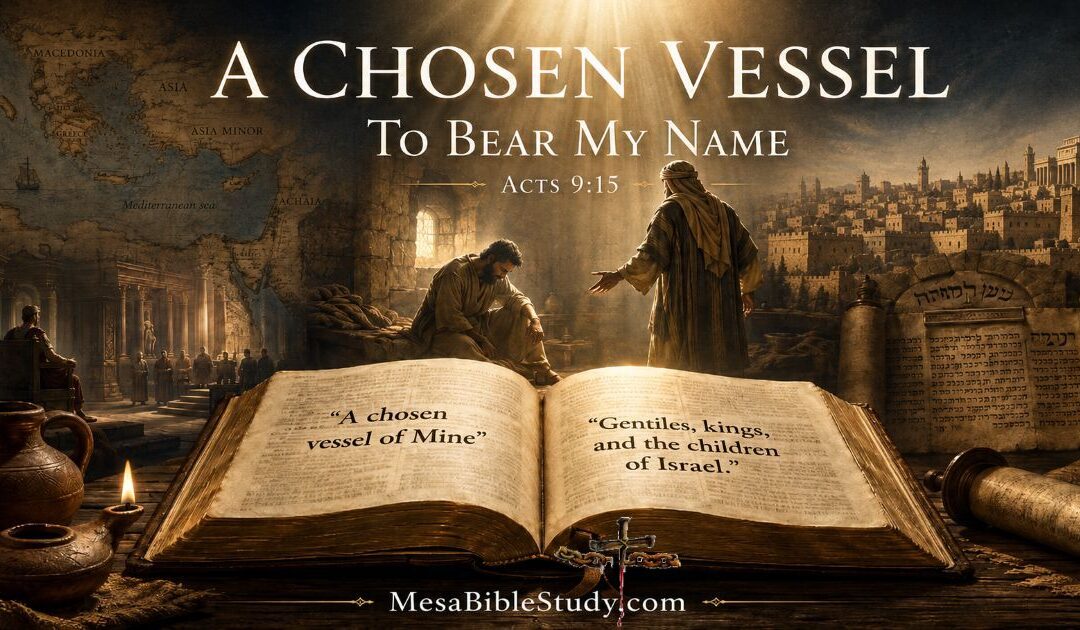
A Chosen Vessel to Bear Christ’s Name
Acts 9:15
“But the Lord said to him, ‘Go, for he is a chosen vessel of Mine to bear My name before Gentiles, kings, and the children of Israel.’”
Introduction
Acts 9:15 raises a question that is rarely given the attention it deserves:
Why did the Lord choose Paul when He already had twelve apostles?
Jesus Christ had personally selected twelve men during His earthly ministry. He had trained them, commissioned them, given them authority, and promised that they would sit upon twelve thrones judging the twelve tribes of Israel.
After the resurrection, Matthias was chosen to replace Judas, restoring the number to twelve. The Twelve were present in Jerusalem. They were preaching that Jesus was the Christ. They were performing miracles. Thousands had responded to their message.
The Lord did not lack apostles.
Yet in Acts 9, the risen and ascended Lord Jesus Christ appeared personally to Saul of Tarsus—one of the greatest persecutors of those who believed that Jesus was Israel’s Messiah—and chose him for an entirely distinct commission.
Paul was not selected to replace Judas.
He was not added to the Twelve.
He was not sent to Jerusalem to become Peter’s student.
He was not instructed to place himself under the authority of the Twelve and continue their existing ministry.
The Lord declared that Saul was “a chosen vessel of Mine” who would bear His name before Gentiles, kings, and the children of Israel. Acts 9:15 marks a decisive development in the unfolding revelation of God.
The question is not merely, “Why did Saul become Paul?”
The deeper question is:
Why did the risen Lord interrupt the prophetic program centered in Jerusalem and personally commission another apostle—an apostle whose ministry would be directed primarily toward the Gentile world?
To understand Acts 9:15, the verse must be read in its historical setting and within the timeline of progressive revelation.
Background, Setting, and Purpose
Who Wrote Acts?
The book of Acts was written by Luke, the physician and companion of the apostle Paul.
Luke also wrote the Gospel of Luke. Together, Luke and Acts form a continuous historical account.
The Gospel of Luke records the earthly ministry of Jesus Christ. Acts records what the risen and ascended Lord continued to do through His chosen messengers.
Luke explains this connection in the opening verse:
“The former account I made, O Theophilus, of all that Jesus began both to do and teach.”
— Acts 1:1
The word “began” is significant. The earthly ministry recorded in Luke was only the beginning. Acts records the continued activity of Christ from heaven.
To Whom Was Acts Written?
Acts was addressed to Theophilus, but it was written for a much broader audience.
The book provides an inspired historical record of the transition from the ministry of the Twelve in Jerusalem to the Gentile ministry entrusted to Paul.
Acts begins with Peter and the Twelve in Jerusalem.
It ends with Paul in Rome, declaring the message of God among the Gentiles.
That movement is not accidental. It is one of the central developments recorded in the book.
When Does Acts 9 Occur?
Acts 9 occurs after several crucial events:
- Jesus Christ had been crucified.
- He had risen from the dead.
- He had ascended into heaven.
- The Holy Spirit had come upon the believing remnant at Pentecost.
- Peter had addressed the nation of Israel.
- Israel’s leadership had continued to resist the testimony of the Holy Spirit.
- Stephen had been rejected and stoned.
- Saul is identified as a leading persecutor of the Jerusalem Church.
The conversion and commission of Saul therefore did not occur during Christ’s earthly ministry or at Pentecost.
It occurred many years after Pentecost just after the stoning of Stephen in Acts 7.
Why Was Acts Written?
The book of Acts is a transitional book. Acts 1–6 continues the kingdom program presented in the four Gospels, with the Twelve ministering to Israel and calling the nation to repentance in light of its prophetic promises.
Beginning in Acts 7 and continuing through Acts 28, the biblical record traces the transition from God’s dealings with Israel under the Law and the prophetic kingdom program to the distinct ministry entrusted to the apostle Paul.
In Acts 9, the risen and ascended Lord Jesus Christ confronts Saul and chooses him as a vessel to bear His name before Gentiles, kings, and the children of Israel. Through Paul, Christ would later make known the preaching of Jesus Christ according to the revelation of the mystery, which had been kept secret since the world began (Romans 16:25).
These revelations were not received from the Twelve or taught to Paul by men. They were given directly to him by the ascended Lord Jesus Christ. They became the doctrinal foundation for the Body of Christ and contain the doctrine, position, walk, and hope of believers living in this present age of grace.
The book does not present this progression as an immediate transfer occurring in Acts 2.
It develops historically.
The first portion of Acts centers upon:
- Jerusalem
- Israel
- The Twelve
- Peter
- The promised kingdom
- National repentance
- The restoration promised by the prophets
- The Stoning of Stephen
Beginning in Acts 9, the narrative gradually transitions toward:
- Paul
- The Gentiles
- Justification apart from the Law
- The gospel of the grace of God
- The revelation of the mystery
- The formation and doctrine of the Body of Christ
Acts 9:15 stands at the beginning of a transitional shift.
Chapter Theme
Acts 9 records the conversion and divine commissioning of Saul of Tarsus.
Saul was not seeking Christ.
He was not reconsidering his position.
He was not traveling to Damascus to study Christianity.
He was traveling with legal authority to arrest those who called upon the name of Jesus.
Luke introduces Saul’s condition with forceful language:
“Then Saul, still breathing threats and murder against the disciples of the Lord, went to the high priest.”
— Acts 9:1
Saul represented the intensity of Israel’s opposition to the testimony that Jesus was the Christ.
But as Saul approached Damascus, the risen Lord Jesus appeared to him:
“Saul, Saul, why are you persecuting Me?”
— Acts 9:4
Saul discovered that the Jesus whom he opposed was alive, glorified, and speaking from heaven.
Blinded by the heavenly appearance, Saul was led into Damascus. The Lord then appeared in a vision to a disciple named Ananias and commanded him to go to Saul.
Ananias hesitated because he knew Saul’s reputation.
Acts 9:15 is the Lord’s answer.
Saul’s past did not prevent the Lord from choosing him. In fact, his conversion would become one of history’s greatest demonstrations of divine grace.
The persecutor would become the apostle of grace.
The enemy would become the chosen vessel.
The man who attempted to destroy those who believed in Jesus would bear the name of Jesus before Gentiles, kings, and Israel.
The Immediate Context
The immediate context begins with the Lord speaking to Ananias:
“Arise and go to the street called Straight, and inquire at the house of Judas for one called Saul of Tarsus, for behold, he is praying.”
— Acts 9:11
Ananias responded:
“Lord, I have heard from many about this man, how much harm he has done to Your saints in Jerusalem.”
— Acts 9:13
Ananias knew Saul as a persecutor.
The Lord knew Saul as His chosen vessel.
Ananias saw Saul’s past.
The Lord revealed Saul’s future.
The Lord did not tell Ananias merely that Saul had sincerely converted. He announced that Saul had been selected for a specific purpose:
“He is a chosen vessel of Mine.”
The language is deliberate.
Saul’s apostleship was not a human appointment. It did not originate with the Twelve, the Jerusalem assembly, Ananias, or any religious institution.
The risen Lord chose him.
Paul would later repeatedly defend this fact:
“Paul, an apostle—not from men nor through man, but through Jesus Christ and God the Father.”
— Galatians 1:1
Acts 9:15 is therefore not merely the account of a sinner’s conversion. It is the announcement of a new divine commission.
Phrase-by-Phrase Breakdown
1. “But the Lord said to him”
The speaker is the risen and ascended Lord Jesus Christ.
This is crucial.
Paul’s commission did not originate during the earthly ministry of Jesus. Paul was not among the Twelve who followed Christ throughout Galilee and Judea.
Paul encountered Christ after the resurrection and ascension— outside of the land of Israel.
The Lord who spoke to Peter and the Twelve upon the earth now spoke from heaven concerning Saul.
This heavenly origin became a defining feature of Paul’s apostleship and message.
Paul later wrote:
“But I make known to you, brethren, that the gospel which was preached by me is not according to man.”
— Galatians 1:11
His commission and gospel came through the revelation of the risen Jesus Christ.
2. “Go”
Ananias had raised understandable objections.
Saul had persecuted the saints.
He possessed authority to arrest believers.
His reputation produced fear.
But the Lord did not ask Ananias to evaluate whether Saul was a reasonable candidate. The Lord issued a command:
“Go.”
God’s grace had accomplished what human reasoning would have considered impossible.
The Lord had stopped Saul.
The Lord had revealed Himself to Saul.
The Lord had chosen Saul.
Ananias was to believe and obey what the Lord had declared.
3. “For he is”
The Lord speaks of Saul’s calling as an established fact.
He does not say that Saul might eventually become useful if he proved himself worthy.
He says:
“He is.”
Saul’s identity had been changed by divine intervention.
Moments earlier, he was a persecutor approaching Damascus with authority from the chief priests to arrest Jewish believers.
Now the Lord identified him according to His sovereign purpose.
This does not minimize Saul’s guilt. It magnifies the grace of God.
Paul later described himself as:
“A blasphemer, a persecutor, and an insolent man; but I obtained mercy because I did it ignorantly in unbelief.”
— 1 Timothy 1:13
Saul was not chosen because he had earned apostleship.
He was chosen as a demonstration of mercy and grace.
4. “A chosen vessel”
The word “chosen” emphasizes divine selection.
Paul did not volunteer for this ministry.
He did not campaign for apostolic recognition.
He did not receive his office through a vote of the Twelve.
The Lord selected him.
The word “vessel” describes an instrument prepared for a particular use. Saul would be the human instrument through whom the risen Christ would make known truths and carry His name into territories not central to the Peter’s ministry.
Paul would later write:
“But when it pleased God, who separated me from my mother’s womb and called me through His grace, to reveal His Son in me, that I might preach Him among the Gentiles.”
— Galatians 1:15–16
Paul’s calling was intentional, personal, and divinely determined.
5. “Of Mine”
Saul belonged to the Lord.
The expression underscores both authority and ownership.
Paul was not Peter’s chosen vessel.
He was not the Jerusalem assembly’s chosen vessel.
He was not Ananias’s chosen vessel.
The Lord said:
“He is a chosen vessel of Mine.”
Paul’s authority therefore rested upon the One who called him.
This explains why Paul repeatedly defended the divine origin of his apostleship:
“Paul, a bondservant of Jesus Christ, called to be an apostle, separated to the gospel of God.”
— Romans 1:1
His ministry could not be invalidated merely because it had not originated with the Twelve.
6. “To bear My name”
Paul was chosen to carry the name of Jesus Christ.
The man who had attempted to silence that name would now proclaim it.
The man who had arrested those who called upon that name would now suffer for that name.
To “bear” Christ’s name involves more than speaking a title. Paul would carry mystery or secret and truth of who Christ is and what Christ had accomplished.
He would proclaim:
- Jesus, of the seed of David
- Jesus Christ crucified
- Jesus Christ buried
- Jesus Christ risen
- Justification by faith
- Reconciliation through the cross
- Salvation apart from the works of the Law
- The gospel of the grace of God
- The revelation of the mystery
- The one new Body composed of believing Jews and Gentiles
Paul’s ministry would center completely upon Christ.
“For I determined not to know anything among you except Jesus Christ and Him crucified.”
— 1 Corinthians 2:2
In 2 Timothy verse 8, the apostle Paul writes:
‘Remember that Jesus Christ, of the seed of David, was raised from the dead according to my gospel,’
What a remarkable statement.
Paul does not say, “according to the gospel of the kingdom.” He does not direct Timothy back to the message proclaimed during Christ’s earthly ministry or to Peter’s Pentecost address. He says:
“According to my gospel.”
The resurrection of Jesus Christ was not itself a secret. The prophets foretold it, Christ repeatedly announced it, and the Twelve witnessed it. What was newly revealed through Paul was the full meaning and saving significance of Christ’s death and resurrection for all mankind.
Paul writes in Ephesians 3:8-11:
‘To me, who am less than the least of all the saints, this grace was given, that I should preach among the Gentiles the unsearchable riches of Christ, and to make all see what is the fellowship of the mystery, which from the beginning of the ages has been hidden in God who created all things through Jesus Christ; to the intent that now the manifold wisdom of God might be made known by the church to the principalities and powers in the heavenly places, according to the eternal purpose which He accomplished in Christ Jesus our Lord,’
It is only through the revelations given directly to the apostle Paul, and then made known through his ministry and letters, that we learn God’s eternal purpose for the Body of Christ and how that purpose was accomplished through the death, burial, and resurrection of Jesus Christ.
7. “Before Gentiles”
The first group named is the Gentiles.
This is extraordinary within the unfolding narrative.
The Twelve had been selected in direct connection with Israel. Their number corresponded to the twelve tribes. During Christ’s earthly ministry, they were commanded:
“Do not go into the way of the Gentiles, and do not enter a city of the Samaritans.”
— Matthew 10:5
Instead, they were sent:
“To the lost sheep of the house of Israel.”
— Matthew 10:6
Their commission was rooted in Israel’s prophetic kingdom program.
Paul’s calling was different.
Although Paul regularly went first to Jewish synagogues, he proclaimed the gospel of grace, not the gospel of the kingdom. His defining apostleship was directed toward the Gentiles:
“For I speak to you Gentiles; inasmuch as I am an apostle to the Gentiles.”
— Romans 11:13
“For He who worked effectively in Peter for the apostleship to the circumcised also worked effectively in me toward the Gentiles.”
— Galatians 2:8
The Lord already had twelve apostles associated with Israel.
He chose Paul as the apostle of the Gentiles.
That distinction is not a human theological invention. It appears directly in the biblical record.
8. “Kings”
Paul would also bear Christ’s name before rulers and political authorities.
This aspect of his commission unfolded throughout Acts.
Paul testified before:
- Sergius Paulus
- The magistrates at Philippi
- Gallio
- Felix
- Festus
- Herod Agrippa II
- Roman authorities
- Members of Caesar’s household
Paul’s imprisonment did not prevent his commission. It placed him before rulers whom he might never otherwise have addressed.
The Lord used chains as a means of advancing the message.
Paul wrote:
“The things which happened to me have actually turned out for the furtherance of the gospel.”
— Philippians 1:12
9. “And the children of Israel”
Paul’s primary apostleship to the Gentiles did not mean that he never ministered to Israel.
Acts repeatedly records Paul entering synagogues and reasoning from the Scriptures that Jesus was the Christ.
Paul’s burden for Israel remained intense:
“My heart’s desire and prayer to God for Israel is that they may be saved.”
— Romans 10:1
However, Paul’s ministry to Israel does not erase his distinct Gentile apostleship.
Acts 9:15 names all three spheres:
- Gentiles
- Kings
- The children of Israel
The order itself is striking. The Gentiles appear first.
Paul would bear the name of Christ widely, but his defining office remained:
“A teacher of the Gentiles in faith and truth.”
— 1 Timothy 2:7
Why Paul if the Lord Already Had Twelve Apostles?
The existence of the Twelve makes Paul’s selection more significant, not less.
If Paul had merely been intended to repeat the same message under the same commission, the Lord could have sent one of the Twelve.
They were already trained.
They had witnessed Christ’s earthly ministry.
They had seen the risen Lord.
They had received authority.
They had been promised positions in Israel’s kingdom.
They were already preaching in Jerusalem.
Yet the Lord personally appeared to Saul and appointed him independently.
Why?
Because Paul’s apostleship was not merely an extension of the Twelve’s ministry.
The Twelve were associated with:
- Israel
- The twelve tribes
- The kingdom promised by the prophets
- National repentance
- The restoration of all things
- Christ’s earthly ministry
- The circumcision
Paul was commissioned in connection with:
- The Gentiles
- The gospel of the grace of God
- Justification apart from the Law
- The preaching of Christ crucified
- The revelation of the mystery
- The Body of Christ
- The uncircumcision
Paul did not replace the Twelve.
He did not become the thirteenth member of their kingdom commission.
He was a uniquely chosen apostle with a distinct stewardship from the risen and glorified Christ.
What This Verse Does Not Mean
It Does Not Mean That Paul Replaced Judas
Judas’s position among the Twelve was filled by Matthias in Acts 1.
Peter explained that another man had to take Judas’s office. Matthias was then numbered with the eleven apostles:
“And he was numbered with the eleven apostles.”
— Acts 1:26
The number twelve was significant because the Twelve were connected to the twelve tribes of Israel.
Paul was not chosen to sit upon one of those twelve thrones.
His apostleship had a different purpose.
It Does Not Mean That Paul Joined the Twelve
Scripture never says that Paul became one of the Twelve.
Paul distinguished himself from them:
“Whether then it was I or they, so we preach and so you believed.”
— 1 Corinthians 15:11
“I” and “they” are not the same group.
Paul later described those who were apostles before him, demonstrating that his apostleship began separately:
“Nor did I go up to Jerusalem to those who were apostles before me.”
— Galatians 1:17
It Does Not Mean That Peter Taught Paul His Gospel
Paul directly denied that his gospel came from men:
“For I neither received it from man, nor was I taught it, but it came through the revelation of Jesus Christ.”
— Galatians 1:12
After his conversion, Paul did not immediately go to Jerusalem for instruction. He went into Arabia and later returned to Damascus.
Only after three years did he go to Jerusalem, where he stayed with Peter for fifteen days.
Paul’s message originated through revelation from Christ, not instruction from the Twelve.
It Does Not Mean That the Twelve Failed
The distinction between Paul and the Twelve should not be framed as though the Twelve were disobedient, inferior, or mistaken.
They faithfully carried out the ministry entrusted to them according to what had been revealed.
Their ministry concerned Israel and the fulfillment of prophetic promises.
Paul’s later commission introduced further revelation.
The difference is not faithfulness versus failure.
The difference is distinct commissions within the progression of God’s plan of redemption.
It Does Not Mean That There Are Two Ways of Salvation Today
Recognizing the distinction between Paul and the Twelve does not mean that two saving messages operate simultaneously today.
Paul declares the gospel by which people are now saved:
“Christ died for our sins according to the Scriptures, and that He was buried, and that He rose again the third day according to the Scriptures.”
— 1 Corinthians 15:3–4
Salvation today is by grace through faith alone, apart from works, through the finished work of Jesus Christ.
What This Verse Does Mean
Acts 9:15 means that the risen Lord Jesus Christ personally and sovereignly selected Saul for a distinct ministry.
Paul’s apostleship did not originate with Jerusalem.
It did not depend upon authorization from the Twelve.
It was not a continuation of Paul’s former religious life.
It was not merely the conversion of a prominent opponent.
The Lord chose Paul as His vessel to carry the name of Christ before Gentiles, kings, and Israel.
This appointment marked a major development in biblical history.
The Lord already had twelve apostles connected to Israel and its promised kingdom.
He chose another apostle because He was revealing and administering something not previously entrusted to the Twelve. These new revelations were hidden in God until revealed to Paul: a Gentile-centered apostleship associated with the gospel of grace and, through later revelation, the mystery concerning the Body of Christ.
Acts 9:15 does not reveal every detail of Paul’s later doctrine.
It announces the man through whom that doctrine would be revealed.
The verse is therefore a doorway.
To understand why Paul was chosen, the reader must continue into Paul’s letters, where the risen Christ explains the nature of Paul’s apostleship, gospel, revelation, and stewardship.
It was Paul as the wise master builder, by the grace of God, and the wisdom given to him— laid the foundation for the body of Christ. Paul gives a clear warning to all. But careful, be aware of what foundation you are building upon— there is only one foundation to build upon and that foundation is Jesus Christ.‘ According to the grace of God which was given to me, as a wise master builder I have laid the foundation, and another builds on it. But let each one take heed how he builds on it. For no other foundation can anyone lay than that which is laid, which is Jesus Christ.’
I Corinthians 3:10-11
Cross-References for Going Deeper
Matthew 10:5–6
Jesus instructed the Twelve not to go to the Gentiles or Samaritans, but to the lost sheep of the house of Israel.
This establishes the original national focus of their ministry.
Matthew 19:28
Jesus promised the Twelve that they would sit upon twelve thrones judging the twelve tribes of Israel.
Their number and ministry were directly connected to Israel.
Acts 1:26
Matthias was numbered with the eleven apostles, restoring the Twelve before Pentecost.
Paul was therefore not chosen as Judas’s replacement.
Acts 22:14–15
Paul recounts that God appointed him to know His will, see the Just One, and become His witness to all men.
His calling originated with God.
Acts 26:16–18
The risen Christ explains Paul’s commission more fully, sending him to the Gentiles to open their eyes and turn them from darkness to light.
Romans 11:13
“I am an apostle to the Gentiles.”
Paul explicitly identifies the defining sphere of his apostleship.
Galatians 1:11–12
Paul’s gospel was not received from man or taught by man. It came through the revelation of Jesus Christ.
Galatians 2:7–9
Paul and the Jerusalem leaders recognized distinct apostleships: the gospel of the uncircumcision (Gentiles) was committed to Paul, while the gospel of the circumcision (Jews) was committed to Peter.
Ephesians 3:1–9
Paul explains that the dispensation of the grace of God and the mystery were made known to him by revelation.
Colossians 1:24–27
Paul describes the stewardship given to him to fulfill the Word of God concerning the mystery hidden from ages and generations.
1 Timothy 1:12–16
Paul explains that he obtained mercy and became a pattern demonstrating the longsuffering of Jesus Christ.
Doctrinal Summary
Acts 9:15 records the Lord’s sovereign selection of Paul as a distinct apostolic vessel.
The Lord already had twelve apostles.
They had been chosen in connection with Israel, the twelve tribes, and the promised kingdom. Their ministry began in Jerusalem and was rooted in the prophetic program spoken by the prophets.
Paul was chosen much later, by the risen and ascended Christ.
He was not selected to replace Judas, join the Twelve, or receive his gospel from Peter.
He was commissioned directly by Christ to bear His name before Gentiles, kings, and Israel.
Paul later explains that he was:
- The apostle of the Gentiles
- Entrusted with the gospel of the uncircumcision
- Given the gospel of the grace of God
- Made a steward of the mysteries of God
- Given the dispensation of the grace of God
- Made the minister through whom the mystery was revealed and proclaimed
This does not diminish the Twelve.
It recognizes the divine purpose of their ministry and the distinct divine purpose of Paul’s ministry.
The Bible is a progressive revelation.
Truth must be read according to when it was revealed, to whom it was revealed, and through whom God made it known.
Acts 9:15 is the divine announcement that Paul would occupy a unique place in that unfolding revelation. And God expects us to believe what He says.
Final Summary
Why Paul? The Lord already had twelve apostles.
He had twelve men connected to the twelve tribes of Israel.
He had twelve men preaching that Jesus was the Christ.
He had twelve men proclaiming Israel’s need to repent.
He had twelve men awaiting the restoration promised by the prophets.
But the risen Lord was about to send His name into the Gentile world through a distinct apostolic ministry.
Therefore, He chose Saul.
Paul was not an afterthought.
He was not the replacement for Judas.
He was not Peter’s assistant.
He was not a late addition to the Twelve.
He was the chosen vessel of the risen Christ.
Through Paul, the Lord would proclaim the gospel of His grace, reveal salvation apart from the works of the Law, make known the mystery of Christ, and provide the doctrine for the Body of Christ, the Church.
Acts 9:15 forces every careful Bible student to confront the question:
If Paul merely continued the same ministry as the Twelve, why was a separate apostle necessary?
The answer is found in the progression of revelation.
The Lord chose twelve apostles for Israel.
Then the risen and glorified Christ chose Paul as the apostle of the Gentiles.
That distinction is crystal clear, and no man, denomination or tradition can build a bridge to get around it.
We have to believe what God says according to His divinely revealed order.
Want to Go Deeper?
This Passage Breakdown examines Acts 9:15 phrase by phrase.
The companion study asks the broader question:
If the Lord already had twelve apostles, why was Paul necessary?
Continue with:
Why Paul? The Lord Already Had Twelve Apostles

by Jamie Pantastico | Jul 31, 2026 | Devotionals |
Faith Under Pressure — Part 19
Psalm 27:11
“Teach me how you want me to live, LORD; lead me along a level path because of those who wait to ambush me.”
Context & Connection
In Part 18, David confronted the pain of abandonment: “Even if my father and mother abandoned me, the LORD would take me in.” Now in Psalm 27:11, he moves from being received by the Lord to being taught by the Lord.
David is still under pressure. Enemies are near. Danger remains. Yet he does not merely ask the Lord to remove the pressure. He asks the Lord to teach him how to live.
The key truth in Part 19 is this: Faith does not only ask God to remove the pressure; faith asks God to lead through it.
Teach Me How You Want Me to Live
David’s prayer is humble. He is not assuming he knows the way. He is not leaning on his own understanding. He is not asking only for escape or vindication. He is asking for instruction.
Pressure can make the heart reactive. We want to defend ourselves, fix everything immediately, or act from fear, frustration, or exhaustion. David slows the heart before the Lord and prays, “Teach me…” That is faith under pressure.
Pressure Makes Us Need Wisdom
Pressure has a way of making the path feel confusing. What should I do? How should I respond? When should I wait? When should I act? David brings that need to the Lord.
He understands that under pressure he needs more than relief. He needs wisdom. He needs instruction. He needs the Lord to shape his steps. Spiritual maturity is seen not only in asking God to change the circumstance, but in asking God to teach us how to walk rightly within it.
Faith Does Not Only Ask for Removal
There is nothing wrong with asking the Lord for deliverance. David has already done that in this Psalm. He has cried out for mercy and asked not to be rejected or abandoned. But now he asks something deeper: “Teach me how you want me to live…”
Many times under pressure our first desire is simply, “Lord, remove this. Stop this. Change this.” Those prayers are understandable. But Psalm 27:11 reminds us that faith also asks, “Lord, teach me. Lead me. Show me how to walk. Keep me faithful while the pressure remains.”
The LORD Must Teach the Way
David does not ask the world, fear, or pressure to teach him. He asks the Lord. Pressure will try to teach its own lessons: Fear teaches panic. Bitterness teaches resentment. Self-reliance teaches control. Weariness teaches withdrawal.
But the Lord teaches truth, wisdom, patience, trust, and faithfulness. The believer’s way must be shaped by the Lord, not by the pressure.
Lead Me Along a Level Path
David continues, “lead me along a level path…” A level path speaks of stability, clarity, and sure footing. David does not want to stumble or be driven into confusion. He asks the Lord to lead him where his steps are steady.
This fits the whole Psalm. David has already said the Lord is his light. Now he asks the Lord to lead him. Light and leading belong together. The believer needs not only strength to endure, but direction to walk faithfully.
Because of Those Who Wait to Ambush Me
David’s prayer for instruction is not abstract. He needs guidance because enemies are watching. There are those who want him to stumble and wait for an opportunity. Under pressure, the way we respond matters. A careless word, a fearful decision, or a bitter reaction can create more trouble.
David knows he needs the Lord’s guidance because opposition is real.
Pressure Can Make Us Vulnerable to Wrong Steps
When believers are tired, discernment can feel harder. Emotions are strained. Fear becomes loud. Decisions can become rushed. The weary heart may be tempted to take a path that seems easier but is not faithful.
David’s prayer is wise: “Teach me… Lead me…” That is not weakness. That is wisdom. The believer under pressure must depend on the Lord not only for comfort, but for guidance.
The Believer’s Walk Matters Under Pressure
Faith under pressure is not only about what we feel. It is also about how we walk. David asks the Lord to teach him how to live because his conduct matters, especially when others are watching.
Pressure does not excuse sin, bitterness, or foolishness. Rather, pressure should drive us to ask the Lord for more wisdom, dependence, humility, and grace to walk rightly. The believer’s walk under pressure can become a testimony to the faithfulness of God.
What This Means
Psalm 27:11 teaches us that faith under pressure seeks the Lord’s instruction. David does not merely ask for the pressure to stop. He asks the Lord to teach him how to live and lead him along a level path. He knows enemies are watching, and he knows he needs divine guidance.
This is faith under pressure: not self-direction, not emotional reaction, not fear-driven decisions, but humble dependence on the Lord’s instruction.
A Word of Encouragement
Beloved, perhaps the pressure has made the path feel unclear. You may not know what to do next or how to respond. You may feel tired, vulnerable, and uncertain.
David’s prayer is a good prayer for you today: “Teach me how you want me to live, LORD.” You do not have to know the whole path. You do not have to carry the burden in your own wisdom. Ask the Lord to teach you. Open His Word. Let Scripture guide your steps. The Lord knows how to lead His own through pressure. He is faithful.
For Further Study
Read Psalm 27:11 slowly. Notice David’s requests: Teach me. Lead me. Ask yourself: Am I only asking the Lord to remove the pressure, or am I asking Him to teach me how to live faithfully through it?
👇
Faith Under Pressure Series
Previous in the Series:
Part 18 — My Father and Mother Abandoned Me
Next in the Series:
Part 20 — Lead Me Along a Level Path
Back to Series Page
Faith Under Pressure — A Psalm 27 Devotional Series
by Jamie Pantastico | Jul 31, 2026 | Pauline Theology |
Part 9 — RETROACTIVE REVELATION SERIES
Why Paul’s repeated personal language cannot be ignored
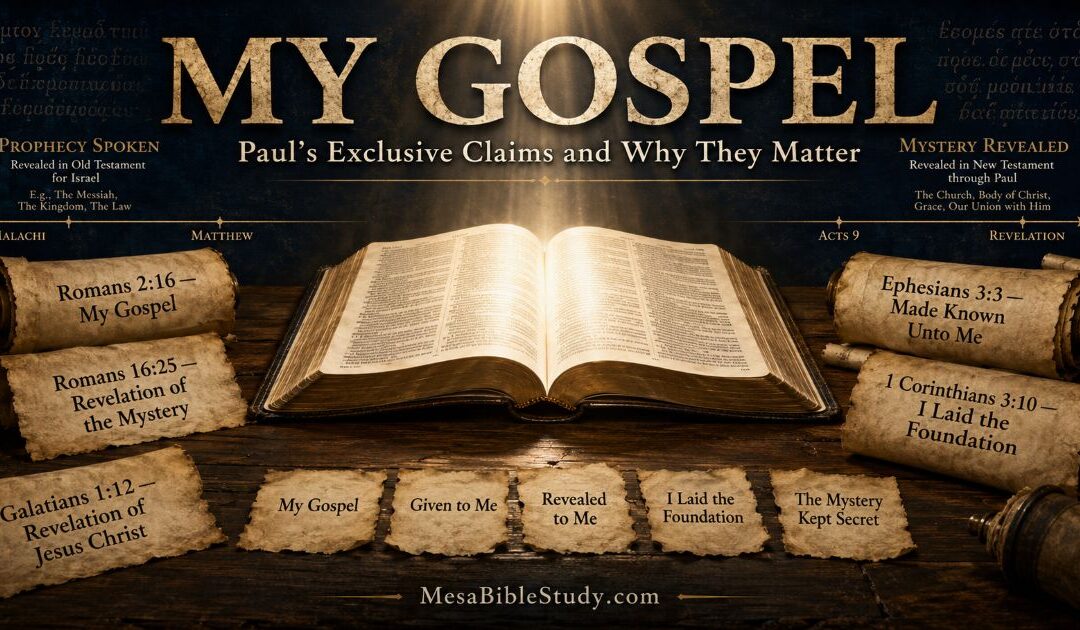
There is a phrase in Paul’s letters that much of Christendom reads too quickly:
“My gospel.”
Paul uses language that no other apostle uses. He does not merely say “the gospel.” He says “my gospel.” He speaks of the gospel preached by him, revelation given to him, the dispensation committed to him, the mystery made known to him, the foundation laid by him, and the wisdom given to him.
That language matters.
Paul does not present his gospel as something he received from Peter. He does not present his ministry as an extension of the Twelve. He does not present the mystery as something already known at Pentecost. He says his gospel came by revelation from Jesus Christ.
If Peter had already preached Paul’s gospel in Acts 2, then Paul’s repeated exclusive claims become very difficult to explain. But if Christ revealed something distinct through Paul — the gospel of grace, the mystery, the Body of Christ, Jew–Gentile equality, and the dispensation of grace — then Paul’s language makes perfect sense.
These exclusive claims are not incidental. They are intentional. They appear repeatedly across Paul’s letters, and they form a consistent pattern that must be taken seriously if we are going to rightly divide the Word of truth.
A Necessary Clarification
Before going further, let this be stated clearly.
All salvation — from Abel to the end of time — is only possible because of the finished work of Jesus Christ: His death, His shed blood, His burial, and His resurrection. There is one Savior. There is one cross. There is one sacrifice. There is one ultimate basis of redemption.
This study is not teaching two Saviors, two crosses, or two ultimate ways of salvation. The issue is not the basis of salvation. The issue is the timing and content of revelation.
When did God reveal the gospel of grace?
When did God reveal the Body of Christ?
When did God reveal Jew–Gentile equality in one Body?
When did God reveal the mystery hidden in Himself?
Paul says that revelation was given to him. That matters. Scripture is progressive. God reveals truth in stages. Ignoring the order of that revelation leads to confusion. Recognizing it leads to clarity.
Paul’s Staggering Phrase: “My Gospel”
Paul writes:
“In the day when God shall judge the secrets of men by Jesus Christ according to my gospel.”
— Romans 2:16
That is a staggering statement. Paul says the secrets of men will be judged by Jesus Christ according to my gospel. He does not say according to Peter’s Pentecost sermon. He does not say according to the Sermon on the Mount. He does not say according to Israel’s kingdom proclamation. He says “according to my gospel.”
This does not mean Paul invented the gospel. It does not mean Paul is the Savior. It means Paul was entrusted with a specific gospel message by direct revelation from Jesus Christ. Paul speaks this way because something was committed to him. The risen Christ gave him a message for this present age, and Paul repeatedly identifies that message as his own by divine entrustment.
This is not the language of a man who is simply repeating what the Twelve already preached. It is the language of a man who received a distinct commission and a distinct revelation.
“My Gospel” and the Mystery Kept Secret
Paul writes again:
“Now to him that is of power to stablish you according to my gospel, and the preaching of Jesus Christ, according to the revelation of the mystery, which was kept secret since the world began.”
— Romans 16:25
This verse is one of the clearest statements in the entire New Testament. Paul says believers are established according to my gospel, the preaching of Jesus Christ, according to the revelation of the mystery, which was kept secret since the world began.
That means Paul’s gospel is not merely a general message about Jesus. It is the preaching of Jesus Christ according to the revelation of the mystery. That mystery was not spoken since the world began. It was kept secret since the world began.
That distinction is essential.
Peter in Acts 3 speaks of what God had spoken by the mouth of all His holy prophets since the world began. Paul in Romans 16 speaks of what had been kept secret since the world began. Those are not the same category. Peter’s ministry is connected to prophecy. Paul’s gospel is connected to the mystery.
If the mystery was kept secret, then it cannot be treated as something already operating and publicly known in Acts 2. The language of “kept secret” and “now revealed” demands a clear chronological distinction.
Paul Did Not Receive His Gospel From Peter
Paul writes:
“But I certify you, brethren, that the gospel which was preached of me is not after man. For I neither received it of man, neither was I taught it, but by the revelation of Jesus Christ.”
— Galatians 1:11–12
This passage leaves no room for confusion. Paul says the gospel he preached was not after man, not received from man, not taught by man, but received by revelation of Jesus Christ.
That means Paul did not get his gospel from Peter. He did not learn it from the Twelve. He did not receive it from the Jerusalem assembly. He did not inherit it from Acts 2. He received it by direct revelation from Jesus Christ.
If Paul was merely repeating what Peter already preached, Galatians 1:11–12 becomes almost impossible to explain. Why would Paul insist that he did not receive his gospel from man if Peter had already preached the same message publicly at Pentecost? Why would Paul emphasize revelation if he was simply passing along what the Twelve already knew? Why would Paul defend the independence of his gospel if it was the same message already established in Jerusalem?
Paul’s own testimony is clear. His gospel came by revelation. That claim is foundational to understanding his apostleship and the content of the message he was given.
The Dispensation of Grace Was Given to Paul
Paul writes:
“For this cause I Paul, the prisoner of Jesus Christ for you Gentiles, If ye have heard of the dispensation of the grace of God which is given me to you-ward.”
— Ephesians 3:1–2
Notice the language: “given me to you-ward.” Paul does not say this dispensation was given to Peter at Pentecost. He does not say it was given to the Twelve in Acts 2. He says it was given to him for the Gentiles.
Then he explains how:
“How that by revelation he made known unto me the mystery…”
— Ephesians 3:3
Again, the language is specific. The mystery was made known to Paul by revelation. And Who revealed it to Paul, the ascended glorified Lord Jesus. This is not vague. This is not tradition. This is Paul’s own explanation of his apostleship. The dispensation of the grace of God was entrusted to him, and the content of that dispensation is the mystery of Christ.
Paul Says the Mystery Was Not Made Known Before
Paul continues:
“Which in other ages was not made known unto the sons of men, as it is now revealed…”
— Ephesians 3:5
This verse is devastating to retroactive revelation. Paul does not say the mystery was known but unclear. He does not say it was preached in seed form. He does not say Peter had already revealed it at Pentecost. He says it “was not made known.”
That must be allowed to mean what it says. If the mystery was not made known in other ages, then it cannot be read backward into Acts 2. If it was not made known, then Peter was not preaching it. If it was not made known, then the Twelve were not proclaiming it. If it was not made known, then the Body of Christ cannot be placed before the revelation of the Body without importing later truth into an earlier passage.
That is the problem with retroactive revelation. It takes what Paul says was not made known and treats it as though it was already operating.
Paul Defines the Mystery as Jew–Gentile Equality in One Body
Paul defines the mystery:
“That the Gentiles should be fellowheirs, and of the same body, and partakers of his promise in Christ by the gospel.”
— Ephesians 3:6
This is not merely Gentiles being blessed. Gentile blessing was not a mystery. The Old Testament spoke of Gentile blessing. The prophets spoke of nations coming to Israel’s light. The mystery is not that Gentiles could be blessed. The mystery is that Gentiles would be fellow heirs, of the same Body, and partakers in Christ through the gospel.
That is Jew–Gentile equality in one Body. That is the Body of Christ. That is the one new man. And Paul says this mystery was not made known in other ages. Therefore, the Body of Christ cannot be responsibly placed in Acts 2 unless Scripture says it was revealed there. It does not.
Paul Says the Mystery Was Hidden in God
Paul writes:
“And to make all men see what is the fellowship of the mystery, which from the beginning of the world hath been hid in God…”
— Ephesians 3:9
This is precise language. Paul does not say the mystery was hidden in the Old Testament. He does not say it was hidden in Joel. He does not say it was hidden in Peter’s Pentecost sermon. He says it was “hid in God.”
That means the mystery (secret) was not available for discovery in earlier Scripture. It was not sitting openly in prophecy waiting to be decoded. It was hidden in God until God revealed it. That destroys the idea that the Body of Christ can be read backward into Acts 2.
Paul Says the Mystery Was Hidden From Ages and Generations
Paul writes:
“Whereof I am made a minister, according to the dispensation of God which is given to me for you, to fulfil the word of God; Even the mystery which hath been hid from ages and from generations, but now is made manifest to his saints.”
— Colossians 1:25–26
Again, Paul speaks of a dispensation given to him, for the saints, to fulfill the Word of God, the mystery hidden from ages and generations, and now made manifest. This is not ordinary language. Paul is describing a revelation entrusted to him. The mystery (secret) had been hidden. Now it was made manifest.
That sequence matters. Hidden. Then revealed. Not hidden while already functioning as revealed doctrine. Not known under another name. Not preached by Peter before Paul. Hidden, then revealed.
Paul Says He Laid the Foundation
Paul writes:
“According to the grace of God which is given unto me, as a wise masterbuilder, I have laid the foundation…”
— 1 Corinthians 3:10
This verse is monumental. Paul does not say Peter laid the foundation for the Body of Christ. He does not say the Twelve laid the foundation. He does not say Pentecost laid the foundation. He says, “I have laid the foundation.” It is crucial to always know the time element. Paul came on the scene many years after Pentecost (Acts 9).
The foundation is Jesus Christ. Not another Christ. Not another Savior. Not another cross. But Jesus Christ according to the revelation of the mystery entrusted to Paul. Paul laid the doctrinal foundation for the Body of Christ as the wise master builder.
That language matters. It fits perfectly with “my gospel,” “given to me,” “revealed to me,” “dispensation given to me,” and “mystery made known to me.” Paul’s testimony is consistent.
Peter Acknowledges the Wisdom Given to Paul
Peter writes near the end of his ministry:
“And consider that the longsuffering of our Lord is salvation—as also our beloved brother Paul, according to the wisdom given to him, has written to you, as also in all his epistles, speaking in them of these things…”
— 2 Peter 3:15–16
This passage is often read too quickly. Peter is speaking about salvation and the longsuffering of the Lord. And when he speaks of these things, he points his readers to Paul. He does not say, “Go back to my sermon at Pentecost.” He does not say, “Go back to Acts 3.” He does not say, “Go back to the Sermon on the Mount.” He points to Paul’s writings.
Peter says Paul wrote according to wisdom given to him. Not wisdom given to Peter. Not wisdom given to John. Not wisdom given equally to all the apostles from the beginning. Wisdom given to Paul. Then Peter warns that some twist Paul’s writings to their own destruction, as they do also the rest of the Scriptures.
That means Peter recognizes Paul’s writings as Scripture. It also means Paul’s writings must be handled carefully and not twisted. One of the most common ways Paul is twisted is by forcing his revelation backward into Peter’s ministry. Peter does not erase Paul’s distinction. He confirms it.
No Other Apostle Uses Paul’s Language
This point must not be ignored. Peter never says “my gospel.” John never says “my gospel.” James never says “my gospel.” No other apostle says the dispensation of grace was given to me, the mystery was revealed to me, I laid the foundation, I am the apostle of the Gentiles, or God will judge according to my gospel.
Paul speaks this way because his apostleship was unique. He was not one of the Twelve. He was not sent under the same commission as Peter. He was not carrying forward the same ministry to Israel. He was raised up by the risen Christ with a distinct apostleship to the Gentiles.
Paul writes:
“For I speak to you Gentiles, inasmuch as I am the apostle of the Gentiles…”
— Romans 11:13
That is not a minor detail. It is central to understanding the present dispensation.
Galatians 2 Confirms Paul’s Distinct Gospel and Apostleship
Paul writes:
“But contrariwise, when they saw that the gospel of the uncircumcision was committed unto me, as the gospel of the circumcision was unto Peter; For he that wrought effectually in Peter to the apostleship of the circumcision, the same was mighty in me toward the Gentiles: And when James, Cephas, and John, who seemed to be pillars, perceived the grace that was given unto me, they gave to me and Barnabas the right hands of fellowship…”
— Galatians 2:7–9
This is not vague. Paul says the gospel of the uncircumcision was committed to him. The gospel of the circumcision was committed to Peter. Peter had an apostleship to the circumcision. Paul had an apostleship to the Gentiles. James, Cephas, and John perceived the grace given to Paul and gave him the right hand of fellowship. They did not correct him. They did not teach him his gospel. They did not absorb him into their commission. They recognized the grace given to him. That confirms Paul’s distinct apostleship.
If Paul Was Repeating Peter, Why Say “My Gospel”
If Peter preached Paul’s gospel in Acts 2, then Paul’s repeated language becomes difficult to explain. Why does Paul say “my gospel”? Why does Paul say his gospel was not received from man? Why does Paul say he was not taught it? Why does Paul say it came by revelation? Why does Paul say the dispensation of grace was given to him? Why does Paul say the mystery was made known to him? Why does Paul say the mystery was not made known in other ages? Why does Paul say the mystery was hidden in God? Why does Paul say he laid the foundation? Why does Peter later point readers to Paul’s writings concerning salvation?
These questions matter. They cannot be answered by simply saying, “Peter and Paul preached the same gospel.” That statement collapses under the weight of Paul’s own words.
Why This Matters
This is not an academic debate. If Paul’s exclusive claims are ignored, the gospel becomes blurred. Law and grace get mixed. Israel and the Church get mixed. Prophecy and mystery get mixed. Kingdom doctrine and Body doctrine get mixed. Peter’s ministry to Israel gets blended with Paul’s apostleship to the Gentiles. And the doctrine for believers today becomes obscured.
That matters because the doctrine for the Body of Christ — grace-age believers today — is found in Paul’s letters. Paul is the apostle of the Gentiles. Paul received the dispensation of the grace of God. Paul reveals the mystery. Paul explains the one Body. Paul lays out the believer’s position, walk, warfare, assurance, liberty, and hope in this present age.
That does not mean the rest of Scripture is unimportant. All Scripture is inspired and profitable. But all Scripture is not written directly to the same people under the same program. Genesis is profitable. Matthew is profitable. Acts is profitable. Hebrews through Revelation are profitable. But the doctrine that establishes the Body of Christ today is found in Paul’s epistles.
When Paul is blurred, doctrine is blurred. When doctrine is blurred, the gospel is blurred. When the gospel is blurred, assurance is weakened. And when assurance is weakened, believers are left striving for what Christ has already accomplished. That is why Paul’s exclusive claims matter.
Final Summary
Paul’s repeated exclusive language cannot be ignored. He says “my gospel,” “given to me,” “revealed to me,” “committed to me,” “dispensation given to me,” and “I laid the foundation.” No other apostle speaks this way.
Paul did not receive his gospel from Peter. He did not learn it from the Twelve. He did not inherit it from Acts 2. He received it by revelation from Jesus Christ. Paul connects his gospel to the mystery kept secret since the world began. He says the mystery was not made known in other ages. He says it was hidden in God. He says it was hidden from ages and generations, but now revealed. He defines that mystery as Gentiles being fellow heirs, of the same Body, and partakers in Christ through the gospel.
Peter later acknowledges the wisdom given to Paul and points readers to Paul’s writings concerning salvation. That is not accidental. That is Scripture confirming Paul’s unique apostleship. If Paul was merely repeating Peter, his language makes no sense. But if Christ revealed the mystery through Paul, then every phrase fits perfectly.
That is why Paul says “my gospel.” And that is why Paul’s exclusive claims matter.
Continue the Retroactive Revelation Series
Paul’s exclusive claims cannot be ignored.
If this study helped clarify why Paul repeatedly says “my gospel,” continue with the full Retroactive Revelation Series.
Have questions or comments? Leave them below. They will be seen, and I will respond.
Previous Study:
Paul the Master Builder: Why 1 Corinthians 3:10 Matters
Next Study:
Retroactive Revelation Is Not a Biblical Hermeneutic
by Jamie Pantastico | Jul 30, 2026 | Verse-by-Verse Bible Studies |
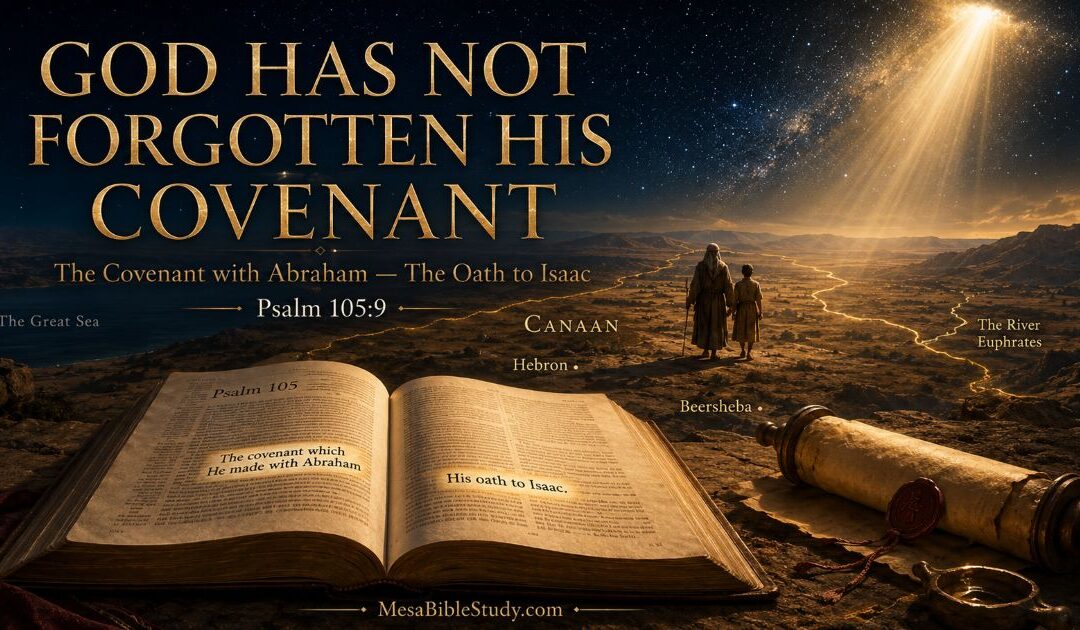
The Covenant with Abraham, the Oath to Isaac, and God’s Unchanging Promises to Israel
“The covenant which He made with Abraham,
And His oath to Isaac,”
—Psalm 105:9
Introduction
Psalm 105:9 is a short verse, but its doctrinal significance reaches across the entire biblical record.
The psalmist is not speaking about a vague promise made to humanity in general. He is identifying a specific covenant that God made with a specific man and then solemnly reaffirmed to a specific son:
- The covenant was made with Abraham.
- The oath was reaffirmed to Isaac.
- It was later confirmed to Jacob.
- It became an everlasting covenant with Israel.
- It included the land of Canaan as their inheritance.
The language is historical, national, covenantal, and unmistakably connected to Israel.
Psalm 105 does not present Israel’s preservation as the result of Israel’s faithfulness. It presents Israel’s preservation as the result of God’s faithfulness to His own word.
Men may forget their promises. Nations may violate their agreements. Generations may pass away. But God remembers the covenant He made.
Psalm 105:9 declares that Israel’s covenantal foundation rests not upon human merit, political circumstances, or national strength, but upon the promise and oath of God Himself.
Background, Setting, and Purpose
Psalm 105 is a historical psalm of praise celebrating the covenant faithfulness of the LORD toward Israel.
The opening verses call upon the people to:
- Give thanks to the LORD.
- Call upon His name.
- Make His deeds known among the nations.
- Remember His marvelous works.
- Seek the LORD continually.
The psalm then traces God’s dealings with Israel from Abraham through the patriarchs, Joseph, Egypt, the Exodus, the wilderness, and Israel’s entrance into the land.
The purpose is not merely to rehearse Israel’s history. It is to demonstrate that Israel’s history is the record of God acting in faithfulness to His covenant.
The psalm emphasizes what God did:
- He made the covenant.
- He protected the patriarchs.
- He sent Joseph ahead of them.
- He brought Israel into Egypt.
- He raised up Moses and Aaron.
- He judged Egypt.
- He delivered His people.
- He provided for them in the wilderness.
- He gave them the lands of the Gentiles.
The chapter concludes by explaining why God did these things:
“That they might observe His statutes
And keep His laws.
Praise the LORD!”
—Psalm 105:45
Israel’s deliverance and possession of the land were rooted in the covenant God made with Abraham.
Psalm 105:9 stands near the beginning of this historical account because everything that follows rests upon that covenantal foundation.
Chapter Theme
The LORD Remembers and Performs His Covenant with Israel
The central theme of Psalm 105 is the unwavering faithfulness of God to the covenant He made with Abraham, Isaac, Jacob, and the nation of Israel.
The chapter may be followed through several movements:
Psalm 105:1–6 — A Call to Remember
Israel is commanded to praise the LORD, proclaim His works, seek Him, and remember what He has done.
Psalm 105:7–11 — The Covenant Remembered
The psalmist identifies the covenant with Abraham, the oath to Isaac, its confirmation to Jacob, and the promise of the land of Canaan.
Psalm 105:12–15 — The Patriarchs Protected
Though the patriarchs were few and vulnerable, God protected them as they moved among foreign nations.
Psalm 105:16–22 — Joseph Sent Ahead
Joseph’s suffering and elevation in Egypt were used by God to preserve the covenant family.
Psalm 105:23–38 — Israel Delivered from Egypt
God judged Egypt and brought His people out with silver and gold.
Psalm 105:39–44 — Israel Sustained and Given the Land
God provided the cloud, fire, quail, manna, and water before giving Israel the lands of the nations.
Psalm 105 is therefore not merely a history of Israel. It is a testimony that God directed Israel’s history according to His covenant promise
Immediate Context
Psalm 105:9 must be read together with the verses immediately surrounding it:
“He remembers His covenant forever,
The word which He commanded, for a thousand generations,
The covenant which He made with Abraham,
And His oath to Isaac,
And confirmed it to Jacob for a statute,
To Israel as an everlasting covenant,
Saying, ‘To you I will give the land of Canaan
As the allotment of your inheritance.’”
—Psalm 105:8–11 NKJV
The sequence is explicit:
Abraham → Isaac → Jacob → Israel → the land of Canaan
The covenant is not left undefined.
Verse 11 identifies one of its central provisions:
“To you I will give the land of Canaan.”
The context does not allow us to detach the covenant from its historical recipients or spiritualize the land into something the passage never says.
God made the covenant with Abraham. He swore it to Isaac. He confirmed it to Jacob. He established it with Israel. He promised them the land of Canaan.
The identity of the recipients remains consistent throughout the passage.
Phrase-by-Phrase Breakdown
“The covenant”
A covenant is a binding commitment established between parties.
However, the covenant described here was not a negotiated agreement between equals. Abraham did not approach God with proposed terms. God sovereignly initiated the covenant, declared its promises, and bound Himself to fulfill them.
The foundation of the covenant was not Abraham’s strength, wisdom, or righteousness. Its foundation was the character and word of God.
The covenant included several interconnected promises:
- Abraham would become a great nation.
- Abraham’s name would be made great.
- Those who blessed him would be blessed.
- Those who cursed him would be cursed.
- All the families of the earth would be blessed through him.
- Abraham’s descendants would receive a specific land.
- The covenant would continue through Isaac and Jacob.
These promises appear throughout Genesis 12, 13, 15, 17, 22, 26, and 28.
The covenant contained a spiritual blessing that would eventually reach the nations, but it cannot be reduced to spiritual blessing alone. It also contained identifiable national, genealogical, and territorial promises.
God promised Abraham a nation, descendants, and land.
“Which He made”
God made the covenant.
The covenant did not originate with Abraham, Isaac, Jacob, Moses, David, the prophets, or the nation of Israel. It originated with God.
Genesis 15 presents one of the most significant covenant ceremonies in Scripture.
Animals were divided, but Abraham did not walk between the pieces. Abraham was placed into a deep sleep, and the visible representation of God passed between them.
This demonstrated that the ultimate responsibility for the covenant’s fulfillment rested upon God.
The fulfillment of the covenant would not depend upon Abraham’s descendants maintaining uninterrupted obedience. Israel’s disobedience would bring discipline, judgment, dispersion, and temporary removal from the land, but it would not cause God to become unfaithful to His oath.
God’s word does not become void because men fail.
The covenant may involve human responsibility, but its ultimate fulfillment rests upon divine faithfulness.
“With Abraham”
The identity of Abraham is essential to the meaning of the verse.
God called Abram out of his country and family and instructed him to go to a land that God would show him.
God then declared:
“I will make you a great nation;
I will bless you
And make your name great;
And you shall be a blessing.”
—Genesis 12:2
The repeated words “I will” reveal the divine initiative behind the covenant.
God later promised Abraham:
“For all the land which you see I give to you and your descendants forever.”
—Genesis 13:15
In Genesis 15:18, God identified the geographical scope of the land promise:
“To your descendants I have given this land, from the river of Egypt to the great river, the River Euphrates.”
The promise was made to Abraham and his physical descendants through the covenant line.
Abraham certainly became the father of all who believe in the sense explained by Paul in Romans 4. Gentile believers share Abraham’s example of justification by faith.
But participation in the blessing of justification does not transfer Israel’s national identity, covenants, or territorial inheritance to the Body of Christ.
Spiritual blessing through Abraham does not erase the promises God made to Abraham’s physical descendants
“And”
The word “and” connects God’s covenant with Abraham to His oath to Isaac.
These are not contradictory or competing promises. God was reaffirming the same covenantal purpose through the chosen line.
The promise did not end with Abraham’s death.
It passed according to God’s declared purpose through:
Abraham → Isaac → Jacob → Israel
Each generation received divine confirmation that God had not forgotten what He had promised.
The covenant’s continuation did not depend upon Abraham remaining physically alive. Its continuation depended upon the living God who had spoken it.
“His oath”
An oath is a solemn confirmation of a promise.
God’s oath demonstrates the certainty and immutability of His purpose.
Hebrews explains that when God made His promise to Abraham, He swore by Himself because He could swear by no one greater:
“Thus God, determining to show more abundantly to the heirs of promise the immutability of His counsel, confirmed it by an oath.”
—Hebrews 6:17
God did not swear an oath because His word was unreliable. His word is always true.
The oath was given as additional confirmation so that the heirs of promise would understand that His purpose could not be changed.
Human beings may break their word because they are dishonest, weak, forgetful, or unable to control future circumstances.
None of those limitations apply to God.
God cannot lie.
God cannot be overpowered.
God cannot forget.
God cannot cease to be faithful.
When God confirms His word with an oath, the fulfillment of that word is as certain as God’s own character.
“To Isaac”
God specifically reaffirmed the covenant to Isaac.
This distinction matters because Abraham had more than one son. Ishmael was Abraham’s physical son and received blessings from God, but God specifically identified Isaac as the son through whom the covenant line would continue.
God told Abraham:
“My covenant I will establish with Isaac.”
—Genesis 17:21
This did not mean that God had no concern for Ishmael. God promised to bless Ishmael and make him fruitful.
However, blessing Ishmael was not the same as establishing the covenant through Ishmael.
The covenant line was determined by God:
- Not merely through Abraham’s physical ability.
- Not through human planning.
- Not through cultural custom.
- Not through the preference of men.
- But through the son God had promised.
After Abraham’s death, the LORD appeared to Isaac and reaffirmed the covenant:
“Dwell in this land, and I will be with you and bless you; for to you and your descendants I give all these lands.”
—Genesis 26:3
God then repeated the promises involving descendants, land, and blessing to the nations.
Psalm 105:9 looks back upon that divine reaffirmation and describes it as God’s oath to Isaac.
The covenant did not become less literal when it passed from Abraham to Isaac. The descendants remained physical descendants, and the land remained an identifiable land.
What This Verse Does Not Mean
It does not mean that every physical descendant of Abraham is automatically saved
Physical descent did not guarantee personal justification or eternal life.
Salvation has never been earned through ethnicity, genealogy, religious privilege, or works of the Law.
The covenant established Israel’s national and historical position in God’s prophetic purpose. It did not eliminate the need for personal faith.
Israel possessed covenant privileges, but individual Israelites were still responsible to believe God.
It does not mean that Israel’s disobedience was insignificant
God’s unconditional covenant faithfulness did not remove Israel’s responsibility to obey Him.
Israel’s rebellion brought severe consequences:
- Judgment
- Captivity
- Dispersion
- Foreign domination
- Temporary removal from the land
- National blindness
God repeatedly disciplined Israel because of unbelief and disobedience.
However, divine discipline is not the same as divine abandonment.
God’s judgment upon Israel did not cancel His covenant with Abraham.
It does not mean that the Church replaced Israel
Psalm 105 does not identify the covenant as being made with a future predominantly Gentile church.
It names the recipients:
- Abraham
- Isaac
- Jacob
- Israel
It also names the inheritance:
The Body of Christ is blessed with all spiritual blessings in heavenly places according to the revelation given through Paul. Israel was promised a national inheritance connected to the earth and the land God swore to Abraham.
These truths should not be confused or collapsed into one another.
The Body of Christ does not need to become Israel in order to be blessed, and Israel does not need to surrender its identity for God’s promises to the Church to remain secure.
God is faithful to both according to His revealed purposes.
It does not mean that the land promise may be spiritualized away
The immediate context identifies the land as “the land of Canaan.”
Canaan was not a metaphor for heaven, salvation, the Church, or a general experience of spiritual blessing.
It was an identifiable geographical land promised to Abraham’s descendants through Isaac and Jacob.
The covenant certainly contains truths with profound spiritual significance, but spiritual significance does not erase historical meaning.
A promise may carry theological implications without losing its original recipients and stated content.
It does not mean that modern political events determine whether God’s covenant remains valid
Governments may recognize or reject Israel.
International institutions may approve or condemn Israel.
Nations may dispute borders, land, history, and identity.
None of these political decisions can amend, annul, or overturn an oath made by God.
The legitimacy of God’s covenant does not rest upon a vote by the United Nations, the policies of a government, or the approval of the nations.
God’s word stands because God spoke it.
What This Verse Does Mean
God established a real covenant with Abraham
The covenant was not merely an inspirational idea or temporary religious arrangement.
God bound Himself by His own word to fulfill specific promises involving Abraham, his descendants, the nation that would come from him, and the land they would inherit.
God reaffirmed the covenant to Isaac
God deliberately continued the covenant through Isaac, the promised son.
The covenant line was not determined by human custom or natural priority. It was determined by God’s sovereign declaration.
God’s covenant purpose continued through Jacob and Israel
The following verse confirms the same covenant to Jacob and identifies it as an everlasting covenant with Israel.
This removes any legitimate basis for separating Psalm 105:9 from Israel’s national covenantal identity.
The land of Canaan was part of the covenant
Psalm 105:11 explains the content of the promise:
“To you I will give the land of Canaan as the allotment of your inheritance.”
The land promise is not an incidental detail. It is explicitly included in the covenant remembered throughout the chapter.
God’s faithfulness is the controlling truth of the passage
Psalm 105 does not glorify Abraham, Isaac, Jacob, Joseph, Moses, or Israel.
It glorifies the LORD who remained faithful through every generation.
The patriarchs were weak.
Joseph was imprisoned.
Israel was enslaved.
Egypt was powerful.
The wilderness was barren.
The nations possessed the land.
Yet none of those circumstances prevented God from advancing His covenant purpose.
The chapter is a declaration that obstacles cannot nullify what God has sworn.
God’s covenant with Israel has not been transferred or cancelled
The covenant was confirmed to Israel as an everlasting covenant.
Israel’s present condition of partial blindness does not mean that God has rejected the nation permanently.
Paul writes:
“For the gifts and the calling of God are irrevocable.”
—Romans 11:29
Israel is presently an enemy concerning the gospel, but remains beloved for the sake of the fathers.
The “fathers” include Abraham, Isaac, and Jacob—the very men named in Psalm 105.
God’s future restoration of Israel will not be an act of divine improvisation. It will be the fulfillment of the covenant He has remembered throughout every generation.
Cross-References for Going Deeper
Genesis 12:1–3
God calls Abram and promises to make him a great nation, bless him, make his name great, bless them that bless you, curse them the curse you, and bless the families of the earth through him.
Genesis 13:14–17
God promises Abraham and his descendants the land he can see and tells him to walk through it.
Genesis 15:7–21
God formally confirms the covenant and defines the land promised to Abraham’s descendants.
Genesis 17:7–8
God describes His covenant as everlasting and promises the land of Canaan as an everlasting possession.
Genesis 17:19–21
God declares that the covenant will be established through Isaac while also promising to bless Ishmael.
Genesis 22:15–18
God confirms His promise to Abraham with an oath after Abraham demonstrates his faith.
Genesis 26:2–5
God appears to Isaac and reaffirms the promises concerning the land, descendants, and blessing.
Genesis 28:13–15
God confirms the covenant to Jacob, promising him the land and assuring him that He will not leave him until He has fulfilled His word.
Exodus 2:23–25
God hears Israel’s groaning in Egypt and remembers His covenant with Abraham, Isaac, and Jacob.
Leviticus 26:40–45
God declares that even after Israel’s disobedience and dispersion, He will remember His covenant and will not utterly cast them away.
Psalm 105:8–11
The covenant with Abraham, oath to Isaac, confirmation to Jacob, everlasting covenant with Israel, and promise of Canaan are presented as one continuous covenantal purpose.
Jeremiah 31:35–37
God ties Israel’s continued national existence to the fixed order of the sun, moon, stars, and heavens.
Ezekiel 36:22–28
God promises to restore Israel, cleanse them, give them a new heart, and bring them into the land—not because of their righteousness, but for the sake of His holy name.
Romans 9:6–13
Paul distinguishes the covenant line through Isaac and Jacob according to God’s purpose.
Romans 11:25–29
Israel’s present blindness is partial and temporary. The nation remains beloved for the sake of the fathers because God’s gifts and calling are irrevocable.
Hebrews 6:13–18
God confirmed His promise with an oath, demonstrating the immutability of His counsel and the impossibility of God lying.
Doctrinal Summary
Psalm 105:9 teaches that God established a covenant with Abraham and solemnly reaffirmed it to Isaac.
That covenant was subsequently confirmed to Jacob and established with Israel as an everlasting covenant. It included the promise of the land of Canaan as Israel’s inheritance.
The covenant did not originate with Israel and does not ultimately rest upon Israel’s ability to preserve it. It originated with God and rests upon His character, word, and oath.
Israel’s disobedience brought discipline, dispersion, and temporary national blindness, but it did not make God’s covenant void.
The Body of Christ has not replaced Israel, inherited Israel’s national identity, or absorbed Israel’s land promises. God’s revelation concerning the Body of Christ does not cancel His previously declared covenant with Israel.
God will fulfill His purpose for Israel because:
- He made the covenant.
- He confirmed it with an oath.
- He cannot lie.
- His calling is irrevocable.
- His faithfulness is not determined by human failure.
Psalm 105:9 is therefore more than a historical reference. It is a declaration concerning the reliability of God Himself.
To deny the covenant God made with Abraham and swore to Isaac is not merely to dispute an interpretation of history. It is to question whether God means what He says.
Final Summary
Psalm 105:9 directs our attention away from Israel’s performance and toward God’s promise.
The covenant was made with Abraham.
The oath was sworn to Isaac.
The promise was confirmed to Jacob.
The everlasting covenant was established with Israel.
The land of Canaan was named as their inheritance.
Israel has failed many times, but God has never ceased to be faithful.
Nations may oppose His purpose. The world may reject His word. The descendants of Abraham may experience judgment because of unbelief. But none of these things can force God to violate His oath.
The covenant remains certain because the God who made it remains faithful.
God has not forgotten Abraham.
God has not revoked His oath to Isaac.
God has not abandoned Jacob.
God has not finished with Israel.
What God promised, He will perform.
Take God at His word.