by Jamie Pantastico | Jul 22, 2026 | Devotionals |
Devotional: Seek My Face – Faith Under Pressure — Part 16
Psalm 27:8
“My heart tells me to pray to you, and I do pray to you, O LORD.”
Context & Connection
In Part 15, David cried out honestly: “Hear me, O LORD, when I cry out! Have mercy on me and answer me!” Now in Psalm 27:8, the tone shifts from urgent plea to responsive obedience: “My heart tells me to pray to you, and I do pray to you, O LORD.”
The key truth in Part 16 is this: Under pressure, the greatest need is not only relief, but nearness to God. David’s heart responds to the Lord’s invitation to seek Him.
My Heart Tells Me to Pray to You
David says, “My heart tells me to pray to you…” This is not cold routine or mechanical prayer. It is the heart turning toward the Lord. David is under real pressure — enemies, danger, and war. Yet his heart is drawn to seek God.
That is faith. Pressure can pull the heart toward fear, self-reliance, or despair. But faith hears the call of God and turns toward Him.
And I Do Pray to You, O LORD
David responds, “and I do pray to you, O LORD.” This is obedience of faith. He does not merely think about prayer. He prays. He does not merely acknowledge the Lord is the answer. He turns to Him personally.
The apostle Paul makes prayer a priority in the life of believers:
‘pray without ceasing,’ — I Thessalonians 5:17
Under pressure, it is easy to become passive. We know we need God, but the burden makes us withdraw. David shows a better way. When his heart is moved to seek the Lord, he obeys.
Seek My Face
The familiar wording of this verse is often translated as the Lord saying, “Seek My face.” David’s heart responds to that invitation. To seek the Lord’s face is to seek the Lord Himself — not merely His gifts, deliverance, or answers. Him.
This connects back to David’s desire in verse 4 — to live in the LORD’s house, gaze at His splendor, and contemplate in His temple. David’s longing for nearness leads him to prayer.
Under Pressure, We Often Seek Relief First
Pressure often makes us seek relief first: “Lord, stop this. Change this. Fix this. Get me out of this.” Those prayers are not wrong. David himself asks for mercy, help, and deliverance. But Psalm 27:8 lifts our eyes higher. The greatest need is not only relief. It is nearness to God.
The Greatest Need Is Nearness to God
David does not only want the Lord to change what is around him. He wants the Lord to shape what is within him. He wants fellowship. He wants communion. He wants to behold the Lord.
If God removed the pressure but left the heart distant from Him, would that be enough? David’s heart says no. The Lord Himself is the greatest need.
Prayer Is More Than Asking for Things
Prayer is not merely presenting requests. It is seeking God. It is fellowship. It is dependence. It is the heart turning toward the Lord and saying, “I need You.”
This is why prayer matters so much under pressure. Pressure tries to isolate the heart. Prayer brings the heart near to God. Pressure makes the soul feel alone. Prayer reminds the soul that the Lord is near.
The Heart Must Be Trained to Turn Toward the LORD
David’s heart knew where to turn because it had been shaped by the Lord over time. He had learned to seek God in danger. The Word, prayer, and worship train the heart. Then, when pressure comes, the heart learns to turn toward the Lord instead of away from Him.
The LORD Invites His People to Seek Him
Psalm 27:8 reflects the Lord’s gracious invitation: “Seek My face.” The holy God invites weak, weary, and pressured people to draw near. He does not say, “Come when you are strong enough” or “Come when you have it all together.” He calls us to seek Him as we are.
Do Not Let Pressure Drive You Away From the LORD
Pressure can tempt us to withdraw. The heart grows tired. Disappointment makes us hesitant. Fear becomes loud. But Psalm 27:8 calls us back: Seek His face. Pray to Him. Turn toward the Lord. Do not let the pressure drive you away from the One you need most. Let it drive you nearer.
The Believer Seeks God Through Christ
For believers today, we seek God through the Lord Jesus Christ. We come not on our own righteousness but through the One who died for our sins, was buried, and rose again. We have bold access to the throne of grace. So the weary believer can seek the Lord with confidence — not in self, but in Christ.
What This Means
Psalm 27:8 teaches us that faith responds to the Lord’s invitation. David’s heart is moved to seek the Lord, and he does seek Him. Under pressure, the greatest need is not only relief. It is the Lord Himself. The heart that seeks God is steadied by His presence.
A Word of Encouragement
To fellow members in particular: the Lord is not far from you in the pressure. He invites you to seek Him. You do not have to come with perfect words or settled emotions. Come through Christ. Come honestly. Come with the burden. Come with the weariness.
David said, “My heart tells me to pray to you, and I do pray to you, O LORD.” May that be our response too. When pressure presses in, seek the Lord. The Lord Himself is your greatest need.
For Further Study
Read Psalm 27:7–8 slowly. Notice the movement: David cries out, asks for mercy, then responds to the call to seek the Lord. Ask yourself: Am I seeking only relief from pressure, or am I seeking nearness to the Lord Himself?
Faith Under Pressure Series
Previous in the Series:
Part 15 — Hear Me, O LORD, When I Cry Out
Next in the Series:
Part 17 — Do Not Reject Me
Back to Series Page:
Faith Under Pressure — A Psalm 27 Devotional Series
by Jamie Pantastico | Jul 20, 2026 | Devotionals |
Faith Under Pressure — Part 15
Psalm 27:7
“Hear me, O LORD, when I cry out!
Have mercy on me and answer me!”
Context & Connection
In Parts 11–14, David expressed strong confidence in the Lord’s protection.
The Lord would shelter him.
The Lord would hide him.
The Lord would place him on a rocky summit.
David would offer sacrifices with shouts of joy and sing praises to the Lord. But now, in Psalm 27:7, the tone shifts. David moves from confident declaration to urgent prayer:
“Hear me, O LORD, when I cry out!”
This is important.
David’s confidence does not mean he never cries.
David’s faith does not mean he never feels need.
David’s worship does not mean he never prays with urgency.
Part 15 focuses on this truth: David’s faith does not silence his cries; it brings them before the Lord. Faith under pressure prays honestly.
That is a needed reminder for weary believers.
Strong faith still cries out to God.
Hear Me, O LORD
David says:
“Hear me, O LORD…”
This is the cry of a man who knows where to bring his burden. David does not carry the pressure silently.
He does not pretend he is unaffected.
He does not hide his need behind spiritual language.
He turns to the Lord and asks to be heard.
That is faith.
Faith does not always sound calm.
Sometimes faith sounds like a cry.
Sometimes faith sounds like pleading.
Sometimes faith sounds like, “Lord, hear me.”
David’s prayer is not polished performance. It is honest dependence.
He knows he needs the Lord.
So he cries out.
When I Cry Out
David says:
“when I cry out!”
That phrase reveals urgency.
This is not casual prayer.
This is not distant religious language.
This is the voice of a pressured heart bringing its need before God.
David has already spoken of enemies, danger, armies, war, and being surrounded. He has already declared confidence in the Lord. He has already spoken of worship and joy. But now we see that confidence and crying can exist together. That is deeply encouraging.
Sometimes we think if we are truly trusting God, they should never cry out in distress.
But Psalm 27 corrects that misunderstanding.
Faith under pressure does not silence the cry.
Faith brings the cry to the Lord.
Faith Does Not Pretend the Heart Is Unmoved
David is not pretending.
He is not acting as though pressure has no effect on him.
He is not presenting himself as emotionally untouched.
He cries out to the Lord.
This is part of what makes Psalm 27 so powerful. It shows real faith in real pressure.
David can say:
“The LORD is my light and my salvation.”
And David can also say:
“Hear me, O LORD, when I cry out!”
Those statements do not contradict each other. They belong together.
Faith declares who the Lord is.
Faith also cries out when the heart is pressed.
Have Mercy on Me
David continues:
“Have mercy on me…”
This is humility. David does not come to the Lord demanding help as though God owes him. He comes seeking mercy.
Mercy recognizes need.
Mercy recognizes dependence.
Mercy recognizes that help must come from the Lord.
David knows he cannot carry the pressure in his own strength. He needs the Lord’s compassion, care, and intervention.
This is a vital part of prayer under pressure.
We do not come to God because we are strong.
We come because He is merciful.
We do not come because we have everything together.
We come because we need Him.
And Answer Me
David says:
“and answer me!”
This is the cry of a heart waiting for God to respond. David is not merely speaking into the air.
He is praying to the living God.
He believes the Lord hears.
He believes the Lord is merciful.
He believes the Lord can answer.
This is why prayer is an act of faith.
When the pressured believer prays, he is acknowledging that God is real, God is near, God is able, and God is the One who must answer.
The world may not understand that.
The flesh may resist that.
Fear may say prayer will not help.
But faith prays because faith knows the Lord hears His own.
Confidence and Crying Can Exist Together
This may be one of the most comforting truths in Psalm 27.
David is confident, but he still cries.
He worships, but he still pleads.
He trusts, but he still asks for mercy.
He believes, but he still wants an answer.
That is real faith.
Faith under pressure is not mechanical. It is not emotionless. It is not detached from pain. Biblical faith can be deeply confident and deeply honest at the same time. David’s cry does not cancel his confidence.
His confidence brings his cry to the Lord. This matters for believers who feel weak, weary, or emotionally overwhelmed.
Your tears do not mean faith is absent.
Your cries do not mean trust has failed.
Your need for mercy does not mean the Lord has abandoned you.
Bring the cry to Him.
Prayer Is Where Pressure Becomes Dependence
Pressure can drive the heart in different directions.
It can drive us into fear.
It can drive us into self-reliance.
It can drive us into bitterness.
It can drive us into distraction.
It can drive us into despair.
But faith lets pressure drive the heart into prayer. David’s cry is not weakness in the wrong sense.
It is dependence.
He knows the Lord is his light.
He knows the Lord is his salvation.
He knows the Lord protects his life.
He knows the Lord shelters, hides, and gives firm footing.
So when the pressure is real, David prays. That is the proper movement of faith. Truth leads to prayer.
Confidence leads to dependence.
Worship leads to crying out honestly before the Lord.
The LORD Is Not Offended by Honest Prayer
Sometimes believers hesitate to pray honestly.
We think they must clean up our emotions before coming to God.
We think we must sound strong.
We think we must hide how weary, afraid, confused, or burdened we feel.
But David does not do that. He cries out. The Lord is not offended by the honest cry of His people.
God already knows our heart.
He already sees the burden.
He already understands the pressure.
Prayer is not informing God of what He does not know.
Prayer is bringing our need before the One who knows us perfectly and cares for His own.
‘Therefore humble yourselves under the mighty hand of God, that He may exalt you in due time, casting all your care upon Him, for He cares for you.’
I Peter 5:6-7
Faith Under Pressure Prays Honestly
This is the key truth of Part 15:
Faith under pressure prays honestly.
Not performatively.
Not pridefully.
Not as though everything is fine.
Honestly.
David does not pretend he is beyond needing mercy.
He says:
“Have mercy on me and answer me!”
That is a humble cry.
That is a believing cry.
That is a dependent cry.
The pressured believer does not need to pretend before God. The Lord already knows.
Bring Him the truth.
Bring Him the burden.
Bring Him the fear.
Bring Him the weariness.
Bring Him the need.
Faith brings the whole heart before the Lord.
The Believer’s Access Through Christ
For believers today, we have precious access to God through the Lord Jesus Christ.
We do not come to God on the basis of our own worthiness.
We come through Christ.
We come because He died for our sins, was buried, and rose again.
We come because we are accepted in Him.
We come because we have peace with God through our Lord Jesus Christ.
We come because our Savior intercedes for us.
That means we can come boldly to the throne of grace. Not proudly. But confidently. Not because we deserve mercy. But because God has made a way through Christ.
‘Let us therefore come boldly to the throne of grace, that we may obtain mercy and find grace to help in time of need.’
Hebrews 4:16
So cry out.
Ask for mercy.
Seek His answer.
The Lord is not far from His own.
What This Means
Psalm 27:7 teaches us that faith does not silence prayer.
Faith produces prayer.
David’s confidence in the Lord does not keep him from crying out. It gives him somewhere to bring the cry. This is important for weary believers.
We do not have to choose between trusting God and crying out to Him.
We can do both.
We can say:
The Lord is my light.
And also say:
Hear me, O LORD.
You can say:
The Lord is my salvation.
And also say:
Have mercy on me.
You can say:
The Lord protects my life.
And also say:
Answer me.
That is faith under pressure.
A Word of Encouragement
To fellow members in particular: the Lord hears the cries of His own.
We may feel tired.
We may feel pressured.
We may feel like the burden has lasted too long.
We may not know what to say except, “Lord, hear me.”
Say it.
Bring the cry to Him.
We do not have to pretend before the Lord.
We do not have to sound strong.
We do not have to hide the weight of what you are carrying.
David’s faith did not silence his cry. It brought his cry to the Lord. May your faith do the same today.
The Lord is merciful.
The Lord hears.
The Lord is able to answer.
‘Let us therefore come boldly to the throne of grace, that we may obtain mercy and find grace to help in time of need.’
Hebrews 4:16
For Further Study
Read Psalm 27:7 slowly.
Notice the honesty of David’s prayer:
Hear me.
Have mercy on me.
Answer me.
Ask yourself:
Am I bringing my pressure honestly before the Lord, or am I trying to carry it silently?
👇
This devotional is Part 15 of the Faith Under Pressure series through Psalm 27. In this series, we are walking slowly through David’s words to see how faith shines when pressure is applied.
In Part 15, David reminds us that strong faith still cries out to God. Faith under pressure does not hide the burden — it brings the cry honestly before the Lord.
Previous in the Series:
Part 14 — I Will Offer Sacrifices with Shouts of Joy
Next in the Series:
Part 16 — Seek My Face
Back to Series Page:
Faith Under Pressure — A Psalm 27 Devotional Series
by Jamie Pantastico | Jul 17, 2026 | Devotionals |
Faith Under Pressure — Part 14
Psalm 27:6
“Now I will triumph over my enemies who surround me. I will offer sacrifices in his dwelling place and shout for joy. I will sing praises to the LORD.”
Context & Connection
In Psalm 27:5, David declared three powerful truths about the Lord’s protection: shelter in the day of danger, hiding in His home, and being placed on an inaccessible rocky summit. Now in verse 6, David responds with worship: “I will offer sacrifices… and shout for joy. I will sing praises to the LORD.”
The key truth in Part 14 is this: Faith praises God before the full deliverance is visible. David does not wait until every enemy is gone. He worships while the battle is still part of the story.
Now I Will Triumph
David says, “Now I will triumph over my enemies who surround me.” He is not pretending the enemies are absent. He has already described being surrounded by opposition, danger, and war.
Yet he speaks of triumph. Why? Because the Lord shelters him, hides him, and sets him on solid rock. David’s confidence is not in himself. It is in the Lord who protects and lifts His own.
I Will Offer Sacrifices
David’s response to God’s protection is worship. He does not boast in his own strength or endurance. He turns to the Lord in sacrifice and praise.
This is the proper response of faith. When the Lord shelters, hides, and establishes us, our hearts should respond with worship.
In His Dwelling Place
David says he will offer sacrifices “in his dwelling place.” This connects back to his desire in verse 4 — to live in the LORD’s house and gaze upon His splendor. David’s longing for nearness leads naturally to worship. He does not merely want relief. He wants fellowship with the God who protects him.
And Shout for Joy
David speaks of shouting for joy. This is not quiet, reluctant worship. Yet remember the setting: enemies still surround him. His joy is not based on easy circumstances. It is rooted in the Lord. Biblical joy runs deeper than pressure because it is anchored in who God is and what He has done.
I Will Sing Praises to the LORD
David concludes, “I will sing praises to the LORD.” His song is rooted in trust, not denial. He has seen enough of the Lord’s faithfulness to praise Him even before every visible circumstance has changed. That is powerful faith.
Faith Praises Before Full Deliverance Is Visible
This is the heart of Part 14: Faith praises God before the full deliverance is visible. David does not wait until the battle is over. He worships because the Lord is worthy.
It is easy to praise after everything works out. It is another thing to praise while the pressure remains. Faith sings because God is faithful, even in the storm.
Worship While Still Under Pressure
Many believers feel they must wait to worship until they feel better or the pressure lifts. But David teaches us that worship belongs in the midst of pressure too. Not fake or forced worship, but honest, faith-filled praise that says: The Lord is still worthy. The Lord is still faithful. The Lord is still greater than the battle.
Joy Is Not the Absence of Pressure
David’s joy is not circumstantial. He speaks of shouting for joy while enemies are still in view. For believers today, this is even more precious. We have eternal life in Christ, peace with God, and the promise that nothing…“shall be able to separate us from the of God which is in Christ Jesus our Lord” (Romans 8:38).
Even when pressure is heavy, we have reason to rejoice — not because life is easy, but because Christ is enough.
What This Means
Psalm 27:6 teaches us that faith responds to the Lord’s protection with worship. David is confident the Lord will lift him above his enemies, so he offers sacrifices, shouts for joy, and sings praises. Faith does not merely ask God for shelter — it worships the God who shelters. The Lord is worthy of praise before, during, and after the pressure.
A Word of Encouragement
Believer, perhaps you do not feel like singing today.
The pressure may be heavy.
The battle may be long.
The joy may feel buried beneath grief or weariness.
David’s words do not call you to pretend. They call you to remember.
The Lord is still your light. The Lord is still your salvation. The Lord still protects your life. The Lord still shelters His own. Even before the full deliverance is visible, the Lord is worthy of praise. Look to Him today. Let your heart remember: The Lord is faithful.
For Further Study
Read Psalm 27:5–6 slowly. Notice the connection: The Lord shelters, hides, and lifts — then David worships.
Ask yourself: Am I waiting for every circumstance to change before I praise the Lord, or can I worship Him because He is faithful even now?
This devotional is Part 14 of the Faith Under Pressure series through Psalm 27. In this series, we are walking slowly through David’s words to see how faith shines when pressure is applied.
In Part 14, David responds to the Lord’s shelter, protection, and firm footing with worship. Faith praises God before the full deliverance is visible.
Previous: Part 13 — He Will Place Me on a Rocky Summit
Next: Part 15 — Hear Me, O LORD, When I Cry Out.
Back to Series Main Page
by Jamie Pantastico | Jul 12, 2026 | Pauline Theology |
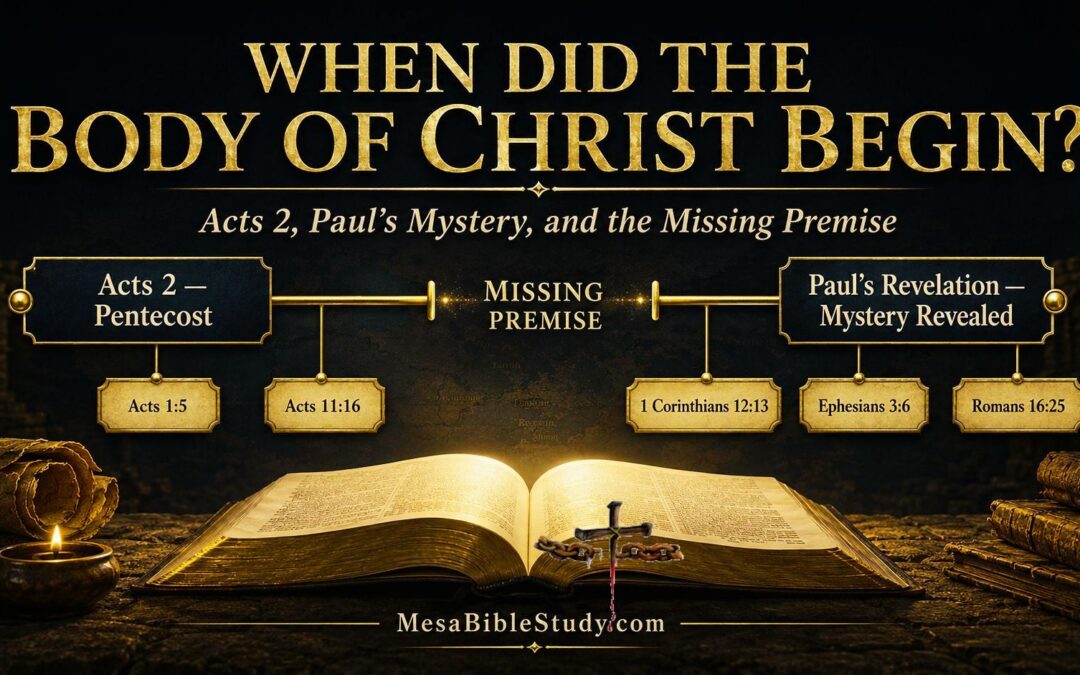
Was the Body of Christ Revealed Before Paul?
There’s a question that sounds simple until you actually try to answer it from Scripture instead of from tradition:
Did God reveal the gospel of grace, the one Body, Jew–Gentile equality, and salvation by grace through faith alone apart from the Law — before Paul, or through Paul?
Ask this to most pastors, scholars, or seminary professors, and you won’t get a yes or no. You’ll get a lecture on covenant continuity, or a reminder that “salvation has always been by faith,” or the assertion that Pentecost was “the birthday of the Church” — followed by nothing that actually engages the question. That evasiveness is itself worth noticing. The question has a textual answer. Most people just don’t want to say it out loud, because saying it exposes a contradiction sitting at the foundation of how Acts 2 gets taught.
The Standard Acts – 2 Claim
Evangelical Christendom broadly teaches that the Church — the Body of Christ, in which “there is neither Jew nor Greek” (Galatians 3:28) — began on the Day of Pentecost in Acts 2. The argument usually runs through three texts:
- Acts 1:5 — Jesus tells the apostles they will be “baptized with the Holy Ghost not many days hence.”
- Acts 11:16 — Peter later recalls that promise after the Holy Spirit falls on Cornelius’s household.
- 1 Corinthians 12:13 — “For by one Spirit are we all baptized into one body.”
The reasoning: Spirit baptism equals incorporation into the Body. Spirit baptism began at Pentecost. Therefore the Body began at Pentecost. Whatever Paul reveals later about the Body’s nature is treated as clarification of something already in motion since Acts 2 — not the introduction of something new.
The Problem: The Key Connection Is Assumed, Not Proven
Here is the pressure point the whole argument rests on, and it rarely gets examined:
Acts 1:5 and Acts 11:16 say “baptized with the Holy Ghost.” First Corinthians 12:13 says “baptized into one Body.” Those are not automatically the same statement.
Go back and read Acts 2, Acts 10, and Acts 11 on their own terms, without importing Paul’s later vocabulary into them:
- Nowhere in Acts 2 does Peter explain the formation of the Body of Christ. He explains Pentecost in light of the prophet Joel — a fulfillment of what Israel had already been promised.
- Nowhere in Acts 10–11 does Peter announce a mystery hidden in God. He defends the fact that God has extended repentance to Gentiles.
- The Jerusalem church’s own summary of the event, in Acts 11:18, is: “Then hath God also to the Gentiles granted repentance unto life.” That is not the language of Ephesians 2 — “one new man,” “fellow heirs,” “of the same body.” It’s the language of extended access to existing promises, not the creation of a new, undifferentiated entity in which the old categories are abolished.
Nowhere in Acts 1, 2, 10, or 11 do you find body-of-Christ language, one-new-man language, or mystery language. That vocabulary belongs to Paul, and Paul is explicit about where it came from.
Paul’s Own Testimony About the Mystery
This isn’t a matter of interpretation. Paul states it directly, repeatedly, in his own words:
“The gospel which was preached of me is not after man. For I neither received it of man, neither was I taught it, but by the revelation of Jesus Christ.” — Galatians 1:11–12
“How that by revelation he made known unto me the mystery… which in other ages was not made known unto the sons of men.”
— Ephesians 3:3, 5
“The mystery which hath been hid from ages and generations, but now is made manifest to his saints.” — Colossians 1:26
‘Now to Him who is able to establish you according to my gospel and the preaching of Jesus Christ, according to the revelation of the mystery kept secret since the world began ‘
— Romans 16:25
That is not soft language. It doesn’t say the implications were hidden while the reality already existed. It says the mystery itself was hidden in God, kept secret since the world began, not made known, and only then revealed — to Paul, by direct revelation, not by instruction from the other apostles.
If the Mystery was Hidden, the Body of Christ Cannot Be Read Backwards into Acts
Here is where the standard position runs into a contradiction it never actually resolves:
A system cannot say, “Yes, the mystery was genuinely unrevealed until Paul,” and then still place the Body it defines before that revelation — unless Scripture itself says the reality existed before its unveiling.
It doesn’t. Nowhere does Scripture say:
- The Body of Christ began in Acts 2.
- Pentecost created the one new man.
- Peter revealed the mystery.
- The mechanism of the Body was functioning before the mystery was made known.
Every one of those is a theological conclusion imposed on the text, not a statement the text makes. The actual chain holding the Acts-2 position together is an inference: Acts 1:5 → Acts 11:16 → 1 Corinthians 12:13, treated as one continuous, unbroken operation across two different authors, two different audiences, and two different vocabularies. That chain is a theological construction. It is not proof.
Galatians 2, Acts 15, and Acts 11 Confirm the Distinction
If Peter and Paul were proclaiming the identical message from the start, two things in Scripture become very hard to explain:
Galatians 2:7–9. The Jerusalem pillars — Peter, James, and John — don’t correct Paul’s gospel or fold it into their own. They recognize it as distinct and give him the right hand of fellowship on that basis: “the gospel of the uncircumcision was committed unto me, as the gospel of the circumcision was unto Peter.” Two named, distinct commissions, acknowledged in writing by the apostles themselves.
Acts 15. If Jew-Gentile equality in one Body, apart from the Law, was already settled doctrine since Pentecost, the Jerusalem council has no reason to exist. But the council doesn’t land on “there is neither Jew nor Greek.” It lands on a modified list of restrictions for Gentile believers — abstain from idol meat, fornication, strangled things, and blood (Acts 15:20). That’s an accommodation within an ongoing distinction, not the “one new man” of Ephesians 2:14–15.
And Acts 11:19 — written well after Pentecost — records believers scattered by persecution “preaching the word to none but unto the Jews only.” It’s crucial to note they are preaching from the Old Testament. That’s not what you’d expect to find if the mystery had already been revealed and was already operative since Acts 2.
The Question Acts-2 Theology Still Has Not Answered
Where is the verse that says the Body of Christ existed before the revelation of the Body of Christ was given?
Where is the verse that says Jew-Gentile equality in one Body was true before God revealed it?
Where is the verse that says what was “hidden in God” was already operating publicly at Pentecost?
There isn’t one. What exists instead is an inference chain, asserted with enough confidence and repeated often enough that it now passes for settled fact. But repetition isn’t exegesis, and a system can be old, widely held, and still wrong.
Paul’s own testimony is not ambiguous:
Hidden. Not made known. Kept secret. Then revealed.
That sequence, taken at face value (by faith), is the answer.
Continue the Retroactive Revelation Series
If this study helped clarify the missing premise behind Acts-2 theology, continue with the full Retroactive Revelation Series.
Start here:
The One Question No Acts-2 Theologian Can Answer
Related study:
Why Acts 2 Cannot Be the Beginning of the Body of Christ
Series hub:
Retroactive Revelation — Why Reading Paul Backward Into Scripture Fails
by Jamie Pantastico | Jul 9, 2026 | Devotionals |
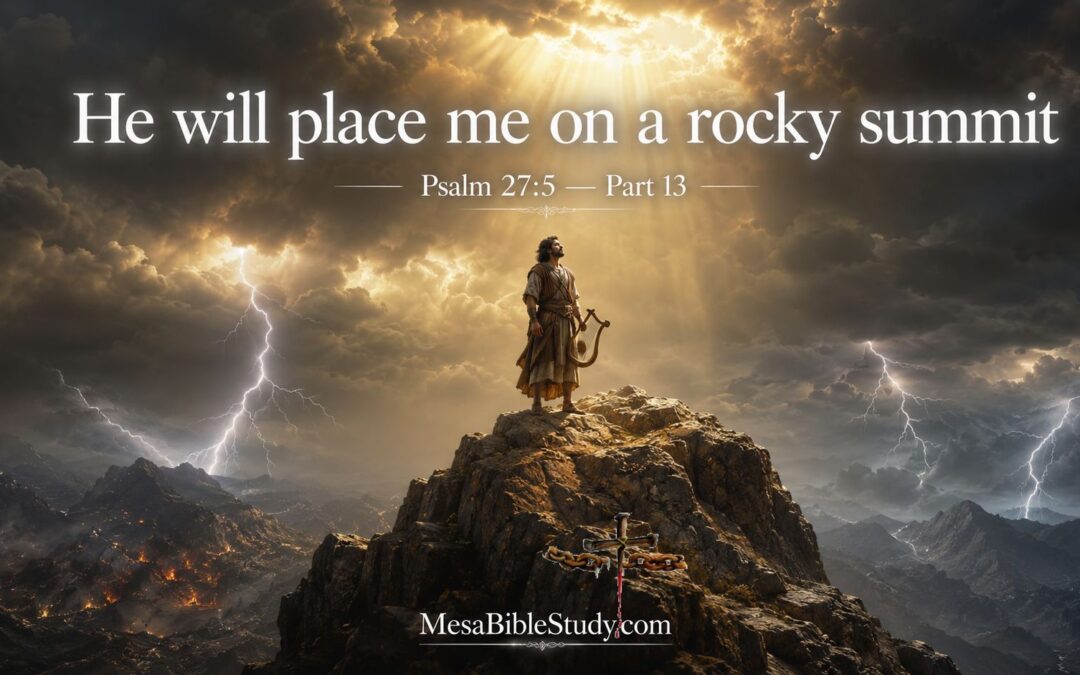
Faith Under Pressure — Part 13
Psalm 27:5
“He will surely give me shelter in the day of danger; he will hide me in his home; he will place me on an inaccessible rocky summit.”
Context & Connection
In Part 11, David declared the Lord would shelter him in the day of danger. In Part 12, he said the Lord would hide him in His home. Now David adds a third declaration of confidence: “he will place me on an inaccessible rocky summit.”
This is a powerful picture of stability, elevation, and divine protection. David is still under real pressure — enemies, armies, and war surround him. Yet his confidence rests in what the Lord will do.
The key truth in Part 13 is this: Faith stands firm because the Lord sets our feet upon the rock. That is exactly what pressured believers need.
He Will Place Me
David says, “he will place me…” Notice who is doing the placing. David does not say, “I will climb high enough” or “I will secure myself.” He trusts the Lord to lift and establish him.
Under pressure, we often try to create our own stability. We look for control, escape, or certainty. But David’s confidence is in the Lord who places him.
On an Inaccessible Rocky Summit
The image is striking: a high, firm, inaccessible rocky summit. This is not shifting sand or unstable ground. It is solid rock — elevated, secure, and out of the enemy’s reach.
David is not saying the danger was imaginary. He is saying the Lord can lift him above what threatens to overwhelm him. The pressure is real, but the Lord’s protection is greater.
Pressure Makes the Ground Feel Unstable
Pressure often makes life feel shaky. One burden follows another. The mind races. The heart grows weary. The future feels uncertain. The believer can feel as though the ground is constantly shifting.
David knew this kind of instability. He had been pursued, opposed, and pressed on every side. Yet he declares with confidence that the Lord will place him on solid rock.
Faith Stands Firm Because the LORD Sets the Feet
This is the heart of Part 13: Faith stands firm because the Lord sets our feet upon the rock. Our stability does not come from perfect circumstances, strong emotions, or personal strength. It comes from the Lord who lifts and establishes His people.
The Lord is not shaken by what shakes us. He is able to give firm footing when everything else feels unstable.
The LORD Lifts Above What Threatens to Overwhelm
David’s imagery shows active care: shelter, hiding, and lifting. The Lord does not merely protect from a distance — He elevates His people above what threatens them. There are times when He may not remove the trial immediately, but He lifts the heart above the fear of it.
The Enemy Cannot Reach Where the LORD Places You
The rocky summit is “inaccessible.” The Lord can place His people where the enemy cannot overthrow them. For believers today, this truth is even stronger: our life is hidden with Christ in God (Colossians 3:3). We are secure in Him.
What This Means
Psalm 27:5 teaches us that the Lord gives stability when pressure makes life feel unstable. David trusts the Lord to place him on solid rock. The battle may still rage and the pressure may remain, but the Lord is able to establish the believer’s heart. Faith stands firm because the Lord sets the feet.
A Word of Encouragement
If the ground beneath you feels unstable today — if grief, fear, financial pressure, or spiritual battles have left you weary — hear David’s words: “He will place me on an inaccessible rocky summit.”
The Lord knows how to steady His own. You do not have to create your own rock. Look to Him. He is faithful. He is able to lift you and give you firm footing even while the storm rages.
For Further Study
Read Psalm 27:5 slowly. Notice the three actions of the Lord: He gives shelter, He hides, and He places His servant on a rocky summit. Ask yourself: Am I trying to find stability in circumstances, or am I trusting the Lord to establish my heart?
👇
This devotional is Part 13 of the Faith Under Pressure series through Psalm 27. In this series, we are walking slowly through David’s words to see how faith shines when pressure is applied.
In Part 13, David reminds us that the Lord gives firm footing when life feels unstable. Faith stands firm because the Lord sets the feet.
Previous: Part 12 — He Will Hide Me in His Home
Next: Part 14 — I Will Offer Sacrifices with Shouts of Joy.
Back to Series Main Page