by Jamie Pantastico | Aug 10, 2026 | Devotionals |
Faith Under Pressure — Part 22
Psalm 27:13
“Where would I be if I did not believe I would experience the LORD’s favor in the land of the living?”
Context & Connection
In Part 21, David brought real danger before the Lord: “Do not turn me over to my enemies…” He did not deny the pressure or pretend false witnesses were harmless. He brought it all honestly before God.
Now in Psalm 27:13, David gives one of the most honest statements in the Psalm: “Where would I be if I did not believe…”
This is the language of a man who knows how close he came to losing heart. David is not speaking as someone untouched by pressure. He has faced enemies, fear, danger, rejection, false witnesses, and long waiting. He is saying, in effect: If I had not believed the Lord was good… if faith had not held me… where would I be?
The key truth in Part 22 is this: Faith keeps the pressured believer from being crushed beneath the weight. Faith does not mean the pressure is light. Faith means the Lord keeps the heart from collapsing under it.
‘But without faith it is impossible to please Him, for he who comes to God must believe that He is, and that He is a rewarder of those who diligently seek Him.’
Hebrews 11:6
Where Would I Be?
David looks at what the pressure could have done to him. He had cried out for mercy, asked not to be forsaken, and pleaded for teaching, leading, and protection. Now he looks back over the weight of it all and asks, “Where would I be…”
This is not weakness. This is testimony. David knows that without faith in the Lord, he would have collapsed beneath the burden.
If I Did Not Believe
That phrase is the center of the verse. David is showing us what preserved him. It was not favorable circumstances, the absence of enemies, emotional ease, or a pressure-free life. It was faith.
He believed God. He believed the Lord was good and faithful. He believed the Lord would show favor. He believed the pressure did not get the final word. That belief (faith) kept him from being crushed under pressure.
It’s no different for believers today. Our faith is our shield, our Holy Spirit powered defence against ALL Satan throws at us daily.
‘above all, taking the shield of faith with which you will be able to quench all the fiery darts of the wicked one.’
Ephesians 6:16
Faith Keeps the Pressured Believer From Losing Heart
Faith does not make the pressure feel easy. It does not remove every tear or answer every question immediately. David’s own words prove that—he has cried, pleaded, and asked for mercy and protection.
But through it all, faith held him.
Faith gave David something stronger than what he could see: confidence in the Lord’s goodness while the pressure remained.
Pressure Can Bring the Heart Close to Fainting
There are seasons when pressure becomes so heavy that the believer feels close to fainting inwardly. The heart grows tired. The mind feels worn. The future feels uncertain. The waiting feels long.
David understood that. Psalm 27:13 does not sound like a man pretending he was never close to discouragement. It sounds like a man saying, “I would have lost heart if I had not believed.” Scripture is honest about the weakness of the human heart under pressure—and clear about the sustaining power of faith in the Lord.
Faith Does Not Deny Weakness
Faith does not say, “I was never close to breaking” or “The pressure never affected me.” Faith says: I would have been crushed, but I believed. I would have collapsed, but the Lord sustained me.
Faith is not the believer boasting in emotional strength. Faith is the believer confessing dependence on the Lord. David’s confidence is not in himself. It is in the Lord who preserves him.
What Did David Believe?
David believed he would experience the LORD’s favor. His belief was not vague optimism or empty positivity. It was confidence in the Lord’s character.
He believed the Lord was still good even while enemies remained. He believed the Lord was still faithful even while pressure continued. He believed the Lord was still working even while the answer was not yet fully visible. Faith is only as strong as its object. David’s faith endured because it rested in the Lord.
The LORD’s Favor in the Land of the Living
David expected to see the Lord’s goodness not only in eternity, but in life. He did not believe the pressure would have the final word over his days. He expected the Lord’s favor to be seen and experienced.
This does not mean he understood every detail or knew exactly when deliverance would come. But he believed the Lord was good, and that belief kept him from losing heart.
Faith Looks Beyond the Present Pressure
Pressure tries to make the present moment feel final.
It whispers that this will never change, the burden will never lift, or the Lord has forgotten you.
But faith looks beyond the present pressure. Faith says: The Lord is still good. The Lord is still faithful. The Lord is in control. The Lord is still my light and my salvation. David’s faith did not erase the pressure, but it kept the pressure from becoming his final truth.
The Believer’s Faith Today
For believers today, our faith rests in the finished work of the Lord Jesus Christ. We know God has shown grace in Christ—He died for our sins, was buried, and rose again. The believer is saved by grace, accepted in Christ, and held by and sustained God’s grace forever.
Pressure does not define our standing before God. Trouble does not cancel grace. Weariness does not undo salvation. Because of Christ, the believer has every reason to keep believing.
What This Means
Psalm 27:13 teaches us that David knew how close he came to losing heart. He does not pretend the pressure was small or that he was strong in himself. He recognizes that faith in the Lord preserved him.
When pressure feels unbearable, faith holds to the Lord. When the heart feels weak, faith looks to the Lord. The pressured believer is kept not by self-confidence, but by faith in the faithful Lord.
A Word of Encouragement
If you know what it feels like to almost lose heart—if the pressure has lasted longer than expected and you feel like you’re being crushed—David’s words are for you:
“Where would I be if I did not believe…”
Faith is not pretending the burden is light. Faith is believing the Lord is good while the burden remains. Faith is not denying weariness. Faith is looking to the Lord when weariness presses hard.
Keep believing. The Lord is still your light. The Lord is still your salvation. The Lord still protects your life. The Lord’s faithfulness and goodness is not cancelled by the pressure you are under.
For Further Study
Read Psalm 27:13 slowly. Notice David’s honesty: “Where would I be if I did not believe…”
Ask yourself:
What truth about the Lord has kept me from losing heart? Then return to His Word and let your faith be strengthened again.
Faith Under Pressure Series
Previous in the Series:
Part 21 — Do Not Turn Me Over to My Enemies
Next in the Series:
Part 23 — I Believe I Will See the LORD’s Goodness
Back to Series Page:
Faith Under Pressure — A Psalm 27 Devotional Series
by Jamie Pantastico | Aug 7, 2026 | Pauline Theology |
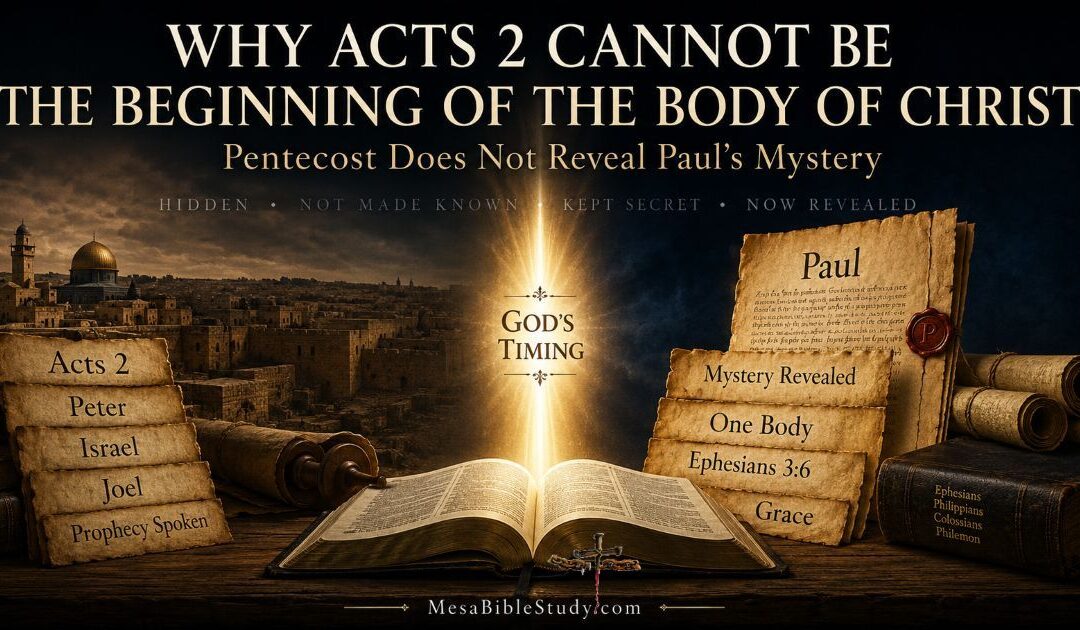
Part 10 — Retroactive Revelation
Opening Statement
The only way much of Christendom can claim that the Body of Christ began in Acts 2 is through retroactive revelation — forcing Paul’s later revelation backward into the day of Pentecost.
Acts 2 never says the Body of Christ began there. It never reveals the mystery. It never teaches Jew–Gentile equality in one Body. It never announces the dispensation of the grace of God. It never presents Paul’s gospel as Paul later defines it.
Those truths were revealed through Paul.
To insert them into Acts 2 is not sound interpretation. It is tradition overriding the text.
This cannot be reconciled exegetically with the claim that the Body of Christ — His Church, of which the ascended Lord Jesus Christ is the Head — had already begun and been clearly revealed at Pentecost. The full equality of Jew and Gentile in one Body was not proclaimed in Acts 2. It was part of the mystery later revealed through the apostle Paul.
Much of Christendom struggles to accept that Gentiles had no direct part in the Lord’s earthly ministry or in the events of Acts 1, 2, and 3. Gentile Christendom often insists on placing itself into passages, promises, and instructions that were plainly addressed to Israel. But discomfort does not change the inspired record. The truth remains the truth, whether Christendom is willing to accept it or not.
And this matters deeply.
When we stand before the Lord Jesus Christ at the Bema Seat, the quality of every believer’s work will be tested. Those who built upon the one foundation — Jesus Christ — with the wood, hay, and stubble of denominational traditions, human creeds, and doctrines that blurred God’s clear distinctions will see those works consumed. They will suffer loss of reward, but not the loss of salvation, for Scripture plainly says:
“He himself shall be saved; yet so as by fire.”
— 1 Corinthians 3:15
But those who built with the gold, silver, and precious stones of sound doctrine — faithfully standing upon God’s Word rightly divided — will receive reward.
That is why this issue is not minor.
Acts 2 cannot be made the beginning of the Body of Christ without placing into Pentecost what God later revealed through Paul. And every believer who teaches, builds, labors, or ministers must take heed how he builds.
A Necessary Clarification
All salvation — from Abel to the end of time — rests on the finished work of Jesus Christ: His death, shed blood, burial, and resurrection.
There is one Savior and one basis of salvation.
This study is not about two ways of salvation. It is about the timing and content of revelation.
When did God reveal the Body of Christ, the one new man, Jew–Gentile equality, and the gospel of grace apart from the Law as the message for this present age?
Paul says that revelation was given to him.
The Standard Acts-2 Claim Scripture Never Proves
The common argument is this:
Jesus promised Spirit baptism in Acts 1:5. Pentecost fulfilled it. Paul later says believers are baptized by one Spirit into one Body in 1 Corinthians 12:13. Therefore, the Body began at Pentecost.
At first glance, this may sound reasonable.
But the conclusion depends on an unstated assumption: that Spirit baptism at Pentecost is the same operation as Spirit baptism into the Body of Christ.
Acts never states this.
Acts 1:5 says baptized with the Holy Ghost.
First Corinthians 12:13 says baptized into one Body.
Those are not automatically identical statements.
That identification is assumed, not proven.
The Simplest Problem: Acts 2 Never Says It
The simplest and strongest argument is this:
Acts 2 never says the Body of Christ began.
Not once.
There is no statement that:
- salvation is by grace through faith apart from the law
- the Body of Christ began
- the mystery was revealed
- the one new man was created
- Jew and Gentile became fellow heirs
- the middle wall of partition was abolished
- the dispensation of grace began
These are Pauline doctrines revealed later. They cannot be inserted into Acts 2 without reading Paul backward into the chapter.
If Acts 2 is the beginning of the Body, the burden of proof rests on those who claim it.
Where does the text say it?
Peter Addresses Jews, Not Gentiles
Acts 2 is entirely Jewish. Pentecost is a Jewish feast day.
Devout Jews from every nation are present:
“And there were dwelling at Jerusalem Jews, devout men, out of every nation under heaven.”
— Acts 2:5
Peter addresses:
“Ye men of Judaea…”
— Acts 2:14
Then:
“Ye men of Israel…”
— Acts 2:22
And finally:
“Therefore let all the house of Israel know assuredly…”
— Acts 2:36
Peter confronts Israel with the fact that God has made the Jesus they crucified both Lord and Christ.
Paul preaches the glorious victory in the finished work of the gross as the means for salvation. A free gift to all mankind, Jew or Gentile apart from the law, apart from temple worship, apart from works.
Peter is preaching to Israel concerning her rejected Messiah under the prophetic program.
Peter Explains Pentecost by Prophecy, Not Mystery
When Peter explains what is happening, he does not say:
“This is the revelation of the mystery.”
He says:
“But this is that which was spoken by the prophet Joel.”
— Acts 2:16
Peter places Pentecost in the prophetic framework of Israel, judgment, restoration, and the day of the Lord.
Paul later says the mystery was hidden and kept secret until revealed to him.
Prophecy is what God made known.
Mystery is what God kept secret.
Acts 2 belongs to prophecy.
Paul’s Body doctrine belongs to the mystery.
Peter Preaches Israel’s Guilt, Not Paul’s Gospel Formula
Peter’s message emphasizes Israel’s guilt:
“Him… ye have taken, and by wicked hands have crucified and slain.”
— Acts 2:23
And again:
“God hath made that same Jesus, whom ye have crucified, both Lord and Christ.”
— Acts 2:36
This is true and inspired, but it is not Paul’s later gospel proclamation in 1 Corinthians 15:3–4:
“Christ died for our sins according to the scriptures;
And that he was buried, and that he rose again the third day according to the scriptures.”
— 1 Corinthians 15:3–4
Peter charges Israel.
Paul glories in the cross as the saving message for all.
The emphasis and audience are different.
Acts 2:38 Is Not Paul’s Gospel of Grace Apart From Works
When the crowd asks:
“Men and brethren, what shall we do?”
— Acts 2:37
Peter replies:
“Repent, and be baptized every one of you in the name of Jesus Christ for the remission of sins…”
— Acts 2:38
Paul later tells the Philippian jailer:
“Believe on the Lord Jesus Christ, and thou shalt be saved…”
— Acts 16:31
And Paul says:
“For Christ sent me not to baptize, but to preach the gospel…”
— 1 Corinthians 1:17
If Acts 2 is the full gospel of grace for the Body of Christ, Acts 2:38 creates confusion.
But if Acts 2 is Peter addressing Israel under the prophetic program, the passage fits its context.
Acts 2 Contains No Jew–Gentile Equality
Paul defines the mystery in Ephesians 3:
“That the Gentiles should be fellowheirs, and of the same body, and partakers of his promise in Christ by the gospel.”
— Ephesians 3:6
Acts 2 does not reveal this. It is not revealed until Paul comes on the scene 7 years later.
It does not announce the one new man.
It does not announce the abolition of the middle wall:
“For to make in himself of twain one new man, so making peace.”
— Ephesians 2:15
These truths come later through Paul.
Ephesians 2 Shows the Gentile Condition Before Paul’s Revelation
Ephesians 2:11–13 gives one of the clearest descriptions in Scripture of the Gentile world before the revelation of the mystery.
Paul writes:
“Therefore remember that you, once Gentiles in the flesh — who are called Uncircumcision by what is called the Circumcision made in the flesh by hands — that at that time you were without Christ, being aliens from the commonwealth of Israel and strangers from the covenants of promise, having no hope and without God in the world. But now in Christ Jesus you who once were far off have been brought near by the blood of Christ.”
— Ephesians 2:11–13
That passage is graphic.
Paul says Gentiles were:
- without Christ
- aliens from the commonwealth of Israel
- strangers from the covenants of promise
- having no hope
- without God in the world
- far off
That is not mild language.
That is not covenant-continuity language.
That is not the language of Gentiles already sharing equal spiritual standing with Israel in one Body.
Paul says Gentiles were without Christ.
That means the Gentile world did not have Israel’s Messiah. They were not looking for the Son of David. They were not part of Israel’s covenant hope. They had no direct covenant standing before the God of Abraham, Isaac, and Jacob.
Paul says Gentiles were aliens from the commonwealth of Israel.
That means they had no national part in Israel’s calling, promises, priesthood, covenants, land, kingdom, or prophetic hope.
Paul says Gentiles were strangers from the covenants of promise.
That means the covenants belonged to Israel, not the Gentile nations. The Gentiles were outside those covenant promises unless they came to Israel’s God through the place and provision God had given through Israel.
Paul says Gentiles had no hope and were without God in the world.
That is devastating.
For nearly two thousand years from Abraham forward, God was dealing covenantally with Israel. The Gentile nations were outside Israel’s covenant structure, outside Israel’s Messiah, outside Israel’s promises, and outside Israel’s hope. A Gentile could be blessed, but not as a member of the Body of Christ. A Gentile could approach Israel’s God, but not as part of a revealed one new man where Jew and Gentile were equal in one Body.
That truth had not yet been revealed.
That is why Ephesians 2 matters.
Paul does not say Gentiles had always been spiritually equal with Israel and simply failed to understand it.
He says they were far off.
Then he says:
“But now in Christ Jesus you who once were far off have been brought near by the blood of Christ.”
The phrase “but now” matters.
It marks a change.
Gentiles who were once far off are now brought near — not through becoming Israel, not through temple worship, not through circumcision, not through the covenants, not through the Law — but by the blood of Christ, according to the revelation later given through Paul.
That is not Acts 2.
- Acts 2 is not Gentiles being brought near in one Body.
- Acts 2 is Peter addressing Israel.
- Acts 2 is Pentecost.
- Acts 2 is Joel.
- Acts 2 is the house of Israel being confronted with the crucifixion of her Messiah.
The full revelation that Gentiles are now fellow heirs, of the same Body, and partakers in Christ through the gospel comes later through Paul.
That is why Ephesians 2:11–13 cannot be ignored.
It shows the Gentile condition before Paul’s revelation.
And it proves that the Body of Christ cannot be read backward into Acts 2.
Acts 2 Continues in Israel’s Temple Framework
After Pentecost, the believers continue daily in the temple:
“And they, continuing daily with one accord in the temple…”
— Acts 2:46
In Acts 3, Peter and John go to the temple at the hour of prayer:
“Now Peter and John went up together into the temple at the hour of prayer, being the ninth hour.”
— Acts 3:1
This is not the abolition of Israel’s religious system.
This is not the clear revelation of the Church apart from Israel’s program.
It fits a transitional period in which God is still dealing with Israel.
Acts 3 Confirms the Prophetic Kingdom Context
Peter speaks of:
“The times of restitution of all things, which God hath spoken by the mouth of all his holy prophets since the world began.”
— Acts 3:21
This is prophecy and restoration for Israel.
Paul later speaks of:
“The revelation of the mystery, which was kept secret since the world began.”
— Romans 16:25
Peter speaks of what was spoken since the world began.
Paul speaks of what was kept secret since the world began.
These are different categories.
Acts 11:19 Devastates the Acts-2 Claim
Even after Pentecost and Cornelius, the scattered believers:
“Preached the word to none but unto the Jews only.”
— Acts 11:19
If the one new man had begun at Pentecost and Jew–Gentile equality had been revealed, why were they still restricting the message to Jews only?
This fits a transitional period.
It does not fit the claim that the Body of Christ had already begun in Acts 2.
Paul Reveals the Body as Part of the Mystery
Paul says the mystery was:
“Hidden from ages and from generations, but now has been revealed…”
— Colossians 1:26
And he defines that mystery as Gentiles being:
“Fellowheirs, and of the same body, and partakers of His promise in Christ through the gospel…”
— Ephesians 3:6
That means the Body is part of the mystery revealed through Paul.
Therefore, the Body cannot be placed before Paul without placing the mystery before its revelation.
That is the contradiction Acts-2 theology never resolves.
Paul’s Apostleship Becomes Unnecessary Under Acts-2 Theology
If the Body and the gospel of grace began at Pentecost, Paul’s repeated claims become difficult to explain:
- my gospel
- given to me
- revealed to me
- I laid the foundation
Why does Paul speak this way if Peter already revealed everything in Acts 2?
Why does Paul say his gospel was not received from man, but by revelation of Jesus Christ?
Why does Paul say the dispensation of the grace of God was given to him?
Why does Paul say the mystery was made known to him?
Why does Paul say he laid the foundation?
Acts-2 theology blurs those statements.
Right division allows them to stand.
For a More In-Depth Study
For readers who want a deeper study of the specific argument behind Acts-2 theology, I highly recommend reading:
When Did the Body of Christ Begin? “The Missing Premise”
This study examines the common inference chain — Acts 1:5 → Acts 11:16 → 1 Corinthians 12:13 — and shows why Spirit baptism in Acts does not prove the Body of Christ began at Pentecost. What it actually exposes is the desperate weakness of Acts-2 interpretation: it must import Paul’s later revelation into Acts and then treat that imported assumption as doctrine.
Why This Matters: Doctrine, Gospel, and Assurance
This is not an abstract debate.
If Acts 2 is made the beginning of the Body of Christ, then Peter’s kingdom message to Israel gets blended with Paul’s gospel of grace to the Body of Christ.
That has and continues to create confusion.
The gospel of the kingdom and the gospel of grace are mixed.
Law and grace get mixed.
Israel and the Church get mixed.
Prophecy and mystery get mixed.
Water baptism and salvation get mixed.
Kingdom doctrine and doctrine for the body of Christ get mixed.
And once those distinctions are blurred, the doctrine for believers today becomes obscured.
That matters because the doctrine for the Body of Christ — grace-age believers today — is found in Paul’s letters alone.
- Paul is the apostle of the Gentiles.
- Paul received the dispensation of the grace of God.
- Paul reveals the mystery.
- Paul explains the one Body.
- Paul lays out the believer’s position, walk, warfare, assurance, liberty, and hope in this present age.
That does not mean the rest of Scripture is unimportant.
All Scripture is inspired and profitable.
But all Scripture is not written directly to the same people under the same program.
Genesis is profitable.
Matthew is profitable.
Acts is profitable.
Hebrews through Revelation are profitable.
But the only message that saves today is Paul’s gospel. The doctrine that establishes the Body of Christ today is found only in Paul’s epistles.
When Paul is blurred, doctrine is blurred.
When doctrine is blurred, the gospel is blurred.
When the gospel is blurred, assurance is weakened.
And when assurance is weakened, believers are left striving for what Christ has already accomplished.
Paul teaches that the believer does not fight for victory, hoping to attain it through effort, religion, or performance.
The believer fights from victory — already complete in Christ, already accepted in the Beloved, already blessed with all spiritual blessings, already sealed by the Holy Spirit, and already seated with Christ in the heavenly places.
That is why rightly dividing Peter and Paul is not optional.
It protects the gospel.
It protects sound doctrine.
It protects the believer’s assurance.
And it keeps Christ’s finished work where Paul places it: complete, sufficient, and received by grace through faith apart from works.
Final Summary
Acts 2 cannot be the beginning of the Body of Christ because Acts 2 never says it began. We can’t believe something that God hasn’t revealed.
It never reveals the mystery.
It never teaches Jew–Gentile equality in one Body.
It never announces the one new man.
It never presents Paul’s gospel as Paul later defines it.
Peter addresses Israel.
He explains Pentecost by Joel.
He charges Israel with crucifying her Messiah.
He calls Israel to repent and be baptized.
The believers continue in the temple framework.
Acts 11:19 later shows the word was still being preached to Jews only.
Paul later reveals the Body as part of the mystery hidden until revealed to him.
The sequence in Scripture is clear:
Hidden. Then revealed.
Placing the Body before its revelation requires retroactive revelation.
Acts 2 is important in its own right as part of Israel’s prophetic program.
But it is not the beginning of the Body of Christ.
The greatest tragedy of Acts-2 theology is not merely bad doctrine — it is a blurred gospel. When Peter’s Pentecost message is mixed with Paul’s gospel of grace, grace is no longer grace, faith is no longer faith, and the finished work of Christ is no longer treated as sufficient. That mixture produces a perverted gospel with no saving power (Galatians 1:11–12; Romans 11:6; Ephesians 2:8–9).
Continue the Retroactive Revelation Series
Acts 2 cannot be the beginning of the Body of Christ because Acts 2 never says the Body began.
If this study helped clarify why Paul’s mystery cannot be read backward into Pentecost, continue with the full Retroactive Revelation Series.
Previous Study:
The Jerusalem Council: Confirmation, Not Correction
Next Study:
Paul the Master Builder: Why 1 Corinthians 3:10 Matters
Related Study:
When Did the Body of Christ Begin? “The Missing Premise”
Back to Series Hub:
Retroactive Revelation — Why Reading Paul Backward Into Scripture Fails
by Jamie Pantastico | Aug 6, 2026 | Devotionals |
Faith Under Pressure — Part 21
Psalm 27:12
“Do not turn me over to my enemies, for false witnesses who want to destroy me testify against me.”
Context & Connection
In Parts 19 and 20, David prayed for the Lord to teach him how to live and to lead him along a level path. He was not only asking for the pressure to be removed—he was asking for instruction and steady steps through it.
Now in Psalm 27:12, David brings the danger directly before the Lord:
“Do not turn me over to my enemies…”
This is an honest prayer. David does not pretend the enemies are harmless or the danger imaginary. He brings the whole situation before the Lord. Faith under pressure does not deny real danger. Faith brings real danger before the Lord.
Do Not Turn Me Over to My Enemies
David’s plea is a cry for deliverance. He knows that if the Lord does not protect him, he is vulnerable. Enemies are waiting. Opposition is real. There are people who want to harm him.
So he prays honestly: “Do not turn me over…” This is not unbelief. It is dependence. David is not trusting his own strength, wisdom, or ability to escape. He is asking the Lord to intervene and preserve him. That is the proper place for the pressured believer—not self-reliance, not panic, not denial, but prayer.
Faith Brings Real Danger Before the LORD
Sometimes believers think faith means never naming the danger. But David names it. He speaks of enemies, false witnesses, and those who want to destroy him.
Faith under pressure does not require vague language or pretending everything is small. Faith brings the real danger before the real God. David does not magnify his enemies above the Lord, but he does bring the enemies to the Lord. That is a crucial distinction.
For False Witnesses Testify Against Me
False witness is one of the most painful forms of opposition. It is not merely attack—it is distortion, accusation, and the twisting of truth. David knew what it meant to be misrepresented, misjudged, and falsely charged.
Physical danger is one kind of trial. False witness attacks a person’s name, reputation, motives, and integrity. David brings even this before the Lord.
When People Misrepresent You
Few things are more painful than being misrepresented—when words are twisted, motives assumed, false things spread, or a name is damaged. That kind of pressure can make the heart restless. The desire to defend yourself can become overwhelming. Anger rises. Hurt goes deep.
David knew that pressure, and he shows us where to bring it: to the Lord. “Do not turn me over to my enemies…”
Who Want to Destroy Me
David says these false witnesses “want to destroy me.” Words can wound. Accusations can damage. Lies can destroy trust. Slander can bring real harm.
Yet even here, David does not take matters into his own hands. He does not let bitterness govern his heart or allow his enemies to define his path. He prays. Faith under pressure recognizes that the Lord is the ultimate defender.
The LORD Knows the Truth
When false witnesses rise, the pressured heart needs to remember this: the Lord knows the truth. People may misunderstand, accuse, distort, or judge motives wrongly. But the Lord sees perfectly. He knows what was said, what was meant, and what is true.
False witness still hurts—David’s prayer shows that—but it does not get the final word. The Lord does.
Do Not Let the Enemy Define Your Response
False accusation can tempt the believer to respond in the flesh: anger, defensiveness, bitterness, or a consuming desire to retaliate. David’s prayer slows the heart before the Lord. He does not let his enemies define his response.
That is not weakness. That is wisdom. The enemy would love to use accusation to make the believer bitter, reckless, or consumed with self-defense. David teaches us to pray.
The LORD Is the Defender of His Own
David has already called the Lord his deliverer, light, salvation, protection, shelter, and firm footing. Now he comes again to the Lord as defender.
The believer may need to answer truthfully, act wisely, or clarify when necessary. But ultimate vindication belongs to the Lord. He sees what others do not see. He knows what others do not know. He judges righteously and protects His own according to His wisdom and timing.
Faith Does Not Pretend the Pain Is Small
False witness hurts. Betrayal hurts. Being misunderstood hurts. Scripture does not ask believers to pretend otherwise. But Scripture does teach us where to bring that pain.
David brings it to the Lord. He does not let the pain, the accusation, or his enemies become lord. The Lord remains Lord. That is faith under pressure.
What This Means
Psalm 27:12 teaches us that faith brings real danger before the Lord. David does not deny his enemies or ignore false witnesses. But he also does not surrender to fear, bitterness, or self-reliance. He prays.
Faith under pressure brings danger, accusation, and opposition before the Lord. The believer can trust that the Lord sees clearly, judges rightly, and knows how to preserve His own.
A Word of Encouragement
If you know the pain of being misunderstood, falsely accused, or opposed, bring it to the Lord. You do not have to carry the burden alone. You do not have to let false witness define you or rule your heart.
The Lord knows the truth. The Lord sees clearly. The Lord is faithful. Ask Him to protect you, lead you, keep your heart from bitterness, and help you walk faithfully even when others speak falsely.
Faith brings real danger before the Lord. And the Lord is able to keep His own.
For Further Study
Read Psalm 27:11–12 slowly. Notice the connection: David asks the Lord to teach him and lead him, then asks the Lord not to turn him over to his enemies. Ask yourself: When I face accusation or false witness, do I bring it first to the Lord?
Faith Under Pressure Series
Previous in the Series:
Part 20 — Lead Me Along a Level Path
Next in the Series:
Part 22 — Where Would I Be If I Did Not Believe?
Back to Series Page:
Faith Under Pressure — A Psalm 27 Devotional Series
by Jamie Pantastico | Aug 6, 2026 | Israel and Bible Prophecy |
The Deception is Not Aliens — Part 8
Key Scriptures:
- 2 Thessalonians 2:7–12
- John 8:44
- Romans 1:18–25
- Revelation 13:11–17
- Revelation 16:9–11
Introduction
The Bible gives a sober explanation for the final deception that will come upon the world.
It is not alien disclosure.
It is not Project Blue Beam.
It is not mankind discovering higher beings from another planet.
It is not a science-fiction awakening.
Paul calls it strong delusion.
That phrase matters. The final deception will not come upon a world that loved the truth and simply lacked information. It will come upon a world that rejected the truth—the gospel of grace.
Paul states the issue plainly:
“because they did not receive the love of the truth, that they might be saved.”
— 2 Thessalonians 2:10
That is the root. They did not receive the love of the truth. And what is the truth— The Jesus Christ died for their sins, was buried, and rose again the third day.
Then Paul continues:
“And for this reason God will send them strong delusion, that they should believe the lie.”
— 2 Thessalonians 2:11
Strong delusion comes because truth was rejected. That is the biblical framework.
Not confusion.
Not ignorance.
Not alien contact.
Rejection of God the Son, Jesus Christ. Belief in the lie. Judgment from God.
The Mystery of Lawlessness Is Already at Work
Paul wrote:
“For the mystery of lawlessness is already at work…”
— 2 Thessalonians 2:7
The spirit of rebellion is already operating in this present age. Lawlessness is not waiting for the Tribulation to begin. It is already at work.
The world is already rejecting God’s authority.
The world is already suppressing truth.
The world is already redefining morality.
The world is already mocking Scripture.
The world is already despising Christ.
The world is already opposing Israel.
The world is already exchanging truth for lies.
The difference is that the full outbreak of lawlessness is still being restrained. When the restraint is removed, the man of sin will be revealed.
The world will not become more reasonable.
It will not become more repentant.
It will not become more enlightened.
It will descend into open rebellion.
The coming delusion will not fall upon a spiritually neutral world. It will fall upon a world already prepared to believe the lie.
The Lie Is Received Because the Truth Was Refused
Paul’s words are exact:
“because they did not receive the love of the truth, that they might be saved.”
— 2 Thessalonians 2:10
The issue is salvation.
The issue is truth.
The issue is Christ.
The issue is the gospel.
The world refuses the truth that could save them. They reject God. They reject His Word. They reject His Son. They reject the gospel. They reject righteousness. They reject the authority of Scripture.
Because they reject the truth, they become vulnerable to the lie.
This is how deception works. Deception does not begin when someone believes a lie. Deception begins when someone refuses the truth.
A person who will not receive the truth will eventually receive something else.
A world that rejects Christ will eventually worship the Beast.
A world that rejects the gospel will eventually believe the lie.
A world that rejects the Creator will eventually worship the creature.
That is exactly what Scripture warns.
Romans 1 Already Shows the Pattern
Paul gives the same pattern in Romans 1.
Mankind suppresses the truth in unrighteousness.
Mankind refuses to glorify God.
Mankind becomes futile in its thoughts.
Mankind’s foolish heart is darkened.
Professing to be wise, mankind becomes foolish.
Then comes the exchange:
They exchange the glory of God for images.
They exchange the truth of God for the lie.
They worship and serve the creature rather than the Creator.
That is the pattern of human rebellion:
Rejection → Darkening → Exchange → Idolatry → Judgment.
Romans 1 explains the spiritual direction of the world.
Second Thessalonians 2 shows where that direction leads prophetically.
Revelation shows the final expression.
The world rejects truth.
The world believes the lie.
The world worships the Beast.
The world refuses to repent.
This is not an alien narrative.
This is a rebellion narrative.
The Lie Will Center on the Man of Sin
Paul says the coming of the lawless one will be according to the working of Satan. The final deception will have Satanic power behind it.
The lawless one will not come as a cartoon villain. He will come with power, signs, and lying wonders. He will deceive those who perish because they did not receive the love of the truth.
This is why the Church must be careful with the word “supernatural.”
Something can be supernatural and still be satanic.
Something can be powerful and still be false.
Something can be explainable and still be a lie.
Something can appear miraculous and still lead people away from God.
The issue is not whether something amazes the world. The issue is whether it is true according to the written Word of God.
Paul does not tell believers to prepare for alien contact. Paul warns of the lawless one, Satanic power, lying wonders, and strong delusion.
Revelation Shows the World Worshiping the Beast
Revelation does not show the world uniting around aliens. It shows the world worshiping the Beast.
Revelation 13 describes a final world system marked by worship, deception, coercion, and control. The false prophet performs signs. The world is deceived. An image is made. Worship is demanded. Economic control is imposed. No one may buy or sell without the mark.
That is the biblical picture.
The final system is not neutral. It is religious. It is worship-based. It is satanic. The dragon gives power to the Beast. The false prophet deceives the earth. The world worships.
The danger is not merely political tyranny. The danger is satanic worship dressed in global authority.
Strong Delusion Is Judicial
Strong delusion is not random. Paul says God sends strong delusion because they did not receive the love of the truth. The delusion is judicial—an act of judgment.
When mankind persistently rejects truth, God gives mankind over to the consequences of that rejection.
This is terrifying.
A world that demands lies may be judged by being given over to lies.
A world that hates truth may be judged by losing the ability to discern truth.
A world that rejects Christ may be judged by receiving the Antichrist.
A world that refuses the gospel may be judged by believing the lie.
That is why this subject is so serious. The issue is not entertainment. It is not curiosity. It is not merely prophecy speculation. It is eternal truth.
Revelation Says They Still Refuse to Repent
Even under judgment, mankind refuses to repent.
Revelation says:
“And they did not repent…”
— Revelation 9:21
Again:
“and they did not repent and give Him glory.”
— Revelation 16:9
And again:
“and did not repent of their deeds.”
— Revelation 16:11
That repeated phrase should make every believer tremble.
They did not repent.
They did not repent.
They did not repent.
The world will know God is judging. They will know God has power over the plagues. They will blaspheme His name. And still, they will refuse to repent.
This is what strong delusion looks like when fully expressed.
Not confusion.
Not innocence.
Not lack of evidence.
Rebellion. Hardness. Hatred of truth.
The Church Must Not Help Build the Wrong Framework
This is why believers must be careful not to help build the wrong prophetic framework.
If we teach people to expect aliens, disclosure, or extraterrestrial explanations, we may unintentionally train them to look away from the categories Scripture actually gives.
The Bible warns about the man of sin.
The Bible warns about Satanic power.
The Bible warns about lying signs and wonders.
The Bible warns about the false prophet.
The Bible warns about the Beast.
The Bible warns about worship of the dragon.
The Bible warns about strong delusion.
That is enough.
The Church does not need to add science fiction to make prophecy relevant. God’s Word is sufficient.
The Gospel Is the Answer Now
Paul says the delusion comes because they did not receive the love of the truth, that they might be saved. That means the answer now is not speculation. The answer is the gospel.
Christ died for our sins.
He was buried.
He rose again the third day according to the Scriptures.
Salvation is by grace through faith, apart from works.
That is the truth the world needs.
That is the truth Satan hates.
That is the truth the Church must preach.
Before the world believes the lie, the Church must proclaim the truth.
Before the Beast rises, the Church must preach Christ.
Before judgment falls, the Church must make known the gospel of grace.
Final Summary
Strong delusion is not an alien deception. It is the judgment of God upon a world that rejected the truth.
Paul says they did not receive the love of the truth, that they might be saved. For that reason, God sends strong delusion. The world believes the lie. The lawless one comes with Satanic power, signs, and lying wonders. Revelation shows the result: the world worships the Beast, follows the false prophet, blasphemes God, and refuses to repent.
That is the biblical warning.
Not aliens.
Not disclosure.
Not Project Blue Beam.
Not science fiction.
Truth rejected.
The lie received.
The Beast worshiped.
God blasphemed.
Repentance refused.
That is why the Church must stay anchored in Scripture.
Preach Christ.
Proclaim the gospel of grace.
Rightly divide the Word of truth.
Warn the world with what God has already revealed.
Because the final deception will not come because the world lacked information.
It will come because the world hated Truth — Jesus Christ.
Previous in the series:
Part 7 — Doctrines of Demons
Next in the series:
Part 9 — Preach Christ Crucified, Buried and Risen — Not Speculation
Back to the Series Main Page
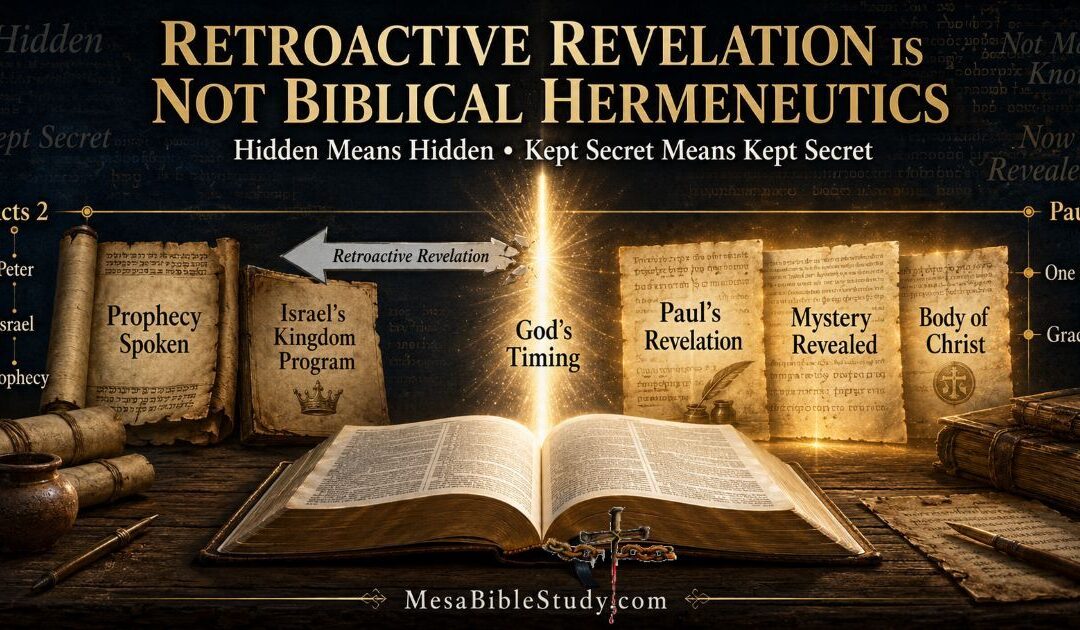
by Jamie Pantastico | Aug 4, 2026 | Pauline Theology |
Why reading Paul backward into earlier Scripture undermines the very timeline God revealed
There is a way of reading Scripture that sounds scholarly, balanced, and traditional—but it creates deep confusion.
It goes something like this:
“Yes, Paul received clearer revelation, but the same truth was already present before him.”
That sounds reasonable at first. But the problem is simple: Paul says the mystery was not made known.
He does not say it was unclear.
He does not say it was dimly understood.
He does not say it was hidden in plain sight.
He says it was:
- hidden
- kept secret
- not made known
- revealed to him
- given to him
- committed to him
That means we cannot take what Christ later revealed through Paul and force it backward into Matthew, Acts 2, Peter’s ministry, Israel’s covenants, or the Old Testament prophets.
That is not sound Bible study.
That is not rightly dividing the Word.
That is retroactive revelation—and it is not a biblical hermeneutic.
A Necessary Clarification
Before going further, let this be stated clearly:
All salvation—from Abel to the end of time—is only possible because of the finished work of Jesus Christ:
His death, His shed blood, His burial, and His resurrection (1 Corinthians 15:1-4).
There is one Savior.
There is one cross.
There is one basis of salvation.
This study is not about two Saviors or two ultimate bases of redemption. It is about what God revealed, when He revealed it, and through whom He revealed it.
The issue is not whether Christ’s cross saves every redeemed soul. It does.
The issue is whether the full doctrinal revelation of the gospel of grace, the Body of Christ, Jew–Gentile equality, and the mystery was known before Paul.
Paul says it was not.
What Is Retroactive Revelation?
Retroactive revelation is the practice of taking truth revealed later in Scripture and reading it backward into earlier passages as if those earlier audiences already knew it.
For example, retroactive revelation says:
- Peter was preaching Paul’s gospel in Acts 2.
- The Body of Christ began at Pentecost.
- The mystery was already present before Paul.
- Old Testament saints understood Christ’s death, burial, and resurrection as Paul later defines it.
- Matthew, Acts 2, and Paul all present the same revealed message.
But this approach ignores one essential fact: God reveals truth in time.
The Bible is not a flat document where every doctrine is fully revealed from Genesis onward. Scripture is a progressive revelation. And Paul’s own letters insist that certain truths were deliberately hidden until the appointed time.
Why Revelation Timing Matters
No serious Bible student denies progressive revelation.
Abraham did not have Moses’ Law.
Moses did not have David’s covenant.
David did not have Isaiah’s full prophetic vision.
The prophets did not have Paul’s revelation of the mystery.
God revealed truth progressively. That means timing matters.
When we ask what someone believed, preached, or understood, we must ask:
- What had God revealed at that point?
- What had God not yet revealed?
- Who was being addressed?
- What program was in view?
- What message was being proclaimed?
Ignoring those questions produces confusion.
Paul Says the Mystery Was Hidden
Paul writes:
“Now to Him who is able to establish you according to my gospel and the preaching of Jesus Christ, according to the revelation of the mystery kept secret since the world began.”
— Romans 16:25
That verse alone creates a serious problem for retroactive revelation.
Paul’s gospel involves the preaching of Jesus Christ according to the revelation of the mystery. And that mystery was kept secret since the world began.
Not spoken since the world began.
Not partially revealed since the world began.
Not hidden in plain sight since the world began.
Kept secret.
That must be allowed to mean what it says.
Paul Says the Mystery Was Not Made Known
Paul writes again:
“which in other ages was not made known to the sons of men, as it has now been revealed by the Spirit to His holy apostles and prophets.”
— Ephesians 3:5
This verse does not say the mystery was poorly understood.
It does not say the mystery was present but undeveloped.
It says the mystery was not made known.
That is a direct statement about revelation timing. If something was not made known, then it cannot be preached, believed, or understood as revealed doctrine in earlier ages.
Retroactive revelation forces the verse to mean the opposite of what it says.
Paul Says the Mystery Was Hidden in God
Paul continues:
“and to make all see what is the fellowship of the mystery, which from the beginning of the ages has been hidden in God…”
— Ephesians 3:9
This is even more precise.
Paul does not say the mystery was hidden in the Old Testament.
He does not say it was hidden in prophecy.
He does not say it was hidden in types and shadows waiting for someone to decode it.
He says it was “hidden in God.”
That means the mystery was not available for discovery through earlier revelation. It was not concealed in prophetic language for later theologians to uncover. It was hidden in God until God chose to reveal it.
That destroys retroactive interpretation.
Paul Says the Mystery Was Hidden From Ages and Generations
Paul writes:
“the mystery which has been hidden from ages and from generations, but now has been revealed to His saints.”
— Colossians 1:26
Again the sequence is clear:
- hidden from ages
- hidden from generations
- now revealed
That is chronology.
That is timing.
That is progressive revelation.
Retroactive revelation reverses Paul’s order and says:
- it was already there
- it was already known
- it was already operating
- Paul merely clarified it
But Paul says: hidden → now revealed.
Those are not the same.
Peter Preached What Was Spoken Since the World Began
This contrast is one of the clearest in Scripture.
Peter says in Acts 3:
“whom heaven must receive until the times of restoration of all things, which God has spoken by the mouth of all His holy prophets since the world began.”
— Acts 3:21
Peter’s message concerns what God had spoken by the prophets since the world began.
Paul’s message concerns what God had kept secret since the world began.
Peter: spoken since the world began.
Paul: kept secret since the world began.
Those are not the same category.
Peter’s ministry in Acts 3 is prophecy.
Paul’s revelation is mystery.
If we collapse those categories, we erase one of the clearest distinctions in the New Testament.
Retroactive Revelation Turns “Hidden” Into “Known”
This is the central problem.
Retroactive revelation takes Paul’s words and changes their function.
Paul says: hidden
Retroactive revelation says: known, but unclear
Paul says: not made known
Retroactive revelation says: partially made known
Paul says: kept secret
Retroactive revelation says: present in seed form
Paul says: revealed to me
Retroactive revelation says: already preached by Peter
That is not interpretation.
That is contradiction.
The issue is not whether someone can create a theological explanation for it. The issue is whether that explanation allows Paul’s words to retain their plain meaning.
Retroactive Revelation Confuses Peter’s Message
When Paul is read backward into Peter, Peter’s message gets distorted.
Peter preached Jesus as Israel’s Messiah:
“Therefore let all the house of Israel know assuredly that God has made this Jesus, whom you crucified, both Lord and Christ.”
— Acts 2:36
Peter called Israel to repentance in connection with promised restoration:
“Repent therefore and be converted… that He may send Jesus Christ.”
— Acts 3:19–20
Peter preached what the prophets had spoken:
“spoken by the mouth of all His holy prophets since the world began.”
— Acts 3:21
But retroactive revelation turns Peter into Paul before Paul is even raised up.
It makes Peter preach what Peter never says.
It makes Acts 2 teach what Acts 2 never states.
It makes Pentecost the beginning of a Body Peter never defines.
That is not respecting Peter.
It is rewriting him.
Retroactive Revelation Confuses Paul’s Message
The same error also distorts Paul.
Paul becomes merely an explainer of what was already known. His repeated phrases lose their force:
Personally, I have had conversations with many Pastors and theologians that believe just this, that Paul comes on the scene to explain to the body of Christ, the Lord’s earthly ministry and the early chapters of Acts. Horror’s!
- my gospel
- given to me
- revealed to me
- the dispensation given to me
- the mystery hidden in God
- I laid the foundation
If Peter already preached Paul’s gospel, why does Paul say he received it by revelation?
If the Body began at Pentecost, why does Paul define it as the mystery not made known in other ages?
If the foundation was laid in Acts 2, why does Paul say,
“as a wise master builder I have laid the foundation”?
— 1 Corinthians 3:10
Retroactive revelation does not magnify Paul’s ministry.
It diminishes it.
It turns Paul’s exclusive claims into exaggerations.
The Greatest Tragedy: Retroactive Revelation Obscures the Gospel
This is not an academic issue only. It affects the clarity of the gospel today.
When Paul is mixed with Peter, many begin to mix:
- faith and works
- grace and Law
- water baptism and salvation
- kingdom commandments and Body doctrine
- Israel’s covenants and the Church’s standing
- discipleship demands and the gospel of grace
The result is confusion.
Most of Christendom says salvation is by grace through faith in the death, burial, and resurrection of Christ — Paul’s gospel as defined in 1 Corinthians 15:1–4 and explained in Ephesians 2:8–9 — but then adds conditions that belong to another context: water baptism, law-keeping, perseverance, confession, surrender, or religious performance.
That is what happens when Peter and Paul are blended.
Peter’s kingdom message to Israel and Paul’s gospel of grace to the Body of Christ cannot be mixed into one saving message for today. Once they are mixed, the gospel is no longer clear. Grace is no longer grace. Faith is no longer faith. The finished work of Christ is no longer treated as sufficient.
That is the single greatest tragedy of retroactive revelation.
It does not merely confuse doctrine. It obscures the gospel that saves today.
You cannot mix Peter and Paul for salvation. It is impossible. Peter preached a real, God-given kingdom message to Israel. Paul preached the gospel of grace revealed to him by the risen Christ for this present age. When those messages are flattened into one, the result is not clarity but confusion — and eternal consequences are at stake.
Peter himself makes this point near the end of his ministry. When speaking of the longsuffering of the Lord and salvation, Peter does not point his readers back to his sermon at Pentecost as the final doctrinal explanation. He does not send them back to Acts 2. He points them to Paul’s writings:
“Therefore, beloved, looking forward to these things, be diligent to be found by Him in peace, without spot and blameless; and consider that the longsuffering of our Lord is salvation—as also our beloved brother Paul, according to the wisdom given to him, has written to you, as also in all his epistles, speaking in them of these things, in which are some things hard to understand, which untaught and unstable people twist to their own destruction, as they do also the rest of the Scriptures.”
That passage should stop every Bible student in their tracks.
Peter says the longsuffering of the Lord is salvation — and then directs his readers to Paul, according to the wisdom given to him. Peter does not erase Paul’s distinct ministry. He confirms it. He warns that Paul’s writings can be twisted by the untaught and unstable, and he says they do so to their own destruction.
That is exactly what retroactive revelation does.
It twists Paul by forcing his gospel, his mystery, and his doctrine for the Body of Christ backward into Peter’s ministry, Acts 2, and Israel’s prophetic program.
For salvation today, we must go where Peter points us.
We must go to Paul’s epistles.
That is where the gospel of grace is defined, explained, defended, and established for the Body of Christ.
For salvation today, Peter points us to Paul — and Paul points us to Christ’s finished work.
Sadly, most of Christendom are told they are not under Law, but then they are placed under kingdom instructions.
They are told Paul’s gospel saves, but then Peter’s Pentecost message is treated as the same commission.
That confusion is everywhere in Christendom. And much of it begins with reading Paul backward into Scripture where his revelation had not yet been given.
All Scripture Is For Us — But Not All Scripture Is To Us
This distinction is essential.
To reject retroactive revelation is not to reject the Gospels.
It is not to ignore Peter.
It is not to throw away Hebrews, James, or Revelation.
All Scripture is inspired.
All Scripture is profitable.
Paul writes:
“All Scripture is given by inspiration of God, and is profitable for doctrine, for reproof, for correction, for instruction in righteousness.”
— 2 Timothy 3:16
But profitable does not mean directly addressed to the same audience under the same program.
Genesis is profitable.
Leviticus is profitable.
Matthew is profitable.
Acts is profitable.
James is profitable.
Revelation is profitable.
Paul writes:
‘For whatever things were written before were written for our learning, that we through the patience and comfort of the Scriptures might have hope.’
Romans 15:4
“Things that were written before…,”.
Before what? Before what was revealed to the apostle of the Gentiles, Paul. What came before Paul, is for our learning, and must be studied no different than Paul’s epistles.
But we do not flatten all Scripture into the same instruction for the same people at the same time.
We read every passage in context. We ask:
- Who is speaking?
- To whom?
- Under what circumstances?
- Under what program?
- Before or after Paul’s revelation?
That is not rejecting Scripture.
That is honoring Scripture.
Right Division Protects the Whole Bible
Rightly dividing the Word does not divide the Bible into pieces that no longer matter. It preserves the Bible’s order.
It protects:
- Israel’s promises
- the Church’s identity
- Peter’s ministry
- Paul’s apostleship
- the kingdom program
- the mystery program
- prophecy
- grace
When distinctions are honored, Scripture becomes clearer, not smaller.
The Gospels shine as the record of Israel’s King among His people.
Acts is the record of transition.
Paul’s letters become the doctrinal foundation for the Body of Christ.
Hebrews through Revelation retain their prophetic and Jewish context.
Israel remains Israel.
The Body remains the Body.
Prophecy remains prophecy.
Mystery remains mystery.
That is clarity.
The Question Retroactive Revelation Cannot Answer
The question remains the same:
Did God reveal the mystery before Paul—or through Paul?
If before Paul, then where?
Where was the one Body preached?
Where was Jew–Gentile equality revealed?
Where was the abolition of the middle wall proclaimed?
Where was Christ preached according to the mystery?
Where was the gospel of grace defined as Paul defines it?
Where was the dispensation of grace announced before Paul?
Not inferred.
Not assumed.
Not read backward.
Where is it plainly revealed?
Paul says it was not.
That should settle the matter.
Final Summary
Retroactive revelation is not a biblical hermeneutic because it reverses the order of revelation.
It takes truth God revealed later and forces it backward into places where God had not yet revealed it.
It makes hidden mean known.
It makes kept secret mean partially revealed.
It makes not made known mean already operating.
It makes Paul’s revelation merely explanatory instead of truly revelatory.
But Scripture is clear.
Peter preached what was spoken since the world began.
Paul preached what was kept secret since the world began.
Peter preached Christ according to prophecy.
Paul preached Christ according to the mystery.
Peter ministered to the circumcision.
Paul was sent to the Gentiles.
Peter proclaimed Israel’s Messiah.
Paul revealed the Body of Christ.
This is not division for division’s sake.
It is the only way to let every passage stand where God placed it.
Retroactive revelation fails because it refuses to let revelation unfold in time.
But when Scripture is read in-time, the confusion disappears.
The Bible becomes clear.
Paul’s apostleship is honored.
Israel’s promises are preserved.
The Body of Christ is rightly understood.
And Christ is magnified according to the revelation God gave in its proper time.
‘“The secret things belong to the Lord our God, but those things which are revealed belong to us and to our children forever, that we may do all the words of this law.’
Deuteronomy 29:29
Continue the Retroactive Revelation Series
Retroactive revelation fails because it reverses the order of revelation God gave.
If this study helped clarify why Paul cannot be read backward into Acts 2, continue with the full Retroactive Revelation Series.
Previous Study:
“My Gospel”: Paul’s Exclusive Claims and Why They Matter
Related Study:
When Did the Body of Christ Begin? “The Missing Premise”
Start the Series:
The One Question No Acts-2 Theologian Can Answer
Back to Series Hub:
Retroactive Revelation — Why Reading Paul Backward Into Scripture Fails