by Jamie Pantastico | Jan 25, 2026 | Verse-by-Verse Bible Studies |
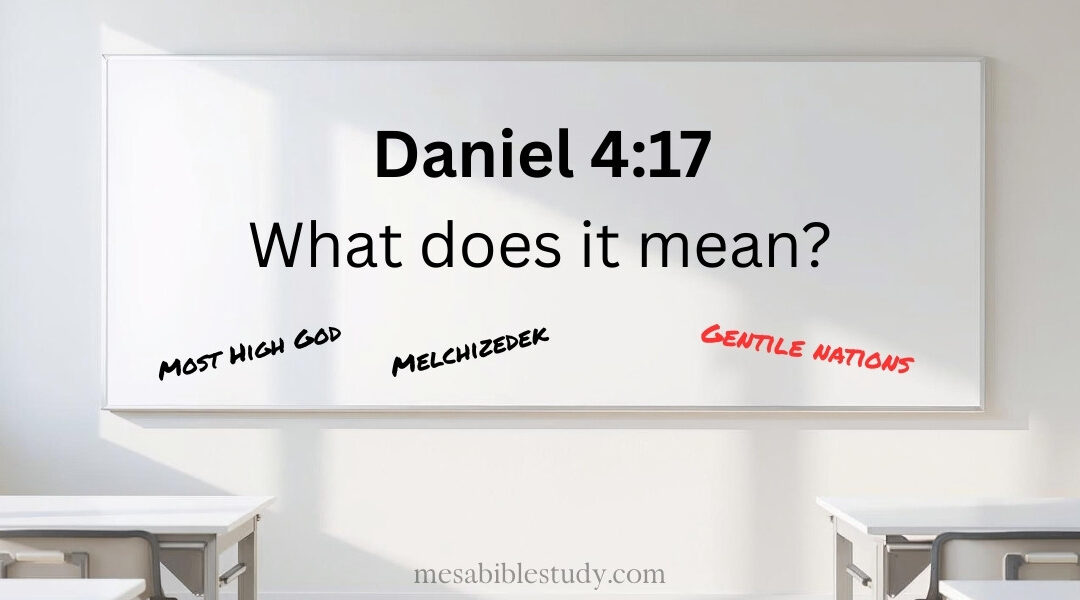
Heaven Rules: The “Most High” Governs Every Nation (Daniel 4:17)
“This decision is by the decree of the watchers, and the sentence by the word of the holy ones, in order that the living may know that the Most High rules in the kingdom of men, gives it to whomever He will, and sets over it the lowest of men.”
📬 Reader Request:
This Passage Breakdown was requested by Andy T, from Orlando, Florida who recently asked about Daniel 4:17.
I’m grateful for every question that helps shape this series.
This series reaches thousands of people around the world daily. Praise God.
📜 Background, Setting & Purpose
✍️ Author
Daniel.
👥 Written To
Daniel 4 is framed as a proclamation from King Nebuchadnezzar to the peoples under Gentile world dominion (Dan. 4:1), making this chapter uniquely “Gentile-facing” in tone and purpose.
⏲️ When
6th century B.C., during Israel’s captivity under Babylon.
🌍 Setting & Purpose of Daniel (book-level)
Daniel is written during the period when Israel is under Gentile rule—what Christ later called “the times of the Gentiles” (Luke 21:24). The throne of David is not reigning in Jerusalem, and Israel is in judgment among the nations.
Yet Daniel reveals this crucial truth:
Even when Israel is scattered, God is not absent. He is governing Gentile dominion from heaven.
Daniel 4 is God humbling the greatest Gentile king on earth to prove an eternal principle of divine government: heaven rules.
📖 Immediate Context
Nebuchadnezzar dreams of a great tree representing his kingdom. Daniel interprets the dream and warns him:
- God will humble him
- he will lose his sanity
- he will live like an animal
- until he acknowledges God’s authority
Daniel 4:17 is the divine purpose statement explaining why this judgment must happen.
✨ Phrase-by-Phrase Breakdown
“This decision is by the decree of the watchers…”
“Watchers” are angelic beings—heavenly agents involved in divine administration.
This reveals a sobering truth:
Earthly governments may look autonomous, but they are not. Heaven is watching, and heaven is ruling.
“…and the sentence by the word of the holy ones…”
God uses holy angelic agents, but the judgment is not theirs independently—God is the sovereign Judge behind the sentence.
Nebuchadnezzar is not being disciplined by politics, chance, or fate.
He is being confronted by the God of heaven.
“…in order that the living may know…”
This is not merely about humbling one king. God’s purpose is educational and universal:
God intends all mankind (“the living”) to learn a lesson about who controls world history.
“…that the Most High rules in the kingdom of men…”
This is the doctrinal centerpiece.
The title “Most High” in Hebrew is El Elyon (אֵל עֶלְיוֹן) — God Most High.
This title emphasizes God’s:
- supreme sovereignty
- exaltation above all rulers
- authority over heaven and earth
- dominion over all nations and peoples
It is not a different God. It is the same God of Scripture, but revealed with a title that highlights His universal dominion—especially in relation to the Gentile world-system.
📌 Key Doctrinal Note: Jehovah vs. Most High (Gentile emphasis)
This distinction is critical for readers to understand:
1) Jehovah / LORD (YHWH)
God’s covenant name tied especially to:
- Israel
- redemption
- covenant promises
- God’s dealings with Abraham, Isaac, and Jacob
2) Most High / El Elyon
A title emphasizing God as:
- possessor of heaven and earth
- ruler over all kings and nations
- sovereign over Gentile dominion and world empires
This is why “Most High” appears in contexts involving:
- Gentile kings and kingdoms
- national boundary-setting
- world government
For example:
- Genesis 14:18–20 — Melchizedek is “priest of the Most High God”
- Genesis 14:22 — Abraham equates El Elyon with Jehovah, proving it’s the same God
- Deuteronomy 32:8–9 — the Most High divides the nations
- Daniel 4 — the Most High humbles Gentile rulers
So Daniel 4 is God teaching the nations:
You may rule on earth, but only under the permission of El Elyon.
“…gives it to whomever He will…”
This destroys man-centered history
God grants dominion.
God removes dominion.
God transfers dominion.
Empires rise, reign, and fall because God allows them to.
“…and sets over it the lowest of men.”
God may place over nations those who appear:
- weak
- unlikely
- unqualified
- foolish
- morally corrupt
Why?
So that mankind does not confuse government power with sovereignty.
The throne is never ultimate—God is.
✦ The Genesis 14 Foundation: El Elyon and Melchizedek
The first major appearance of El Elyon in Scripture is Genesis 14:18:
“Then Melchizedek king of Salem brought out bread and wine; he was the priest of God Most High.” (NKJV)
Melchizedek is introduced as:
- king of Salem (peace / ancient Jerusalem)
- priest of the Most High God (El Elyon)
I do not believe Melchizedek is merely a type—he is best understood as a theophany: a pre-incarnate appearance of Christ.
Hebrews 7:1–3 describes him as:
- King of righteousness
- King of peace
- without recorded father/mother/genealogy
- no recorded beginning/end
- “made like the Son of God”
- abiding a priest continually
This priesthood is outside Israel’s later Levitical system and fits perfectly with the title El Elyon, emphasizing God’s universal dominion and access beyond Israel’s national structure at that time.
The bread and wine foreshadow Christ’s sacrifice and the later communion picture—early progressive revelation pointing forward to the greater Priest-King: Jesus Christ.
❌ What This Verse Does Not Mean
- Not that every ruler is righteous
- Not that God morally approves every regime
- Not that God’s sovereignty excuses evil
- Not that nations are random accidents of history
✅ What This Verse Does Mean
- God rules the Gentile world-system
- God appoints rulers and removes rulers
- God humbles the proud
- God governs world history toward His prophetic conclusions
- Heaven rules—even in times of Gentile dominion
📘 Doctrinal Summary
Daniel 4:17 reveals that the God of Scripture—El Elyon, the Most High—rules over the kingdoms of men. This title emphasizes God’s universal sovereignty over the Gentile world-system, particularly during Israel’s captivity and Gentile dominion. Jehovah is God’s covenant name tied to Israel and redemption, but “Most High” highlights His exalted authority over all nations and kings. The first major revelation of this title occurs in Genesis 14 with Melchizedek, priest of the Most High God, foreshadowing Christ’s eternal priesthood. Daniel 4 teaches what every nation must learn: kings rise and fall, but the Most High reigns forever.
🔗 Cross-References for Going Deeper
Genesis 14:18–22 — El Elyon + Abraham equates with Jehovah
Deuteronomy 32:8–9 — Most High divides the nations
Daniel 2:21 — removes kings, raises up kings
Psalm 47:2 — the LORD Most High is awesome
Acts 17:26 — boundaries and times of nations
Hebrews 7:1–3 — Melchizedek and eternal priesthood
by Jamie Pantastico | Jan 24, 2026 | Pauline Theology |
A Deep Dive into What God Has Already Given the Believer
There are passages in Paul’s epistles that quietly hold staggering depth—verses that, if read too quickly, are reduced to sentimental comfort instead of being recognized as doctrinal anchors. 2 Thessalonians 2:16–17 is one of those passages.
These verses are not emotional encouragement alone. They are theological conclusions—a summation of what believers already possess in Christ because of God’s grace.
Paul writes:
“Now our Lord Jesus Christ Himself, and our God and Father, who has loved us and given us everlasting consolation and good hope through grace, comfort your hearts and establish you in every good word and work.”
(2 Thessalonians 2:16–17, NKJV)
In two verses, Paul brings together salvation, assurance, present comfort, future glory, and the unmerited grace of God—all without a single reference to human effort, law-keeping, or religious performance.
This is pure Pauline theology.
The Context: Assurance After Distress
The Thessalonian believers were shaken. False teaching had entered the assembly, suggesting that the Day of the Lord had already begun. Fear, confusion, and spiritual instability followed.
Paul spends much of chapter 2 correcting that error—explaining the sequence of events, the restrainer, and the coming deception. But after doctrinal correction, Paul does something deeply pastoral:
He grounds them in what God has already given them.
Before exhortation, before instruction, before any call to faithfulness—Paul reminds them of who they are and what they possess in Christ.
“Who Has Loved Us”
Paul begins with God’s love, not human obedience.
This love is not conditional.
It is not reactive.
It is not earned.
It is settled, accomplished, and rooted in God’s eternal purpose.
Paul does not say “who will love us if we endure” or “who loves us because we obey.”
He says “who has loved us.”
This love precedes sanctification, service, and growth. It is the foundation upon which everything else rests.
“And Given Us Everlasting Consolation”
This phrase deserves careful attention.
Everlasting Means Everlasting
“Everlasting consolation” does not mean temporary comfort.
It does not mean emotional relief.
It does not mean encouragement only when life is going well.
It means a permanent, unending source of comfort—one that began the moment we were placed into Christ and continues both now and forever.
This consolation is not postponed until heaven.
It is not reserved for the resurrection alone.
It is present possession.
Even while we live in a fallen world…
Even while suffering, loss, persecution, and weakness persist…
Even while groaning inwardly…
The believer already possesses everlasting consolation.
Why?
Because our standing before God is settled.
“And Good Hope”
Biblical hope is not wishful thinking.
It is not optimism.
It is not uncertainty.
Hope, in Paul’s writings, is confident expectation grounded in accomplished truth.
This “good hope” is not fragile.
It is not dependent on circumstances.
It does not fluctuate with performance.
It is “good” because it is anchored in:
- Christ’s finished work
- Our justification by faith
- Our future glorification
This hope looks forward because it is secure.
And it is secure because it is not sustained by us.
“Through Grace”
Here is the heart of the passage.
Paul does not say:
- through obedience
- through perseverance
- through holiness
- through religious discipline
- through law-keeping
He says “through grace.”
Grace is unmerited favor.
God was not obligated.
God was not responding to worthiness.
God was not compelled by human action.
He gave—freely.
He loved—freely.
He secured—freely.
Everything listed in this verse:
- love
- everlasting consolation
- good hope
comes through grace.
Not mixed with works.
Not sustained by effort.
Not maintained by religious systems.
Grace is not a starting point we graduate from.
Grace is the atmosphere of the Christian life.
“Comfort Your Hearts”
Paul now moves from what God has given to what God does.
Because believers possess everlasting consolation and good hope through grace, God is able to comfort their hearts—not temporarily, but deeply and continually.
This comfort is not denial of pain.
It is not emotional suppression.
It is spiritual stability rooted in truth.
Grace comforts because grace assures.
“And Establish You in Every Good Word and Work”
Notice the order.
Paul does not say:
“Do good works so you may be established.”
He says:
“May God establish you… resulting in good words and works.”
Good works are the fruit, not the foundation.
Grace does not produce lawlessness.
Grace produces stability.
Grace establishes.
Grace empowers.
The believer does not serve God to earn consolation or hope.
The believer serves God because consolation and hope are already secure.
A Word of Clarification on Grace
Grace must never be misunderstood.
Grace is not permission to sin.
Grace is not spiritual apathy.
Grace is not moral indifference.
Grace is the reason anything good flows from the believer at all.
If God had done nothing for us, He would still be righteous.
But He did everything—because of grace.
And because of that grace:
- We are secure
- We are comforted
- We are established
- We have hope—now and forever
Final Reflection
2 Thessalonians 2:16–17 is not merely encouragement—it is assurance anchored in grace.
In a world filled with deception, instability, suffering, and spiritual confusion, Paul does not point believers inward.
He points them back to what God has already done.
Loved.
Given.
Secured.
Established.
All of it—
through grace.
And because it is through grace,
it will never fail.

by Jamie Pantastico | Jan 22, 2026 | Verse-by-Verse Bible Studies |
Philippians 4:1
“Therefore, my beloved and longed-for brethren, my joy and crown, so stand fast in the Lord, beloved.”
📜 Background, Setting & Purpose
✍️ Author
Paul the Apostle.
👥 Written To
Believers in Philippi, a predominantly Gentile church deeply supportive of Paul’s ministry.
⏲️ When
Approximately A.D. 60–62, during Paul’s first Roman imprisonment.
🌍 Setting & Purpose of Philippians (book-level)
Philippians is a prison epistle focused on joy, unity, humility, and steadfastness in Christ. Unlike Galatians or Corinthians, Philippians addresses no major doctrinal crisis, but rather encourages believers to live consistently with the gospel they have already received.
Chapter 3 has just contrasted:
- confidence in the flesh vs. confidence in Christ
- earthly religion vs. heavenly citizenship
- law-righteousness vs. righteousness by faith
Philippians 4:1 is the bridge between doctrine and exhortation.
📖 Immediate Context (Philippians 3)
Paul has just declared:
- “our citizenship is in heaven” (3:20)
- believers await Christ’s return
- righteousness is found in Christ alone
Now he draws a conclusion.
✨ Phrase-by-Phrase Breakdown
“Therefore…”
This word connects everything Paul has just taught.
Because:
- righteousness is by faith (3:9)
- our hope is heavenly (3:20)
- Christ will transform our bodies (3:21)
Therefore, live accordingly.
“my beloved and longed-for brethren…”
This reveals Paul’s pastoral heart.
Paul’s doctrine is never cold or detached.
Truth produces affection, not arrogance.
“my joy and crown…”
The Philippians themselves are Paul’s reward.
Not money.
Not recognition.
But people standing firm in grace.
“so stand fast…”
Stand fast = remain firm, unmoved, settled.
This is a call to doctrinal stability, not emotional strength.
“in the Lord…”
Stability is not found in circumstances, discipline, or resolve.
It is found in Christ.
“beloved.”
Paul closes the verse the same way he opened it—with love.
Exhortation flows from relationship, not authority alone.
❌ What This Verse Does Not Mean
- Not standing fast in self-effort
- Not clinging to religious systems
- Not striving to earn approval
- Not law-based perseverance
✅ What This Verse Does Mean
- Believers are to remain grounded in grace
- Christian stability flows from gospel clarity
- Doctrine leads to steadfast living
- Love and truth belong together
🔗 Cross-References for Going Deeper
1 Corinthians 15:58 — Stand firm in gospel truth
Galatians 5:1 — Stand fast in liberty
Colossians 2:6–7 — Rooted and built up in Christ
Ephesians 6:13 — Having done all, stand
📘 Doctrinal Summary
Philippians 4:1 is Paul’s call to steadfastness grounded in grace. Because believers are righteous by faith, citizens of heaven, and awaiting Christ’s return, they are to remain firm in the Lord—not in fleshly confidence or religious effort. Standing fast is not about striving harder, but about staying anchored in the truth of who we are in Christ. When doctrine is clear, stability follows.
by Jamie Pantastico | Jan 21, 2026 | Devotionals |
Psalm 61:1 — A Cry from an Overwhelmed Heart
“Hear my cry, O God;
Attend unto my prayer.”
— Psalm 61:1
Background & Setting
Psalm 61 is attributed to David and is most likely written during one of the darkest seasons of his life—when his own son, Absalom, rose up in rebellion and drove him from Jerusalem (2 Samuel 15–18). David is no longer seated on the throne. He is fleeing, grieving, betrayed, and surrounded by uncertainty. Verse by verse, Psalm 61 reveals how a godly heart responds when circumstances are overwhelming—and why faith anchored in God and His Word — does not collapse under pressure.
Yet the psalm opens not with strategy, anger, or despair—but with prayer.
This verse is not poetic ornamentation. It is the raw cry of a man who has nowhere left to turn but God.
Phrase-by-Phrase Insight
“Hear my cry, O God”
This is not a polished prayer. The word cry speaks of distress, urgency, and emotional exhaustion. David is not asking God to evaluate his prayer—he is asking God to hear him. This is the language of a heart that is overwhelmed, not composed.
David does not cry about God.
He cries to God.
That distinction matters.
“Attend unto my prayer”
To “attend” means to give careful attention. David is expressing complete dependence—not on his position, his past victories, or even the promises he knows—but on the personal nearness of God in this moment.
David believes God is not distant.
He believes God is listening.
And he believes God cares.
That belief is the foundation of everything that follows in this psalm.
Devotional Reflection
What makes Psalm 61 so powerful is not that David is strong—it is that he is honest.
David does not minimize his pain.
He does not pretend to be unaffected.
He does not isolate himself in silence.
Instead, he brings his distress directly to God.
This verse reminds us that faith does not require eloquence. It requires direction. When life overwhelms us, the question is not how we pray—but where we turn.
Even in the dispensation of grace, this principle remains unchanged. We may not be under Israel’s covenants, but we serve the same faithful God who hears the cries of His people. Our access is even greater—secured through Christ—but the posture of the heart is the same.
God invites us to come honestly.
Word of Encouragement
If your heart feels heavy today…
If circumstances feel unfair, confusing, or crushing…
If all you can do is cry out—
God hears you.
You do not need the right words.
You do not need strength you don’t have.
You only need to bring your cry to Him.
David shows us that the first step out of despair is not answers—it is prayer.
And God is listening.
📖Psalm 61:1 — Reading Plan
Theme: Crying Out to God When Overwhelmed
-
Day 1: Psalm 61
-
Day 2: Psalm 62
-
Day 3: Psalm 63
-
Day 4: Romans 8:26–27
by Jamie Pantastico | Jan 21, 2026 | Israel and Bible Prophecy |
A prophetic essay on warning signs the Church must not ignore
For much of modern history, the United States has been one of the safest places on earth for Jewish people. It has functioned as a refuge—socially, economically, and culturally—especially in the aftermath of European antisemitism and the horrors of the twentieth century.
But something is changing.
Not gradually.
Not subtly.
And not accidentally.
A new hostility toward Jewish people is forming in the public square, on college campuses, in political rhetoric, and—most concerning of all—within sectors of the visible Church itself.
This essay is not alarmist.
It is not speculative.
It is discernment rooted in Scripture and history.
1. Hostility Toward Israel Always Precedes Hostility Toward Jews
This pattern is consistent throughout history:
When Israel is demonized as a nation, Jewish people soon become targets as individuals.
The rhetoric usually begins with:
- accusations of power
- claims of manipulation
- moral inversion
- collective guilt
- justification language
History shows that once a society normalizes hostility toward Jewish self-determination, it eventually tolerates hostility toward Jewish neighbors.
What we are witnessing now is the early ideological stage of that pattern—not its conclusion.
2. The Church Has Historically Played a Decisive Role—for Good or for Harm
The Church’s posture toward Jewish people has always mattered.
When the Church:
- upheld Scripture
- honored God’s covenants
- rejected replacement theology
Jewish communities tended to be protected.
When the Church:
- spiritualized Israel
- taught God had rejected the Jews
- framed Jews as obstacles to God’s purposes
hostility followed—sometimes from the Church directly, sometimes with the Church’s silence.
Paul warned Gentile believers precisely to prevent this:
“Do not boast against the branches… do not be haughty, but fear.”
— Romans 11:18, 20
That warning was not theoretical.
It was preventative.
3. Replacement Theology Creates a Moral Vacuum
When Christians are taught that:
- God is finished with Israel
- Jewish identity has no covenant meaning
- Israel’s role has expired
then Jewish people are no longer seen through the lens of promise—but through the lens of politics, ideology, or grievance.
This does not automatically produce hatred.
But it removes the theological guardrails that once restrained it.
A vacuum is never neutral.
Something always fills it.
4. Cultural Ideologies Are Reframing Jewish Identity
Modern Western thought increasingly divides the world into simplified categories:
- oppressor vs. oppressed
- powerful vs. powerless
In this framework:
- Jewish continuity is misread as dominance
- Jewish survival is reframed as privilege
- Jewish nationhood is portrayed as illegitimate
This lens ignores:
- centuries of persecution
- repeated expulsions
- attempted annihilation
- the miracle of survival
Scripture warns against judging by appearances rather than truth (John 7:24).
5. Apostasy Weakens Discernment
Paul warned that in the last days:
- truth would be resisted
- doctrine would be abandoned
- discernment would decline
“Evil men and impostors will grow worse and worse, deceiving and being deceived.”
— 2 Timothy 3:13 (NKJV)
When sound doctrine erodes, Christians become vulnerable to narratives that sound moral but contradict Scripture.
This includes narratives about Israel and the Jewish people.
6. Prophecy Foretells Increasing Pressure on Israel—and Its People
Zechariah prophesied:
“All nations of the earth are gathered against it.”
— Zechariah 12:3
This global alignment does not happen in a vacuum.
It begins with:
- ideas
- rhetoric
- conditioning
- moral justification
Pressure against Israel eventually spills into pressure against Jews worldwide.
This is not new.
It is prophetic.
7. God Uses Pressure to Fulfill His Purposes—Without Authoring Evil
Scripture is clear: God does not cause hatred, but He overrules human hostility to accomplish His promises.
Throughout history, periods of pressure have preceded:
- Jewish migration
- regathering
- redirection
“I will take you from among the nations… and bring you into your own land.”
— Ezekiel 36:24
This does not excuse hostility.
It explains how God remains sovereign even when humanity fails.
8. The Body of Christ Has a Responsibility in This Moment
Christians are not called to:
- inflame tensions
- demonize others
- respond with fear or anger
But we are called to:
- speak truth
- reject false teaching
- resist theological arrogance
- uphold God’s faithfulness
- protect against dehumanization
Silence in the face of error is not neutrality—it is abdication.
9. The Divide Between the Remnant and Apostate Church Will Become Clearer
As pressure increases, the distinction will sharpen:
The Remnant Church
- believes Scripture plainly
- honors God’s covenants
- understands Israel’s role
- rejects cultural manipulation
The Apostate Expression
- spiritualizes prophecy
- dismisses Israel
- adopts secular frameworks
- confuses compassion with compromise
This divide is theological before it is social.
10. God Will Vindicate His Word—and His People
The Bible does not end in confusion.
It ends in clarity.
“The LORD will be King over all the earth.”
— Zechariah 14:9
“All Israel will be saved.”
— Romans 11:26
“The gifts and the calling of God are irrevocable.”
— Romans 11:29
Hostility does not have the final word.
Faithfulness does.
Conclusion: Why This Warning Matters
This essay is not about predicting events.
It is about recognizing patterns.
Scripture warns.
History confirms.
Discernment requires attention.
The Church must:
- remain anchored in the Word
- reject theological arrogance
- refuse dehumanizing narratives
- stand firm in truth and grace
The measure of a generation is not how loudly it speaks—but how faithfully it listens to what God has already said.
Explore the Series
← Previous | 📖 Series Home |