by Jamie Pantastico | Nov 17, 2025 | Pauline Theology |
Galatians 5:11 – The Offense of the Cross
Before Paul makes his thunderous statement in Galatians 5:11, he walks the Galatians through a series of spiritual diagnostics in verses 7–10. Each verse builds toward one unavoidable conclusion:
Someone has pulled them away from the truth—and it was not God.
Let’s follow Paul’s inspired reasoning.
Galatians 5:7 — “You Did Run Well…”
“Ye did run well; who did hinder you that ye should not obey the truth?”
Paul begins with a reminder:
“You started well. You believed the gospel. What in the world happened?”
Paul knew exactly what happened, but he asks the question the same way Jesus often did—not because He needed information, but because questions force the listener to face what they already know.
Paul’s question exposes the problem:
Somebody had stepped in and cut them off from the truth of grace.
These believers had been running the race of faith with joy and freedom (Galatians 5:1)—and now they were bogged down in law-keeping, rituals, and performance-based salvation.
Galatians 5:8 — This Didn’t Come From God
“This persuasion cometh not of Him that calleth you.”
Paul says bluntly:
“This message didn’t come from the Holy Spirit.”
If the Spirit of God didn’t persuade them to abandon grace, then what spirit did?
There are only two spiritual influences in the world:
- The Holy Spirit, who leads us into truth
- The evil spirit, Satan, who leads into deception
Legalism never comes from God.
Works-based salvation never comes from God.
The pressure to earn what Christ already accomplished never comes from God.
The same evil spirit who once held them in paganism was now trying to pull them into legalism.
Satan doesn’t care which ditch you fall into—just so long as you leave the gospel of grace.
And he never, ever gives up.
Galatians 5:9 — Leaven Always Spreads
“A little leaven leaveneth the whole lump.”
Leaven is yeast—and yeast does not partially spread.
It permeates everything.
Legalism works the same way. So does false teaching. So does moral compromise.
What begins as “just a small doctrinal adjustment” becomes a complete takeover.
Paul’s warning is prophetic.
Look at Christendom today:
- The world knocked on the door of the Church.
- The Church cracked the door open.
- A little more world came in.
- The door opened wider.
- Now you can hardly tell the Church and the world apart.
A little leaven leavens the whole lump.
And legalism is the most destructive leaven of all.
Galatians 5:10 — Paul’s Confidence (and His Warning)
“I have confidence in you through the Lord…”
Paul hasn’t given up on them.
He refuses to throw these believers to the wolves.
He trusts that the Lord will bring them back to the truth of the gospel of grace.
But then comes one of the most severe warnings in all of Paul’s letters:
“…but he that troubleth you shall bear his judgment, whosoever he be.”
Paul doesn’t care who the false teacher is:
- A scholar
- A philosopher
- A trained theologian
- A respected rabbi
- A man from Jerusalem
- An apostle’s acquaintance
It doesn’t matter.
They will bear judgment.
And we’re not talking about earthly consequences. Paul is referring to the future judgment of the lost:
The Great White Throne.
🔥 BOLD. EMPHATIC. NON-NEGOTIABLE.
“…he that troubleth you—
with his false teaching—
SHALL BEAR HIS JUDGMENT, whosoever he be.”
There is nothing more serious than corrupting the gospel.
Teachers who mislead people—pastors, influencers, theologians, seminary-trained wolves—
will occupy the hottest place in the lake of fire.
Handling Scripture is a fearful responsibility.
Now the Explosion: Galatians 5:11 — “The Offense of the Cross”
After examining the spiritual sabotage in verses 7–10, Paul asks the decisive question:
“And I, brethren, if I yet preach circumcision, why do I yet suffer persecution? Then the offense of the cross has ceased.”
Here’s Paul’s point:
If I preached what the Judaizers preach, I would not be persecuted.
- Nobody would hate me.
- Nobody would beat me.
- Nobody would try to kill me.
- Nobody would slander me.
If Paul preached:
- Law-keeping
- Circumcision
- Works
- Performance
- Effort
- Human righteousness
Then the offense of the cross would disappear.
Because the cross is offensive for one reason:
It tells every human being that they bring NOTHING to the table.
The cross is offensive because it strips away:
- Boasting
- Merit
- Ritual
- Pride
- Personal contribution
The cross says:
“You are helpless.
Christ did everything.
You add nothing.”
The self-righteous despise that message. Their in opposition to God’s grace.
The Parallel Today—Nothing Has Changed
The Galatians faced false teachers from Jerusalem.
Today’s believers face false teachers from pulpits.
Then it was circumcision and law-keeping.
Today it is:
- “Faith plus repentance.”
- “Faith plus baptism.”
- “Faith plus holiness.”
- “Faith plus fruit.”
- “Faith plus endurance.”
- “Faith plus obedience.”
- “Faith plus doing your part.”
Different vocabulary.
Same leaven.
Same deception.
Same bondage.
Paul faced it 2,000 years ago. Believers face it today.
And the same gospel Paul defended is the same gospel the world hates:
Grace without works.
Christ without additives.
Salvation without human contribution.
Paul Never Compromised—And Neither Can We
Paul could have ended all persecution by compromising.
By saying, “You guys are right—faith alone is too simple.”
But he didn’t. Not once. Not ever. Why?
His gospel came directly from the risen, glorified Christ.
—Galatians 1:11–12
He refused to surrender to Judaizers then.
‘to whom we did not yield submission even for an hour, that the truth of the gospel might continue with you.’ Galatians 2:5
We refuse to surrender to modern Judaizers now.
The offense of the cross has not ceased. And it will not cease—because grace will always offend works.
This is why Paul warned the Church for three years with tears that wolves would come (Acts 20:29–30).
And they did. They always do.
Most of Paul’s congregations eventually abandoned Paul’s message, not Paul himself.
And today, 95% of Christendom has done the same.
But the truth stands:
‘In Him you also trusted, after you heard the word of truth, the gospel of your salvation;
in whom also, having believed, you were sealed with the Holy Spirit of promise, ‘
Ephesians 1:13
Salvation is by grace through faith alone in the finished work of Christ.
Not of works.
Lest any man should boast. Ephesians 2:8-9

by Jamie Pantastico | Nov 15, 2025 | Bible Doctrine |
📖 Passage Breakdown — Psalm 27:13 — Faith to See the Goodness of the Lord
📜 Background, Setting & Purpose
✍️ Author:
David, King of Israel.
👥 Written To:
Israel—God’s covenant people.
⏲️ When:
Likely during one of David’s many seasons of trial, possibly while fleeing from Saul or Absalom.
🌍 Setting & Purpose:
Psalm 27 reflects David’s unwavering faith in the Lord even when surrounded by fear and enemies. Verses 1–6 declare his faith and desire to dwell in God’s presence, while verses 7–14 reveal his heart of dependence and prayer. Verse 13 is a statement of faith under pressure—David believed, even before the cross, that he would one day see his Redeemer and the fulfillment of God’s promises in the land of the living.
🔍 Psalm 27:13
“I would have lost heart, unless I had believed that I would see the goodness of the Lord in the land of the living.”
✨ Phrase-by-Phrase Breakdown
“I would have lost heart…”
- David admits his human frailty—without faith, despair would have overtaken him.
- Even the strongest believers can feel weak, but faith anchors the heart amid fear.
- This echoes Job’s perseverance: “Though He slay me, yet will I trust Him” (Job 13:15).
“…unless I had believed…”
- Faith is the dividing line between despair and hope.
- David’s confidence wasn’t in himself, but in the covenant-keeping God who cannot lie.
- This shows that saving faith—trusting God to do what He said He will do—has always been the basis for relationship with God, even before Paul’s revelation of grace.
“…that I would see the goodness of the Lord…”
- David expected literal, visible fulfillment—not vague optimism.
- Like Job, he believed he would one day stand before his Redeemer in the flesh (Job 19:25-27).
- This was Israel’s hope: the coming of the Messiah to establish the promised kingdom on earth (Luke 1:68-74).
“…in the land of the living.”
- David isn’t speaking of heaven, but of life restored and renewed upon the earth under Messiah’s reign.
- For Israel, “the land of the living” refers to the promised land—where God’s goodness and faithfulness would be seen when the King reigns in Jerusalem.
🔑 Doctrinal Insight
Before Paul, no provision for salvation was given directly to Gentiles apart from Israel.
Israel was to be the channel of blessing and salvation to the nations (Genesis 12:3; Isaiah 60:1-3). David’s faith looked forward to that kingdom hope—seeing the Messiah rule from Jerusalem.
But when Israel rejected her King and the kingdom was postponed, God revealed a new and previously hidden plan to Paul—the dispensation of grace (Ephesians 3:1-9).
Now salvation comes freely to Jew and Gentile alike, not through Israel’s rise but through her fall (Romans 11:11-12).
🙏 Devotional Summary
David’s faith in Psalm 27:13 was rooted in God’s promises. He believed that even though circumstances were bleak, the goodness of the Lord would prevail.
We, too, live by faith—but in the revelation given to Paul: that salvation is by grace alone through faith alone in the finished work of Christ.
Just as David’s faith sustained him until he would see, our faith sustains us until that glorious day when we will see Him, and we shall always be with the Lord (1 Thessalonians 4:17).
“For we walk by faith, not by sight… until faith becomes sight.” (2 Corinthians 5:7)
by Jamie Pantastico | Nov 14, 2025 | Israel and Bible Prophecy |
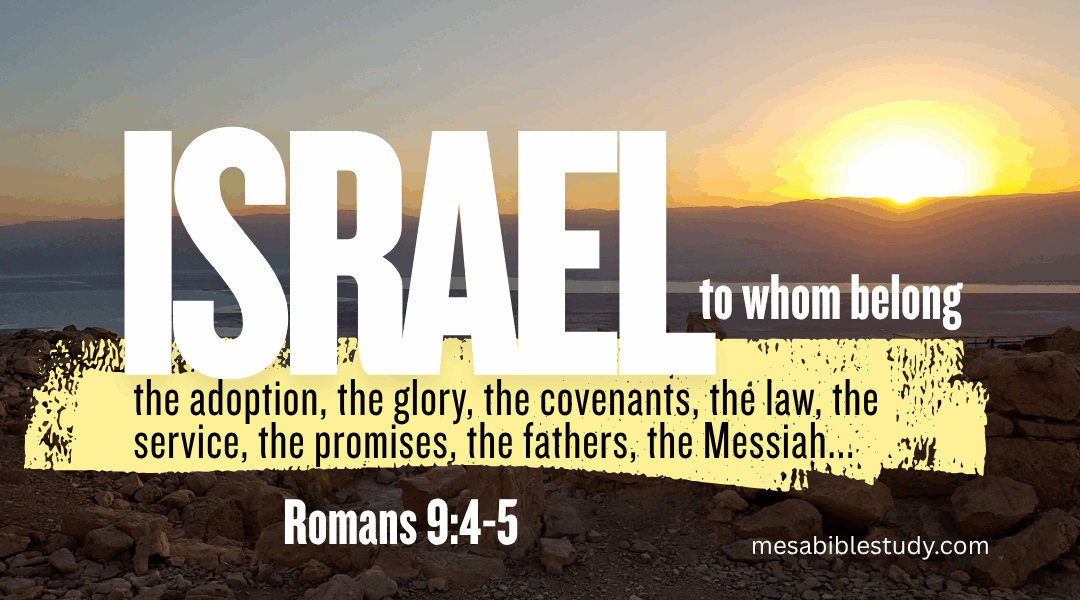
Israel’s Privileges (Romans 9:4–5)
“Who are Israelites, to whom pertain the adoption, the glory, the covenants, the giving of the law, the service of God, and the promises; of whom are the fathers and from whom, according to the flesh, Christ came, who is over all, the eternally blessed God. Amen.”
Israel’s privileges and blessings are Israel’s alone—rooted in God’s covenants, promises, and prophetic plan. Yet in this present age of grace, Gentiles are brought in, not by becoming Israel, but by believing the gospel.
The apostle Paul makes this truth crystal clear:
“That the Gentiles should be fellow heirs, of the same body, and partakers of His promise in Christ through the gospel.”
— Ephesians 3:6
Gentiles are not given Israel’s covenants. Instead, by grace, we become partakers in Christ through the gospel—sharing in the spiritual blessings that flow through the Messiah, the promised Seed (Galatians 3:8, 14, 16).
Here Paul lists Israel’s extraordinary blessings:
- The Adoption — God called Israel His “firstborn son” (Exodus 4:22).
- The Glory — The visible presence of God (the Shekinah) dwelled among them in the tabernacle and temple.
- The Covenants — The Abrahamic, Mosaic, Davidic, and New Covenants were given to Israel, not to Gentiles.
- The Law — God gave His commandments and moral standard to Israel alone.
- The Service — The priesthood, sacrifices, and temple worship were entrusted to them.
- The Promises — Every prophetic and Messianic promise in the Old Testament pointed through Israel.
- The Fathers — Abraham, Isaac, and Jacob were the patriarchs of faith and the foundation of God’s dealings with man.
- Christ Himself — The ultimate privilege: the Messiah came through Israel, “according to the flesh.”
Paul ends with exaltation: “Christ… who is over all, the eternally blessed God.” This is a direct affirmation of Christ’s deity. The promised Messiah was not merely Israel’s hope but God in the flesh, born into the very nation that would reject Him.
Truth over Tradition

by Jamie Pantastico | Nov 13, 2025 | Israel and Bible Prophecy |
🕊️The olive tree represents continuity—not replacement.
“And if some of the branches were broken off, and you, being a wild olive tree, were grafted in among them, and with them became a partaker of the root and fatness of the olive tree, do not boast against the branches. But if you do boast, remember that you do not support the root, but the root supports you.”
This powerful imagery illustrates the relationship between Israel and the Gentile believers.
- The olive tree represents the covenantal blessings and promises of God.
- The natural branches are Israel.
- The wild branches are believing Gentiles, grafted in by grace.
Gentiles are not replacing Israel but sharing in her spiritual blessings.
We are partakers, not possessors.
Paul warns Gentile believers not to boast. The root (Israel’s covenant with God through Abraham) supports the Church—not the other way around.
This strikes directly at the error of replacement theology, which falsely teaches that the Church has taken Israel’s place.
🕊️The olive tree represents continuity—not replacement.
🕎Israel is the root, the Church is grafted in, and the same God sustains both by grace.

by Jamie Pantastico | Nov 12, 2025 | Pauline Theology |
📖 Passage Breakdown — Ephesians 1:7 — Redemption Through His Blood
📜 Background, Setting & Purpose
✍️ Author:
Paul, the apostle to the Gentiles (Ephesians 3:1–2).
👥 Written To:
The saints at Ephesus and all believers in the Body of Christ (Ephesians 1:1)—Jew and Gentile alike.
⏲️ When:
Around A.D. 60–62, during Paul’s first Roman imprisonment.
🌍 Setting & Purpose:
Paul writes from prison to reveal the believer’s spiritual blessings “in Christ.” This letter emphasizes our heavenly position right now, the mystery of the Church—the Body of Christ—and the riches of God’s grace freely given through the finished work of Christ.
Ephesians 1:7 anchors this entire theme: our redemption, forgiveness, and acceptance before God are found only “in Him.”
🔍 Ephesians 1:7
“In Him we have redemption through His blood, the forgiveness of sins, according to the riches of His grace.”
✨ Phrase-by-Phrase Breakdown
“In Him we have redemption…”
- Our salvation and every spiritual blessing are found in Christ—not in religion, ritual, or law-keeping.
- “Redemption” (Greek: apolutrōsis) means to buy back by paying a ransom. Christ purchased us out of sin’s slave market.
- The verb “have” is present tense—we possess redemption now, not someday.
“…through His blood…”
- The blood of Christ is the divine payment. Without the shedding of blood, there is no remission (Hebrews 9:22).
- His death was not symbolic but substitutionary—the sinless Son of God bore the full penalty of sin.
- Our forgiveness is not earned; it was bought at infinite cost.
“…the forgiveness of sins…”
- Forgiveness (aphesis) means release or freedom from bondage.
- God has removed sin’s penalty and its record forever (Colossians 2:13–14).
- Forgiveness is not based on confession, repentance, or ritual—it is grounded entirely in Christ’s finished work.
“…according to the riches of His grace.”
- Notice: according to, not out of. God doesn’t give from His riches but in proportion to His riches—an inexhaustible measure.
- Every believer stands forgiven and redeemed because of God’s overflowing, boundless grace (Romans 5:20).
❌ What This Passage Does Not Mean
- It does not suggest that redemption requires our works or performance.
- It does not imply partial or temporary forgiveness.
- It does not depend on our ongoing effort to “stay saved.”
✅ What It Does Mean
- Redemption and forgiveness are present realities for every believer.
- Salvation is through Christ’s blood alone, not through human merit.
- God’s grace is immeasurable and inexhaustible, securing the believer forever.
🙏 Devotional Summary
The believer’s entire standing before God rests on one truth: “In Him we have redemption.”
The blood of Christ satisfied the justice of God, erased the record of sin, and made us complete in Him. Nothing needs to be added—no law, no ritual, no human merit.
The riches of God’s grace not only redeem the sinner but sustain the saint.
The same grace that saved us keeps us.
“In Him we have redemption through His blood, the forgiveness of sins, according to the riches of His grace.”