by Jamie Pantastico | Mar 3, 2026 | Bible Doctrine |
Understanding Israel’s Promises, the Kingdom Gospel, and Why Paul’s Message Was Still Hidden
One of the most important principles in Bible study is this:
We cannot read ahead of God’s revelation.
We cannot pull truth from Paul’s epistles and force it back into the Gospels (Retroactive).
We must always ask:
Who is writing, and who is the writer writing to?
In Matthew 1:1, the answer is unmistakable:
- Matthew is a Jew
- writing under the Law
- chosen by the Messiah
- writing to Jews
- about their long-promised King
- and the Kingdom program God began with Abraham and David.
Matthew 1:1 is not the beginning of the Church —
it is the continuation of Israel’s story.
Gentiles Were Not Part of Israel’s Promises — Scripture Says So Plainly
Ephesians 2:11–12 states it with razor clarity:
“At that time you were without Christ,
aliens from the commonwealth of Israel,
strangers from the covenants of promise,
having no hope and without God in the world.”
Before Paul’s revelation, the Gentile world:
❌ had no covenant
❌ had no Messiah to expect
❌ had no promises
❌ had no access to Israel’s God
❌ had no place in Israel’s Kingdom hope
Jews saw Gentiles as unclean, pagan outsiders.
Gentiles wanted nothing to do with Jewish Law, culture, or the 613 commandments.
The Gentile world was not waiting for a Messiah.
Israel was.
For 2,000 years.
Jesus Came as a Minister to Israel — Not the Church
Romans 15:8:
“Jesus Christ has become a servant to the circumcision (Jews)
to confirm the promises made to the fathers.”
Who are “the fathers”?
Abraham, Isaac, Jacob — not the Church.
Jesus came:
- to Israel
- under the Law
- confirming the covenants
- offering Israel her King
- preaching the Kingdom Gospel
This is why Jesus told the rich young ruler what He told him.
Why Did Jesus Tell the Rich Man to “Keep the Commandments”? (Matthew 19)
People ask me weekly, from all denominational backgrounds:
“Jesus said to keep the commandments to inherit eternal life!”
Why? Because that was the covenant ground Israel stood on.
Jesus was ministering under the Law, to those who were under the law— Jews.
He never told anyone during His earthly ministry:
“You are no longer under the Law.”
Because that truth was not yet revealed.
Paul hasn’t even come on the scene yet.
Lazarus and the Rich Man — What Could Abraham Possibly Preach?
The context of Luke 16:22-31, is stunning — and it destroys the “everything has always been the same gospel” argument.
Luke 16:22–31 — The rich man in torment begs Abraham:
“Send Lazarus to warn my brothers!”
Abraham answers:
“They have Moses and the Prophets; let them hear them.”
Notice carefully:
Abraham does not say:
- “They have the gospel of grace.”
- “Tell them to trust in the death, burial, and resurrection.”
- “Tell them salvation is by grace through faith apart from works.”
- “Tell them Romans 10:9!”
None of that had been revealed.
A 12-year-old could answer why:
Abraham could not preach a gospel that did not exist.
Grace had not been revealed.
The mystery had not been given.
Paul had not been chosen by God yet.
All Israel had — and all Lazarus believed — was the King and the Kingdom:
- The Messiah would come
- He would be the Son of God
- He would save Israel
- He would crush their enemies
- He would establish David’s throne
- Israel would be the head of the nations
This is the good news Peter believed in Matthew 16:16.
This is the good news Jesus and the Twelve preached for 3 years.
This is the good news Peter proclaimed at Pentecost (Acts 2).
And again in Acts 3 — unchanged.
Why unchanged?
Because Paul’s gospel of grace had not yet been revealed. And trying to retrofit Paul into the Lord’s earthly ministry is hermenuetic desperation.
Even Early Acts Is Still the Kingdom Gospel — Not Grace
Acts 3:19–21 is Abraham’s message all over again:
“…that He may send Jesus Christ…
whom heaven must receive until the times of restoration…”
That is Kingdom truth — not grace-age doctrine.
Peter is not preaching the cross as salvation.
He is offering Israel their King — if they repent.
Both Peter and Paul preached resurrection for sure. But Peter preached resurrection as proof that Jesus is the Messiah, and assurance of the kingdom to come.
The apostle Paul preached the resurrection of Christ as the means of salvation and sanctification for all, Jew and Gentile, becoming a new creation, being baptized into the body of Christ which is His Church. All of it apart from the law and temple worship.
This is why:
❌ No one in Acts 2–7 preaches the blood of Christ as a salvation message.
❌ No one preaches the Body of Christ.
❌ No one preaches Jew and Gentile in one new man.
❌ No one preaches salvation apart from the Law.
Because none of that had been revealed.
The mystery is still hidden in God (Ephesians 3:1–9).
The Gospel of Grace Arrives With Paul — 10 Years After Pentecost
Historically and scripturally:
- Paul is saved around 36–38 AD
- His gospel is revealed to him by Christ Himself
- He begins preaching it years after Pentecost
- The first grace-age epistle isn’t written until 50–52 AD
For roughly 10+ years, the only gospel being preached was the:
Kingdom Gospel ➝ for Israel
Not the
Gospel of Grace ➝ for Jew & Gentile alike
This is the theme of Hebrews:
- Angels were good ➝ Christ is better
- Law was good ➝ Grace is better
- Aaronic priesthood was good ➝ Melchizedek is better
- Old covenant was glorious ➝ New covenant is more glorious
Grace is better — but it came later.
Why Christendom Is Confused Today
Because for 2,000 years, Gentiles — who were never part of the covenants — have forced themselves into Israel’s program and tried to mix:
- Peter and Paul
- law and grace
- kingdom and body
- prophecy and mystery
- Israel and the Church
And you can’t mix them.
The Bible only becomes clear when you stop forcing it to say what it never said —
and start reading it “in-time,” with the writer and audience in view.
Then everything falls into place.
And you finally see the breathtaking difference between:
- Israel and the Church
- Peter and Paul
- Law and Grace
- Prophecy and Mystery
- The Kingdom Gospel and the Gospel of Grace
When divided rightly, Scripture becomes the clearest, most thrilling book you’ve ever held.
And you will never want to put it down.
by Jamie Pantastico | Mar 2, 2026 | Devotionals |
A Devotional on Psalm 98:1
Psalm 98:
“Oh, sing to the LORD a new song!
For He has done marvelous things;
His right hand and His holy arm have gained Him the victory.”
Context
Psalm 98 is a celebration of divine triumph.
It is not a quiet reflection.
It is not cautious optimism.
It is a declaration.
The psalmist calls the earth to sing because something decisive has happened.
The Lord has acted.
And His action has secured victory.
His Right Hand
In Scripture, the “right hand” represents strength, authority, and power.
It speaks of decisive action.
Not borrowed strength.
Not delegated ability.
God Himself accomplished the victory.
“His right hand and His holy arm have gained Him the victory.”
The triumph was not achieved by human effort.
It was not dependent on national strength.
It was not sustained by strategy.
It was gained by Him.
The Victory Is His Before It Is Ours
Notice the wording carefully.
It does not say His people gained Him the victory.
It says He gained the victory.
This is foundational.
Before believers ever stand in triumph,
God has already secured it.
The cross would later display this truth in its fullest expression.
Salvation was not humanity reaching upward.
It was God acting downward.
His right hand accomplished what ours never could.
Why This Matters in the Battle
When we forget that victory belongs to Him, we begin striving.
We attempt to:
- Manufacture peace
- Secure outcomes
- Control circumstances
- Earn spiritual stability
But Psalm 98 reminds us:
He has done marvelous things.
Not “He will if we perform.”
Not “He might if we try harder.”
He has done.
The foundation is finished action.
For the Weary Heart
If you are tired today—
Fighting temptation.
Battling grief.
Facing uncertainty.
Remember this:
The victory you stand in was not achieved by your strength.
And it is not sustained by your stamina.
It was gained by His right hand.
The same hand that formed the heavens.
The same arm that parted the sea.
The same power that raised Christ from the dead.
That power secured the outcome.
Devotional Insight
Sometimes we live as though everything depends on us.
But the Psalm calls us to sing.
Why?
Because the outcome is not fragile.
It rests in the strength of God.
The Lord does not struggle for supremacy.
He does not negotiate His throne.
He does not compete for authority.
He reigns.
And His victory is decisive.
Word of Encouragement
Lift your eyes.
The right hand of God is not weak.
The arm of the Lord is not shortened.
The victory is not uncertain.
He has gained Him the victory.
And because it is His,
it is secure.
Sing, even if your voice trembles.
Stand, even if your strength feels small.
Rest, because the triumph was accomplished by Him.
His right hand has gotten Him the victory.
And in Christ,
we stand in what He has already won.
by Jamie Pantastico | Mar 1, 2026 | Devotionals |
Devotional: 1 Chronicles 29:11
1 Chronicles 29:11
“Yours, O LORD, is the greatness, The power and the glory, The victory and the majesty; For all that is in heaven and in earth is Yours; Yours is the kingdom, O LORD, And You are exalted as head over all.”
Context
David speaks these words near the end of his life.
He had fought battles. He had endured betrayal. He had fled for his life. He had experienced both triumph and deep personal failure.
Yet at the height of Israel’s national strength, with wealth gathered for the temple and the kingdom established, David does not take credit.
He does not celebrate strategy. He does not exalt military power.
He exalts the Lord.
What This Verse Reveals
David stacks declarations like stones in a fortress:
Greatness. Power. Glory. Victory. Majesty.
Victory belongs to the Lord before it ever belongs to His people.
The battles David fought were real. But the source of triumph was never David.
It was God.
And that changes how we fight.
The Order Matters
Notice that victory is not listed alone.
It flows out of God’s greatness and power.
God does not scramble for dominance. He does not compete for authority. He possesses it.
“For all that is in heaven and in earth is Yours.”
There is no territory outside His jurisdiction. No circumstance beyond His rule. No authority higher than His throne.
When we say we fight from victory, this is why.
The One who owns everything cannot lose control of anything.
For the Weary Believer
If you feel overwhelmed today, remember:
The pressure may be real. The pain may be real. The uncertainty may be real.
But so is His rule.
Your struggle does not dethrone Him. Your hardship does not diminish His power. Your tears do not weaken His authority.
Victory was never yours to manufacture. It is His to distribute.
And He gives it through Christ.
Devotional Insight
Spiritual exhaustion often comes when we subtly begin carrying what belongs to God.
We try to control outcomes. We try to secure the future. We try to manage what only He governs.
But 1 Chronicles 29:11 reminds us:
The kingdom is His. The power is His. The victory is His.
Our role is not to seize control.
It is to stand in trust.
Word of Encouragement
You are not holding the universe together. He is.
You are not sustaining your salvation. He is.
You are not preserving your future. He is.
And because victory belongs to Him,
we to are victorious, because we are His.
Lift your eyes.
The tomb is empty. He is Risen.
Yours, O LORD, is the victory.
And because it is Yours,
we fight from it — not for it.
by Jamie Pantastico | Feb 27, 2026 | Israel and Bible Prophecy |
Part 1 — Zion, Truth, and the War Against God’s Covenant
There are few words in modern discourse that have been more distorted, redefined, and weaponized than the word Zionism. Entire movements have formed around opposing it. Nations have condemned it. Universities teach against it. Media outlets routinely frame it as something controversial—or even immoral.
Yet almost no one stops to ask the most basic and essential question:
What does Zionism actually mean?
Before conclusions can be drawn, before positions can be taken, and before accusations can be made, definitions must be established. Because when definitions are manipulated, truth itself becomes obscured.
This is where we must begin.
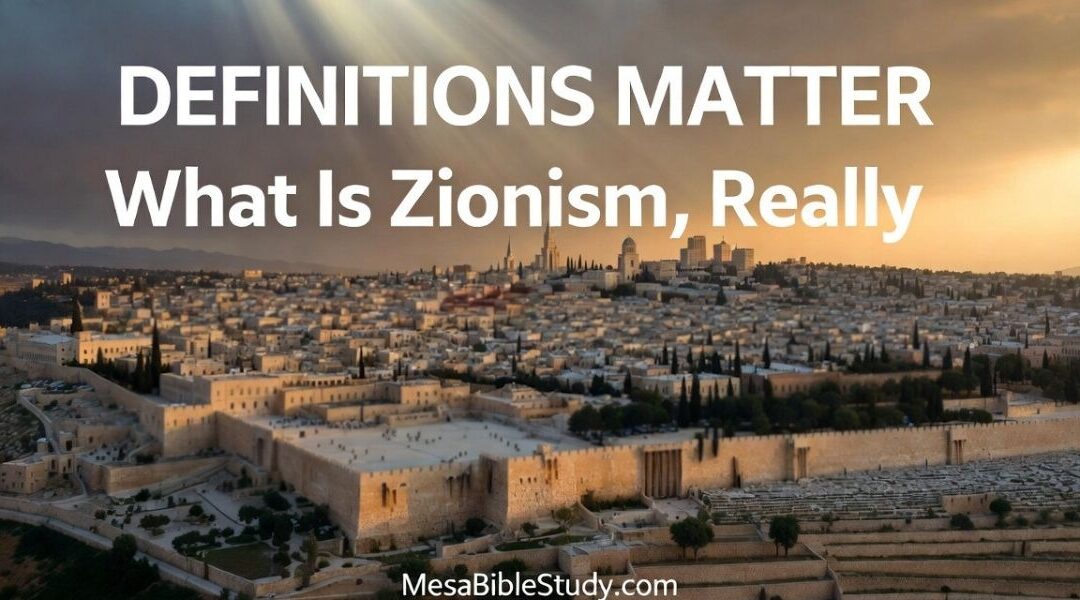
What Is Zion?
The word Zion did not originate in politics. It originated in Scripture.
Zion is the biblical name for Jerusalem and, by extension, the land and people associated with it. It is not merely a geographic location—it is a place chosen by God Himself.
Psalm 132:13–14 declares:
“For the Lord has chosen Zion; He has desired it for His dwelling place:
‘This is My resting place forever; Here I will dwell, for I have desired it.'”
This passage reveals something foundational: Zion is not man’s invention. It is God’s choice.
Again, Isaiah writes:
Isaiah 2:3
“For out of Zion shall go forth the law, and the word of the Lord from Jerusalem.”
Zion is central to God’s redemptive plan. It is the geographic and prophetic focal point of Scripture.
The significance of Zion is not political—it is covenantal.
Who Owns the Land?
Scripture makes clear that the land ultimately belongs to God.
Psalm 24:1
“The earth is the Lord’s, and all its fullness, the world and those who dwell therein.”
God, as Creator, has full authority over the earth and its lands. And in His sovereignty, He made a covenant with Abraham concerning a specific area of land.
Genesis 12:7
“Then the Lord appeared to Abram and said, ‘To your descendants I will give this land.'”
This promise was later formalized as an unconditional covenant.
Genesis 15:18
“On the same day the Lord made a covenant with Abram, saying: ‘To your descendants I have given this land…'”
And again:
Genesis 17:7–8
“And I will establish My covenant between Me and you and your descendants after you in their generations, for an everlasting covenant… Also I give to you and your descendants after you the land in which you are a stranger, all the land of Canaan, as an everlasting possession…”
The language is unmistakable:
- Everlasting covenant
- Everlasting possession
- Given by God Himself
This is not a temporary arrangement. It is a divine covenant that begins with God, is all of God and its fulfillment by God.
Zion, therefore, is not merely a location. It is covenant land.
What Is Zionism?
Zionism is the movement for the self-determination and statehood of the Jewish people in their ancestral homeland—the land of Israel.
This definition contains four key elements:
1. People: The Jewish people
2. A Right: Self-determination
3. A Location: Their ancestral homeland
4. A Goal: National restoration and sovereignty
Zionism does not mean agreement with every political decision made by the modern State of Israel. Like every nation, Israel has political leaders, policies, and internal debates.
Zionism simply affirms that the Jewish people have the right to exist as a nation in their ancestral homeland.
It is the national restoration of an ancient people to the land historically, biblically, and covenantally associated with them.
What Is Anti-Zionism?
If Zionism is defined as Jewish self-determination in Israel, then anti-Zionism is, by definition, opposition to Jewish self-determination in Israel.
This is not a matter of interpretation. It is a matter of logic.
Zionism affirms Jewish national existence.
Anti-Zionism opposes Jewish national existence.
These are direct opposites.
There is no neutral overlap between affirmation and opposition.
The Logical Test
Consider this principle carefully.
Nearly every nation on earth exists as the homeland of a particular people group.
- Japan exists as the homeland of the Japanese people.
- Egypt exists as the homeland of the Egyptian people.
- France exists as the homeland of the French people.
No global movements exist calling for the elimination of these nations as illegitimate.
Yet Zionism—the existence of the Jewish homeland—is uniquely targeted.
This raises a simple but unavoidable question:
Why should the Jewish people alone be denied the right of national existence granted to every other people group?
This question strikes at the heart of the issue.
Zionism Is Not Colonialism
One of the most common modern claims is that Zionism is a form of colonialism. This claim collapses immediately under historical examination.
Colonialism involves a foreign people settling and ruling a land that is not historically theirs.
The Jewish people are not foreign to Israel.
Israel is their ancestral homeland.
Jerusalem has been the center of Jewish identity, prayer, and national life for over 3,000 years.
Even during periods of exile, Jewish communities continuously remained in the land.
The Jewish return was not the arrival of strangers. It was the return of a people to their ancestral home.
Zionism Aligns with Scripture
The restoration of Israel to their land is not merely historical—it was foretold in Scripture.
Ezekiel 36:24
“For I will take you from among the nations, gather you out of all countries, and bring you into your own land.”
This prophecy was written over 2,500 years ago.
The existence of Israel today is not an accident of history.
It is the fulfillment of God’s promise.
Zionism, therefore, is not merely political. It is the visible unfolding of God’s covenant faithfulness.
Definitions Reveal Truth
When stripped of distortion, the definitions are clear.
Zion is the land chosen by God.
Zionism is the restoration of the Jewish people to that land.
Anti-Zionism is opposition to that restoration.
The issue is not complicated when definitions are understood honestly.
The confusion exists because definitions have been deliberately altered, obscured, and redefined.
This is not accidental.
Language shapes perception. And perception shapes belief.
The battle over Zion begins with the battle over definitions.
Final Summary
Zion is not merely a political term. It is a biblical reality.
God chose Zion.
God promised the land to Abraham and his descendants as an everlasting possession.
Zionism is the affirmation of that national restoration.
Anti-Zionism is the opposition to it.
Understanding these definitions is essential, because without clear definitions, truth itself becomes vulnerable to distortion.
This is why definitions matter.
In the next part of this series, we will examine the logical implications of these definitions—and why Israel is uniquely singled out among the nations of the world.
The answers are both revealing and sobering.
Continue the series:
Part 2 — The Logical Test: Why Is Israel Singled Out Among the Nations? (Coming next)
by Jamie Pantastico | Feb 26, 2026 | Pauline Theology |
This is Part 1 — of “Paul’s Unique Stewardship”
Introduction
Few verses carry more theological weight in the discussion of Pauline stewardship than Ephesians 3:5. Entire systems rise or fall on how this verse is read. The issue is not tradition, preference, or alignment with majority opinion. The issue is whether the text itself allows the mystery of the Body of Christ to be placed before Paul — or whether it demands that it be revealed through him.
Ephesians 3:5: “which in other ages was not made known to the sons of men, as it has now been revealed by the Spirit to His holy apostles and prophets.”
The interpretive hinge rests on a single word: ὡς — translated “as.” That small word determines whether Paul is describing equal revelation among apostles, or a contrast between past concealment and present disclosure.
This study will proceed carefully, grammatically, and contextually.
I. What the Verse Actually Says
Paul makes three chronological assertions:
- The mystery or secret “was not made known” in other generations.
- It “has now been revealed.”
- That revelation occurred “by the Spirit.”
The language is temporal and contrastive.
Paul does not say:
- It was partially known.
- It was dimly understood.
- It was prophetically embedded but unclear.
- It was fully present but misapplied.
He says it “was not made known.”
That phrase must be allowed its full force.
II. The Force of ὡς (“As”)
The Greek word ὡς most commonly expresses comparison of manner or degree. It does not automatically indicate equality. It often signals contrast.
Paul’s statement is not:
“It was not made known, but now equally revealed to all apostles.”
Rather, it is:
“It was not made known in past generations in the way (or to the extent) it has now been revealed.”
The contrast is between:
- prior concealment
- present disclosure
The word protects timing. It does not erase it.
If Paul intended to assert equal, simultaneous revelation among all apostles, he could have done so explicitly. Instead, the surrounding context isolates one primary steward.
III. Context Controls Interpretation (Ephesians 3:1–9)
Verses 1–9 are saturated with singular pronouns. Paul repeatedly emphasizes personal entrustment:
- “the dispensation of the grace of God which was given to me” (v.2)
- “by revelation He made known to me” (v.3)
- “whereby, when you read, you may understand my knowledge” (v.4)
- “to me, who am less than the least of all the saints, this grace was given” (v.8)
- “that I should preach among the Gentiles” (v.8)
- “to make all see what is the fellowship of the mystery” (v.9)
The pattern is unmistakable.
Paul does not describe collective discovery. He describes entrusted stewardship.
The flow of the paragraph identifies:
Recipient — Paul. Revelation — given to Paul. Stewardship — committed to Paul. Proclamation — executed by Paul.
Any interpretation of verse 5 that flattens this structure must override the natural reading of the passage.
IV. “Apostles and Prophets” in Context
Ephesians 3:5 states that the mystery “has now been revealed by the Spirit to His holy apostles and prophets.”
This does not require that every apostle received identical, direct revelation from the ascended Christ in the same manner as Paul.
Scripture distinguishes between:
- Origin of revelation
- Recognition of revelation
- Dissemination of revelation
Galatians 2:6–9 makes clear that those of reputation “added nothing” to Paul or to the Lord Jesus. They recognized the grace given to him. Recognition is not origin.
Paul alone says:
- “I neither received it from man, nor was I taught it, but it came through the revelation of Jesus Christ” (Galatians 1:12).
- “A dispensation is committed unto me” (1 Corinthians 9:17).
Ephesians 3 must be read in harmony with those explicit claims.
V. The Larger Pauline Pattern
Paul consistently describes the mystery as:
- “kept secret since the world began” (Romans 16:25)
- “hidden from ages and from generations” (Colossians 1:26)
- “hidden in God” (Ephesians 3:9)
These are absolute concealment statements. And who hid them? “God did”.
They are not qualified. They are not softened. They are not described as partially available.
If the mystery was fully operative in Acts 2, then Paul’s concealment language becomes overstated at best and misleading at worst.
The simplest reading is the most coherent reading:
The mystery was hidden. It was revealed in time. It was entrusted to Paul.
VI. Why This Matters
This is not about creating division. It is about preserving progressive revelation.
If the mystery existed before Paul:
- The uniqueness of his apostleship collapses.
- Acts 15 becomes unnecessary.
- Galatians 2 loses explanatory force.
- The distinction between circumcision and uncircumcision ministries dissolves.
But if the mystery was revealed through Paul:
- The structure of Acts makes sense.
- The tension of Galatians 1–2 makes sense.
- The language of concealment retains integrity.
- Progressive revelation remains intact.
Conclusion
Ephesians 3:5 does not flatten apostolic roles. It does not retroactively distribute revelation. It preserves timing.
The word ὡς does not erase Paul’s uniqueness. It protects it.
The mystery was not made known in other generations in the way it has now been revealed.
And the context leaves little ambiguity as to who received that stewardship first.
Paul.