
by Jamie Pantastico | Jun 12, 2023 | Daily Encouragement |
50 Days After the Lord’s Ascension
Peter, in his earnestness, continues to appeal to the nation of Israel, urging them to repent for the grave act of killing their own Messiah, their promised King. He passionately pleads with them to accept the One they Killed (Jesus) as their King, and God will still send His Son to set up the promised Kingdom. However, despite Peter’s heartfelt appeals, the nation of Israel stubbornly rejects this offer.
Does this mark the pinnacle of Israel’s final rejection? Well, it is not the absolute end, but it certainly signifies a significant turning point. The nation of Israel reaches its height of rejection when they stone Stephen in Acts 7:54-60. From that moment onward, Israel begins its descent into dispersion, and their beloved Temple is ultimately destroyed in 70 A.D, with Jesus’ prophetic words in Matthew 24:1-2 regarding the destruction of the temple. At this juncture, God shifts His focus to the Gentiles, NOT to change His plan but to fulfill His predetermined plan (Acts 2:23; 2 Timothy 1:9; Romans 11:32; Ephesians 3:1-11).
This brings us to the mystery or secret that has been hidden in the mind of God since before the world began (Romans 16:25; 11:25; Colossians 1:24-27; Ephesians 3:1-11). The concept of God calling out a distinct group of people for His name (Act 15:14). This group, often referred to by Paul as the Body of Christ or the Church (1 Corinthians 12:12-14; Colossians 1:24), is the chosen bride of Christ (Ephesians 5:25-27). The body of Christ, which is His church purchased by the Lord’s shed blood (Acts 20:28) is made up of both Jews and Gentiles (Galatians 3:28) but mostly Gentiles (Romans 11:25). All saved in this dispensation of Grace (Ephesians 3:1-3) by grace through faith alone (Ephesians 2:8-9) in the finished work of the cross alone (Romans 4:4-5; Ephesians 2:8-9) apart from keeping the Mosaic law and temple worship (Romans 3:21).
The Gospel
‘Moreover, brethren, I declare to you the gospel which I preached to you, which also you received and in which you stand, by which also you are saved, if you hold fast that word which I preached to you—unless you believed in vain. For I delivered to you first of all that which I also received: that Christ died for our sins according to the Scriptures, and that He was buried, and that He rose again the third day according to the Scriptures, ‘
I Corinthians 15:1-4
Get out your Bible and Study. Listed below are the verses as they appear in the post. Use the timeline as a reference.
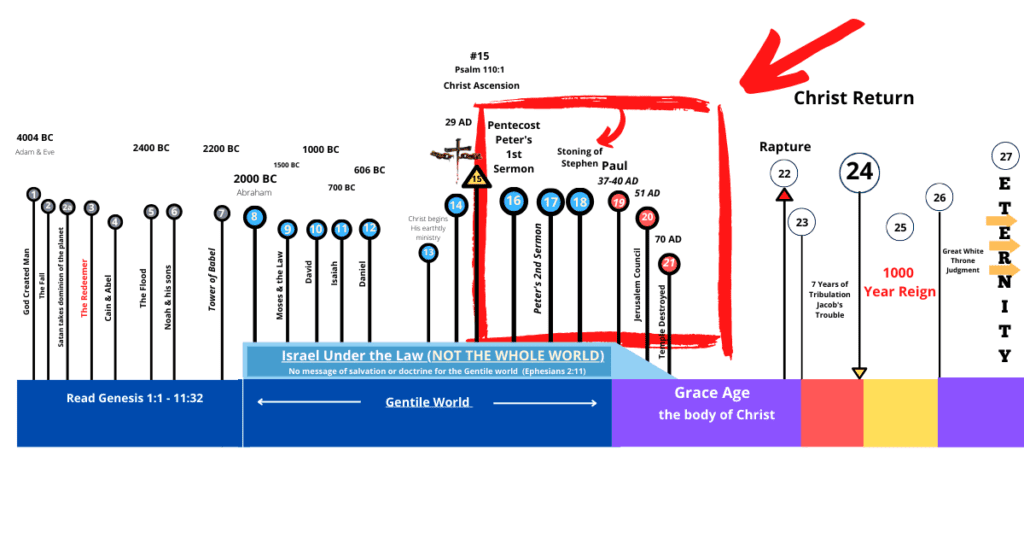
Acts 2:22-38
Acts 3:19
Acts 7:54-60
Matthew 24:1-2
Acts 2:23
2 Timothy 1:9
Romans 11:32
Ephesians 3:1-11
Romans 16:25
Romans 11:25
Colossians 1:24-27
Ephesians 3:1-11
Acts 15:14
1 Corinthians 12:12-14
Colossians 1:24
Ephesians 5:25-27
Acts 20:28
Galatians 3:28
Romans 11:25
Ephesians 3:1-3
Ephesians 2:8-9
Romans 4:4-5
Ephesians 2:8-9
Romans 3:21
1 Corinthians 15:1-4
Please note that some verses are mentioned multiple times throughout the post.

by Jamie Pantastico | Jun 10, 2023 | Daily Encouragement |
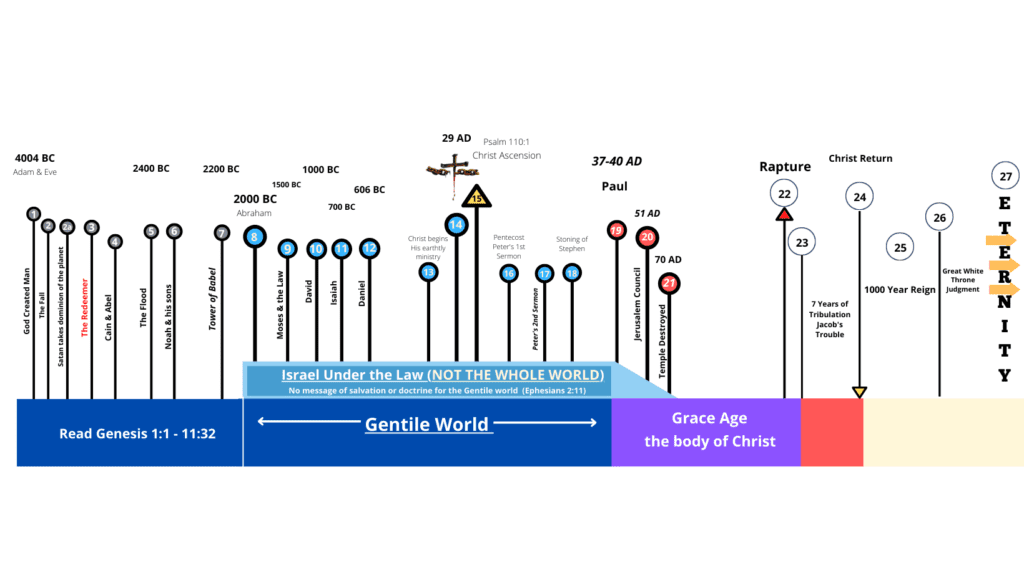
Throughout the pages of the Bible, we witness a remarkable progression of God’s purpose and plan of salvation for humanity. One significant aspect of this progression is the distinction between the Jews and the Gentiles, first graphically observed in Exodus 11:7. This separation continued until the revelations given to Paul regarding the mystery of the Gospel of Grace, some 2000 years later, where God would pour out His grace unto both Jew and Gentile apart from the Law.
This division between Jews and Gentiles traces back to around 2000 BC, as depicted in Genesis 12. First, it is crucial to understand that for the first 2000 years, (From Genesis chapter one to Genesis chapter 12), of biblical and human history God dealt directly with all of mankind, and all of mankind spoke one language. Yet due to humanity’s continual defiance of God’s commands, He sovereignly chose one man—Abram, who we now know as Abraham—to create a people for Himself, the Jewish people, and would reveal Himself only to the nation of Israel through Jewish prophets (with few “ONLY 9” Gentile exceptions ).
Through the nation of Israel, the Jewish people, God’s chosen people, brought forth Scripture, the Ten Commandments, the gospel, and the teachings for righteous living. And it is through the nation of Israel that our Savior, who is Jewish, Jesus Christ, God the Son, will come on the scene in the flesh as the once for all sacrifice for the sin of the world.
One of the keys to truly understanding the Bible is understanding the difference between Israel (God dealing with Jews only) and the body of Christ (the mystery revealed that God will save both Jew and Gentile apart from the law for an unspecified time period called the dispensation of grace), which is His church. The theme of Scripture until we, the body of Christ, is revealed to Paul is all Jewish. All scripture up until Paul is prophetic and direct only to the nation of Israel, that one day a Messiah would come to the nation of Israel (not Gentiles) and be their King, crushing Israel’s enemies (who are Gentiles, read Luke 1:67-75), with the nation of Israel as the top nation above all nations with their King, Jesus Christ, the Son of God, ruling from David’s throne in Jerusalem. Through this kingdom, Gentiles would be blessed (Zechariah 8.23; Isaiah 42.1). This kingdom was to be the fulfillment of all that the Jewish prophets had proclaimed and the promise God had given to Abraham (Genesis 12.1-3).
Before we delve into the following five verses that delineate this separation of Jew and Gentile, let us first turn our attention to Exodus 33:12-17, where a profound declaration is made—Israel, the chosen people of God, is unmistakably revealed. Additionally, in Exodus 33:18-19, God openly proclaims to both Moses and the world the reasons behind His choosing of Israel as His own. His sovereign nature shines through as He bestows His grace and mercy upon those He chooses.
The following verses clearly and unmistakably declare that the Jewish people are God’s chosen people, not the Gentile world. I know most of Christianity does not accept this truth, but God Himself makes this graphically clear in these verses and in all of the Old and New Testaments. God does not change, nor can He lie (Psalm 89:33-37).
Exodus 33:12-17
‘Then Moses said to the Lord , “See, You say to me, ‘Bring up this people.’ But You have not let me know whom You will send with me. Yet You have said, ‘I know you by name, and you have also found grace in My sight.’ Now therefore, I pray, if I have found grace in Your sight, show me now Your way, that I may know You and that I may find grace in Your sight. And consider that this nation is Your people.” And He said, “My Presence will go with you, and I will give you rest.” Then he said to Him, “If Your Presence does not go with us, do not bring us up from here. For how then will it be known that Your people and I have found grace in Your sight, except You go with us? So we shall be separate, Your people and I, from all the people who are upon the face of the earth.” So the Lord said to Moses, “I will also do this thing that you have spoken; for you have found grace in My sight, and I know you by name.”’
Then God gives the reason why He chose Abraham to create a people for Himself.
God proclaims to Moses and the world, “Why? “I will be gracious to whom I will be gracious, and I will have compassion on whom I will have compassion.”
Exodus 33:18-19
‘And he said, “Please, show me Your glory.” Then He said, “I will make all My goodness pass before you, and I will proclaim the name of the Lord before you. I will be gracious to whom I will be gracious, and I will have compassion on whom I will have compassion.”’
Here are five key passages that trace this theme of the separation of Jews from the Gentile world:
#1
Abrahamic Covenant (Genesis 12:1-3): God promises Abraham that he will become a great nation, blessed and separate from others. This is the foundational promise of Israel’s distinction from the Gentiles.
Genesis 12:1-3
Now the Lord had said to Abram:
“Get out of your country,
From your family
And from your father’s house,
To a land that I will show you.
I will make you a great nation;
I will bless you
And make your name great;
And you shall be a blessing.
I will bless those who bless you,
And I will curse him who curses you;
And in you all the families of the earth shall be blessed.”“`
#2
Mosaic Covenant (Exodus 19:4-6): God separates the Israelites as His “treasured possession” among all nations, further establishing their uniqueness.
Exodus 19:4-5
‘You have seen what I did to the Egyptians, and how I bore you on eagles’ wings and brought you to Myself. Now therefore, if you will indeed obey My voice and keep My covenant, then you shall be a special treasure to Me above all people; for all the earth is Mine. And you shall be to Me a kingdom of priests and a holy nation.’`
#3
Sabbatic Covenant (Exodus 31:12-18): This covenant sets the Israelites apart through the Sabbath, a sign between God and the Israelites throughout their generations.
#4
Land Covenant (Deuteronomy 9:1-29): God promises to give Israel a land where they will be established as a nation.
#5
Davidic Covenant (2 Samuel 7:4-29): God promises David an eternal dynasty, further setting Israel apart.
Here is another verse of many during the Lord’s earthly ministry that clearly makes the distinction between Jew and Gentile. But this verse is so graphically clear that it is impossible not to see that up until this time in Biblical and human history God was dealing only with His chosen people, not Gentiles.
‘“What do you think? If a man has a hundred sheep, and one of them gets lost, will he not leave the ninety-nine on the mountain and go in search of the one that is lost? And if it turns out that he finds it, I assure you and most solemnly say to you, he rejoices over it more than over the ninety-nine that did not get lost. So it is not the will of your Father who is in heaven that one of these little ones be lost. “If your brother sins, go and show him his fault in private; if he listens and pays attention to you, you have won back your brother. But if he does not listen, take along with you one or two others, so that every word may be confirmed by the testimony of two or three witnesses. If he pays no attention to them [refusing to listen and obey], tell it to the church; and if he refuses to listen even to the church, let him be to you as a Gentile (unbeliever) and a tax collector.’
Matthew 18:12-17
Temporary Blinding of the Nation of Israel
In Acts 7, 36-37 AD, Stephen’s stoning marks Israel’s final rejection of Jesus as the Messiah (Israel’s promised King), which in turn allows (sovereignly and predetermined before time began) for the calling of Paul (approximately 37 AD). With the Apostle Paul, the apostle to the Gentiles (Acts 9:15; Romans 11:13; Ephesians 3:1-2) comes the revelation of the Gospel of Grace, extending salvation to both Jews and Gentiles, as depicted in Acts 20:24 and 1 Corinthians 15:1-4. This marks (sometime around 40 AD, and not before) the temporary blinding of Israel (as the favored nation, temporarily), as mentioned in Romans 11, and the beginning of the Church Age, the age of grace, where there is no distinction between Jew and Gentile in Christ Jesus. The middle wall of partition has been broken down by the blood of Christ, and all mankind has access to Israel’s God apart from the law and temple worship (Ephesians 2:11-13; Romans 3:21).
Ephesians 2:11-12
‘Therefore remember that you, once Gentiles in the flesh—who are called Uncircumcision by what is called the Circumcision made in the flesh by hands— that at that time you were without Christ, being aliens from the commonwealth of Israel and strangers from the covenants of promise, having no hope and without God in the world.’
But now, after the cross, after the stoning of Stephen, after God calls Saul, whom we now know as the apostle Paul, the apostle to the Gentiles, writes the next verse…
‘But now in Christ Jesus you who once were far off have been brought near by the blood of Christ.’
Ephesians 2:13

by Jamie Pantastico | Jun 7, 2023 | Daily Encouragement |
It may not feel like you’re living a victorious life but you are!
Regardless of our circumstances the Lord Jesus shed His blood, died on the cross, was buried, and was resurrected from the dead three days later victorious over sin, the law, Satan, and even death. It is finished.
The work of the cross is the culmination of all that God does on our behalf, and when a person simply believes the gospel they identify (Romans 6:5) with Christ’s death, burial and “RESURRECTION. The result is our salvation, which is far more then a fire escape; we to are victorious over death, the law, sin and Satan. Sealed with Holy Spirit as the guarantee of our inheritance (Ephesians 1:13-14), which we will be with the Lord Jesus forever.
As believers, we can rest in the power of Christ’s resurrection, knowing that through it, we have victory over sin (NOW), the law (NOW), Satan (NOW), and death (NOW). Let us continue to fix our eyes on the Lord Jesus and His word, the author and finisher of our faith, and trust in “resurrection power” to sustain us in every aspect of our lives.
Without the resurrection we have nothing but praise God, He is Risen:
1. What is the believer’s position right now?
Answer: The believer’s position right now is on resurrection ground, resting on the power of Christ’s resurrection for every aspect of daily life. (Philippians 3:10, Ephesians 1:3-6; )
2. What gives believers the ability to live a victorious life?
Answer: Resurrection power gives believers the ability to live a victorious life and overcome challenges such as addiction, loss, physical pain, heartbreak, and ultimately sin, Satan, and death itself. (Philippians 3:10, Romans 8:37, 1 Corinthians 15:55-57)
3. What is the core of our faith as Christians?
Answer: The core of our faith as Christians is the resurrection of Jesus Christ. Without Christ’s resurrection, we have nothing. (1 Corinthians 15:17)
4. What is the significance of Christ being the first fruits of those who have died?
Answer: When we say Christ is the first fruits of those who have died, it means that just as He was raised from the dead and will never die again, so too will those who believe the gospel be raised from the dead to be with the Lord forever. (1 Thessalonians 4:14, 1 Corinthians 15:20, Romans 6:5)
5. What happens to believers who have already died when Christ returns?
Answer: Believers who have died will be raised from the dead first then those who are still alive will be caught up (the rapture) together with them to meet the Lord in the air, and thus we shall always be with the Lord. (1 Thessalonians 4:14-17)

by Jamie Pantastico | Jun 6, 2023 | Daily Encouragement |
In the Book of Job, we witness a profound statement of depression in Chapter 3. Job’s losses have stripped him bare before God. Everything and everyone he relied on for help and encouragement has been taken away—his health, wealth, family, and even his wife’s support. Unbeknownst to Job, he has become the subject of a challenge between God and Satan. Amidst indescribable misery and a seemingly hopeless outlook, Job resists Satan’s suggestion to curse God and die. Weeks have passed since the onset of his afflictions (chapter 2). Job is not only enduring physical pain but also grappling with emotional and spiritual anguish. His body and spirit are broken. This glimpse into Job’s despair serves as a profound testament to the depths of human suffering and the resilience of faith – faith in God above all else.
‘After this Job opened his mouth and cursed the day of his birth. And Job spoke, and said: “May the day perish on which I was born, And the night in which it was said, ‘A male child is conceived.’ May that day be darkness; May God above not seek it, Nor the light shine upon it. May darkness and the shadow of death claim it; May a cloud settle on it; May the blackness of the day terrify it. As for that night, may darkness seize it; May it not rejoice among the days of the year, May it not come into the number of the months. Oh, may that night be barren! May no joyful shout come into it! May those curse it who curse the day, Those who are ready to arouse Leviathan. May the stars of its morning be dark; May it look for light, but have none, And not see the dawning of the day; Because it did not shut up the doors of my mother’s womb, Nor hide sorrow from my eyes.’
Job 3:1-10
Even as believers and followers of Christ, we may find ourselves engulfed in the depths of depression. Job, a righteous man before God, experienced the weight of despair that plagued his soul. In Job 3:1-10, we witness his anguish pouring forth, as he cursed the day of his birth and lamented the darkness surrounding his existence. Then in verse eleven, we have the striking almost unbelievable question asked by Job. “Why did I not die at birth? Wow!
Job’s cries reveal a loss of perspective, distorted judgment, and a skewed view of God. Yet, amidst his struggles, Job’s testament toward overcoming depression teaches us valuable lessons.
First and foremost, Job was honest with himself and God. In Job 7:11, he boldly expressed his anguish, refusing to restrain his emotions. Acknowledging our pain and pouring out our hearts to God in raw honesty is a crucial step toward finding healing and restoration (King David is a perfect example in Psalm 69:1-4 and many others).
‘“Therefore I will not restrain my mouth; I will speak in the anguish of my spirit; I will complain in the bitterness of my soul.’
Job 7:11
King David’s Cry to God in Psalm 69
‘Save me, O God! For the waters have come up to my neck. I sink in deep mire, Where there is no standing; I have come into deep waters, Where the floods overflow me. I am weary with my crying; My throat is dry; My eyes fail while I wait for my God. Those who hate me without a cause Are more than the hairs of my head; They are mighty who would destroy me, Being my enemies wrongfully; Though I have stolen nothing, I still must restore it.’
Psalms 69:1-4
Job’s Faithfulness
Furthermore, Job clung to his faith in God. In the face of devastating losses, he declared in Job 23:10-12 that he trusted in the Lord’s sovereignty and righteous ways. Job’s faith sustained him, even when he couldn’t comprehend the purpose behind his suffering.
In the end, God revealed Himself to Job in a powerful way. Job confessed his repentance and recognized his finite understanding in light of God’s infinite wisdom (Job 42:5-6). Job’s journey through depression led him to a deeper revelation of God’s faithfulness and goodness.
And let us remember the unchanging promise of Hebrews 13:5: God will never leave us nor forsake us. In our darkest moments, when depression threatens to overwhelm us, we can find comfort and strength in the unwavering presence of our Lord and Savior Jesus Christ.
If you find yourself wrestling with depression, follow the example of Job. Be honest with yourself and pour out your heart to God. Hold on to your faith, knowing that God’s ways are higher than our understanding. Trust in His unwavering love and presence, for He will guide you through the darkest valleys and bring you into the light of His joy.
In Christ.
Here are five common signs of depression:
- Persistent sadness or feelings of emptiness: A prevailing sense of sadness, hopelessness, or a lack of interest in activities once enjoyed can be indicative of depression.
- Loss of interest or pleasure in activities: A diminished interest or pleasure in hobbies, social interactions, or previously enjoyable activities may be a sign of depression.
- Changes in appetite and weight: Significant changes in appetite, such as a noticeable increase or decrease in eating, leading to weight gain or weight loss, can be associated with depression.
- Fatigue or loss of energy: Feeling constantly tired, lacking energy, or experiencing a general sense of fatigue, even after a restful sleep, can be a symptom of depression.
- Difficulty concentrating or making decisions: Depression can affect cognitive functioning, leading to difficulties in concentration, memory, decision-making, and overall cognitive processing.
It’s important to note that experiencing these signs alone may not necessarily indicate depression, as they can also be related to other factors. If you or someone you know is experiencing these symptoms, it is recommended to seek professional help for a comprehensive evaluation and appropriate support.
https://www.mayoclinic.org/diseases-conditions/depression/symptoms-causes/syc-20356007
Disclaimer:
The following content on depression is provided from a Biblical perspective and does not replace professional advice or treatment. Please consult a licensed therapist or psychologist for comprehensive support.
Dear reader,
Please note that the information shared in this post regarding depression is based solely on a Biblical perspective. It is important to understand that this content does not serve as a substitute for professional advice, diagnosis, or treatment.
Depression is a complex mental health condition, and seeking the guidance of qualified mental health professionals is crucial for proper assessment and treatment. They can provide personalized care, therapy, and medical interventions tailored to individual needs.
If you or someone you know is experiencing depression, it is essential to reach out to a healthcare provider or a mental health professional for appropriate guidance and support.
Remember, prioritizing your mental well-being is vital, and along with prayer, fellowship with other believers in addition to seeking help from trained professionals is the best course of action.

by Jamie Pantastico | Jun 3, 2023 | Daily Encouragement |
“Blessed be the God and Father of our Lord Jesus Christ, who has blessed us with every spiritual blessing in the heavenly places in Christ.”
Ephesians 1:3
Rejoice in the abundant blessings bestowed upon you by our gracious God! In Ephesians 1:3, the apostle Paul reminds us of a powerful truth: we are already blessed with every spiritual blessing in the heavenly places.
Notice the past tense in the word “has.” It signifies that God’s blessings are not future promises but present realities for those who are in Christ. As a believer, you are not lacking anything spiritually. God has poured out His blessings upon you, pouring out His love, grace, and mercy.
Take a moment to meditate on the magnitude of this truth. You have been chosen, adopted, redeemed, forgiven, and sealed by the Holy Spirit. You possess the riches of God’s wisdom and knowledge. You are a co-heir with Christ, destined for glory. All, the moment you believed the gospel alone by faith alone. The blessings aren’t given out over time, salvation is an event, not a process!
Guaranteed by God
‘In Him you also trusted, after you heard the word of truth, the gospel of your salvation; in whom also, having believed, you were sealed with the Holy Spirit of promise, who is the guarantee of our inheritance until the redemption of the purchased possession, to the praise of His glory.’
Ephesians 1:13-14
So, in times of doubt or discouragement, remember that you are already blessed. Draw near to God (by prayer and studying His word), embrace His promises, and walk in the fullness of your spiritual inheritance. Rejoice, for you are abundantly blessed in Christ!
Reflection and Takeaway
How does knowing that you are already blessed with every spiritual blessing impact your perspective on life and your relationship with God?
Prayer:
Heavenly Father, I thank You for blessing me with every spiritual blessing in Christ. Help me grasp the fullness of these blessings and live in the confidence of who I am in You. May Your abundant grace and love empower me to walk victoriously in this world. In Jesus’ name, Amen.