by Jamie Pantastico | Jan 10, 2024 | Daily Encouragement |
Hebrews 11:28 recounts the faith of the Israelites during the Passover, applying the blood to their doorposts. In that moment, their faith, trust, believing in God’s instructions (His word) saved them from a certain death. Similarly, in this age of grace, our faith determines our salvation. When God sees our faith alone in the gospel— when we believe that Christ’s shed blood, death, burial, and resurrection saves us—He saves us.
Romans 3:24–25, Ephesians 1:7, and 1 Peter 1:18–19 highlight the significance of Christ’s blood, emphasizing that we are saved by grace through faith in His blood. Because without the shedding of blood, there is no remission of sins (Hebrews 9:22) Let this truth be a source of encouragement: we are saved by the blood of Christ.
Verses:
Hebrews 11:28
“By faith, he kept the Passover and the sprinkling of blood, lest he who destroyed the firstborn should touch them.”
Romans 3:24-25
“being justified freely by His grace through the redemption that is in Christ Jesus, whom God set forth as a propitiation by His blood, through faith, to demonstrate His righteousness.”
Ephesians 1:7
“In Him, we have redemption through His blood, the forgiveness of sins, according to the riches of His grace.”
1 Peter 1:18-19
“knowing that you were not redeemed with corruptible things, like silver or gold, from your aimless conduct received by tradition from your fathers, but with the precious blood of Christ, as of a lamb without blemish and without spot.”
by Jamie Pantastico | Jan 9, 2024 | Daily Encouragement |
Hebrews 1:1-3
“God, who at various times and in various ways spoke in time past to the fathers by the prophets, has in these last days spoken to us by His Son, whom He has appointed heir of all things, through whom also He made the worlds; who being the brightness of His glory and the express image of His person, and upholding all things by the word of His power, when He had by Himself purged our sins, sat down at the right hand of the Majesty on high.”
“If Christ’s finished work on the cross was enough for Him to sit down at the right hand of the Majesty on High, then let us rest assured, for indeed, ‘It is finished!’ Embrace the completeness of His sacrifice and find your rest in the assurance that the work is done—once and for all.”
In God’s great plan of redemption, Christ’s flawless work on the cross is the culmination of all that God does. The resounding declaration from Calvary was not a tentative “to be continued” but a triumphant “it is finished.” As the sinless Lamb, He bore the weight of our transgressions (our sins), and with arms outstretched, He declared perfection in the death, burial, and resurrection (1 Corinthians 15:1-4).
The image of Christ seated at the right hand of the Majesty on High (God the Father) is the divine proclamation of a completed work. There, at the pinnacle of heaven, He sits—having purged our sins by Himself. The redemption price, once and for all, paid in full. There is nothing left undone, nothing left for us to add.
The redemption story concludes with an invitation to all: come as you are and believe. Simply, wholly, believe by faith alone in the finished, perfect work of Christ. By faith alone, we find not just redemption (salvation) but a profound peace that comes from resting in His flawless, finished work of the cross.
The gospel
‘Moreover, brethren, I declare to you the gospel which I preached to you, which also you received and in which you stand, by which also you are saved, if you hold fast that word which I preached to you—unless you believed in vain. For I delivered to you first of all that which I also received: that Christ died for our sins according to the Scriptures, and that He was buried, and that He rose again the third day according to the Scriptures, ‘
I Corinthians 15:1-4
by Jamie Pantastico | Jan 8, 2024 | Daily Encouragement |
The Abrahamic Covenant illuminated a profound truth—Gentile blessings would find their channel through Israel (Isaiah 42.1, 60.1-3; Zechariah 8.22–23). Contingent upon national Israel’s obedience, this blessing was intricately linked to the obedience of the chosen people. The Messiah, the conduit of blessings for Israel and, subsequently, for the Gentiles through Israel, framed the covenant’s narrative. However, a critical question arose (or at least it should, and it did for the so-called church fathers): How could Gentiles partake in these blessings amidst Israel’s disobedience, especially in their rejection and crucifixion of their own Messiah? They couldn’t.
In all of the Old Testament, the four gospels, and the early chapters of the book of Acts, there is no scripture record of God having a plan to bless the Gentiles apart from and through the nation of Israel.
The answer lay in the divine foreknowledge of God. Sovereign and omniscient, God knew Israel would reject their Messiah and devised a plan (Romans 11:32; Romans 11:25) before time began (Acts 2:23; 1 Peter 1:20), before He created the heavens and the earth, to bless Gentiles despite Israel’s disobedience. Putting a pause on the prophesied Day of the Lord, God does what is mind-boggling: He temporarily blinds Israel, commits them all to disobedience (read Romans chapter 11; highlighted in Romans 11:32), and pours out His love and grace in the unexpected call and conversion of Saul of Tarsus. Through Paul, God established the Church—the body of Christ—not based on a covenant (Ephesians 2.11–14), but on grace alone (Ephesians 2.5, 8–9), apart from the Mosaic law and temple worship.
This new revelation, the “secret” (μυστήριον) (Romans 16:25; Colossians 1:26; Ephesians 3:1-11; Romans 11:25), remained veiled until the ascended Lord revealed it to Paul alone many years after Pentecost. God’s preordained plans manifested as He blessed Gentiles (Romans 11; Romans 11:32) through the gospel of the grace of God (Acts 20:24; 1 Corinthians 15:1-4) and established the Church, which is His body, the body of Christ, despite Israel’s fall (Romans 11.25). A future awaits national Israel, poised to fulfill its role as a blessing to the nations during the tribulation and beyond, beginning with 144,000 young Jewish men preaching the gospel of the kingdom (Matthew 24:14) during 7 years of tribulation.
In all, God’s sovereignty prevails!
by Jamie Pantastico | Jan 7, 2024 | Daily Encouragement |
‘Now those who were scattered after the persecution that arose over Stephen traveled as far as Phoenicia, Cyprus, and Antioch, preaching the word to no one but the Jews only.
Acts 11:19
For 2000 years, from Abraham’s call (2000 BC) to Paul’s apostleship (37–40 AD), God exclusively engaged with His chosen people under covenants. The Gentile world received no salvation message or doctrinal guidance during this period, illustrating God’s preparation of His chosen people (Exodus 19:5–6). Acts 11:19, the post-Jerusalem church persecution led by Saul (later Paul), emphasizes this biblical truth. Those who dispersed preached exclusively to Jews, armed only with the Old Testament promises, heralding Jesus as the promised Messiah—the gospel of the kingdom (Matthew 9:35). This underscores that attempting to inject unrevealed doctrines into early Acts or the gospels is untenable. The scriptural clarity in Acts 11:19 dispels any notion of introducing concepts unknown to that period.
Between Genesis 12:1 and Acts 9, there is no gospel or “good news” extended to the Gentile world (Ephesians 2:11–12). Throughout these 2000 years, in which God exclusively interacted with the nation of Israel, only 9 Gentiles found salvation. From Genesis 12 until the divine appointment of the apostle Paul, God’s revelations were confined to the nation of Israel under covenants.
The Gentile world received no message of salvation or doctrinal guidance during this period. God’s focus was on preparing His chosen people to eventually serve as the conduit for salvation to the pagan Gentile world. They were to be a “kingdom of priests,” a holy nation (Exodus 19:5).
The Call of Abraham and the “Abrahamic Covenant”
God set in motion His divine, preordained blueprint for the nation of Israel through the call of Abraham and the establishment of the Abrahamic Covenant. This foundational covenant served as the bedrock for all subsequent agreements between God and Israel. The overarching purpose of these covenants was to shape Israel into a holy nation and a kingdom of priests, as outlined in Exodus 19:5–6. Despite Israel falling short of this goal, the sovereign nature of God ensures its eventual realization in the future. The unwavering faithfulness of God guarantees the fulfillment of every promise made through these covenants. These covenants were God’s promises to Israel, and God cannot and will not break His promises. The culmination of these promises is destined to unfold when the Lord returns to establish His kingdom on earth, reigning as Israel’s King and ruling all the nations from David’s throne in Jerusalem, as prophesied in 2 Samuel 7:11–16 and Luke 1:31–33.
Recommend reading
Israel is at the Core of God’s Dealings with Mankind
by Jamie Pantastico | Jan 5, 2024 | Daily Encouragement |
A comprehensive understanding of the first 2000 years of biblical history is not just beneficial but essential. Without delving into these foundational years meticulously detailed in Genesis chapters 1–11, individuals will find themselves unable to unravel the progression of God’s redemptive plan. This lack of foundational knowledge will lead to a mishmash of scripture, preventing individuals from rightly dividing the word of truth. It’s a pivotal truth: without grasping the initial 2000 years, the unfolding of the rest of scripture will be left to rely on man’s ideas (denominational beliefs and creeds), made up by mixing all of scripture to fit a man-made prescribed theology, a historical fact observed in much of Christendom. The call to rightly divide the Word of Truth is a call to understand the chronological and theological progression that God has meticulously and so carefully laid out in His Word.
To be a good Bible student, we must know and understand how everything started. To do that, we must study the book of Genesis. All of it, but it is crucial to understand the first eleven chapters of Genesis and what God does in the very next chapter, Genesis chapter 12. Why? Two reasons:
Number one: the first 2000 years of Biblical history (out of 6,000) are packed into the first eleven chapters (out of 66 chapters) of the Bible.
Second: What God does in the very next chapter, chapter 12 of Genesis, sets the theme for all scripture moving forward.
Below is a summary of the key events that occurred in the first eleven chapters of the Bible, which covered a period of 2000 years from approximately 4000 BC to 2000 BC, from Genesis 1:1 to Genesis 12:1-3.
But first:
‘For whatever things were written before were written for our learning, that we through the patience and comfort of the Scriptures might have hope.’
Romans 15:4
‘All Scripture is given by inspiration of God, and is profitable for doctrine, for reproof, for correction, for instruction in righteousness, that the man of God may be complete, thoroughly equipped for every good work.’
II Timothy 3:16-17
‘Study to shew thyself approved unto God, a workman that needeth not to be ashamed, rightly dividing the word of truth.
2 Timothy 2:15
The Bible is a progressive revelation; it wasn’t all dealt out at once to Adam and Eve, Abraham, Moses, Isaiah, Daniel, or the apostle Peter. God is the same and will never change, but the instructions He gave mankind for salvation and how to worship Him changed throughout Biblical history.
It is important to understand that for the first 2000 years, God dealt with all mankind directly; they were one race and spoke one language (Genesis 11:1). There was no written law, doctrine, or instructions on how to worship God. It was all based on mankind’s conscience: when a person sinned, they were to bring God a blood sacrifice (the instructions given to Cain and Abel) by faith. And it was their faith that saved them, just like it does for us today.
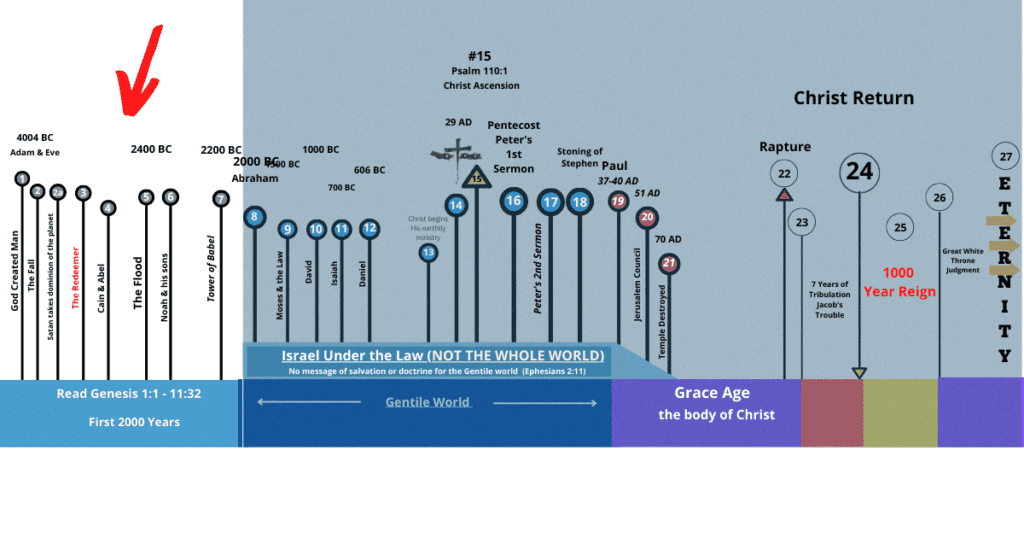
*Highly recommend using the Bible timeline to see exactly when these events occurred, to see what came before and what came after, and to see where we are today.
God creates the heavens and the earth – Genesis 1:1
God creates man and gives mankind dominion over the earth – Genesis 1:26-28, 4000 BC – #1 on the timeline
The fall of man (Genesis 3:6) – #2 on the timeline
Adam’s fall (sin and death enter the world), and all mankind born of Adam is now separated from God because of sin. “We sin not because we break God’s law; we sin because we are born sinners, sons and daughters of Adam.” So it is because we are born with a sin nature that we are prone to sin. All mankind is born with the Adamic nature (Romans 5:12).
Satan takes Dominion of the Planet – 2 Corinthians 4:4; Matthew 4:8 – #2a on the timeline
It’s crucial to recall that during Adam and Eve’s time in the Garden, they were in a close relationship with God. They belonged to Him, and their fellowship with Him was flawless. However, with the introduction of sin, that harmonious connection was severed, and God lost them as they fell under the influence of the god of this world, Satan. Without delay, God establishes a means by which He can reconcile humanity back to Himself, and we refer to this process as redemption.
The Promise of a Redeemer: Genesis 3:15–16; Galatians 3:16 – #3 on the timeline
God immediately provides a remedy to the sin dilemma that now separates mankind from Himself. This is the first prophetic utterance in the Bible.
Genesis 3:15 contains a prophecy about the enduring conflict between the forces of Satan and God, particularly focusing on the future appearance of the Redeemer, who is the Son of God, Jesus Christ. This enmity is expressed as a battle between the Seed of the woman, Jesus Christ, and His believers, and the powers of Satan, with the ultimate victory of the woman’s Seed (Jesus Christ) over the serpent (Satan). Which was fulfilled at the cross.
In Galatians 3:16, we find further clarification on the identity of the “Seed of the Woman.” It connects back to the promises made to Abraham and emphasizes that the singular “seed” refers to Christ. This insight allows us to consistently identify the Lord Jesus as the fulfillment of the prophesied Redeemer mentioned in Genesis 3:15. The continuity of this theme underscores the significance of Christ as the central figure in the divine plan of redemption, tying together the Old and New Testament Scriptures.
Cain murders Abel – Genesis 4:8 – #4 on the timline
The first ever case of murder committed on Earth. It was all downhill for mankind from this point forward until the flood.
The Flood – Genesis 6:3–7 – Date: 2400 BC – #5 on the timeline
God destroyed mankind with the flood because the thoughts in their hearts were only of evil all the time. The whole earth was corrupt and filled with murders. But Noah…
Noah and his Sons – Genesis 6:8 – #6 on the timeline
Out of billions of people on earth before the time of the flood, only one man found grace in the eyes of God: Noah. So God starts over with eight people: Noah, his three sons—Ham, Shem, and Japheth—and their wives. Noah and his sons are blessed by God and commanded to repopulate and fill the earth.
The Tower of Babel – Genesis 11:1-9 – 2200 BC – #7 on the timeline
Two hundred years go by from the time of the flood and God starting over with Noah, and again, mankind rebels against God, and we have the tower of Babel. Under the leadership of Nimrod, all of mankind unites and rebels (in unbelief, no faith) once more against God’s commands to repopulate and fill the earth. They unite in the land of Shinar (Babylon), refusing to fill the earth, wanting to make a name for themselves, and openly defying God’s command. So God comes down and confuses their language (all mankind spoke one language), forcing mankind to scatter across the planet.
Mankind Rebels Again! – Joshua 24:2 & 14 – #8 on the timeline
Another 200 years go by since the tower of Babel, and again, the whole world rebels against God and worships idols and other gods (Joshua 24:2). So God does something different (all preordained; in other words, this was all part of God’s plan, made before time began based on His foreknowledge) and chooses one man, from the line of Shem, Abraham, out of millions to create a new race of people for Himself (Deuteronomy 32:8–9; Isaiah 43:21), the Jewish people.
From this point forward (Genesis 12:1-3; 2000 BC), until God calls Paul to be the apostle to the Gentiles, a timespan of approximately 2000 years, God will no longer deal with all mankind directly like He did the previous 2000 years, but instead, He will reveal Himself only to His chosen people, a race of people created for Himself, the Jewish people.
It is crucial to study and comprehend the first 2000 years of biblical history to clearly see the progression of God’s plan of redemption.
Quick Look at the Next 2000 Years “Jew Only”
Between Genesis 12:1 and Acts 9, (or between 2000 BC and 37-40 AD), there is no gospel or “good news” extended to the Gentile world (Ephesians 2:11–12). Throughout these 2000 years, in which God exclusively interacted with the nation of Israel (Romans 3:1-2; Psalms 147:19-20; Deuteronomy 4:5-8; Romans 9:4; Acts 11:19), only nine Gentiles found salvation. From Genesis 12 until the appointment of the apostle Paul, God’s revelations were confined to the nation of Israel under covenants. The Gentile world received no message of salvation or doctrinal guidance during this period. God’s focus was on preparing His chosen people to eventually serve as the conduit for salvation to the pagan Gentile world.
The next post will cover the next 2000 years. From Abraham to Paul.