by Jamie Pantastico | Jul 10, 2025 | Verse-by-Verse Bible Studies |
📘 Passage Breakdown: Romans 8:3
Author: Paul
Written To: Gentiles in Rome (and some Jews)
Date: Around AD 56
Purpose/Context: Paul is explaining how God accomplished what the Law could not—victory over sin through Jesus Christ. Romans 8 builds on the tension of chapter 7, where Paul wrestles with the power of sin and the inability of the flesh to produce righteousness.
📖 Romans 8:3
“For what the law could not do in that it was weak through the flesh, God did by sending His own Son in the likeness of sinful flesh, on account of sin: He condemned sin in the flesh,”
1. “For what the law could not do in that it was weak through the flesh…”
✍️ Meaning:
- The Law of Moses is holy, just, and good (Romans 7:12), but it could not save or make someone righteous.
- It was “weak through the flesh” – meaning that the law depended on sinful human ability to keep it.
- “Flesh” here refers to the fallen, sinful nature inherited from Adam (see Romans 5:12).
- The problem wasn’t with the law itself—it was with us, because we are born with a nature that rebels against God.
💡 In other words:
The law could command righteousness, but it couldn’t empower it. Because of the weakness of human nature, the law only revealed sin—it couldn’t remove it.
2. “God did by sending His own Son in the likeness of sinful flesh…”
✍️ Meaning:
- Since the law couldn’t save, God took the initiative to do what the law could not.
- He sent His Son—this speaks of the incarnation, that Jesus came from heaven, not from Adam.
- “In the likeness of sinful flesh” is precise:
-
- Jesus came as a real man—He had real human flesh.
- But the word “likeness” protects the truth that He was without sin (Hebrews 4:15).
- His body was fully human, but not sinful in nature—He did not inherit Adam’s sin.
💡 In other words:
Jesus came looking like any other man, subject to hunger, weakness, and pain, yet without the inner corruption of sin that all other humans carry.
3. “On account of sin…”
✍️ Meaning:
- Jesus was sent “on account of sin”—this refers to the reason for His coming: to deal with our sin.
- This is not referring to His sin (He had none), but ours—the sin of the world (John 1:29).
- It means that His death was a sin offering—He came to take the full penalty for our sin (2 Corinthians 5:21).
💡 In other words:
Jesus was sent specifically to deal with the sin problem that we inherited and committed. He came to rescue us because of our sin.
4. “He condemned sin in the flesh.”
✍️ Meaning:
- “He” = God the Father.
- “Condemned” = to pass sentence against, to punish, to judge as guilty.
- “In the flesh” = in Jesus’ human body.
- At the cross, God poured out His wrath on sin—not on us, but on His Son.
- Jesus bore our judgment in His flesh, and in doing so, God condemned sin itself—He dealt with it fully and finally.
💡 In other words:
At the cross, sin was judged once and for all in the person of Jesus. This satisfied God’s justice and freed us from sin’s penalty and power.
✅ Summary:
Romans 8:3 shows the total inability of the law to save us, because of our fallen nature. But what the law couldn’t do, God did—by sending His sinless Son in a real human body, to be a substitute for our sins. On the cross, God condemned sin—He passed judgment on it in Christ, so that believers are no longer condemned (Romans 8:1).
‘For He made Him who knew no sin to be sin for us, that we might become the righteousness of God in Him.’
II Corinthians 5:21

by Jamie Pantastico | Jun 30, 2025 | Daily Encouragement |
For Your Encouragement and Edification
*“Eye has not seen, nor ear heard, nor have entered into the heart of man the things which God has prepared for those who love Him.” – 1 Corinthians 2:9
Have you ever stopped to truly consider what happens the moment you believe the gospel? Not after years of spiritual growth, not after memorizing Scripture, and not after “cleaning up your life”—but the very second you place your faith in the finished work of Jesus Christ: His death for your sins, His burial, and His resurrection (1 Corinthians 15:1–4)?
No rituals. No probationary period. No waiting list. No religious ladder to climb. It’s mind-boggling. It’s supernatural. It’s beyond human comprehension.
Because in that very moment, God does only what God can do—and this is just the beginning.
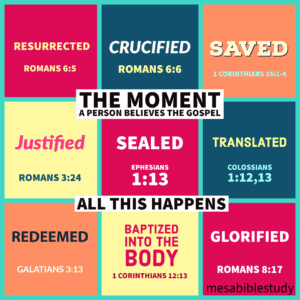
Let’s walk through the nine things God does the moment you believed the gospel:
1. You Are Crucified with Christ
Romans 6:6
Your old self, bound by sin, was nailed to the cross. You died with Christ. Sin’s dominion over you is shattered—not by your strength, but by His death.
2. You Are Resurrected with Him
Romans 6:5
Just as surely as Christ rose from the dead, so did you in Him. You are now alive to God, a new creation, no longer defined by your past.
3. You Are Saved
1 Corinthians 15:1–4
The gospel doesn’t just improve you—it saves you. From eternal separation. From wrath. From condemnation. Jesus did what you never could: He saved your soul.
4. You Are Justified
Romans 3:24
You are declared righteous in God’s courtroom. Cleared of all charges. Not because you did anything, but because Christ is your righteousness.
5. You Are Redeemed
Galatians 3:13
Jesus paid the price to buy you back from the curse of the law. You are no longer under bondage. You’ve been purchased by the precious blood of Christ.
6. You Are Sealed
Ephesians 1:13
The Holy Spirit seals you for the day of redemption. You now belong to God, forever. Nothing and no one can break that seal.
7. You Are Baptized into the Body of Christ
1 Corinthians 12:13
The Holy Spirit places you into the body of Christ—the Church. You’re not just an individual believer; you are part of all believers tha.
8. You Are Translated
Colossians 1:12–13
You’ve been transferred out of the kingdom of darkness into the kingdom of God’s dear Son. You don’t belong to this world anymore—you’re a citizen of heaven.
9. You Are Glorified
Romans 8:17
This is so certain in God’s eyes, He speaks of it in the past tense. Glorification is your future, guaranteed. One day, your earthly body will be transformed to be like Christ’s glorious body.
And All This Happens—In an Instant
Again, No rituals. No probationary period. No waiting list. No religious ladder to climb.
All of this and more occurs the very moment you believe the gospel. It’s not a process of earning God’s favor—it’s the free gift of God through faith in Jesus Christ.
You don’t feel most of these things happen. But they do. Because God said they do.
And This… Is Just the Beginning
As breathtaking as these truths are, they’re only the starting point. We can barely begin to imagine the glory that awaits us when we are finally with the Lord.
Paul puts it best:
“For I consider that the sufferings of this present time are not worthy to be compared with the glory which shall be revealed in us.”
—Romans 8:18
We may groan now. We may struggle now. But we are not who we once were—and we will not remain as we are. The best is yet to come.
Cling to this truth:
What God began in you at the moment you believed the gospel, He will complete in glory.
Not one promise will fail.
Not one gift will be revoked.
Not one adopted child will be forgotten.
So keep looking up. You are crucified, risen, saved, justified, sealed, and glorified—in Christ. And when He returns, your faith will become sight, and your hope will explode into eternal reality.
“Thanks be to God for His indescribable gift!”
—2 Corinthians 9:15

by Jamie Pantastico | Jun 29, 2025 | Daily Encouragement |
“Stand fast therefore in the liberty by which Christ has made us free, and do not be entangled again with a yoke of bondage.”
— Galatians 5:1
The book of Galatians isn’t a gentle letter.
It’s a spiritual emergency flare.
Paul is writing to Gentile believers in the region of Galatia who were being duped, deceived, and derailed—not by the pagan world, but by religious men from the Jerusalem church (Galatians 2:3–4).
These men taught that faith in Christ’s death, burial, and resurrection wasn’t enough (sound familiar?).
They claimed Gentile believers could not be saved unless they were circumcised and kept the law of Moses.
Paul’s response?
Absolutely not.
He didn’t compromise—not for a moment.
Instead, he stood boldly in the truth of the gospel that had been revealed to him by the risen Lord Jesus Christ.
‘to whom we did not yield submission even for an hour, that the truth of the gospel might continue with you.’
—Galatians 2:5
“…in the day when God will judge the secrets of men by Jesus Christ, according to my gospel.”
— Romans 2:16
“I do not set aside the grace of God; for if righteousness comes through the law, then Christ died in vain.”
— Galatians 2:21
A New Revelation from the Risen Christ
This wasn’t just about circumcision—it was about the entire Mosaic law.
Was salvation by grace through faith alone in the gospel, or was it a mix of faith plus law-keeping?
Paul makes it crystal clear:
He didn’t receive his gospel from Peter, James, or John.
He received it by direct revelation from the ascended, glorified Christ (Galatians 1:11–12).
This gospel wasn’t a continuation of Israel’s covenant law—it was something entirely new, entrusted to Paul for the Gentiles:
“But when it pleased God… to reveal His Son in me, that I might preach Him among the Gentiles…”
— Galatians 1:15–16
Paul Confronts the Jerusalem Leaders
Paul didn’t just fire off a letter—he went to Jerusalem (directed by the Lord Jesus Himself) and stood face-to-face with the apostles and elders.
He confronted their commands of keeping the law head-on (Galatians 2:1–5).
He told them plainly:
Salvation is now by grace through faith—period.
Not grace plus law.
Not faith plus works.
Faith alone in the finished work of Christ alone.
“We who are Jews by nature… knowing that a man is not justified by the works of the law but by faith in Jesus Christ…”
— Galatians 2:15–16
Why It Still Matters
The Galatian error is alive and well today.
Religious voices continue to blend law and grace—adding rituals, requirements, and works to the gospel of Christ.
But Paul’s warning stands:
‘But even if we, or an angel from heaven, preach any other gospel to you than what we have preached to you, let him be accursed. As we have said before, so now I say again, if anyone preaches any other gospel to you than what you have received, let him be accursed.’
—Galatians 1:8-9
“Are you so foolish? Having begun in the Spirit, are you now being made perfect by the flesh?”
— Galatians 3:3
“Stand fast… do not be entangled again with a yoke of bondage.”
— Galatians 5:1
The law was a burden no one could bear (Acts 15:10).
Christ came not to reinforce it—but to fulfill it and set us free from its demands (Romans 10:4).
You Are Free—Stand in It
If you’ve trusted in Christ alone for salvation, then this is who you are:
✅ Justified by grace
✅ Sealed by the Spirit
✅ Free from the law
✅ Secure in Christ
So don’t go back.
Don’t let anyone drag you into a gospel of works, fear, or religious performance.
“For you are not under law but under grace.”
— Romans 6:14
Final Word
The gospel Paul preached is the only gospel that saves today:
“…that Christ died for our sins according to the Scriptures, and that He was buried, and that He rose again the third day…”
— 1 Corinthians 15:1–4
Salvation is by grace alone, through faith alone, in Christ alone—apart from the works of the law.
That’s why Paul wrote Galatians.
That’s why he confronted the leaders in Jerusalem.
And that’s why you must stand fast in the liberty Christ has purchased for you.
You are free.
Now walk in it, believe it, and never trade it for the bondage of law again.
📖 Reading Plan: Grace vs. Law
Day 1: Galatians 5:1–6
Stand firm in the freedom Christ purchased. Don’t return to bondage.
Day 2: Acts 15:1–11
Peter confirms that salvation is through grace—not the law.
Day 3: Romans 6:14 & Romans 10:1–4
We are not under the law, but under grace—Christ is the end of the law for righteousness.
👇
Free PDF Download👉 📄 Stand Fast in Freedom – Study Guide

by Jamie Pantastico | Jun 28, 2025 | Devotionals |
For Your Encouragement and Edification
No matter how dark the valley or deep the pain, it is nothing compared to the glory that will be revealed when we are with the Lord in heaven.
“For His anger is but for a moment,
His favor is for life;
Weeping may endure for a night,
But joy comes in the morning.”
— Psalm 30:5
“For our light affliction, which is but for a moment, is working for us a far more exceeding and eternal weight of glory.”
— 2 Corinthians 4:17
Tears come.
Trials come.
There are nights that feel unending—and valleys that seem too deep to climb out of.
But God’s Word doesn’t minimize your pain; it puts it into eternal perspective.
Your sorrow is real—but so is the promise of joy.
Your affliction hurts—but it is momentary compared to the eternal glory being prepared for you.
God Is Not Finished
Psalm 30 reminds us: the weeping is temporary, but God’s favor is forever.
He doesn’t leave you in the night—He walks with you through it.
And 2 Corinthians 4 reminds us: your affliction is doing something.
It’s not pointless.
It’s not wasted.
God is using every painful step to work in you something weighty, eternal, and glorious.
Hope for the Broken
If you’re in a season of heaviness right now, don’t lose heart:
- The night will break.
- The tears will dry.
- The morning will come.
And with it—joy that the world didn’t give and can never take away.
So hold on.
You’re not being crushed—you’re being prepared for something far greater than you can imagine.
“Weeping may endure for a night,
But joy comes in the morning.”
📖 Today’s Reading Plan: Hope Through Hardship
- Psalm 30:1–12 — From sorrow to song
- 2 Corinthians 4:7–18 — Afflicted, not crushed
- Revelation 21:1–7 — No more pain, no more tears—only glory
by Jamie Pantastico | Jun 24, 2025 | Devotionals |
For Your Encouragement and Edification
“For God has not given us a spirit of fear, but of power and of love and of a sound mind.”
—2 Timothy 1:7
We don’t belong here.
Not in this fallen system. Not under this dark rule. Not in this world system ruled by the evil one.
We are outsiders—citizens of heaven, ambassadors of a kingdom not of this world (Philippians 3:20).
We’ve been rescued—snatched from the grip of darkness and translated into the body of Christ (Colossians 1:13). And because of that, we don’t blend in—we clash.
The Battle Is Real
The pain, the persecution, the despair—it isn’t your imagination.
Believers face more than just the troubles of life.
We face hell’s hatred.
We stand in direct opposition to the god of this world, Satan, who is bent on destroying everything God has created. And that includes you.
He attacks your joy.
He stirs confusion.
He sows fear.
He whispers lies into your mind and uses the world around you as a weapon.
But here’s the truth:
The War Is Already Won
The Lord Jesus Christ crushed the serpent’s head at the cross.
Victory isn’t pending—it was accomplished 2,000 years ago by God the Son.
We are not fighting for victory—we are fighting from victory.
And because of that, you have nothing to fear.
“God has not given us a spirit of fear…”
That fear you feel?
That crippling anxiety?
That sense of dread and discouragement?
It’s not from God.
What is from God?
- Power – the strength of the Holy Spirit to stand, speak truth, and press on.
- Love – a heart that overcomes evil with good, never compromising.
- A sound mind – clear thinking, grounded truth (what is truth? Christ Jesus), and unshakable confidence in His Word.
Your Weapon: The Word
This battle isn’t won with willpower.
It’s not won with optimism.
It’s won with truth.
“The weapons of our warfare are not carnal but mighty in God for pulling down strongholds.”
—2 Corinthians 10:4
You want to walk in power?
You want to resist fear, lies, and spiritual attacks?
Study the Word of God.
Know it. Stand on it. Speak it. Cling to it.
Because when the world screams in chaos, and Satan presses in with deception, your greatest defense and deadliest offense is truth rightly divided (2 Timothy 2:15).
Final Word
You were never promised ease.
You were promised eternal life.
You were never promised applause.
You were promised tribulation.
But you were also promised power, love, and a sound mind.
Fear is a liar.
Christ is the Victor.
And you are His.
So take your stand, soldier of Christ.
Suit up.
Hold fast.
And never surrender to fear.
🔥 Reading Plan: Strength for the Battle
Day 1: 2 Timothy 1:6–14
Fan into flame the gift of God. You’ve been entrusted with truth—walk in power, love, and a sound mind.
Day 2: Ephesians 6:10–18
The armor of God equips you for spiritual battle. Stand firm, fully armed, and ready for the fight.
Day 3: Romans 8:31–39
Nothing can separate you from God’s love. You are more than a conqueror through Christ who loves you.