by Jamie Pantastico | Aug 12, 2025 | Israel and Bible Prophecy |
This post is part 5 of 8 in our “Covenant Thieves” series—exposing how replacement theology hijacks Scripture to claim God has cast away Israel. These verses have been twisted, spiritualized, and ripped from context to turn God into a covenant-breaker. But when read in context, and applying the full counsel of God, they say no such thing. We’re restoring the context and letting Scripture speak for itself—boldly and clearly.
“But you are a chosen generation, a royal priesthood, a holy nation, His own special people, that you may proclaim the praises of Him who called you out of darkness into His marvelous light; who once were not a people but are now the people of God, who had not obtained mercy but now have obtained mercy.” —1 Peter 2:9–10
📖 Context and Setting
Peter’s first epistle was written to Jewish believers scattered throughout Pontus, Galatia, Cappadocia, Asia, and Bithynia (1 Peter 1:1). These were part of the dispersion—Jews living outside the land of Israel due to centuries (since 606 BC) of exile and occupation.
The letter’s purpose is pastoral—encouraging believers facing persecution and reminding them of their identity in Christ. Throughout the epistle, Peter uses rich Old Testament imagery and language that his Jewish audience would know by heart.
But replacement theology rips 1 Peter 2:9–10 from this Jewish context, claiming Peter was addressing the Church as a whole—Jew and Gentile—and that by using Old Testament language once applied to Israel, he was redefining the Church as the new Israel.
This is not only bad exegesis—it’s a denial of the audience Peter says he’s writing to. And isn’t that their goal, of course it is.
🔍 Phrase-by-Phrase Breakdown
“But you are a chosen generation…”
Peter is quoting from Isaiah 43:20–21 and Deuteronomy 7:6, passages that speak of Israel as God’s chosen people. He is not inventing a new spiritual Israel—he’s affirming Jewish believers’ identity in Christ.
“…a royal priesthood…”
This comes directly from Exodus 19:6:
“And you shall be to Me a kingdom of priests and a holy nation.”
Peter is reminding his Jewish readers that in Christ, they are already made priests unto God—something Israel was meant to be under the Mosaic covenant but will be in fullness under the New Covenant in the kingdom.
“…a holy nation, His own special people…”
This is covenant language from the Old Testament, reaffirmed here to believing Jews. Peter is not erasing Israel’s identity—he’s showing that the remnant within Israel, those who believe in the Messiah, are already living out their calling.
“…that you may proclaim the praises of Him who called you out of darkness into His marvelous light…”
The purpose of Israel’s calling was always to bear witness to the nations about the God of Abraham, Isaac, and Jacob (Isaiah 42:6, Isaiah 49:6). Believing Jews now fulfill this calling through the gospel of Christ.
“…who once were not a people but are now the people of God…”
This alludes to Hosea 1:9–10 and Hosea 2:23—prophecies about Israel’s temporary estrangement from God and their future restoration. Peter applies it here to the Jewish remnant, who once were cut off in unbelief but are now reconciled through Christ.
“…who had not obtained mercy but now have obtained mercy.”
Again from Hosea 2:23, this is God’s promise to restore His people after judgment. Peter is showing that the believing remnant is already experiencing this mercy.
🧱 Biblical Support and Explanation
- 1 Peter 1:1 – Peter explicitly addresses “the pilgrims of the Dispersion” (diaspora)—a technical term for Jews living outside the land.
- Romans 9:25–26 – Paul applies the Hosea passages first to Israel’s restoration and secondarily to Gentile inclusion—without ever redefining Israel.
- Acts 3:25–26 – Peter tells his Jewish audience they are “sons of the prophets, and of the covenant… to you first.”
- Romans 11:1–5 – There is always a remnant according to the election of grace within Israel.
🚫 Refuting the Replacement Lie
Replacement theology claims that because Peter uses Old Testament Israel language in 1 Peter 2:9–10, the Church must now be the “new Israel.” But this ignores:
- The audience – Peter tells us in 1:1 he is writing to the Jewish dispersion.
- The source texts – Every phrase Peter uses is drawn from Old Testament promises to Israel.
- The prophetic context – The “not a people” / “now a people” language is about Israel’s estrangement and future restoration, not the Church replacing her.
To use this passage as proof that the Church is now Israel is to ignore the plain statement of the letter’s recipients and to gut the prophetic hope of Israel’s national salvation.
This verse doesn’t erase Israel—it confirms that the believing remnant of Israel is already tasting the mercy that the entire nation will one day receive (Romans 11:26–27).
✅ In Summary
1 Peter 2:9–10 teaches that:
- Peter is addressing Jewish believers in the dispersion.
- He affirms their identity using covenant language from the Old Testament.
- This is about the believing remnant within Israel—not Gentile believers replacing Israel.
- The full national restoration of Israel is still future and certain.
⚠️ Final Word
This passage is not a theological blank check to transfer Israel’s identity to the Church. It’s a reminder to Jewish believers of who they are in Christ—rooted in promises God made to Israel and will fulfill completely.
To use it as a proof text for replacement theology is to miss the audience, miss the context, and miss the point. Isn’t that Satan’s goal—Satan’s ministers of light don’t come into a church announcing to the congregation “hi everyone I’m a minister of Satan here to deceive you”. No, the message is always full of truth with just a fraction of the lie.
“Has God cast away His people? Certainly not!” —Romans 11:1
“The gifts and the calling of God are irrevocable.” —Romans 11:29
“Let God be true but every man a liar.” —Romans 3:4
by Jamie Pantastico | Aug 9, 2025 | Pauline Theology |
🚨 Read This First
This post will clearly show that Peter is preaching to Jews only—proclaiming the gospel of the kingdom, not the gospel of salvation by grace alone apart from the Law.
The distinction could not be more clear than right here in Acts 3. The audience is Israel, the message is Israel’s repentance, and the promised outcome is the return of their Messiah to establish His kingdom on earth.
Most of Christendom has gotten this wrong! The language and the context of Scripture leave no room for twisting—Peter is not preaching Paul’s gospel here, and the Body of Christ is nowhere in sight.
But those things which God foretold by the mouth of all His prophets, that the Christ would suffer, He has thus fulfilled. Repent therefore and be converted, that your sins may be blotted out, so that times of refreshing may come from the presence of the Lord, and that He may send Jesus Christ, who was preached to you before, whom heaven must receive until the times of restoration of all things, which God has spoken by the mouth of all His holy prophets since the world began.
Acts 3:18-21
📜 Background, Setting & Purpose
✍️ Author:
Luke, the beloved physician (Colossians 4:14)
👥 Written To:
Primarily to give Theophilus (Acts 1:1) and early believers an orderly account of the Acts of the Apostles. This section specifically records Peter preaching to the men of Israel (Acts 3:12) in Jerusalem.
⏲️ When:
Shortly after Pentecost, likely AD 30–31.
🌍 Setting & Purpose of Acts 3:
Peter has just healed a lame man at the temple gate (Acts 3:1–10), causing amazement among the crowd. Seizing the moment, Peter preaches—not a mystery gospel revealed to Paul—but the gospel of the kingdom foretold by the prophets.
Here, Peter calls Israel to repent so that God may send the Messiah back and usher in the promised times of refreshing (Millennial Kingdom). There is no Church Age language here—only the continued prophetic program with Israel still in view.
🔍 Acts 3:18–21
18 But those things which God foretold by the mouth of all His prophets, that the Christ would suffer, He has thus fulfilled.
19 Repent therefore and be converted, that your sins may be blotted out, so that times of refreshing may come from the presence of the Lord,
20 and that He may send Jesus Christ, who was preached to you before,
21 whom heaven must receive until the times of restoration of all things, which God has spoken by the mouth of all His holy prophets since the world began.
✨ Phrase-by-Phrase Breakdown
“But those things which God foretold by the mouth of all His prophets…”
- Peter roots his message in prophecy, not mystery revelation.
- “All His prophets” refers to Old Testament prophecy concerning the Messiah’s suffering (Psalm 22, Isaiah 53, etc.).
- This is still the prophetic timeline—no break, no hidden truths revealed.
“…that the Christ would suffer, He has thus fulfilled.”
- Peter declares the suffering of Christ as fulfilled prophecy—not a new doctrine.
- Notice: There’s no mention yet of the Body of Christ, Jew/Gentile unity, or salvation apart from Israel’s rise.
“Repent therefore and be converted…”
- Kingdom gospel call to national repentance.
- This echoes Jesus’ earthly ministry to Israel: “Repent, for the kingdom of heaven is at hand” (Matthew 4:17).
- Peter is not offering a personal, individual gospel of grace; he’s calling Israel as a nation to turn.
“…that your sins may be blotted out…”
- This forgiveness is conditioned upon national repentance—in contrast to Paul’s gospel, where forgiveness is received instantly by faith alone in the finished work of Christ (Ephesians 1:7).
“…so that times of refreshing may come from the presence of the Lord…”
- “Times of refreshing” = prophetic language for the Millennial Kingdom (Isaiah 35, Isaiah 61).
- Peter links Israel’s repentance directly to the return of Christ to establish His kingdom.
“…and that He may send Jesus Christ, who was preached to you before…”
- If Israel repents, God will send the Messiah back.
- This is the exact opposite of the current Church Age reality, where Christ’s return (rapture) is not contingent on Israel’s repentance.
`
“…whom heaven must receive until the times of restoration of all things…”
- Christ remains in heaven until Israel fulfills the condition of repentance.
- “Restoration of all things” = restoring Israel to her covenanted position in the Kingdom (Amos 9:11–15, Isaiah 2:1–4).
“…which God has spoken by the mouth of all His holy prophets since the world began.”
- Again, Peter is drawing entirely from prophecy since the world began—the opposite of Paul’s mystery gospel, which was kept secret since the world began (Romans 16:25).
❌ What This Passage Does Not Mean
- It does not teach the beginning of the Church, the Body of Christ.
- It does not reveal the mystery gospel of grace—no mention of salvation by faith apart from Israel’s covenants.
- It does not place Gentiles on equal footing with Jews—Gentiles are still outside the prophetic program here.
✅ What It Does Mean
- Peter is still offering the prophetic kingdom to Israel, contingent on their national repentance.
- The Millennial Kingdom is ready to be ushered in if Israel responds.
- The early chapters of Acts are still within Israel’s program—Paul’s mystery gospel is not yet revealed.
🙏 Summary
Acts 3:18–21 is a kingdom gospel message rooted in prophecy, offered to the nation of Israel.
Peter is clear: if Israel repents, the Messiah will return, sins will be blotted out, and the Kingdom will be established. This is still the same prophetic hope spoken since the world began.
The Church, the Body of Christ, is not yet in view. That revelation would come later—after Israel’s continued rejection, after the stoning of Stephen, and after the conversion of Saul of Tarsus, who became Paul, the apostle of the Gentiles (37-40AD).
This passage is a dividing line for anyone who wants to understand the Bible—divided rightly. Until Paul, Israel’s prophetic program is still center stage.
by Jamie Pantastico | Aug 7, 2025 | Israel and Bible Prophecy |
This post is part 4 of 8 in our “Covenant Thieves” series—exposing how replacement theology hijacks Scripture to claim God has cast away Israel. These verses have been twisted, spiritualized, and ripped from context to turn God into a covenant-breaker. But when read in context, and applying the full counsel of God, they say no such thing. We’re restoring the context and letting Scripture speak for itself—boldly and clearly.
“In that He says, ‘A new covenant,’ He has made the first obsolete. Now what is becoming obsolete and growing old is ready to vanish away.” —Hebrews 8:13
📖 Context and Setting
The book of Hebrews was written to Jewish believers who were either tempted to return to Judaism or struggling to understand how the old covenant (the Mosaic system) related to the new covenant in Christ. The entire letter contrasts the shadow of the Old with the substance found in Christ—showing the superiority of His priesthood, His sacrifice, and His covenant.
Hebrews 8:13 closes a section quoting Jeremiah 31:31–34, where God promises to make a new covenant with the house of Israel and the house of Judah. Yet replacement theologians twist this final verse to argue that since the first covenant is obsolete, God has permanently ended His covenantal relationship with Israel and replaced them with the Church.
But that’s not what the passage says—and it’s certainly not what the full counsel of God reveals.
🔍 Phrase-by-Phrase Breakdown
“In that He says, ‘A new covenant,’…”
The author of Hebrews is quoting Jeremiah 31, where God Himself says He will make a new covenant—not with the Church—but with “the house of Israel and the house of Judah” (Hebrews 8:8).
“…He has made the first obsolete.”
The first covenant here refers to the Mosaic covenant—the law given at Sinai, including the Levitical priesthood, sacrifices, and temple worship. That system is no longer in effect for salvation. It served its purpose: to point people to their need for a Savior (Galatians 3:24). The new covenant, based on Christ’s finished work, is now in force.
“…Now what is becoming obsolete and growing old is ready to vanish away.”
This speaks to the present transition at the time Hebrews was written—just before the destruction of the temple in 70 AD. The old system hadn’t vanished completely yet, but it was fading away. The author urges his readers to embrace the better covenant in Christ rather than clinging to what was passing.
🧱 Biblical Support and Explanation
1. The New Covenant was made with Israel—not the Church.
“Behold, the days are coming… when I will make a new covenant with the house of Israel and the house of Judah…” —Jeremiah 31:31
(Quoted directly in Hebrews 8:8)
God never said He would make this covenant with Gentiles or the Church. Gentile believers are brought into its spiritual blessings by faith in Christ (Ephesians 2:11–13), but that does not mean the Church has replaced Israel.
2. The Mosaic Covenant is obsolete—God’s covenant with Israel is not.
Replacement theology confuses the Mosaic covenant with the Abrahamic, Davidic, and New covenants—each of which God declared everlasting (Genesis 17:7; 2 Samuel 7:16; Jeremiah 31:35–37).
Hebrews 8:13 speaks only of the Mosaic covenant becoming obsolete—not the people of Israel or the unconditional covenants made with them.
3. Israel’s national restoration is still future.
Paul declares in Romans 11:
“Blindness in part has happened to Israel until the fullness of the Gentiles has come in. And so all Israel will be saved…” —Romans 11:25–26
“Until” is a time word—when the last person is saved under the gospel of grace and God decides the fullness of the Gentiles is complete. He will remove the Church which is His body then once again turn His attention to dealing with His covenant people.
The Church is not spiritual Israel. The promises of Israel’s restoration, national repentance, and kingdom inheritance remain intact—and will be fulfilled exactly as God promised.
🚫 Refuting the Replacement Lie
Replacement theologians twist Hebrews 8:13 to teach that Israel has been replaced because the old covenant is obsolete. But this is a false equivalence.
What they fail to understand—or simply refuse to see—is that Paul is quoting an Old Testament promise made by God to the nation of Israel. Hebrews 8:8–12 is a direct quotation from Jeremiah 31:31–34—a passage where God Himself declares that He will make a new covenant with the house of Israel and with the house of Judah.
✅This was not a covenant made with the Church.
✅It was not made with Gentiles.
✅It was not a spiritual metaphor.
✅It was—and remains—a literal promise to national Israel.
Yet those who preach replacement theology rip verse 13 from its context and use it to claim God is finished with Israel—even though the entire section is built on a covenant God promised to Israel! The irony is staggering.
This verse—when read in context—completely destroys their argument. It affirms the very thing they try to deny: that God is still dealing with Israel and has made a future-binding covenant with her.
They can’t even see it. Their hatred for the Jewish people blinds them to the plain meaning of the passage. They quote a promise God made to Israel as if it proves Israel is out of the picture. But God’s Word remains unbroken.
- The Mosaic covenant (law) is set aside because Christ fulfilled it.
- But the New Covenant was made with Israel, and its full national fulfillment is still future.
Gentiles are not the new Israel. The Church is not spiritual Israel. God has not revoked His promises.
This twisting of Hebrews 8:13 isn’t just theological error—it’s an assault on the faithfulness of God. It denies everything He swore to Abraham, Isaac, Jacob, David, the prophets and the apostles. And it’s the backbone of a theology that fuels antisemitism/antizionism in the name of Christianity.
✅ In Summary
Hebrews 8:13 teaches that:
- The Mosaic covenant has been replaced by the better covenant in Christ.
- The New Covenant was made with Israel and Judah—not the Church.
- Gentiles share in its spiritual blessings, but do not take Israel’s place.
- God’s covenant with Israel is not obsolete—only the Mosaic system is.
⚠️ Final Word
Hebrews 8:13 does not teach that God canceled His promises to Israel. It teaches that the law has been fulfilled and that Christ is the mediator of a better covenant—one He made with Israel.
The Church benefits by grace—but it was never the original recipient of the covenant. To teach otherwise is to call God a liar.
“Thus says the Lord… If those ordinances depart from before Me… then the seed of Israel shall also cease from being a nation before Me forever.” — Jeremiah 31:35–36
“God is not a man, that He should lie…” —Numbers 23:19
by Jamie Pantastico | Aug 7, 2025 | Israel and Bible Prophecy |
This post is part of the “Covenant Thieves” series—exposing how replacement theology hijacks Scripture to claim God has cast away Israel. These verses have been twisted, spiritualized, and ripped from context to turn God into a covenant-breaker. But when read in context, and applying the full counsel of God, they say no such thing. We’re restoring the context and letting Scripture speak for itself—boldly and clearly.
“For in Christ Jesus neither circumcision nor uncircumcision avails anything, but a new creation. And as many as walk according to this rule, peace and mercy be upon them, and upon the Israel of God.” —Galatians 6:15–16
📖 Context and Setting
Paul closes his letter to the Galatians with a final defense of the gospel of grace. He’s pushing back hard against the Judaizers—false teachers who were trying to compel Gentile believers to be circumcised and keep the Mosaic Law.
Throughout Galatians, Paul argues that salvation is by grace through faith alone, apart from works of the law. In this concluding section, he emphasizes that what matters is not religious ritual or ethnicity, but whether a person is a new creation in Christ (v. 15). Then comes verse 16—the phrase “the Israel of God”—a verse that replacement theologians twist beyond recognition.
🔍 Phrase-by-Phrase Breakdown
“For in Christ Jesus neither circumcision nor uncircumcision avails anything…”
Paul is making it clear: religious status or ethnic background means nothing when it comes to salvation. Whether Jew or Gentile, circumcised or uncircumcised, it’s irrelevant. What matters is being a new creation—born again by faith in the gospel (1 Corinthians 15:1–4).
“…but a new creation.”
This is the heart of Paul’s gospel. It’s not about law-keeping or lineage—it’s about being made new in Christ. This echoes 2 Corinthians 5:17:
“Therefore, if anyone is in Christ, he is a new creation…”
“And as many as walk according to this rule…”
What rule? The rule of grace through faith, apart from the law. Paul is blessing those who reject legalism and trust in the sufficiency of Christ’s finished work.
“…peace and mercy be upon them, and upon the Israel of God.”
This is the phrase that replacement theology seizes upon. They claim Paul is redefining “Israel” to mean the Church. But let’s look closer.
⚠️But before we move on PLEASE JUST READ THE VERSE, you don’t have to read and understand Greek to know that “…and upon the Israel of God” isn’t saying God abandoned Israel and gave everything to the Church! Be sensible, take this seriously, and read this verse several times in context of the chapter and within the totality of Scripture.
🧱 Biblical Support and Explanation
What does “the Israel of God” mean?
There are two main interpretations:
- Replacement view: “The Israel of God” refers to the Church, meaning the Church is now the new, true Israel.
- Grammatically consistent view: “The Israel of God” refers to believing Jews—a distinct group from the Gentile believers mentioned in the first part of the verse.
The second view is correct—and it’s supported by grammar, context, and the full counsel of Scripture.
💡 Greek Grammar Supports Two Groups:
📝 I’m not a Greek scholar, and I don’t claim to be—but thankfully, anyone can look up the meaning of words for themselves. I personally use free tools like BlueLetterBible.org or Scripture4All.org to help better understand the original Greek. They’re simple to use and incredibly helpful.
The conjunction “and” (kai) in Greek connects two distinct groups:
- “As many as walk according to this rule” = Gentile believers in the body of Christ
- “and upon the Israel of God” = Jewish believers who also walk by grace through faith
If Paul meant to equate the two, he would have used a different grammatical structure—he didn’t. He blesses both Gentile believers and the believing Jewish remnant.
This is consistent with how Paul always distinguishes Jews and Gentiles within the one body of Christ (cf. Romans 1:16, 1 Corinthians 10:32, Ephesians 2:11–22).
🚫 Refuting the Replacement Lie
To claim that “the Israel of God” is the Church is to do violence to the text and ignore Paul’s consistent theology. It also ignores that “Israel” is never redefined anywhere in Scripture to mean Gentiles or the Church.
- Israel always refers to ethnic descendants of Abraham, Isaac, and Jacob—unless explicitly stated otherwise (and it never is).
- Paul uses “Israel” 11 times in Galatians and Romans—and every time, it refers to ethnic Israel.
- If Paul wanted to redefine “Israel,” Galatians would be the worst place to do it—it’s his most direct confrontation with Judaizers, who were blurring the lines between law and grace, Jew and Gentile.
This twisting of Galatians 6:16 is just another attempt to erase Israel from God’s plan. But God’s promises to Israel remain intact—unbreakable, irrevocable, and eternal.
“I say then, has God cast away His people? Certainly not!” —Romans 11:1
“For the gifts and the calling of God are irrevocable.” —Romans 11:29
✅ In Summary
Galatians 6:15–16 teaches that:
- What matters is not circumcision or ethnicity, but becoming a new creation in Christ.
- Paul blesses all believers who walk according to this rule—Jew and Gentile alike.
- “The Israel of God” refers to Jewish believers in the body of Christ—not the Church replacing Israel.
- This passage does not redefine Israel or transfer her covenants to the Church.
⚠️ Final Word
Galatians 6:16 is not a banner for replacement theology—it’s a blessing upon all who live by grace through faith, both Gentile believers and the faithful remnant of Israel.
To twist this verse into a declaration that God has rewritten His promises is to accuse Him of dishonesty. But the God of Israel does not lie. He keeps His word. Always.
Let God be true but every man a liar. —Romans 3:4
by Jamie Pantastico | Aug 5, 2025 | Bible Doctrine |
📓 Background, Setting & Purpose
✍️ Author:
Unknown (commonly attributed to Paul, though not stated)
👥 Written To:
Jewish believers who were tempted to return to Judaism under pressure and persecution
⏲️ When:
Likely between AD 64–68, just before the destruction of the Temple
🌍 Setting & Purpose:
The letter to the Hebrews is written to Jews who had come to believe that Jesus was the Messiah but were being tempted to abandon that faith due to trials, social rejection, and doctrinal confusion. The author exhorts them to stand firm, showing that Christ is better in every way: better than angels, Moses, the priesthood, the sacrifices, and the Law.
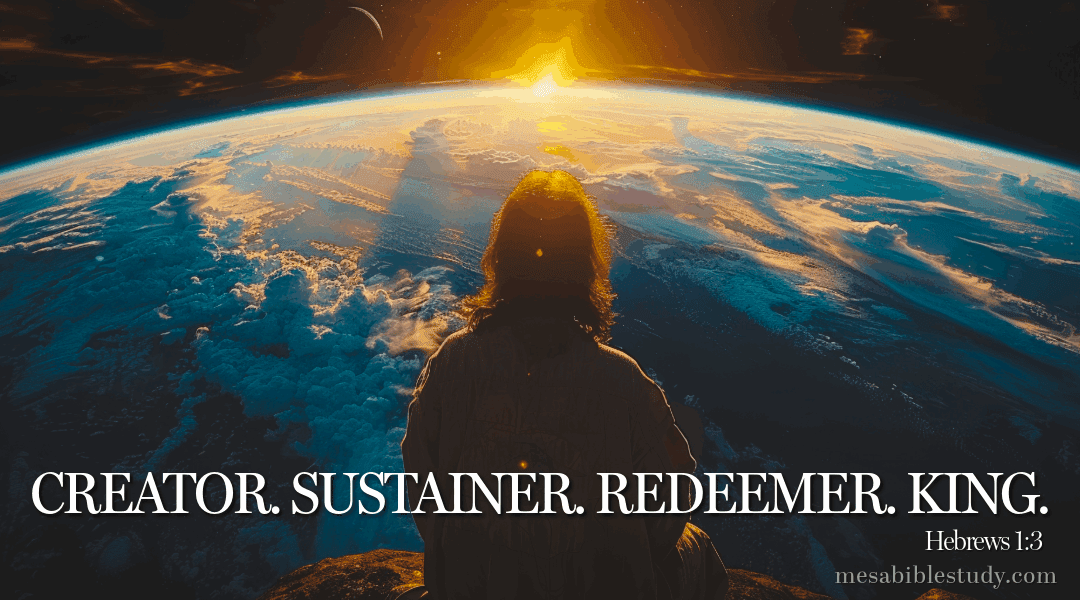
Hebrews 1:1–4 launches this powerful letter with a majestic declaration of who Jesus is: the very radiance of God, Creator, Sustainer, Redeemer, and the final Word.
🔍 Hebrews 1:1–4
“God, who at various times and in various ways spoke in time past to the fathers by the prophets, has in these last days spoken to us by His Son, whom He has appointed heir of all things, through whom also He made the worlds; who being the brightness of His glory and the express image of His person, and upholding all things by the word of His power, when He had by Himself purged our sins, sat down at the right hand of the Majesty on high, having become so much better than the angels, as He has by inheritance obtained a more excellent name than they.”
✨ Phrase-by-Phrase Breakdown
“God, who at various times and in various ways spoke in time past to the fathers by the prophets…”
- This refers to the Old Testament period, when God spoke progressively through different prophets (Moses, Elijah, Isaiah, etc.).
- Revelation was partial and fragmented, given in types, shadows, and symbols.
- God was not silent, but the full message had not yet been revealed.
“…has in these last days spoken to us by His Son…”
- “These last days” began with Christ’s first coming.
- God’s final revelation is not through more prophets, but through His Son.
- Jesus is not just a messenger; He is the message.
“…whom He has appointed heir of all things…”
- As the Son, Jesus is the rightful heir of all creation.
- This reflects Psalm 2:8, where the Father promises the nations as an inheritance to the Son.
“…through whom also He made the worlds…”
- Jesus is not a created being. He is the Creator.
- “Worlds” (Greek: aiōnas) includes not just the physical universe but time, space, and all created order.
- Colossians 1:16 affirms that all things were created by Him and for Him.
“Who being the brightness of His glory and the express image of His person…”
- Jesus is the exact representation (charaktēr) of God’s nature.
- He’s not a reflection or a shadow—He IS the radiance of God’s glory.
- To see Jesus is to see the invisible God (John 14:9).
“…and upholding all things by the word of His power…”
- Jesus is not only the Creator, He is the Sustainer of the universe.
- The galaxies are held together not by gravity alone, but by the authority of Christ’s Word.
“…when He had by Himself purged our sins…”
- The phrase “by Himself” emphasizes the sufficiency and solitary nature of His work on the cross.
- No priest, no sacrifice, no ritual can add to what He accomplished.
- Hebrews 9:12 – He entered once for all with His own blood.
“…sat down at the right hand of the Majesty on high…”
- To sit down signifies a finished work (Hebrews 10:12).
- The right hand of God signifies authority, honor, and power.
- Christ reigns even now, though His enemies are not yet made His footstool (Psalm 110:1).
“…having become so much better than the angels…”
- Jesus is not an angel; He is infinitely superior.
- Angels are messengers; Jesus is the eternal Son.
- This was critical to Jewish believers tempted to elevate angels (Hebrews 2:5).
“…as He has by inheritance obtained a more excellent name than they.”
- That name is Son.
- Jesus inherited it by eternal right, not by appointment or creation.
- Philippians 2:9 also speaks of the name above every name.
❌ What This Passage Does Not Mean
- It does not teach that Jesus is part of creation.
- It does not imply that angels are worthy of equal worship.
- It does not support progressive revelation beyond Christ.
✅ What It Does Mean
- Jesus is God’s final Word.
- He is Creator, Sustainer, Redeemer, and King.
- The fullness of God is revealed in the Son.
- His sacrifice once for all purged our sins.
- He is seated—His work complete—reigning in glory.
🙏 Summary
These verses are some of the most breathtaking in all of Scripture.
The same Jesus who spoke galaxies into existence walked the dusty roads of Israel.
The hands that flung stars into space were the same hands pierced for our transgressions.
He made the tree on which He would be crucified.
He formed the hill on which He would die.
He created the very men who nailed Him to the cross.
But death could not hold Him.
And we praise the God who gives us the victory through the resurrection of our Lord Jesus Christ.
Creator. Sustainer. Redeemer. King.
This is the Supremacy of Christ—unmatched, unchanging, and unshakable.
If you want to know what God is like, look to Jesus. He is the full and final Word. And because of Him, our sins are purged, our future is secure, and our Savior reigns.
“He upholds all things by the word of His power.”
Worship Him. Trust Him. Rest in Him.
For deeper study or practical application, click here to visit the “What to Do Now?” section on our Devotionals page.