by Jamie Pantastico | Aug 30, 2025 | Bible Doctrine |
Once for All: Not Once You Earn It
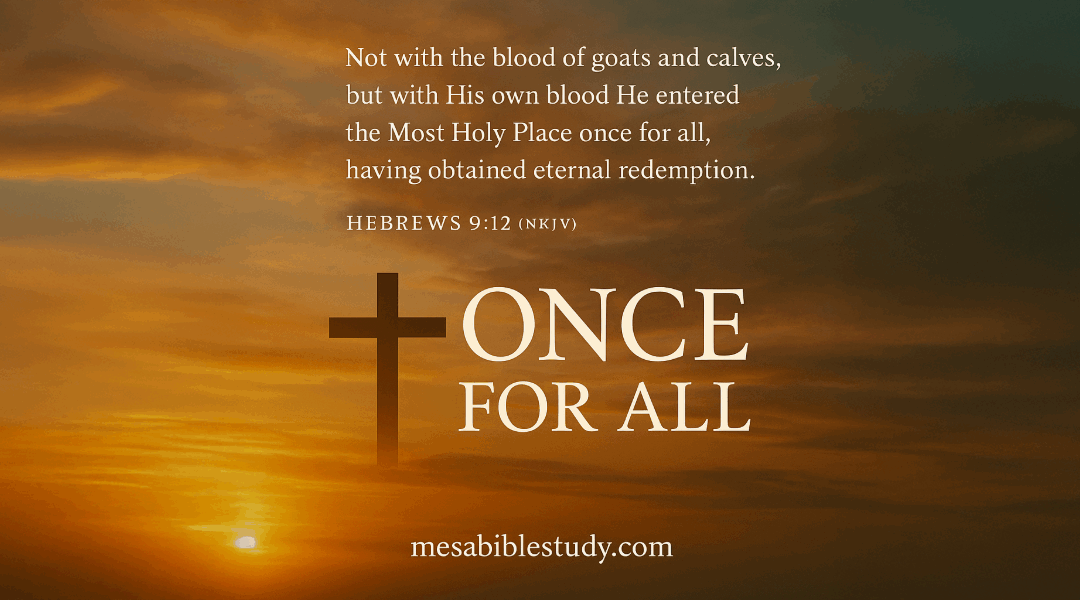
📖 “Not with the blood of goats and calves, but with His own blood He entered the Most Holy Place once for all, having obtained eternal redemption.”
— Hebrews 9:12
✝ The Work of the Cross Is Complete
The writer of Hebrews makes it unmistakably clear—Christ’s sacrifice was not partial, nor was it temporary. Under the Old Covenant, priests repeatedly offered sacrifices for sin, yet those offerings could never remove sin. They only covered it for a time, pointing forward to the greater sacrifice to come.
But when Christ shed His blood, He did so once for all. The penalty for the sin of all mankind was paid in full at the cross. There is nothing left to add, nothing left to finish. Jesus Himself declared, “It is finished!” (John 19:30). The work of salvation is complete.
⚖ God: Just and the Justifier
Romans 3:26 tells us that God is both “just and the justifier of the one who has faith in Jesus.”
- He is Just: Sin had to be dealt with. God could not simply overlook it and remain Holy. His justice demanded that sin’s penalty—death—be paid.
- He is the Justifier: In His infinite love, He sent His Son to take our place. By pouring out His wrath on Christ, He satisfied justice while making a way for sinners to be declared righteous.
This is the heart of the gospel: God remains holy and just, and yet through the cross He is also the merciful justifier of all who believe.
🙌 Eternal Redemption
Notice the words in Hebrews 9:12—“eternal redemption.” This is not a temporary fix. It’s not a salvation we can lose or forfeit based on our performance. It is eternal. Christ entered the heavenly sanctuary with His own blood and secured redemption that cannot be undone.
Because of this truth, believers can rest. We don’t need to strive to “earn” what has already been purchased. Our hope isn’t in ourselves—it is in Christ alone.
🌟 Encouragement for Today
- If you are weighed down by guilt, remember: the blood of Jesus has already paid for that sin.
- If you feel weak in faith, stand on this unshakable truth: your redemption is eternal, not fragile.
- If the enemy whispers lies of condemnation, remind him of this—“There is therefore now no condemnation to those who are in Christ Jesus.” (Romans 8:1).
The cross is enough. The blood of Christ is enough. Your salvation is secure because Jesus paid it all—once for all.
🕊 Closing Thought
Hebrews 9:12 pulls back the curtain on heaven itself and shows us Christ, not with the blood of goats or calves, but with His own precious blood—entering the very presence of God and securing eternal redemption.
What a Savior! What assurance! What peace to know that the work is done. Trust Him, rest in Him, and rejoice in Him today—because in Christ, you are eternally redeemed.
by Jamie Pantastico | Aug 26, 2025 | Bible Doctrine |
⚓ Doctrine is our Anchor
In today’s world, many treat doctrine as optional, even divisive. But Paul makes it abundantly clear: without sound doctrine, we have no foundation for faith, no anchor for truth, and no strength for daily living. Doctrine is not cold theology—it is the very lifeblood of the believer’s walk.
1. Doctrine Equips Us for Life
2 Timothy 3:16–17
“All Scripture is given by inspiration of God, and is profitable for doctrine, for reproof, for correction, for instruction in righteousness, that the man of God may be complete, thoroughly equipped for every good work.”
Without doctrine, we are incomplete and unequipped. Doctrine is the framework God has given us to be thoroughly prepared for every circumstance.
2. Doctrine Delivers Us from Sin
Romans 6:17
“But God be thanked that though you were slaves of sin, yet you obeyed from the heart that form of doctrine to which you were delivered.”
It was doctrine—truth revealed by God—that freed us from Satan’s slave market to the kingdom of God. No human wisdom or effort could ever accomplish this.
3. Doctrine Nourishes Our Faith
1 Timothy 4:6
“…nourished in the words of faith and of the good doctrine which you have carefully followed.”
Doctrine is spiritual food. Without it, we starve. With it, we grow strong and remain grounded in Christ.
4. Doctrine Anchors Our Teaching
Titus 2:1
“But as for you, speak the things which are proper for sound doctrine.”
Ministry without doctrine is empty words. Paul charges us to speak only what aligns with sound doctrine, because truth—not opinion—transforms lives.
5. Doctrine Guards Us from Deception
2 Timothy 4:3–4
“For the time will come when they will not endure sound doctrine… and they will turn their ears away from the truth, and be turned aside to fables.”
When doctrine is abandoned, deception rushes in. Without it, people are left with myths and lies instead of truth.
6. Doctrine Gives Us Hope
Romans 15:4
“For whatever things were written before were written for our learning, that we through the patience and comfort of the Scriptures might have hope.”
Doctrine is not dry—it is deeply personal. It teaches us patience, brings comfort, and secures our hope in God’s promises.
7. Doctrine Requires Diligence
2 Timothy 2:15
“Be diligent to present yourself approved to God, a worker who does not need to be ashamed, rightly dividing the word of truth.”
Paul reminds us that doctrine must be studied, handled carefully, and rightly divided. It is our responsibility to labor in God’s Word with diligence and faithfulness.
✨ Conclusion
Without doctrine, we have no truth, no nourishment, no freedom, and no hope to win the daily battle. Doctrine is not optional—it is essential. It is the very means by which God equips, strengthens, and comforts His people.
Let us cling to sound doctrine, rightly divide the Word, and let our faith rest not on feelings or traditions, but on the unshakable truth of God’s Word.

by Jamie Pantastico | Aug 25, 2025 | Bible Doctrine |
Love Is Kind
“Love suffers long and is kind; love does not envy; love does not parade itself, is not puffed up.” — 1 Corinthians 13:4
When Paul wrote that “love is kind,” he wasn’t describing a sentimental feeling but a Spirit-produced reality. Kindness is love in action. It is patience and gentleness expressed toward others—especially when it is undeserved.
The World in the Last Days
Paul warned us in 2 Timothy 3:1–4 that in the last days men would be “lovers of themselves, lovers of money, boasters, proud, blasphemers… unthankful, unholy, unloving, unforgiving… brutal… lovers of pleasure rather than lovers of God.” We don’t have to look far to see that we are living in these very days. The world is growing darker, more deceitful, and increasingly hostile toward Christ and His Church. Love and kindness are vanishing virtues in a culture consumed with self.
And yet, it is here—right now—that the body of Christ is called to stand out.
Ambassadors of Christ
Paul declares in 2 Corinthians 5:20 that we are “ambassadors for Christ, as though God were pleading through us: we implore you on Christ’s behalf, be reconciled to God.” Imagine that—the Creator of heaven and earth is pleading with the world through us! His message is simple: I sent My Son to die in your place and pay for your sins. Believe the gospel and be saved.
That message is urgent, and the way we deliver it matters. Our words must be spoken in truth, but they must also be wrapped in kindness. Why? Because “love is kind.”
Kindness in a Brutal World
Kindness may seem like a small thing, but in a world dominated by anger, hatred, and division, kindness shines like a blazing light in the darkness. Every act of kindness—a gentle word, a patient response, a helping hand, a listening ear—becomes a testimony. It may be the very thing God uses to open the heart of someone drowning in bitterness and despair.
Not all of us can preach to the multitudes like Billy Graham, but every one of us can show kindness to the people around us. In doing so, we are not only reflecting Christ’s love, we are actively resisting the spirit of this age.
Staying the Course
The Lord Jesus said, “You are the salt of the earth… You are the light of the world” (Matthew 5:13–14). If there has ever been a time when believers must live that out, it is now. The darker the world becomes, the brighter even the smallest light will shine.
So, as the days grow more perilous, let us not be swept up in the hatred and harshness of the age. Instead, let us walk in the Spirit, remembering that true love is always kind.

by Jamie Pantastico | Aug 25, 2025 | Bible Doctrine |
📖 “In the day when God shall judge the secrets of men by Jesus Christ according to my gospel.”
— Romans 2:16
When Paul, under the inspiration of the Holy Spirit, writes “my gospel,” he is not boasting in himself. He is declaring the unique revelation given to him by the risen, glorified Lord Jesus Christ. This gospel is distinct from the kingdom message preached by Peter and the Twelve. Paul’s gospel is the good news that salvation is offered to Jew and Gentile alike—completely apart from works, law, or religion—through faith alone in the death, burial, and resurrection of Jesus Christ (1 Corinthians 15:1–4).
Paul could call it “my gospel” because it was revealed directly to him (Galatians 1:11–12). It is the message entrusted to him for the Body of Christ in this present age of grace (Romans 16:25; Ephesians 3:1–9). And it is by this gospel that every secret of the human heart will ultimately be judged.
There is no escaping it:
✅ Either you stand before God clothed in your own works—which cannot save— Great White Throne.
✅ Or you stand before Him clothed in Christ’s finished work—which saves completely— Bema Seat.
The question is not, “Have you done enough?” but “Have you believed the gospel?”
✝️ Today, the invitation is open: “if you confess with your mouth the lord Jesus and believe in your heart that God raised Him from the dead, you will be saved (Romans 10:9).

by Jamie Pantastico | Aug 24, 2025 | Pauline Theology |
📖 What It Means Biblically
📢In an email I sent out a week ago I mention “the scandal of grace,” almost immediately I was getting emails from subscribers asking “What do you mean by “the scandal of grace”? After several days past I had dozens upon dozens of people asking the exact same question. This post is in response to that question.
When we speak of “the scandal of grace,” we are not saying that God’s grace is sinful or shameful. Rather, we mean that His grace offends human pride and religious systems. Grace is shocking—almost scandalous—because it completely overturns how mankind thinks about salvation.
- Grace declares that God justifies the ungodly (Romans 4:5), not the good, moral, or religious person.
- Grace strips away all boasting (Ephesians 2:8–9). No works, rituals, or merit can earn salvation.
- Grace leaves nothing for mankind to do but trust, believe — have faith in Christ alone for salvation.
- Grace elevates sinners—tax collectors, prostitutes, idolaters, the worst of society—onto the same ground of faith as the most “religious” person.
To the self-righteous, this feels unjust, offensive, and scandalous.
⚖️ Why It’s “Scandalous” in Human Terms
From man’s perspective, grace is hard to accept because it seems to break every rule of fairness:
- It seems too easy — no price to pay, no ladder to climb, no religious checklist.
- It cuts against our sense of justice — we think good people should get in, while bad people should be excluded.
- It levels the ground — the “worst sinner” can be saved in the exact same way as a lifelong moralist.
Jesus illustrated this powerfully in the parable of the prodigal son (Luke 15). The elder brother was offended—scandalized—that the father welcomed the rebellious younger son with open arms. That’s exactly how religious people react when grace takes the stage.
🕊️ The Heart of the Phrase
So when we say “the scandal of grace,” what we really mean is:
➡️ Grace shocks, offends, and overturns human ideas of fairness and religion.
➡️ Grace exalts Christ alone and humbles man’s pride.
➡️ Grace makes salvation accessible to the vilest sinner who simply believes.
This is why Romans 4:5 is such a dagger against every works-based gospel. It declares:
“But to him who does not work but believes on Him who justifies the ungodly, his faith is accounted for righteousness.”
Grace saves the ungodly who believe the gospel apart from works—not the self-righteous who work to earn salvation. That’s the shocking, offensive, life-giving power of God’s amazing grace.