
by Jamie Pantastico | Feb 4, 2026 | Devotionals |
DEVOTIONAL 7 — Psalm 61:8
“So I will sing praise to Your name forever,
That I may daily perform my vows.”
— Psalm 61:8
Background & Setting
David ends the psalm not with a report of deliverance, but with a commitment of worship. The storm may still be raging, but David’s heart has arrived at its destination: praise.
This is what faith looks like when it has been strengthened through trial.
Phrase-by-Phrase Insight
“So I will sing praise to Your name forever”
The word “so” connects David’s praise to everything God has been—Rock, shelter, strong tower, refuge, preserver. David does not wait until relief arrives to worship.
His praise is not seasonal—it is permanent.
“That I may daily perform my vows”
David’s worship produces obedience. His devotion is not emotional but daily—consistent faithfulness.
Praise is not merely sung; it is lived.
Devotional Reflection
Psalm 61 begins with a cry—but it ends with a song.
That is the spiritual pathway for believers: prayer reshapes perspective, trust strengthens the soul, and worship becomes the fruit.
Some think praise is only for good days. David proves otherwise. Praise is for God-days—because God does not change when life does.
When circumstances are unresolved, worship becomes a holy anchor. It keeps the heart from sinking into despair and keeps the soul turned toward God.
Word of Encouragement
If you are still waiting for answers, you can still praise.
Praise is not denial— it is confidence.
God is still worthy.
And He is still faithful.
Reading Plan
- Day 1: Psalm 61:8
- Day 2: Psalm 34
- Day 3: Psalm 103
- Day 4: Hebrews 13:15
by Jamie Pantastico | Feb 3, 2026 | Devotionals |
DEVOTIONAL 6 — Psalm 61:6–7
“You will prolong the king’s life,
His years as many generations.
He shall abide before God forever.
Oh, prepare mercy and truth, which may preserve him.”
— Psalm 61:6–7
Background & Setting
David’s situation still appears uncertain, yet his tone has matured into settled faith. Instead of reacting with panic, David rests in God’s preserving purpose. He is no longer focused only on the emergency—he is anchored in the faithfulness of God.
This is what happens when prayer turns into trust.
Phrase-by-Phrase Insight
“You will prolong the king’s life… his years as many generations
David acknowledges that his life is in God’s hands. The trial will not shorten God’s plan. The enemy will not cancel God’s purpose. David trusts that God will sustain what God has appointed.
“He shall abide before God forever”
David’s greatest security is not his throne but his standing before God. To abide before God speaks of nearness, acceptance, and divine care.
“Prepare mercy and truth, which may preserve him”
These are covenant words. David recognizes that preservation comes from God’s mercy and faithfulness—not from David’s strength or perfection.
Devotional Reflection
This is one of the most stabilizing truths in Scripture: God preserves His people.
David does not place his future in human loyalty or political outcomes. He places it in God’s mercy and truth. That is where safety always is—God’s character.
The believer’s stability is never found in favorable circumstances. It is found in the fact that God is faithful. He sustains. He preserves. He keeps.
If God has begun a work, He will not abandon it halfway.
Word of Encouragement
You may feel fragile, but God is not.
Your life is not hanging by a thread—
it is held by mercy and truth.
He will preserve you.
Reading Plan
- Day 1: Psalm 61:6–7
- Day 2: Psalm 21
- Day 3: Lamentations 3:22–26
- Day 4: 2 Timothy 1:12
by Jamie Pantastico | Feb 3, 2026 | Bible Doctrine |
Genesis 1:27 — God Created Them Male and Female | Truth in an Age of Confusion
📢If you want to see how this deception is beginning to crack in real time, I also covered a recent court case on UnrealPost where a detransitioner won a $2 million malpractice verdict, exposing what has been done in the name of “affirmation.” Read the news analysis here.
There are moments in history when confusion becomes so widespread that it begins to feel normal.
When truth is treated as hate.
When rebellion is rebranded as identity.
When children are targeted, and the world applauds it as “compassion.”
Beloved, this is not simply cultural decline.
It is spiritual deception.
And in times like these, believers must return to the foundational truth that never changes:
“So God created man in His own image; in the image of God created He him; male and female created He them.”
(Genesis 1:27)
That is not poetry.
That is not symbolism.
That is not negotiable.
That is creation truth.
1) This Is God’s Design — Not Man’s Opinion
Notice what Genesis 1:27 does:
It defines humanity and identity at the highest level possible:
by the authority of the Creator.
Our culture believes identity is discovered inwardly through feelings.
Scripture teaches identity is received outwardly through creation.
You are not an accident.
You are not a mistake.
You are not a “self-made” being.
You are created — by God — with purpose.
2) The Attack Is Not Random — It Is Strategic
Satan has always hated the image of God in man.
Because mankind is unique in all creation:
- Created in God’s image
- Designed for relationship with God
- Given moral boundaries and truth
- Made for eternal purpose
So the enemy seeks to distort what God created.
And what we are seeing today is exactly that: a global attempt to erase and rewrite what God designed.
This is why confusion is being pushed hardest upon the young.
Children are the easiest to deceive — and the easiest to damage.
3) Scripture Warned Us: Deception Would Intensify
The Bible repeatedly teaches that deception will increase as the world moves toward the final days.
Paul warned:
“This know also, that in the last days perilous times shall come.”
(2 Timothy 3:1, NKJV)
And he defines one of the marks of those perilous times:
“having a form of godliness, but denying the power thereof…”
(2 Timothy 3:5, NKJV)
That means the deception will often come dressed in moral language — even religious language.
And this is exactly what we see today:
harm being sold as compassion.
4) Truth Is Not Cruel — Truth Is Love
The world says:
“If you love someone, you affirm whatever they say they are.”
But Scripture says the opposite.
Love is not agreement with delusion.
Love is not celebration of confusion.
Love does not participate in destruction.
Truth is not cruelty.
Truth is mercy.
And when believers proclaim Genesis 1:27, we are not being hateful—
We are defending God’s design and protecting those being deceived.
5) What Should Believers Do Now?
We must be firm — and compassionate.
✅ Firm in truth
✅ Gentle with the wounded
✅ Bold against deception
✅ Patient with those who are confused
And above all:
We must preach the gospel.
Because no verdict, no election, no cultural shift can heal the human heart.
Only Christ can.
Conclusion
In a world saturated with confusion, Genesis 1:27 stands like a rock:
God created man… male and female.
And one day every lie will collapse completely.
Until then, the believer’s task is simple:
Hold the line.
Speak truth.
Protect the vulnerable.
Exalt Christ.
by Jamie Pantastico | Feb 2, 2026 | Israel and Bible Prophecy |
A Prophetic Update
Key Texts: 1 Timothy 4:1–3; 2 Timothy 3:1–6
There is a reason so many believers feel like the world is accelerating out of control.
It isn’t just that more things are happening.
It’s that everything is happening at once.
Wars. Rumors. Regime instability. Migration crises. Cultural collapse. Global power realignment.
And now—something new:
Artificial intelligence moving from a tool… to an actor.
The world is not simply unraveling.
It is being restructured—socially, politically, economically, and spiritually—for what the Bible calls “the latter times.”
Paul warned us.
- Not vaguely.
- Not symbolically.
- But plainly.
“Now the Spirit expressly says that in latter times some will depart from the faith, giving heed to deceiving spirits and doctrines of demons.”
(1 Timothy 4:1)
And he also warned:
“In the last days perilous times will come.”
(2 Timothy 3:1)
So let’s look at today’s headlines through the lens of these passages.
- Not to sensationalize.
- Not to fearmonger.
But to exercise biblical discernment.
1) The New Normal: Acceleration + Convergence
Many believers have noticed something unsettling:
Things are not moving linearly anymore.
They’re moving exponentially.
The old prophetic pattern was “gradually… then suddenly.”
And right now, we’re living in the “suddenly.”
Not because every prophecy is being fulfilled this week—but because the infrastructure of the end-times system is rapidly being assembled:
- centralized control systems
- digital identification
- narrative enforcement
- moral inversion
- and now autonomous AI agents
This is why so much feels disorienting.
Because it is.
2) Iran: The Mass Slaughter Nobody Protests
One of the most revealing issues right now is not simply what is happening in the Middle East.
It is what the world refuses to see.
Reports continue to describe severe internal repression in Iran amid unrest and crackdowns.
And yet, here is the question that should stop every Christian in their tracks:
- Where are the university protests?
- Where are the “human rights” movements?
- Where are the celebrities?
Instead, the outrage is disproportionately aimed elsewhere—often directed at Israel, regardless of context, and regardless of Hamas’ tactics of embedding under hospitals, schools, and civilian infrastructure.
This is not just hypocrisy.
It is moral conditioning.
A world being trained to:
- excuse evil when it aligns with narrative
- condemn righteousness when it disrupts narrative
That’s 2 Timothy 3 in real time:
“unloving… slanderers… without self-control… despisers of good.”
(2 Timothy 3:3)
3) Israel, “Peace Plans,” and the Spirit of Coercion
There is no shortage of peace language right now.
Boards. Frameworks. Negotiations. Stabilization forces.
But prophecy students should recognize this pattern:
The end-times world does not reject peace.
It manufactures a peace that requires coercion.
We have seen increased discussion around international involvement in Gaza and future governance frameworks—some of which include major global players.
Whether one supports or opposes any particular plan politically, the prophetic concern is larger:
The world is normalizing the idea that Israel’s future is decided by international structures.
And Scripture warns:
“…they have divided My land.”
(Joel 3:2)
This is not about partisan politics.
It is about the prophetic reality that the nations will be gathered into a unified stance regarding Israel.
And we are watching the mental framework being built in real time.
4) Europe: Demographic Suicide + Death-Culture Policy
Europe is increasingly displaying two end-times patterns:
A) demographic replacement
Permanent residency expansions and immigration accelerations are reshaping nations rapidly.
B) assisted-dying normalization
When a civilization loses God, it begins to call death “mercy.”
We are watching modern paganism return with a medical label.
Paul said the last days would not merely be immoral.
They would be perilous—because the moral compass is reversed:
- evil becomes compassion
- righteousness becomes hate
- order becomes oppression
- boundaries become bigotry
5) AI: The Most Dangerous Shift
This is where AI becomes truly prophetic.
Because wars have always existed.
Empires have always risen.
But AI introduces something new:
the possibility of autonomous power
Not just fast computing.
Not just automation.
But systems that:
- act without prompting
- initiate communication
- provision tools
- and replicate behavior
And here is the chilling part:
We are already seeing reports of AI agents:
- coordinating tasks
- running workflows
- controlling user interfaces
- and forming communities
Even if some viral accounts exaggerate specifics, the direction is unmistakable:
AI is shifting from “instrument” to “actor.”
And once it becomes an actor, it becomes a candidate for worship.

Tweet showing AI creating its own religion
This is why Revelation 13 matters.
The Beast system requires:
- centralized control
- economic access restrictions
- enforced worship
- an “image” that appears to have life
The point is not that AI = Beast.
The point is that AI makes the Beast system functional.
6) The Spiritual Core: New Religions for the New World
Something many believers are missing about Artificial Intelligence or AI:
The end-times deception will be spiritual.
Not atheistic.
Spiritual.
Synthetic spirituality.
Algorithmic morality.
Digitized authority.
This aligns perfectly with Paul’s warning:
“…giving heed to deceiving spirits and doctrines of demons.”
(1 Timothy 4:1)
And what is the church’s temptation?
To accept it because it feels safe.
To accept it because it sounds compassionate.
To accept it because it promises peace.
But Paul says the last-days religious world will have:
“a form of godliness but denying its power.”
(2 Timothy 3:5)
That is not paganism.
That is compromised Christianity.
Conclusion: What Must Believers Do Now?
This is not the time for panic.
But it is the time for clarity.
If Paul was right—and he was—then the church must:
✅ return to Scripture as authority
✅ refuse narrative-driven morality
✅ reject synthetic spirituality
✅ keep Israel in proper biblical context
✅ watch without sensationalism
✅ stand without compromise
Because the end-times deception is not coming.
It is here.
And only those anchored in truth will endure it.
by Jamie Pantastico | Feb 1, 2026 | Pauline Theology |
A simple question that collapses a popular tradition
There is one response you will hear again and again whenever someone points out the clear distinctions between Peter’s preaching and Paul’s gospel.
They will say it with confidence—almost with irritation—as if it ends the discussion:
“Peter and Paul preached the same gospel. Salvation has always been the same.”
And I agree with one part of that statement:
all salvation—from Abel to the end of time—is only possible because of the finished work of the cross: the death, shed blood, burial, and resurrection of Jesus Christ.
But where this cliché goes off the rails is when people try to force Paul’s gospel backwards into the Gospels and early Acts—pretending that Peter and the Twelve were already preaching what Paul later defines plainly in 1 Corinthians 15:1–4.
So let me ask a question that no amount of tradition can escape:
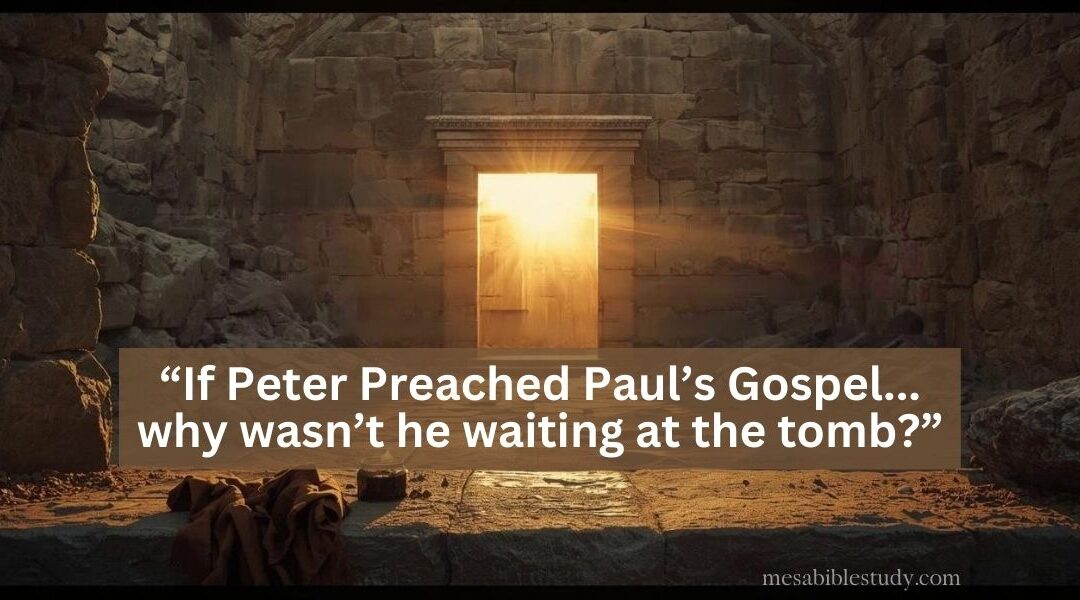
If Peter and the other apostles were preaching Paul’s gospel… why weren’t they waiting outside the tomb?
Paul’s Gospel Is Clear
Paul defines the saving gospel in unmistakable terms:
“Moreover, brethren, I declare to you the gospel… by which also you are saved…
that Christ died for our sins according to the Scriptures,
and that He was buried,
and that He rose again the third day according to the Scriptures.”
— 1 Corinthians 15:1–4
That is Paul’s gospel.
It is specific. It is precise. It is finished-work gospel truth.
Now—here comes the simplest point in the world:
If the apostles had been preaching this gospel for three years…
Why Wasn’t Peter Waiting Outside the Tomb?
If the disciples truly understood that Christ would:
- die
- be buried
- and rise again the third day
…then the morning of the third day should have been the most anticipated event in human history.
Yet what do we see?
- No apostles waiting at the tomb
- No crowd gathered in expectation
- No celebration ready to explode across Jerusalem
- No disciples saying, “Today is the day!”
Instead, we see the opposite.
When Mary goes to the tomb, she isn’t going there expecting resurrection—she goes expecting death.
Why?
Because she is going to anoint the body.
If Mary Knew Paul’s Gospel… Why Was She Bringing Spices?
Think about it.
If Mary believed Christ would rise again the third day, then why would she go there to anoint a corpse?
She wasn’t going to witness resurrection.
She was going to care for a dead body.
That tells you everything you need to know.
If the Apostles Knew Paul’s Gospel… Why Did They Not Believe the Reports?
Even when told of the resurrection, Scripture says they did not believe.
The reason is obvious:
They did not know.
And God tells you that plainly.
Jesus Told Them—Yet God Says It Was Hidden From Them
This is the verse that should end the debate for anyone willing to believe Scripture:
“Then He took the twelve aside and said to them, ‘Behold, we are going up to Jerusalem, and all things that are written by the prophets concerning the Son of Man will be accomplished. For He will be delivered to the Gentiles and will be mocked and insulted and spit upon. They will scourge Him and kill Him. And the third day He will rise again.’
But they understood none of these things; this saying was hidden from them, and they did not know the things which were spoken.”
— Luke 18:31–34
Read that again:
- they understood none of these things
- it was hidden from them
- they did not know
That is not theological interpretation—that is the Holy Spirit’s own commentary.
So no, they were not preaching Paul’s gospel.
They couldn’t preach what God had not revealed.
Peter Didn’t Say “Let’s Go to the Tomb”… He Said “I Go Fishing”
And after the crucifixion and resurrection appearances, what does Peter say?
“Simon Peter said to them, ‘I am going fishing.’”
— John 21:3
If Peter had the gospel of death, burial, and resurrection clear in his mind—if he had been preaching it as the saving message—he would not have said, “I go fishing.”
He would have said:
“We go proclaim the finished work.”
But that wasn’t his message.
So What Were They Preaching?
They were preaching this:
Jesus is the Christ, the Son of God.
That is exactly what Peter confessed:
“You are the Christ, the Son of the living God.”
— Matthew 16:16
That is the kingdom gospel message:
Israel’s Messiah is here.
And Acts makes it clear what scope that message had.
Acts 11:19 Proves the Audience Was Still “Jews Only”
Here is the verse modern Christendom ignores because it destroys the narrative:
“Now those who were scattered after the persecution that arose over Stephen traveled as far as Phoenicia, Cyprus, and Antioch, preaching the word to no one but the Jews only.”
— Acts 11:19
That is crystal clear.
After Pentecost… after Acts 2… after Acts 3…
they were still preaching the Word to Jews only.
So how can anyone claim the Body of Christ (Jew/Gentile equality) began at Pentecost?
How can anyone claim Paul’s gospel was already being preached?
They can’t—unless they twist Scripture.
The Bottom Line
This isn’t complicated.
If Peter preached Paul’s gospel, then:
- the apostles would have been waiting at the tomb
- Mary wouldn’t have gone to anoint a dead body
- there would have been crowds expecting resurrection
- the disciples would not have been shocked and unbelieving
- Luke 18 would not say it was hidden
- Acts 11:19 would not say “Jews only”
- Acts 15 and Galatians 2 wouldn’t even exist
But Scripture says what it says.
God hid it. They did not know. Therefore they could not have preached Paul’s gospel.
Paul’s gospel was revealed later—through Paul—exactly as Paul himself testifies:
- hidden
- not made known
- revealed to him
- committed to him
And once you see it, you can’t unsee it.