Part 10 — Retroactive Revelation
Opening Statement
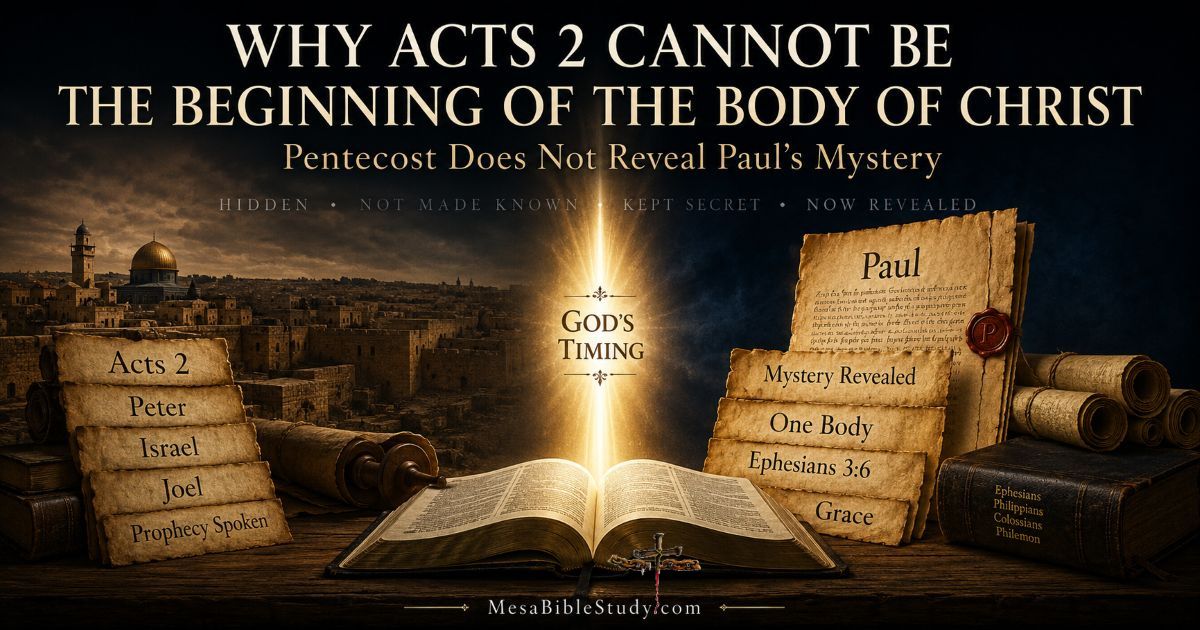
The only way much of Christendom can claim that the Body of Christ began in Acts 2 is through retroactive revelation — forcing Paul’s later revelation backward into the day of Pentecost.
Acts 2 never says the Body of Christ began there. It never reveals the mystery. It never teaches Jew–Gentile equality in one Body. It never announces the dispensation of the grace of God. It never presents Paul’s gospel as Paul later defines it.
Those truths were revealed through Paul.
To insert them into Acts 2 is not sound interpretation. It is tradition overriding the text.
This cannot be reconciled exegetically with the claim that the Body of Christ — His Church, of which the ascended Lord Jesus Christ is the Head — had already begun and been clearly revealed at Pentecost. The full equality of Jew and Gentile in one Body was not proclaimed in Acts 2. It was part of the mystery later revealed through the apostle Paul.
Much of Christendom struggles to accept that Gentiles had no direct part in the Lord’s earthly ministry or in the events of Acts 1, 2, and 3. Gentile Christendom often insists on placing itself into passages, promises, and instructions that were plainly addressed to Israel. But discomfort does not change the inspired record. The truth remains the truth, whether Christendom is willing to accept it or not.
And this matters deeply.
When we stand before the Lord Jesus Christ at the Bema Seat, the quality of every believer’s work will be tested. Those who built upon the one foundation — Jesus Christ — with the wood, hay, and stubble of denominational traditions, human creeds, and doctrines that blurred God’s clear distinctions will see those works consumed. They will suffer loss of reward, but not the loss of salvation, for Scripture plainly says:
“He himself shall be saved; yet so as by fire.”
— 1 Corinthians 3:15
But those who built with the gold, silver, and precious stones of sound doctrine — faithfully standing upon God’s Word rightly divided — will receive reward.
That is why this issue is not minor.
Acts 2 cannot be made the beginning of the Body of Christ without placing into Pentecost what God later revealed through Paul. And every believer who teaches, builds, labors, or ministers must take heed how he builds.
A Necessary Clarification
All salvation — from Abel to the end of time — rests on the finished work of Jesus Christ: His death, shed blood, burial, and resurrection.
There is one Savior and one basis of salvation.
This study is not about two ways of salvation. It is about the timing and content of revelation.
When did God reveal the Body of Christ, the one new man, Jew–Gentile equality, and the gospel of grace apart from the Law as the message for this present age?
Paul says that revelation was given to him.
The Standard Acts-2 Claim Scripture Never Proves
The common argument is this:
Jesus promised Spirit baptism in Acts 1:5. Pentecost fulfilled it. Paul later says believers are baptized by one Spirit into one Body in 1 Corinthians 12:13. Therefore, the Body began at Pentecost.
At first glance, this may sound reasonable.
But the conclusion depends on an unstated assumption: that Spirit baptism at Pentecost is the same operation as Spirit baptism into the Body of Christ.
Acts never states this.
Acts 1:5 says baptized with the Holy Ghost.
First Corinthians 12:13 says baptized into one Body.
Those are not automatically identical statements.
That identification is assumed, not proven.
The Simplest Problem: Acts 2 Never Says It
The simplest and strongest argument is this:
Acts 2 never says the Body of Christ began.
Not once.
There is no statement that:
- salvation is by grace through faith apart from the law
- the Body of Christ began
- the mystery was revealed
- the one new man was created
- Jew and Gentile became fellow heirs
- the middle wall of partition was abolished
- the dispensation of grace began
These are Pauline doctrines revealed later. They cannot be inserted into Acts 2 without reading Paul backward into the chapter.
If Acts 2 is the beginning of the Body, the burden of proof rests on those who claim it.
Where does the text say it?
Peter Addresses Jews, Not Gentiles
Acts 2 is entirely Jewish. Pentecost is a Jewish feast day.
Devout Jews from every nation are present:
“And there were dwelling at Jerusalem Jews, devout men, out of every nation under heaven.”
— Acts 2:5
Peter addresses:
“Ye men of Judaea…”
— Acts 2:14
Then:
“Ye men of Israel…”
— Acts 2:22
And finally:
“Therefore let all the house of Israel know assuredly…”
— Acts 2:36
Peter confronts Israel with the fact that God has made the Jesus they crucified both Lord and Christ.
Paul preaches the glorious victory in the finished work of the gross as the means for salvation. A free gift to all mankind, Jew or Gentile apart from the law, apart from temple worship, apart from works.
Peter is preaching to Israel concerning her rejected Messiah under the prophetic program.
Peter Explains Pentecost by Prophecy, Not Mystery
When Peter explains what is happening, he does not say:
“This is the revelation of the mystery.”
He says:
“But this is that which was spoken by the prophet Joel.”
— Acts 2:16
Peter places Pentecost in the prophetic framework of Israel, judgment, restoration, and the day of the Lord.
Paul later says the mystery was hidden and kept secret until revealed to him.
Prophecy is what God made known.
Mystery is what God kept secret.
Acts 2 belongs to prophecy.
Paul’s Body doctrine belongs to the mystery.
Peter Preaches Israel’s Guilt, Not Paul’s Gospel Formula
Peter’s message emphasizes Israel’s guilt:
“Him… ye have taken, and by wicked hands have crucified and slain.”
— Acts 2:23
And again:
“God hath made that same Jesus, whom ye have crucified, both Lord and Christ.”
— Acts 2:36
This is true and inspired, but it is not Paul’s later gospel proclamation in 1 Corinthians 15:3–4:
“Christ died for our sins according to the scriptures;
And that he was buried, and that he rose again the third day according to the scriptures.”
— 1 Corinthians 15:3–4
Peter charges Israel.
Paul glories in the cross as the saving message for all.
The emphasis and audience are different.
Acts 2:38 Is Not Paul’s Gospel of Grace Apart From Works
When the crowd asks:
“Men and brethren, what shall we do?”
— Acts 2:37
Peter replies:
“Repent, and be baptized every one of you in the name of Jesus Christ for the remission of sins…”
— Acts 2:38
Paul later tells the Philippian jailer:
“Believe on the Lord Jesus Christ, and thou shalt be saved…”
— Acts 16:31
And Paul says:
“For Christ sent me not to baptize, but to preach the gospel…”
— 1 Corinthians 1:17
If Acts 2 is the full gospel of grace for the Body of Christ, Acts 2:38 creates confusion.
But if Acts 2 is Peter addressing Israel under the prophetic program, the passage fits its context.
Acts 2 Contains No Jew–Gentile Equality
Paul defines the mystery in Ephesians 3:
“That the Gentiles should be fellowheirs, and of the same body, and partakers of his promise in Christ by the gospel.”
— Ephesians 3:6
Acts 2 does not reveal this. It is not revealed until Paul comes on the scene 7 years later.
It does not announce the one new man.
It does not announce the abolition of the middle wall:
“For to make in himself of twain one new man, so making peace.”
— Ephesians 2:15
These truths come later through Paul.
Ephesians 2 Shows the Gentile Condition Before Paul’s Revelation
Ephesians 2:11–13 gives one of the clearest descriptions in Scripture of the Gentile world before the revelation of the mystery.
Paul writes:
“Therefore remember that you, once Gentiles in the flesh — who are called Uncircumcision by what is called the Circumcision made in the flesh by hands — that at that time you were without Christ, being aliens from the commonwealth of Israel and strangers from the covenants of promise, having no hope and without God in the world. But now in Christ Jesus you who once were far off have been brought near by the blood of Christ.”
— Ephesians 2:11–13
That passage is graphic.
Paul says Gentiles were:
- without Christ
- aliens from the commonwealth of Israel
- strangers from the covenants of promise
- having no hope
- without God in the world
- far off
That is not mild language.
That is not covenant-continuity language.
That is not the language of Gentiles already sharing equal spiritual standing with Israel in one Body.
Paul says Gentiles were without Christ.
That means the Gentile world did not have Israel’s Messiah. They were not looking for the Son of David. They were not part of Israel’s covenant hope. They had no direct covenant standing before the God of Abraham, Isaac, and Jacob.
Paul says Gentiles were aliens from the commonwealth of Israel.
That means they had no national part in Israel’s calling, promises, priesthood, covenants, land, kingdom, or prophetic hope.
Paul says Gentiles were strangers from the covenants of promise.
That means the covenants belonged to Israel, not the Gentile nations. The Gentiles were outside those covenant promises unless they came to Israel’s God through the place and provision God had given through Israel.
Paul says Gentiles had no hope and were without God in the world.
That is devastating.
For nearly two thousand years from Abraham forward, God was dealing covenantally with Israel. The Gentile nations were outside Israel’s covenant structure, outside Israel’s Messiah, outside Israel’s promises, and outside Israel’s hope. A Gentile could be blessed, but not as a member of the Body of Christ. A Gentile could approach Israel’s God, but not as part of a revealed one new man where Jew and Gentile were equal in one Body.
That truth had not yet been revealed.
That is why Ephesians 2 matters.
Paul does not say Gentiles had always been spiritually equal with Israel and simply failed to understand it.
He says they were far off.
Then he says:
“But now in Christ Jesus you who once were far off have been brought near by the blood of Christ.”
The phrase “but now” matters.
It marks a change.
Gentiles who were once far off are now brought near — not through becoming Israel, not through temple worship, not through circumcision, not through the covenants, not through the Law — but by the blood of Christ, according to the revelation later given through Paul.
That is not Acts 2.
- Acts 2 is not Gentiles being brought near in one Body.
- Acts 2 is Peter addressing Israel.
- Acts 2 is Pentecost.
- Acts 2 is Joel.
- Acts 2 is the house of Israel being confronted with the crucifixion of her Messiah.
The full revelation that Gentiles are now fellow heirs, of the same Body, and partakers in Christ through the gospel comes later through Paul.
That is why Ephesians 2:11–13 cannot be ignored.
It shows the Gentile condition before Paul’s revelation.
And it proves that the Body of Christ cannot be read backward into Acts 2.
Acts 2 Continues in Israel’s Temple Framework
After Pentecost, the believers continue daily in the temple:
“And they, continuing daily with one accord in the temple…”
— Acts 2:46
In Acts 3, Peter and John go to the temple at the hour of prayer:
“Now Peter and John went up together into the temple at the hour of prayer, being the ninth hour.”
— Acts 3:1
This is not the abolition of Israel’s religious system.
This is not the clear revelation of the Church apart from Israel’s program.
It fits a transitional period in which God is still dealing with Israel.
Acts 3 Confirms the Prophetic Kingdom Context
Peter speaks of:
“The times of restitution of all things, which God hath spoken by the mouth of all his holy prophets since the world began.”
— Acts 3:21
This is prophecy and restoration for Israel.
Paul later speaks of:
“The revelation of the mystery, which was kept secret since the world began.”
— Romans 16:25
Peter speaks of what was spoken since the world began.
Paul speaks of what was kept secret since the world began.
These are different categories.
Acts 11:19 Devastates the Acts-2 Claim
Even after Pentecost and Cornelius, the scattered believers:
“Preached the word to none but unto the Jews only.”
— Acts 11:19
If the one new man had begun at Pentecost and Jew–Gentile equality had been revealed, why were they still restricting the message to Jews only?
This fits a transitional period.
It does not fit the claim that the Body of Christ had already begun in Acts 2.
Paul Reveals the Body as Part of the Mystery
Paul says the mystery was:
“Hidden from ages and from generations, but now has been revealed…”
— Colossians 1:26
And he defines that mystery as Gentiles being:
“Fellowheirs, and of the same body, and partakers of His promise in Christ through the gospel…”
— Ephesians 3:6
That means the Body is part of the mystery revealed through Paul.
Therefore, the Body cannot be placed before Paul without placing the mystery before its revelation.
That is the contradiction Acts-2 theology never resolves.
Paul’s Apostleship Becomes Unnecessary Under Acts-2 Theology
If the Body and the gospel of grace began at Pentecost, Paul’s repeated claims become difficult to explain:
- my gospel
- given to me
- revealed to me
- I laid the foundation
Why does Paul speak this way if Peter already revealed everything in Acts 2?
Why does Paul say his gospel was not received from man, but by revelation of Jesus Christ?
Why does Paul say the dispensation of the grace of God was given to him?
Why does Paul say the mystery was made known to him?
Why does Paul say he laid the foundation?
Acts-2 theology blurs those statements.
Right division allows them to stand.
For a More In-Depth Study
For readers who want a deeper study of the specific argument behind Acts-2 theology, I highly recommend reading:
When Did the Body of Christ Begin? “The Missing Premise”
This study examines the common inference chain — Acts 1:5 → Acts 11:16 → 1 Corinthians 12:13 — and shows why Spirit baptism in Acts does not prove the Body of Christ began at Pentecost. What it actually exposes is the desperate weakness of Acts-2 interpretation: it must import Paul’s later revelation into Acts and then treat that imported assumption as doctrine.
Why This Matters: Doctrine, Gospel, and Assurance
This is not an abstract debate.
If Acts 2 is made the beginning of the Body of Christ, then Peter’s kingdom message to Israel gets blended with Paul’s gospel of grace to the Body of Christ.
That has and continues to create confusion.
The gospel of the kingdom and the gospel of grace are mixed.
Law and grace get mixed.
Israel and the Church get mixed.
Prophecy and mystery get mixed.
Water baptism and salvation get mixed.
Kingdom doctrine and doctrine for the body of Christ get mixed.
And once those distinctions are blurred, the doctrine for believers today becomes obscured.
That matters because the doctrine for the Body of Christ — grace-age believers today — is found in Paul’s letters alone.
- Paul is the apostle of the Gentiles.
- Paul received the dispensation of the grace of God.
- Paul reveals the mystery.
- Paul explains the one Body.
- Paul lays out the believer’s position, walk, warfare, assurance, liberty, and hope in this present age.
That does not mean the rest of Scripture is unimportant.
All Scripture is inspired and profitable.
But all Scripture is not written directly to the same people under the same program.
Genesis is profitable.
Matthew is profitable.
Acts is profitable.
Hebrews through Revelation are profitable.
But the only message that saves today is Paul’s gospel. The doctrine that establishes the Body of Christ today is found only in Paul’s epistles.
When Paul is blurred, doctrine is blurred.
When doctrine is blurred, the gospel is blurred.
When the gospel is blurred, assurance is weakened.
And when assurance is weakened, believers are left striving for what Christ has already accomplished.
Paul teaches that the believer does not fight for victory, hoping to attain it through effort, religion, or performance.
The believer fights from victory — already complete in Christ, already accepted in the Beloved, already blessed with all spiritual blessings, already sealed by the Holy Spirit, and already seated with Christ in the heavenly places.
That is why rightly dividing Peter and Paul is not optional.
It protects the gospel.
It protects sound doctrine.
It protects the believer’s assurance.
And it keeps Christ’s finished work where Paul places it: complete, sufficient, and received by grace through faith apart from works.
Final Summary
Acts 2 cannot be the beginning of the Body of Christ because Acts 2 never says it began. We can’t believe something that God hasn’t revealed.
It never reveals the mystery.
It never teaches Jew–Gentile equality in one Body.
It never announces the one new man.
It never presents Paul’s gospel as Paul later defines it.
Peter addresses Israel.
He explains Pentecost by Joel.
He charges Israel with crucifying her Messiah.
He calls Israel to repent and be baptized.
The believers continue in the temple framework.
Acts 11:19 later shows the word was still being preached to Jews only.
Paul later reveals the Body as part of the mystery hidden until revealed to him.
The sequence in Scripture is clear:
Hidden. Then revealed.
Placing the Body before its revelation requires retroactive revelation.
Acts 2 is important in its own right as part of Israel’s prophetic program.
But it is not the beginning of the Body of Christ.
The greatest tragedy of Acts-2 theology is not merely bad doctrine — it is a blurred gospel. When Peter’s Pentecost message is mixed with Paul’s gospel of grace, grace is no longer grace, faith is no longer faith, and the finished work of Christ is no longer treated as sufficient. That mixture produces a perverted gospel with no saving power (Galatians 1:11–12; Romans 11:6; Ephesians 2:8–9).
Continue the Retroactive Revelation Series
Acts 2 cannot be the beginning of the Body of Christ because Acts 2 never says the Body began.
If this study helped clarify why Paul’s mystery cannot be read backward into Pentecost, continue with the full Retroactive Revelation Series.
Previous Study:
The Jerusalem Council: Confirmation, Not Correction
Next Study:
Paul the Master Builder: Why 1 Corinthians 3:10 Matters
Related Study:
When Did the Body of Christ Begin? “The Missing Premise”
Back to Series Hub:
Retroactive Revelation — Why Reading Paul Backward Into Scripture Fails