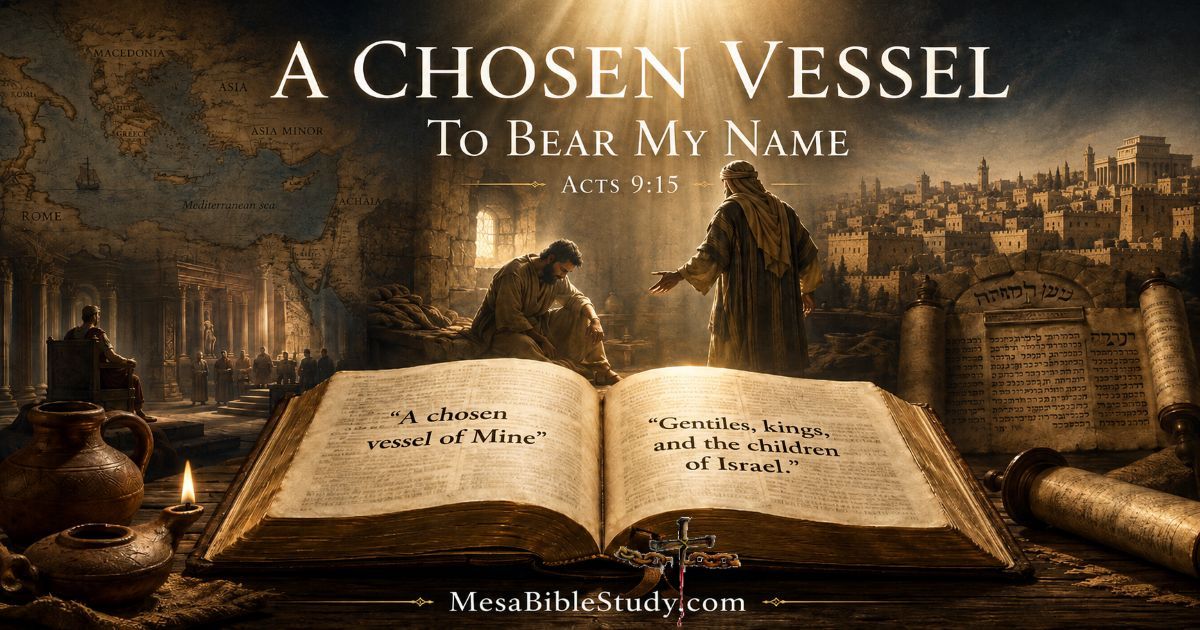
A Chosen Vessel to Bear Christ’s Name
Acts 9:15
“But the Lord said to him, ‘Go, for he is a chosen vessel of Mine to bear My name before Gentiles, kings, and the children of Israel.’”
Introduction
Acts 9:15 raises a question that is rarely given the attention it deserves:
Why did the Lord choose Paul when He already had twelve apostles?
Jesus Christ had personally selected twelve men during His earthly ministry. He had trained them, commissioned them, given them authority, and promised that they would sit upon twelve thrones judging the twelve tribes of Israel.
After the resurrection, Matthias was chosen to replace Judas, restoring the number to twelve. The Twelve were present in Jerusalem. They were preaching that Jesus was the Christ. They were performing miracles. Thousands had responded to their message.
The Lord did not lack apostles.
Yet in Acts 9, the risen and ascended Lord Jesus Christ appeared personally to Saul of Tarsus—one of the greatest persecutors of those who believed that Jesus was Israel’s Messiah—and chose him for an entirely distinct commission.
Paul was not selected to replace Judas.
He was not added to the Twelve.
He was not sent to Jerusalem to become Peter’s student.
He was not instructed to place himself under the authority of the Twelve and continue their existing ministry.
The Lord declared that Saul was “a chosen vessel of Mine” who would bear His name before Gentiles, kings, and the children of Israel. Acts 9:15 marks a decisive development in the unfolding revelation of God.
The question is not merely, “Why did Saul become Paul?”
The deeper question is:
Why did the risen Lord interrupt the prophetic program centered in Jerusalem and personally commission another apostle—an apostle whose ministry would be directed primarily toward the Gentile world?
To understand Acts 9:15, the verse must be read in its historical setting and within the timeline of progressive revelation.
Background, Setting, and Purpose
Who Wrote Acts?
The book of Acts was written by Luke, the physician and companion of the apostle Paul.
Luke also wrote the Gospel of Luke. Together, Luke and Acts form a continuous historical account.
The Gospel of Luke records the earthly ministry of Jesus Christ. Acts records what the risen and ascended Lord continued to do through His chosen messengers.
Luke explains this connection in the opening verse:
“The former account I made, O Theophilus, of all that Jesus began both to do and teach.”
— Acts 1:1
The word “began” is significant. The earthly ministry recorded in Luke was only the beginning. Acts records the continued activity of Christ from heaven.
To Whom Was Acts Written?
Acts was addressed to Theophilus, but it was written for a much broader audience.
The book provides an inspired historical record of the transition from the ministry of the Twelve in Jerusalem to the Gentile ministry entrusted to Paul.
Acts begins with Peter and the Twelve in Jerusalem.
It ends with Paul in Rome, declaring the message of God among the Gentiles.
That movement is not accidental. It is one of the central developments recorded in the book.
When Does Acts 9 Occur?
Acts 9 occurs after several crucial events:
- Jesus Christ had been crucified.
- He had risen from the dead.
- He had ascended into heaven.
- The Holy Spirit had come upon the believing remnant at Pentecost.
- Peter had addressed the nation of Israel.
- Israel’s leadership had continued to resist the testimony of the Holy Spirit.
- Stephen had been rejected and stoned.
- Saul is identified as a leading persecutor of the Jerusalem Church.
The conversion and commission of Saul therefore did not occur during Christ’s earthly ministry or at Pentecost.
It occurred many years after Pentecost just after the stoning of Stephen in Acts 7.
Why Was Acts Written?
The book of Acts is a transitional book. Acts 1–6 continues the kingdom program presented in the four Gospels, with the Twelve ministering to Israel and calling the nation to repentance in light of its prophetic promises.
Beginning in Acts 7 and continuing through Acts 28, the biblical record traces the transition from God’s dealings with Israel under the Law and the prophetic kingdom program to the distinct ministry entrusted to the apostle Paul.
In Acts 9, the risen and ascended Lord Jesus Christ confronts Saul and chooses him as a vessel to bear His name before Gentiles, kings, and the children of Israel. Through Paul, Christ would later make known the preaching of Jesus Christ according to the revelation of the mystery, which had been kept secret since the world began (Romans 16:25).
These revelations were not received from the Twelve or taught to Paul by men. They were given directly to him by the ascended Lord Jesus Christ. They became the doctrinal foundation for the Body of Christ and contain the doctrine, position, walk, and hope of believers living in this present age of grace.
The book does not present this progression as an immediate transfer occurring in Acts 2.
It develops historically.
The first portion of Acts centers upon:
- Jerusalem
- Israel
- The Twelve
- Peter
- The promised kingdom
- National repentance
- The restoration promised by the prophets
- The Stoning of Stephen
Beginning in Acts 9, the narrative gradually transitions toward:
- Paul
- The Gentiles
- Justification apart from the Law
- The gospel of the grace of God
- The revelation of the mystery
- The formation and doctrine of the Body of Christ
Acts 9:15 stands at the beginning of a transitional shift.
Chapter Theme
Acts 9 records the conversion and divine commissioning of Saul of Tarsus.
Saul was not seeking Christ.
He was not reconsidering his position.
He was not traveling to Damascus to study Christianity.
He was traveling with legal authority to arrest those who called upon the name of Jesus.
Luke introduces Saul’s condition with forceful language:
“Then Saul, still breathing threats and murder against the disciples of the Lord, went to the high priest.”
— Acts 9:1
Saul represented the intensity of Israel’s opposition to the testimony that Jesus was the Christ.
But as Saul approached Damascus, the risen Lord Jesus appeared to him:
“Saul, Saul, why are you persecuting Me?”
— Acts 9:4
Saul discovered that the Jesus whom he opposed was alive, glorified, and speaking from heaven.
Blinded by the heavenly appearance, Saul was led into Damascus. The Lord then appeared in a vision to a disciple named Ananias and commanded him to go to Saul.
Ananias hesitated because he knew Saul’s reputation.
Acts 9:15 is the Lord’s answer.
Saul’s past did not prevent the Lord from choosing him. In fact, his conversion would become one of history’s greatest demonstrations of divine grace.
The persecutor would become the apostle of grace.
The enemy would become the chosen vessel.
The man who attempted to destroy those who believed in Jesus would bear the name of Jesus before Gentiles, kings, and Israel.
The Immediate Context
The immediate context begins with the Lord speaking to Ananias:
“Arise and go to the street called Straight, and inquire at the house of Judas for one called Saul of Tarsus, for behold, he is praying.”
— Acts 9:11
Ananias responded:
“Lord, I have heard from many about this man, how much harm he has done to Your saints in Jerusalem.”
— Acts 9:13
Ananias knew Saul as a persecutor.
The Lord knew Saul as His chosen vessel.
Ananias saw Saul’s past.
The Lord revealed Saul’s future.
The Lord did not tell Ananias merely that Saul had sincerely converted. He announced that Saul had been selected for a specific purpose:
“He is a chosen vessel of Mine.”
The language is deliberate.
Saul’s apostleship was not a human appointment. It did not originate with the Twelve, the Jerusalem assembly, Ananias, or any religious institution.
The risen Lord chose him.
Paul would later repeatedly defend this fact:
“Paul, an apostle—not from men nor through man, but through Jesus Christ and God the Father.”
— Galatians 1:1
Acts 9:15 is therefore not merely the account of a sinner’s conversion. It is the announcement of a new divine commission.
Phrase-by-Phrase Breakdown
1. “But the Lord said to him”
The speaker is the risen and ascended Lord Jesus Christ.
This is crucial.
Paul’s commission did not originate during the earthly ministry of Jesus. Paul was not among the Twelve who followed Christ throughout Galilee and Judea.
Paul encountered Christ after the resurrection and ascension— outside of the land of Israel.
The Lord who spoke to Peter and the Twelve upon the earth now spoke from heaven concerning Saul.
This heavenly origin became a defining feature of Paul’s apostleship and message.
Paul later wrote:
“But I make known to you, brethren, that the gospel which was preached by me is not according to man.”
— Galatians 1:11
His commission and gospel came through the revelation of the risen Jesus Christ.
2. “Go”
Ananias had raised understandable objections.
Saul had persecuted the saints.
He possessed authority to arrest believers.
His reputation produced fear.
But the Lord did not ask Ananias to evaluate whether Saul was a reasonable candidate. The Lord issued a command:
“Go.”
God’s grace had accomplished what human reasoning would have considered impossible.
The Lord had stopped Saul.
The Lord had revealed Himself to Saul.
The Lord had chosen Saul.
Ananias was to believe and obey what the Lord had declared.
3. “For he is”
The Lord speaks of Saul’s calling as an established fact.
He does not say that Saul might eventually become useful if he proved himself worthy.
He says:
“He is.”
Saul’s identity had been changed by divine intervention.
Moments earlier, he was a persecutor approaching Damascus with authority from the chief priests to arrest Jewish believers.
Now the Lord identified him according to His sovereign purpose.
This does not minimize Saul’s guilt. It magnifies the grace of God.
Paul later described himself as:
“A blasphemer, a persecutor, and an insolent man; but I obtained mercy because I did it ignorantly in unbelief.”
— 1 Timothy 1:13
Saul was not chosen because he had earned apostleship.
He was chosen as a demonstration of mercy and grace.
4. “A chosen vessel”
The word “chosen” emphasizes divine selection.
Paul did not volunteer for this ministry.
He did not campaign for apostolic recognition.
He did not receive his office through a vote of the Twelve.
The Lord selected him.
The word “vessel” describes an instrument prepared for a particular use. Saul would be the human instrument through whom the risen Christ would make known truths and carry His name into territories not central to the Peter’s ministry.
Paul would later write:
“But when it pleased God, who separated me from my mother’s womb and called me through His grace, to reveal His Son in me, that I might preach Him among the Gentiles.”
— Galatians 1:15–16
Paul’s calling was intentional, personal, and divinely determined.
5. “Of Mine”
Saul belonged to the Lord.
The expression underscores both authority and ownership.
Paul was not Peter’s chosen vessel.
He was not the Jerusalem assembly’s chosen vessel.
He was not Ananias’s chosen vessel.
The Lord said:
“He is a chosen vessel of Mine.”
Paul’s authority therefore rested upon the One who called him.
This explains why Paul repeatedly defended the divine origin of his apostleship:
“Paul, a bondservant of Jesus Christ, called to be an apostle, separated to the gospel of God.”
— Romans 1:1
His ministry could not be invalidated merely because it had not originated with the Twelve.
6. “To bear My name”
Paul was chosen to carry the name of Jesus Christ.
The man who had attempted to silence that name would now proclaim it.
The man who had arrested those who called upon that name would now suffer for that name.
To “bear” Christ’s name involves more than speaking a title. Paul would carry mystery or secret and truth of who Christ is and what Christ had accomplished.
He would proclaim:
- Jesus, of the seed of David
- Jesus Christ crucified
- Jesus Christ buried
- Jesus Christ risen
- Justification by faith
- Reconciliation through the cross
- Salvation apart from the works of the Law
- The gospel of the grace of God
- The revelation of the mystery
- The one new Body composed of believing Jews and Gentiles
Paul’s ministry would center completely upon Christ.
“For I determined not to know anything among you except Jesus Christ and Him crucified.”
— 1 Corinthians 2:2
In 2 Timothy verse 8, the apostle Paul writes:
‘Remember that Jesus Christ, of the seed of David, was raised from the dead according to my gospel,’
What a remarkable statement.
Paul does not say, “according to the gospel of the kingdom.” He does not direct Timothy back to the message proclaimed during Christ’s earthly ministry or to Peter’s Pentecost address. He says:
“According to my gospel.”
The resurrection of Jesus Christ was not itself a secret. The prophets foretold it, Christ repeatedly announced it, and the Twelve witnessed it. What was newly revealed through Paul was the full meaning and saving significance of Christ’s death and resurrection for all mankind.
Paul writes in Ephesians 3:8-11:
‘To me, who am less than the least of all the saints, this grace was given, that I should preach among the Gentiles the unsearchable riches of Christ, and to make all see what is the fellowship of the mystery, which from the beginning of the ages has been hidden in God who created all things through Jesus Christ; to the intent that now the manifold wisdom of God might be made known by the church to the principalities and powers in the heavenly places, according to the eternal purpose which He accomplished in Christ Jesus our Lord,’
It is only through the revelations given directly to the apostle Paul, and then made known through his ministry and letters, that we learn God’s eternal purpose for the Body of Christ and how that purpose was accomplished through the death, burial, and resurrection of Jesus Christ.
7. “Before Gentiles”
The first group named is the Gentiles.
This is extraordinary within the unfolding narrative.
The Twelve had been selected in direct connection with Israel. Their number corresponded to the twelve tribes. During Christ’s earthly ministry, they were commanded:
“Do not go into the way of the Gentiles, and do not enter a city of the Samaritans.”
— Matthew 10:5
Instead, they were sent:
“To the lost sheep of the house of Israel.”
— Matthew 10:6
Their commission was rooted in Israel’s prophetic kingdom program.
Paul’s calling was different.
Although Paul regularly went first to Jewish synagogues, he proclaimed the gospel of grace, not the gospel of the kingdom. His defining apostleship was directed toward the Gentiles:
“For I speak to you Gentiles; inasmuch as I am an apostle to the Gentiles.”
— Romans 11:13
“For He who worked effectively in Peter for the apostleship to the circumcised also worked effectively in me toward the Gentiles.”
— Galatians 2:8
The Lord already had twelve apostles associated with Israel.
He chose Paul as the apostle of the Gentiles.
That distinction is not a human theological invention. It appears directly in the biblical record.
8. “Kings”
Paul would also bear Christ’s name before rulers and political authorities.
This aspect of his commission unfolded throughout Acts.
Paul testified before:
- Sergius Paulus
- The magistrates at Philippi
- Gallio
- Felix
- Festus
- Herod Agrippa II
- Roman authorities
- Members of Caesar’s household
Paul’s imprisonment did not prevent his commission. It placed him before rulers whom he might never otherwise have addressed.
The Lord used chains as a means of advancing the message.
Paul wrote:
“The things which happened to me have actually turned out for the furtherance of the gospel.”
— Philippians 1:12
9. “And the children of Israel”
Paul’s primary apostleship to the Gentiles did not mean that he never ministered to Israel.
Acts repeatedly records Paul entering synagogues and reasoning from the Scriptures that Jesus was the Christ.
Paul’s burden for Israel remained intense:
“My heart’s desire and prayer to God for Israel is that they may be saved.”
— Romans 10:1
However, Paul’s ministry to Israel does not erase his distinct Gentile apostleship.
Acts 9:15 names all three spheres:
- Gentiles
- Kings
- The children of Israel
The order itself is striking. The Gentiles appear first.
Paul would bear the name of Christ widely, but his defining office remained:
“A teacher of the Gentiles in faith and truth.”
— 1 Timothy 2:7
Why Paul if the Lord Already Had Twelve Apostles?
The existence of the Twelve makes Paul’s selection more significant, not less.
If Paul had merely been intended to repeat the same message under the same commission, the Lord could have sent one of the Twelve.
They were already trained.
They had witnessed Christ’s earthly ministry.
They had seen the risen Lord.
They had received authority.
They had been promised positions in Israel’s kingdom.
They were already preaching in Jerusalem.
Yet the Lord personally appeared to Saul and appointed him independently.
Why?
Because Paul’s apostleship was not merely an extension of the Twelve’s ministry.
The Twelve were associated with:
- Israel
- The twelve tribes
- The kingdom promised by the prophets
- National repentance
- The restoration of all things
- Christ’s earthly ministry
- The circumcision
Paul was commissioned in connection with:
- The Gentiles
- The gospel of the grace of God
- Justification apart from the Law
- The preaching of Christ crucified
- The revelation of the mystery
- The Body of Christ
- The uncircumcision
Paul did not replace the Twelve.
He did not become the thirteenth member of their kingdom commission.
He was a uniquely chosen apostle with a distinct stewardship from the risen and glorified Christ.
What This Verse Does Not Mean
It Does Not Mean That Paul Replaced Judas
Judas’s position among the Twelve was filled by Matthias in Acts 1.
Peter explained that another man had to take Judas’s office. Matthias was then numbered with the eleven apostles:
“And he was numbered with the eleven apostles.”
— Acts 1:26
The number twelve was significant because the Twelve were connected to the twelve tribes of Israel.
Paul was not chosen to sit upon one of those twelve thrones.
His apostleship had a different purpose.
It Does Not Mean That Paul Joined the Twelve
Scripture never says that Paul became one of the Twelve.
Paul distinguished himself from them:
“Whether then it was I or they, so we preach and so you believed.”
— 1 Corinthians 15:11
“I” and “they” are not the same group.
Paul later described those who were apostles before him, demonstrating that his apostleship began separately:
“Nor did I go up to Jerusalem to those who were apostles before me.”
— Galatians 1:17
It Does Not Mean That Peter Taught Paul His Gospel
Paul directly denied that his gospel came from men:
“For I neither received it from man, nor was I taught it, but it came through the revelation of Jesus Christ.”
— Galatians 1:12
After his conversion, Paul did not immediately go to Jerusalem for instruction. He went into Arabia and later returned to Damascus.
Only after three years did he go to Jerusalem, where he stayed with Peter for fifteen days.
Paul’s message originated through revelation from Christ, not instruction from the Twelve.
It Does Not Mean That the Twelve Failed
The distinction between Paul and the Twelve should not be framed as though the Twelve were disobedient, inferior, or mistaken.
They faithfully carried out the ministry entrusted to them according to what had been revealed.
Their ministry concerned Israel and the fulfillment of prophetic promises.
Paul’s later commission introduced further revelation.
The difference is not faithfulness versus failure.
The difference is distinct commissions within the progression of God’s plan of redemption.
It Does Not Mean That There Are Two Ways of Salvation Today
Recognizing the distinction between Paul and the Twelve does not mean that two saving messages operate simultaneously today.
Paul declares the gospel by which people are now saved:
“Christ died for our sins according to the Scriptures, and that He was buried, and that He rose again the third day according to the Scriptures.”
— 1 Corinthians 15:3–4
Salvation today is by grace through faith alone, apart from works, through the finished work of Jesus Christ.
What This Verse Does Mean
Acts 9:15 means that the risen Lord Jesus Christ personally and sovereignly selected Saul for a distinct ministry.
Paul’s apostleship did not originate with Jerusalem.
It did not depend upon authorization from the Twelve.
It was not a continuation of Paul’s former religious life.
It was not merely the conversion of a prominent opponent.
The Lord chose Paul as His vessel to carry the name of Christ before Gentiles, kings, and Israel.
This appointment marked a major development in biblical history.
The Lord already had twelve apostles connected to Israel and its promised kingdom.
He chose another apostle because He was revealing and administering something not previously entrusted to the Twelve. These new revelations were hidden in God until revealed to Paul: a Gentile-centered apostleship associated with the gospel of grace and, through later revelation, the mystery concerning the Body of Christ.
Acts 9:15 does not reveal every detail of Paul’s later doctrine.
It announces the man through whom that doctrine would be revealed.
The verse is therefore a doorway.
To understand why Paul was chosen, the reader must continue into Paul’s letters, where the risen Christ explains the nature of Paul’s apostleship, gospel, revelation, and stewardship.
It was Paul as the wise master builder, by the grace of God, and the wisdom given to him— laid the foundation for the body of Christ. Paul gives a clear warning to all. But careful, be aware of what foundation you are building upon— there is only one foundation to build upon and that foundation is Jesus Christ.‘ According to the grace of God which was given to me, as a wise master builder I have laid the foundation, and another builds on it. But let each one take heed how he builds on it. For no other foundation can anyone lay than that which is laid, which is Jesus Christ.’
I Corinthians 3:10-11
Cross-References for Going Deeper
Matthew 10:5–6
Jesus instructed the Twelve not to go to the Gentiles or Samaritans, but to the lost sheep of the house of Israel.
This establishes the original national focus of their ministry.
Matthew 19:28
Jesus promised the Twelve that they would sit upon twelve thrones judging the twelve tribes of Israel.
Their number and ministry were directly connected to Israel.
Acts 1:26
Matthias was numbered with the eleven apostles, restoring the Twelve before Pentecost.
Paul was therefore not chosen as Judas’s replacement.
Acts 22:14–15
Paul recounts that God appointed him to know His will, see the Just One, and become His witness to all men.
His calling originated with God.
Acts 26:16–18
The risen Christ explains Paul’s commission more fully, sending him to the Gentiles to open their eyes and turn them from darkness to light.
Romans 11:13
“I am an apostle to the Gentiles.”
Paul explicitly identifies the defining sphere of his apostleship.
Galatians 1:11–12
Paul’s gospel was not received from man or taught by man. It came through the revelation of Jesus Christ.
Galatians 2:7–9
Paul and the Jerusalem leaders recognized distinct apostleships: the gospel of the uncircumcision (Gentiles) was committed to Paul, while the gospel of the circumcision (Jews) was committed to Peter.
Ephesians 3:1–9
Paul explains that the dispensation of the grace of God and the mystery were made known to him by revelation.
Colossians 1:24–27
Paul describes the stewardship given to him to fulfill the Word of God concerning the mystery hidden from ages and generations.
1 Timothy 1:12–16
Paul explains that he obtained mercy and became a pattern demonstrating the longsuffering of Jesus Christ.
Doctrinal Summary
Acts 9:15 records the Lord’s sovereign selection of Paul as a distinct apostolic vessel.
The Lord already had twelve apostles.
They had been chosen in connection with Israel, the twelve tribes, and the promised kingdom. Their ministry began in Jerusalem and was rooted in the prophetic program spoken by the prophets.
Paul was chosen much later, by the risen and ascended Christ.
He was not selected to replace Judas, join the Twelve, or receive his gospel from Peter.
He was commissioned directly by Christ to bear His name before Gentiles, kings, and Israel.
Paul later explains that he was:
- The apostle of the Gentiles
- Entrusted with the gospel of the uncircumcision
- Given the gospel of the grace of God
- Made a steward of the mysteries of God
- Given the dispensation of the grace of God
- Made the minister through whom the mystery was revealed and proclaimed
This does not diminish the Twelve.
It recognizes the divine purpose of their ministry and the distinct divine purpose of Paul’s ministry.
The Bible is a progressive revelation.
Truth must be read according to when it was revealed, to whom it was revealed, and through whom God made it known.
Acts 9:15 is the divine announcement that Paul would occupy a unique place in that unfolding revelation. And God expects us to believe what He says.
Final Summary
Why Paul? The Lord already had twelve apostles.
He had twelve men connected to the twelve tribes of Israel.
He had twelve men preaching that Jesus was the Christ.
He had twelve men proclaiming Israel’s need to repent.
He had twelve men awaiting the restoration promised by the prophets.
But the risen Lord was about to send His name into the Gentile world through a distinct apostolic ministry.
Therefore, He chose Saul.
Paul was not an afterthought.
He was not the replacement for Judas.
He was not Peter’s assistant.
He was not a late addition to the Twelve.
He was the chosen vessel of the risen Christ.
Through Paul, the Lord would proclaim the gospel of His grace, reveal salvation apart from the works of the Law, make known the mystery of Christ, and provide the doctrine for the Body of Christ, the Church.
Acts 9:15 forces every careful Bible student to confront the question:
If Paul merely continued the same ministry as the Twelve, why was a separate apostle necessary?
The answer is found in the progression of revelation.
The Lord chose twelve apostles for Israel.
Then the risen and glorified Christ chose Paul as the apostle of the Gentiles.
That distinction is crystal clear, and no man, denomination or tradition can build a bridge to get around it.
We have to believe what God says according to His divinely revealed order.
Want to Go Deeper?
This Passage Breakdown examines Acts 9:15 phrase by phrase.
The companion study asks the broader question:
If the Lord already had twelve apostles, why was Paul necessary?
Continue with: