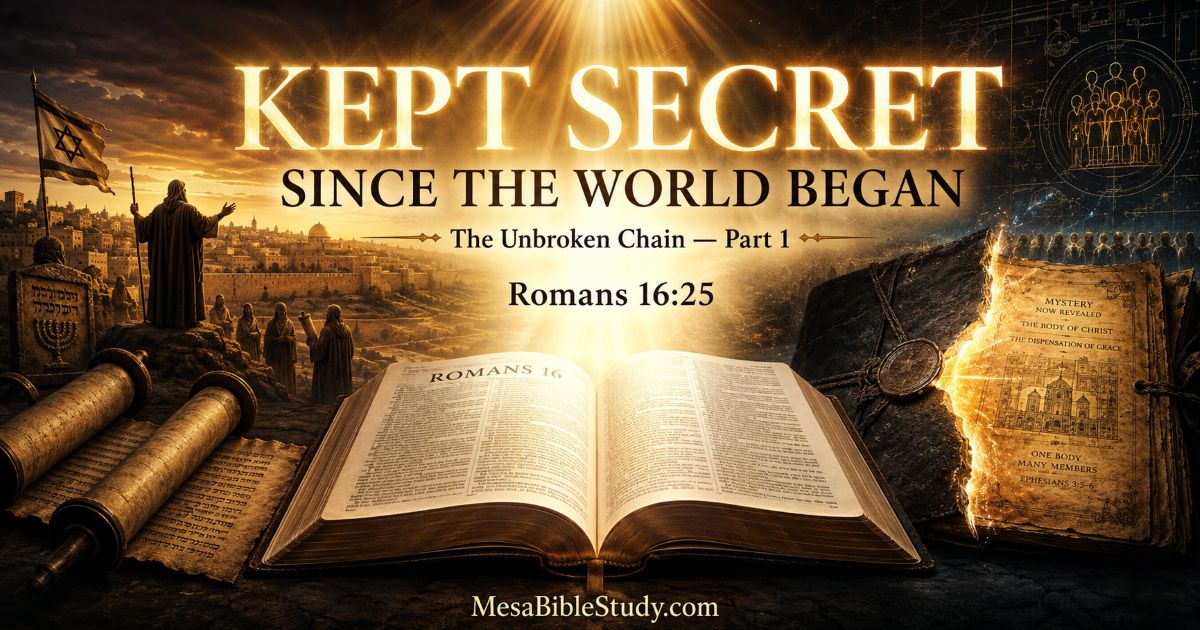
Romans 16:25 and the Distinction Tradition Cannot Explain Away
Romans 16:25 and the distinction tradition cannot explain away
This series is a systematic walk through a flawless, literal chain of Scripture that completely bypasses centuries of confusing human tradition.
The purpose is simple: to read the Word of God exactly as it is written on the page, in its proper chronological and dispensational order, without forcing the text through denominational systems, theological traditions, or centuries of commentary. We are not going to begin with an inherited system and make Scripture fit it. We are going to begin with the words God placed on the page and allow those words to establish the divisions for us.
When Scripture is allowed to say exactly what it says, an unmistakable chain begins to emerge. And that chain begins with one of the clearest statements in all of Paul’s epistles: Romans 16:25.
The Literal Text
|
Placed at the conclusion of Paul’s great doctrinal masterpiece, this verse provides the absolute, definitive description of the message entrusted to him. Every phrase matters. Paul says believers are established according to “my gospel,” according to “the preaching of Jesus Christ,” and according to “the revelation of the mystery, which was kept secret since the world began.”
This is not vague language. It is not a theological riddle that requires centuries of commentary to decode. It is black-and-white text. Paul’s gospel is directly connected to a revelation that had been kept secret since the world began.
“My Gospel”
Paul does not call it the gospel of the Twelve, the gospel he learned from Peter, or merely a common message that everyone had been preaching from the beginning. He calls it “my gospel.”
Paul uses this precise expression three times in his epistles: Romans 2:16, Romans 16:25, and 2 Timothy 2:8. That repeated wording is not Paul claiming ownership of something that belonged to him personally. The gospel belongs to God. The finished work belongs to Jesus Christ. But the stewardship, revelation, and commission were specifically entrusted to Paul.
|
That statement raises the stakes beyond a debate between theological systems. Paul says mankind will be judged according to his gospel. Therefore, identifying that gospel correctly is not optional. It is a matter of eternal consequence.
Why would the Holy Spirit repeatedly preserve the words “my gospel” if Paul was merely repeating the same message Peter and the Twelve had already preached? Why would Paul say he received it “by the revelation of Jesus Christ” if it had been publicly taught throughout the Lord’s earthly ministry? The traditional explanation asks us to ignore the very words that require an explanation.
The Preaching of Jesus Christ
Romans 16:25 does not say Paul preached a different Jesus. There is one Lord Jesus Christ. The distinction is in how Jesus Christ is being preached and what God is now revealing through His finished cross-work.
Israel had long been promised a Messiah, a King, and an earthly kingdom. The prophets spoke of His coming, His sufferings, His glory, Israel’s restoration, and the blessing that would flow to the nations through Israel. During His earthly ministry, the Lord Jesus was proclaimed as “the Christ, the Son of the living God” and as Israel’s promised King.
Paul, however, says Jesus Christ is now preached “according to the revelation of the mystery.” The cross itself did not suddenly appear without prophetic witness. Paul explicitly says Christ died for our sins and rose again “according to the scriptures” (1 Corinthians 15:3–4). What had been kept secret was the previously hidden purpose God would accomplish through that cross: the fall of Israel becoming the riches of the Gentiles, salvation going directly to Jew and Gentile apart from Israel’s covenants and the Law, and believing Jews and Gentiles being placed on equal ground in one new Body with the risen and glorified Christ as its Head.
The same Jesus Christ can be preached according to prophecy or according to the revelation of the mystery. Failing to preserve that distinction is where centuries of confusion begin.
The Revelation of the Mystery
The word “mystery” does not mean something mystical, unknowable, or permanently hidden. In Paul’s usage, it is a sacred secret—truth that human intellect could never discover and that no prophet could search out unless God chose to reveal it.
A mystery is not prophecy gradually becoming clearer. It is something previously concealed and then revealed by God at the time of His choosing. Paul does not say the mystery was recovered, rediscovered, or more fully explained. He says it was revealed.
This is exactly why Paul later writes:
|
Paul closes every possible human route. He did not receive his gospel from Peter. He was not taught it by the Twelve. He did not take the Kingdom message preached at Jerusalem and merely repackage it for a Gentile audience. The ascended, glorified Lord Jesus Christ revealed it to him.
Romans 16:25 identifies the message as a mystery. Galatians 1 identifies its source as direct revelation from Jesus Christ. Ephesians 3 will identify Paul as its recipient and steward. Colossians 1 will say it had been hidden from ages and generations. The chain is already beginning to lock together.
Kept Secret Since the World Began
The text is completely untwistable here. Paul plainly declares that the mystery was “kept secret since the world began.” The expression carries the sense of being held in silence. God did not reveal it through Moses. He did not place it in the covenants. He did not announce it through Israel’s prophets. It was hidden in God until the appointed time when the ascended Lord revealed it through Paul.
If the mystery had already been revealed in the Old Testament, it was not a secret. If the Twelve had already understood and preached it during the Lord’s earthly ministry, it was not held in silence. If Peter proclaimed it at Pentecost, Paul would not later describe it as a revelation he did not receive from man.
The words “kept secret” must be allowed to mean kept secret.
The Grand Contrast: Prophecy and Mystery
Acts 3 gives us the clearest possible contrast. Peter, speaking to Israel, calls the nation to repentance and points forward to the restoration promised by the prophets:
|
Read the two statements exactly as God wrote them:
| PROPHECY | MYSTERY |
| Acts 3:21 | Romans 16:25 |
| Spoken by all His holy prophets since the world began | Kept secret since the world began |
Those two statements cannot describe the same body of revealed truth. Something spoken since the world began cannot simultaneously be something kept secret since the world began. One was proclaimed. The other was concealed. One belongs to prophecy. The other belongs to mystery.
The Kingdom program was prophetic. The earthly reign of the Messiah, the restoration of Israel, the covenants, the land, and the blessing of the nations through Israel were spoken by the prophets. These truths were not hidden in God; they were written throughout Israel’s Scriptures.
The Grace program was a mystery. God’s temporary setting aside of Israel in unbelief, the direct reconciliation of Gentiles apart from Israel’s rise, the creation of the Body of Christ, and the equal standing of Jew and Gentile in that Body were kept secret until revealed through Paul.
To force all Scripture into one flat, unchanging gospel requires a person to claim that “spoken since the world began” means the same thing as “kept secret since the world began.” Textually, that is an absolute impossibility.
What the Twelve Did Not Yet Understand
The Gospel accounts themselves confirm the distinction. When Jesus began telling the Twelve that He would be rejected, killed, and raised again, Luke records that “they understood none of these things: and this saying was hid from them, neither knew they the things which were spoken” (Luke 18:34).
They believed Jesus was the Christ, the Son of God, and Israel’s promised King. That was true faith according to the revelation then given. But they were not preaching faith alone in Christ’s death, burial, and resurrection for our sins while they did not yet understand or believe that He was going to die and rise again.
This does not diminish Peter or the Twelve. It honors the truthfulness of the biblical timeline. God had not yet revealed everything He would accomplish through the cross. Progressive revelation means God reveals truth in His time, through the messenger He chooses, for the purpose He appoints.
Why This Distinction Matters
This is not an academic argument over labels. If prophecy and mystery are blended together, the instructions attached to Israel’s Kingdom program are inevitably mixed with Paul’s Gospel of Grace. Repentance and water baptism for the remission of sins, circumcision, law-keeping, covenant identity, signs, and Kingdom promises are pulled into a message Paul defines as the free gift of God received by faith apart from works.
The result is a corrupted hybrid: grace plus works, faith plus ritual, Christ’s finished work plus human effort. But the moment anything is added as a requirement for salvation, grace is no more grace (Romans 11:6).
The good news for mankind today is the Gospel of Grace: Jesus Christ shed His blood and died for our sins, was buried, and rose bodily from the dead on the third day. The moment a person believes that good news—trusting completely in what Christ accomplished and not in anything he or she can do—God saves that person by grace through faith.
Faith plus absolutely nothing.
The First Link in the Unbroken Chain
Romans 16:25 is the first link because it establishes the boundary every passage that follows will confirm:
The message: Paul calls it “my gospel.”
The subject: Jesus Christ is preached according to a newly revealed purpose.
The source: It came by revelation, not human instruction.
The character: It is a mystery—a sacred secret.
The historical boundary: It was kept secret since the world began.
From here, the chain moves naturally to Ephesians 3:1–9, where Paul repeatedly identifies himself—“me,” “unto me,” and “I”—as the recipient, steward, and dispenser of this previously hidden revelation.
No tradition is required to produce this distinction. No denominational confession is required. No Mid-Acts chart has to be imposed upon the text. The reader only has to believe the words on the page.
The Kingdom program was spoken since the world began.
The Mystery was kept secret since the world began.
Those two statements cannot mean the same thing. And once that first straight line is drawn, the rest of the Bible begins to open exactly as God intended.
NEXT IN THE SERIES
Part 2 — The Mystery Was Given to Paul [on deck]
Ephesians 3:1–9
MesaBibleStudy.com