🎄 Part 7 — The Promised King Announced: From Eden to David to Christ
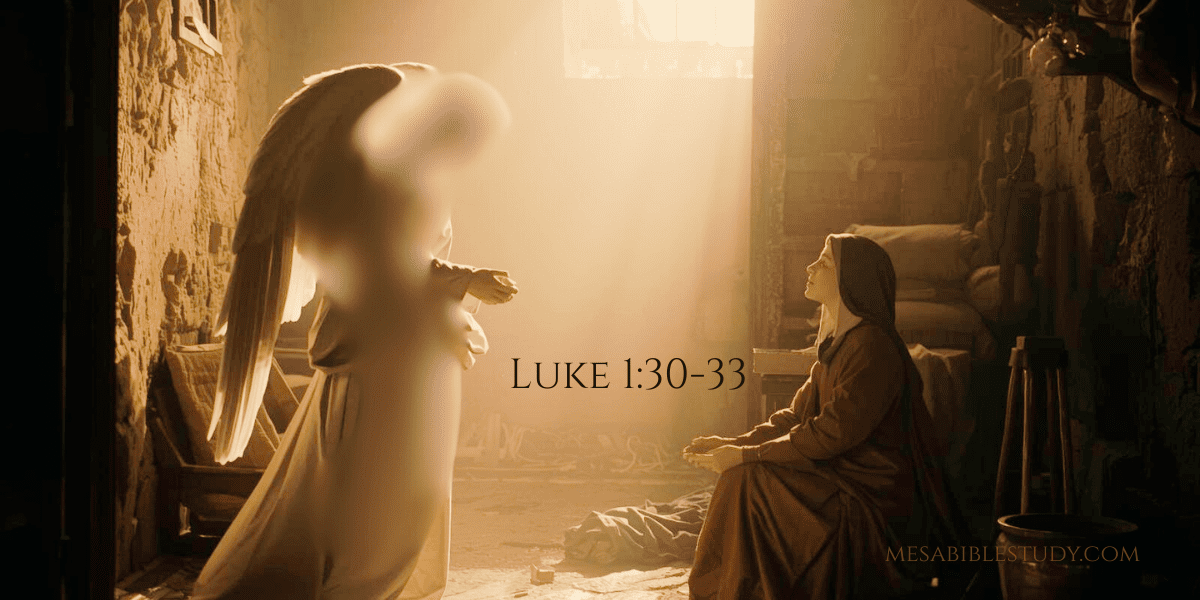
Key Text: Luke 1:30–33
“Then the angel said to her, ‘Do not be afraid, Mary, for you have found favor with God. And behold, you will conceive in your womb and bring forth a Son, and shall call His name Jesus. He will be great, and will be called the Son of the Highest; and the Lord God will give Him the throne of His father David. And He will reign over the house of Jacob forever, and of His kingdom there will be no end.’”
Devotional: The Angel’s Announcement and God’s Unbroken Promise
Theme Connection:
- Genesis 3:15 promised a coming Seed who would crush the serpent.
- Abraham preserved the Seed through a chosen family.
- David was promised an eternal throne and kingdom.
- Isaiah foretold the virgin birth and divine identity of the Child.
- The Virgin Shall Conceive (Isaiah 7:14)
- The Birthplace Foretold (Micah 5:2)
Luke 1:30–33 is where all of those promises converge.
This is not merely a birth announcement.
It is a covenant confirmation.
Context & Connection
When the angel Gabriel appeared to Mary, he did not speak in vague or sentimental language. He anchored his message in the very promises God had been making for thousands of years.
Gabriel’s words are deliberate, precise, and deeply rooted in Scripture:
- A Son will be born
- He will be great
- He will be called the Son of the Highest
- He will receive the throne of David
- He will reign over the house of Jacob
- His kingdom will be everlasting
This is 2 Samuel 7 spoken again — now attached to a name, a person in Mary, and a moment in history.
Devotional Insight
1. “Do not be afraid… you have found favor with God.”
God’s redemptive plan does not begin with fear, but with grace.
Mary did not earn this role.
She was chosen by God’s sovereign favor.
This reminds us that redemption has always been God’s initiative — from Eden to Nazareth.
2. “You will conceive… and bring forth a Son.”
This echoes Genesis 3:15 — the Seed of the woman.
The Redeemer would come through a woman, not through human strength or planning, but by divine intervention.
Christmas is not man reaching up to God.
It is God reaching down to man.
3. “The Lord God will give Him the throne of His father David.”
This is the heart of the announcement.
Gabriel does not reinterpret the Davidic Covenant.
He confirms it.
This Child is the rightful heir to David’s throne — the King promised in 2 Samuel 7:12–17.
This is not symbolic language.
It is covenant language.
Jesus is not merely a spiritual figure —
He is Israel’s promised King.
4. “He will reign over the house of Jacob forever.”
This is critical.
Gabriel does not say “over the Church.”
He does not say “over a spiritualized Israel.”
He says the house of Jacob.
God has not forgotten Israel.
God has not replaced Israel.
God is fulfilling His promises exactly as He spoke them.
The kingdom promised to David will be fulfilled by David’s greater Son.
5. “Of His kingdom there will be no end.”
Earthly kingdoms rise and fall.
Human rulers come and go.
But this King’s reign is eternal.
What began in a womb will one day rule the world.
The manger points forward to a throne.
The Child points forward to a crown.
The first coming guarantees the second.
Encouragement for Today
Luke 1:30–33 reminds us of a powerful truth:
God has never deviated from His plan.
From Eden to Abraham, from David to Mary, God has been moving history toward this moment — and beyond it.
The birth of Christ is proof that:
- God keeps His promises
- God honors His covenants
- God is faithful across generations
And because Christ has come once exactly as promised, we can trust Him to come again.
Christmas is not the end of the story.
It is the confirmation that every word God speaks will stand.
Reading Plan
- Genesis 3:15 — The promised Seed
- 2 Samuel 7:12–17 — The promised throne
- Isaiah 9:6–7 — The promised King
- Luke 1:30–33 — The announcement fulfilled
- Revelation 11:15 — The kingdom established
← Previous | 📖 Series Home | Next→
0 Comments