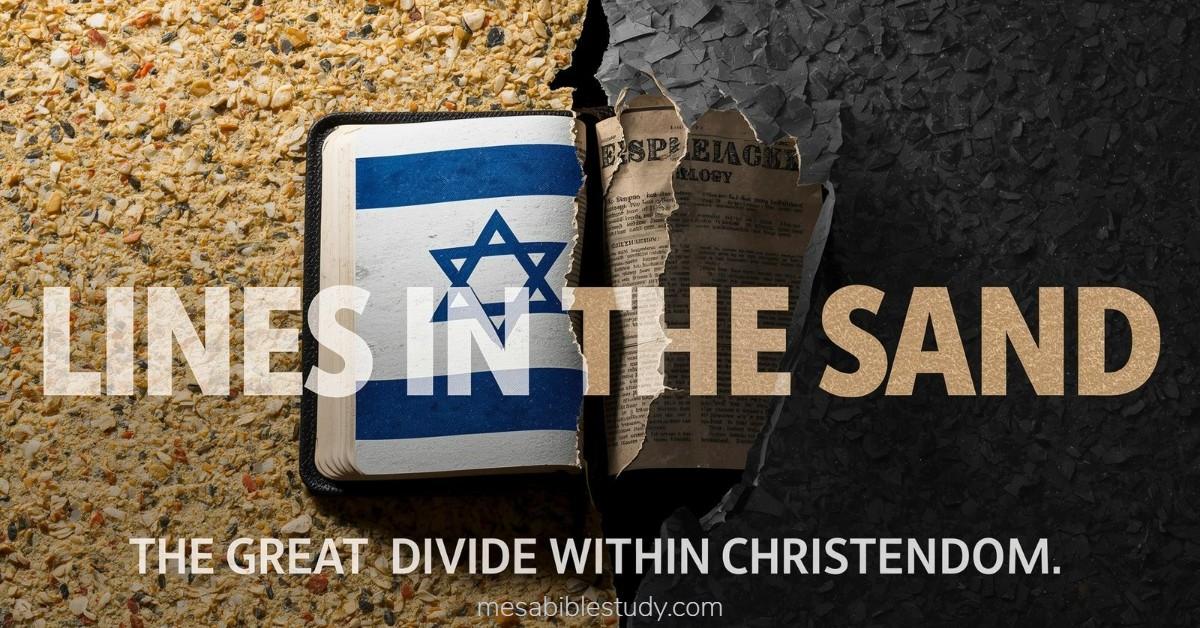
The Great Divide Within Christendom
Introduction
Since October 7, 2023, the spiritual landscape of Christendom has been laid bare. Lines have been drawn. Sides have been chosen. Those who stand with Israel because they believe God keeps His promises—and those who insist that God is finished with Israel and that the Church has replaced her.
At no time since the apostle Paul first revealed the mystery of the Body of Christ has there been such a clear, worldwide exposure of belief. The dividing line has been etched deep: Does God mean what He says—and will He do what He promised to Abraham, Isaac, and Jacob?
The Growing Divide
The speed and boldness of this shift have been staggering. Denominations that for decades were silent on Israel have turned against her almost overnight. From pulpits to pews, from seminaries to small groups, the message has spread: “God is finished with Israel; those who stand with her are misguided, political, or heretical.”
This isn’t limited to fringe voices. Protestants and Catholics—once divided on nearly everything—are now united in opposition to what they label “Christian Zionism.” In other words, anyone who simply believes that God keeps His Word is accused of twisting Scripture or worshiping a nation. The charge is clear: support for Israel is no longer seen as faithfulness to God’s covenant promises but as betrayal of one’s own country or religion.
And it’s not confined to institutions. Everyday believers—pastors, teachers, and lifelong friends—are echoing centuries-old accusations, repeating the very blood libels and replacement doctrines that have fueled antisemitism for millennia.
Why This Matters
This isn’t a political issue. It’s not about foreign policy or nationalism. It’s about the character of God.
If God can break His promises to Israel, what makes us think He won’t break His promises to the Church? If He can reject the very people through whom He brought forth the Messiah, how secure is our salvation in Christ?
Paul answers that question in Romans 11:1–2:
“I say then, has God cast away His people? Certainly not! For I also am an Israelite, of the seed of Abraham, of the tribe of Benjamin. God has not cast away His people whom He foreknew.”
To deny Israel’s future restoration is to deny Paul’s Spirit-inspired words. It is to reject the plain teaching of the prophets and apostles.
Scripture’s Witness to Israel’s Future
From Genesis to Revelation, the testimony is clear: God’s covenant with Israel is everlasting.
- Genesis 17:7–8 – “And I will establish My covenant between Me and you and your descendants after you… an everlasting covenant, to be God to you and your descendants after you.”
- Jeremiah 31:35–37 – As long as the sun, moon, and stars endure, Israel will not cease from being a nation before God.
- Ezekiel 36–37 – God promises to regather Israel, restore her land, and one day breathe spiritual life into her.
- Zechariah 12:9–10 – “I will pour on the house of David and on the inhabitants of Jerusalem the Spirit of grace and supplication; then they will look on Me whom they pierced.”
- Romans 11:25–29 – “Blindness in part has happened to Israel until the fullness of the Gentiles has come in. And so all Israel will be saved… For the gifts and the calling of God are irrevocable.”
The Church is not Israel. The Church is a new creation revealed to Paul—the Body of Christ, composed of Jew and Gentile alike, saved by grace through faith alone (Ephesians 3:1–9). Israel remains God’s earthly people; the Church, His heavenly people.
The Spirit of the Age
What we are witnessing is not simply a theological debate. It’s a spiritual rebellion against the authority of Scripture and the faithfulness of God. The same spirit that blinded Israel in Paul’s day (Romans 11:7–10) now blinds much of modern Christendom.
Those who reject Israel’s prophetic significance often reject dispensational truth entirely. They merge law and grace, Israel and the Church, prophecy and mystery—creating a theological fog that leaves believers confused and vulnerable.
But Scripture is not confused. God is not the author of confusion (1 Corinthians 14:33). The enemy is. And this growing hatred toward Israel and those who stand with her is the visible outworking of that unseen war.
A Call to Stand Firm
Now is the time for courage. Now is the time for clarity. Believers who rightly divide the Word of Truth must not shrink back in silence.
We are called to be ambassadors for Christ (2 Corinthians 5:20), not ambassadors for popular opinion. We are called to stand on the unchanging promises of God—even when it costs us relationships, reputation, or comfort.
God has not abandoned Israel. He has temporarily set her aside in unbelief so that grace could flow freely to all mankind through Paul’s gospel. But make no mistake: He will fulfill every promise made to His covenant people.
“For the LORD will not forsake His people, for His great name’s sake, because it has pleased the LORD to make you His people.”
— 1 Samuel 12:22
The day is coming when Israel will look upon her Messiah, repent, and be restored. Until that day, we stand by faith, proclaiming both the gospel of grace and the faithfulness of God—because they are inseparable.
Closing Exhortation
The lines have been drawn. The separation within Christendom will only grow clearer. Let it be said of us that we stood on the side of God’s Word—unashamed, unwavering, and anchored in the unbreakable promises of our faithful God.
Explore the Series
← Previous | 📖 Series Home | Next →
0 Comments