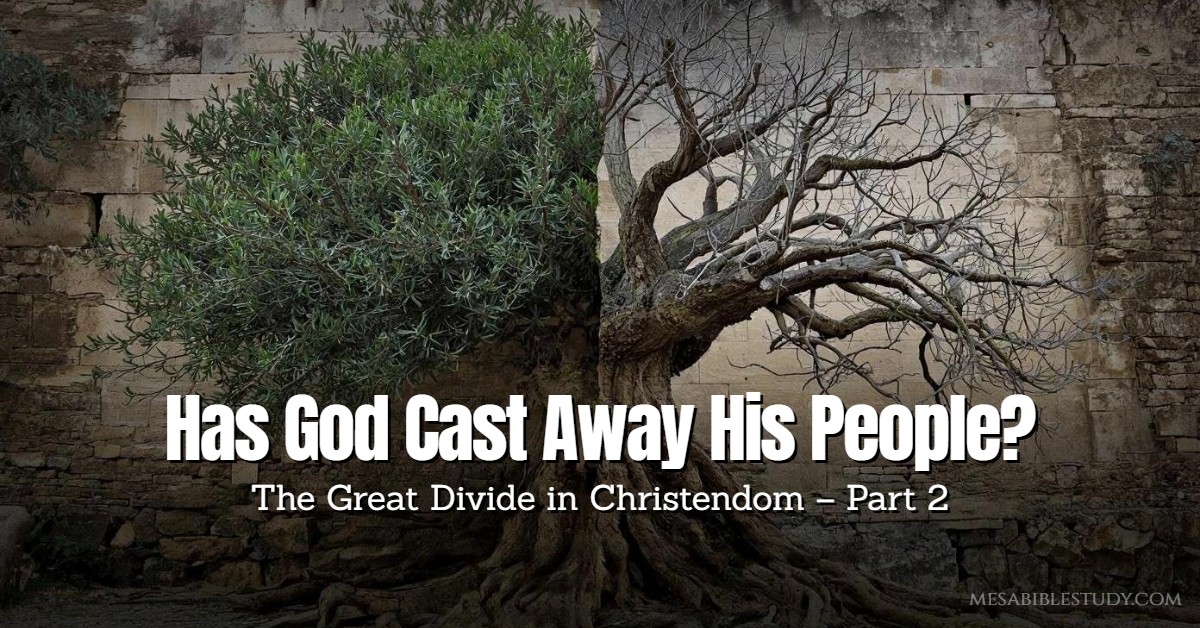
Has God Cast Away His People? Romans 11 Answers
Romans 11:1–2
“I say then, has God cast away His people? Certainly not! For I also am an Israelite, of the seed of Abraham, of the tribe of Benjamin. God has not cast away His people whom He foreknew.”
Introduction
The apostle Paul’s question pierces through nearly two thousand years of theological confusion: Has God cast away His people?
For centuries, that question has divided Christendom. Many claim that Israel’s rejection of the Messiah caused God to permanently reject them—that He transferred all covenant promises to the Church, and that the modern state of Israel has no prophetic significance.
But Paul’s Spirit-inspired answer in Romans 11 could not be clearer: “Certainly not!”
God has not—and will not—cast away His people. The same God who made an everlasting covenant with Abraham, Isaac, and Jacob remains faithful to His Word, even when His people are faithless.
Paul’s Personal Proof
Paul begins with himself.
“For I also am an Israelite…”
If God had truly cast away Israel, then Paul himself—an Israelite of the tribe of Benjamin—would have no claim to salvation. Yet here he stands, saved by grace through faith in Christ. Paul’s very existence as a believing Jew disproves the claim that God is finished with Israel.
God’s rejection was partial, not total; temporary, not permanent. A remnant remained—and still remains—by grace.
“Even so then, at this present time there is a remnant according to the election of grace.” — Romans 11:5
The Remnant of Grace
Throughout Israel’s history, there has always been a believing remnant. In Elijah’s day, it was the seven thousand who had not bowed the knee to Baal (Romans 11:4). In Paul’s day, it was Jewish believers in Christ—the firstfruits of a future national restoration.
That remnant continues today. Though the majority of Israel remains blinded, individual Jews are being saved through the gospel of grace—the same gospel Paul received by revelation (Galatians 1:11–12).
“For there is no distinction between Jew and Greek, for the same Lord over all is rich to all who call upon Him.” — Romans 10:12
Israel’s Blindness—Not Her End
Paul reveals a mystery that was hidden before his ministry began:
“For I do not desire, brethren, that you should be ignorant of this mystery, lest you should be wise in your own opinion, that blindness in part has happened to Israel until the fullness of the Gentiles has come in.” — Romans 11:25
Notice the precision of the Spirit’s words: “blindness in part” and “until.”
Israel’s blindness is not total—it is partial. And it is not permanent—it lasts until God’s purpose with the Gentiles is complete.
That means Israel’s national restoration is still future—but it is certain. When the fullness of the Gentiles has come in, the Deliverer will come out of Zion, and “all Israel shall be saved” (Romans 11:26).
The Faithfulness of God
To claim that God has cast away Israel is to question His integrity. If His everlasting covenants with Abraham, Isaac, and Jacob can be annulled, then the believer’s assurance in Christ collapses as well.
But Scripture will have none of it.
“For the LORD will not forsake His people, for His great name’s sake, because it has pleased the LORD to make you His people.” — 1 Samuel 12:22
“For I am the LORD, I do not change; Therefore you are not consumed, O sons of Jacob.” — Malachi 3:6
“For the gifts and the calling of God are irrevocable.” — Romans 11:29
If God could forsake Israel, He could forsake the Church. But He cannot—because He is faithful. His character guarantees His promises.
The Danger of Replacement Theology
Replacement theology—or supersessionism—teaches that the Church has permanently replaced Israel in God’s plan. This doctrine not only distorts Scripture but also undermines the gospel of grace.
- It denies the clear covenant promises made to Abraham and his descendants (Genesis 17:7–8).
- It confuses Israel’s earthly kingdom hope with the Church’s heavenly calling (Ephesians 1:3).
- It leads to pride and spiritual blindness—the very thing Paul warns Gentile believers against:
“Do not boast against the branches. But if you do boast, remember that you do not support the root, but the root supports you.” — Romans 11:18
When the Church claims Israel’s promises, it steps into territory that does not belong to her. The result is confusion, arrogance, and—tragically—hatred toward the very people God calls His own.
God’s Purpose in This Present Age
In His wisdom, God has temporarily set aside Israel as a nation to extend mercy to all mankind.
“Through their fall, salvation has come to the Gentiles, to provoke them to jealousy.” — Romans 11:11
Israel’s fall opened the door for Gentiles to be saved by grace apart from the law. This is the dispensation of grace revealed to and through Paul—the mystery hidden from ages past (Ephesians 3:1–9).
But God’s mercy has a purpose. One day, Israel will see the faithfulness of God displayed through the Church and will turn back to her Messiah.
The Coming Restoration
The same prophets who foretold Israel’s scattering also declared her regathering and restoration.
- Jeremiah 31:35–37 – Israel will never cease to be a nation before God.
- Ezekiel 36:24–28 – God will gather them from all nations and give them a new heart and spirit.
- Zechariah 12:10 – They will look upon the One they pierced and mourn.
Paul ties it all together:
“And so all Israel will be saved, as it is written: ‘The Deliverer will come out of Zion, and He will turn away ungodliness from Jacob.’” — Romans 11:26
The same grace that saves the Church will one day open Israel’s eyes. The same Christ who appeared to Paul on the road to Damascus will appear to His people in glory.
Application and Encouragement
Believers today must hold fast to the truth that God keeps His Word. Do not be swayed by the theological currents of the age. The same Christ who saved you by grace will fulfill every promise He made to His earthly people.
Standing with Israel is not about politics—it’s about proclaiming the faithfulness of God.
And in a world where even many within Christendom are turning against Israel, we must stand firm, remembering Paul’s warning:
“Boast not against the branches.” (Romans 11:18)
Conclusion
Paul’s question still echoes: Has God cast away His people?
And God’s Word still answers: “Certainly not!”
Israel’s story is not finished. Her blindness is temporary. Her future is certain. Her God is faithful.
Scripture References
Romans 11:1–29; Romans 10:12; 1 Samuel 12:22; Malachi 3:6; Genesis 17:7–8; Jeremiah 31:35–37; Ezekiel 36–37; Zechariah 12:10; Ephesians 3:1–9; Romans 1:16; Titus 2:11–13
Explore the Series
← Previous | 📖 Series Home | Next →
0 Comments