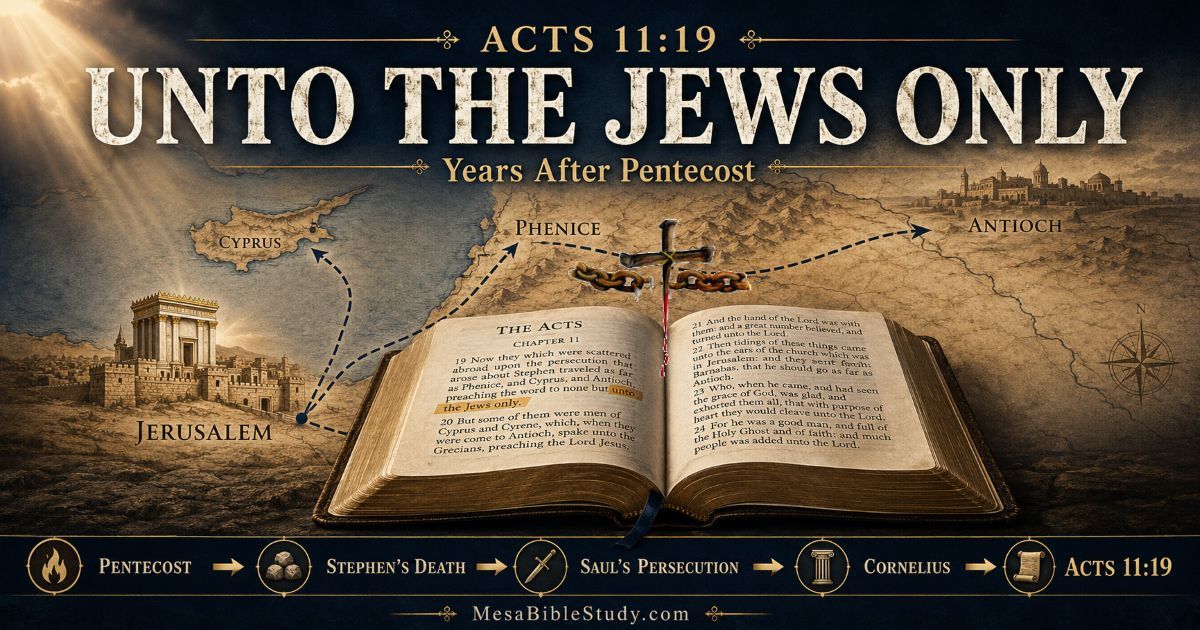
Who Were the Scattered Believers, What Word Were They Preaching, and Why Was Their Audience Restricted to Jews Only?
“Now they which were scattered abroad upon the persecution that arose about Stephen travelled as far as Phenice, and Cyprus, and Antioch, preaching the word to none but unto the Jews only.”
— Acts 11:19
Acts 11:19 is one of the clearest chronological and doctrinal markers in the book of Acts— which is completely ignored and twisted. It isn’t that the exegetical work hasn’t been done on this passage, the problem is the conclusion. That is, approximately 7 to 8 years after Pentecost, the only word that was being proclaimed was Old Testament— “…to none but unto the Jews only.”
This fact cannot be reconciled exegetically with the claim that the Body of Christ—His Church, of which the ascended Lord Jesus Christ is the Head—had already begun and been clearly revealed in Acts 2. The full equality of Jew and Gentile in one Body was not proclaimed at Pentecost. It was part of the mystery later revealed through the apostle Paul.
Much of Christendom cannot accept that Gentiles had no direct part in the Lord’s earthly ministry or in the events of Acts 1, 2, and 3. Gentile Christendom insists on placing itself into passages, promises, and instructions that were plainly addressed to Israel. But discomfort does not change the inspired record. The truth remains the truth, whether Christendom is willing to accept it or not.
When we stand before the Lord Jesus Christ at the Bema Seat, the quality of every believer’s work will be tested. Those who built upon the one foundation—Jesus Christ—with the wood, hay, and stubble of denominational traditions, human creeds, and doctrines that blurred God’s clear distinctions will see those works consumed. They will suffer the loss of reward, but not the loss of salvation, for Scripture plainly says, “he himself shall be saved; yet so as by fire” (1 Corinthians 3:15). But those who built with the gold, silver, and precious stones of sound doctrine, faithfully standing upon God’s Word rightly divided, will receive a reward.
“Now they which were scattered abroad upon the persecution that arose about Stephen travelled as far as Phenice, and Cyprus, and Antioch, preaching the word to none but unto the Jews only.”
— Acts 11:19
Luke does not merely tell us where these believers traveled. He tells us who they were, why they had been scattered, what they preached, and exactly whom they preached it to.
The language is not vague:
“Preaching the word to none but unto the Jews only.”
That statement cannot honestly be turned into Paul’s later ministry to the nations, the gospel of the grace of God, or the revelation of Jew and Gentile joined together in one Body.
The passage says what it says.
“Now They Which Were Scattered Abroad”
The word “they” refers to the believers who had been scattered from Jerusalem because of the persecution connected with Stephen.
Acts 8 records the beginning of that scattering:
“And Saul was consenting unto his death. And at that time there was a great persecution against the church which was at Jerusalem; and they were all scattered abroad throughout the regions of Judaea and Samaria, except the apostles.”
— Acts 8:1
These were not members of a previously revealed, predominantly Gentile Body of Christ.
They were Jewish believers connected with the Lord’s earthly ministry. They believed that Jesus was the Christ, Israel’s promised Messiah and the Son of God.
Their faith was rooted in what was promised to Abraham in Genesis 12, Israel’s covenants, Israel’s prophetic hope, and Israel’s promised kingdom.
They were the believing remnant of Israel that made up the Jerusalem assembly (Church).
“Upon the Persecution That Arose About Stephen”
The scattering occurred because of the persecution that followed Stephen’s death.
Stephen had confronted Israel’s rulers with their continued resistance to the Holy Spirit:
“Ye stiffnecked and uncircumcised in heart and ears, ye do always resist the Holy Ghost.”
— Acts 7:51
After Stephen was killed, persecution intensified against the Jerusalem believers.
And who stood at the center of that persecution?
Saul of Tarsus.
“As for Saul, he made havock of the church, entering into every house, and haling men and women committed them to prison.”
— Acts 8:3
The very man who would later become the apostle Paul was originally the leading persecutor of these believing Jews.
That distinction matters.
The scattered believers of Acts 11:19 were not traveling around preaching a message they had learned from Paul. They had been scattered because of Paul’s and before Paul’s apostolic ministry had been publicly established. They were fleeing the persecution Saul/Paul himself had helped lead.
It is historical and doctrinal confusion to read Paul’s later revelation backward into the preaching of Acts 11:19.
The Chronology Matters
Acts 11 occurs approximately seven or eight years after Pentecost, depending on the chronology used.
That means this is not the morning after Acts 2.
Many years have passed.
Stephen has been killed.
The Jerusalem believers have been scattered.
Saul has persecuted the assembly.
Saul has encountered the risen Christ.
Peter has been sent to the house of Cornelius (Acts 10).
Peter has returned to Jerusalem and having to defend his actions before the assembly of Jewish believers.
And yet Luke still tells us that these scattered Jewish believers were preaching:
“To none but unto the Jews only.”
That is devastating to the claim that Acts 2 immediately began the newly revealed Jew-Gentile Body of Christ. More importantly, failing to recognize this clear distinction has caused—and continues to cause—doctrinal confusion throughout Christendom. It blends a message directed to Jews only with Paul’s later revelation of the one new man, in which believing Jews and Gentiles are baptized by one Spirit into the Body of Christ. Entrance into that Body is not through Israel’s kingdom message, water baptism, or covenant promises, but by believing Paul’s gospel of grace.
If the Body of Christ had been clearly revealed at Pentecost, why were believing Jews still limiting their proclamation to Jews only years later?
Why did Peter need a special vision and actually refused to go, before entering the home of Cornelius?
Why did the believers in Jerusalem challenge Peter for eating with uncircumcised men?
Why were these scattered believers still preaching to Jews only?
The answer is straightforward: they were Jewish believers still operating within Israel’s prophetic program. They not only believed the gospel of the kingdom but they were also keeping the Mosaic law.
“Travelled as Far as Phenice, and Cyprus, and Antioch”
These Jewish believers traveled far beyond Jerusalem.
But geographical expansion does not automatically mean doctrinal change.
They carried the message into Phenice, Cyprus, and Antioch, but Luke specifically tells us that their audience remained Jews only.
They had traveled outside the land, but they had not abandoned Israel’s prophetic framework.
They were scattered Jews preaching to other Jews.
This is entirely consistent with the kingdom message proclaimed earlier in Acts. Israel was being called to repent and acknowledge Jesus as the Christ. The hope of the promised kingdom remained before the nation.
A change in location is not necessarily a change in message.
“Preaching the Word”
This phrase is often treated as though it automatically means that these believers were preaching Paul’s gospel of grace.
It does not.
The expression “the word” must be understood within its progressive, historical and doctrinal context.
The written Scriptures available to these believers were the Old Testament Scriptures. From those prophetic Scriptures, they proclaimed that Jesus was Israel’s promised Messiah.
They could preach His identity, His resurrection, His fulfillment of prophecy, and His right to Israel’s throne.
That does not mean they were preaching the later-revealed mystery concerning the Body of Christ.
Acts 11:19 says nothing about:
- Salvation is by grace through faith alone in the finished work apart from the law
- Jew and Gentile being reconciled in one Body
- The one new man
- The mystery hidden from previous generations
- The heavenly position of the Body of Christ
- The gospel of the uncircumcision committed to Paul
- The dispensation of the grace of God
- Baptism by one Spirit into one Body
- The revelation later recorded in Paul’s epistles
Those doctrines cannot simply be inserted into the words “preaching the word.”
The passage must be allowed to speak for itself.
“To None but Unto the Jews Only”
This is the controlling statement of the verse.
Luke could hardly have used clearer language.
“None but.”
“The Jews.”
“Only.”
This is not a universal commission being carried equally to Jew and Gentile.
This is not the revelation of one new man in which the middle wall of partition has been abolished.
This is not Paul’s distinct apostleship and message to the nations.
These Jewish believers were deliberately limiting their preaching to other Jews.
The word “only” closes the door on every attempt to pretend that they were already functioning according to the later-revealed truth of the Body of Christ.
The passage does not say they preached primarily to Jews.
It does not say they began with Jews and then immediately moved to Gentiles.
It says:
“To none but unto the Jews only.”
That is a exclusive, not a suggestion.
They Were Believing Jews
These men believed that Jesus was the Christ, Israel’s promised Messiah, the Son of God. They believed what the apostle Peter believed when Jesus asked the apostles, “But who do you say that I am?”
In Matthew 16:16, we have Peter’s answer and profession of faith:
‘Simon Peter answered and said, “You are the Christ, the Son of the living God.”’
Matthew 16:16
Peter doesn’t say “You are Jesus, the Son of God, who died for my sins, was buried, and rose again the third day”. How could he say that, Jesus is right in front of Him, and alive!
But believing in Jesus does not erase the historical and dispensational setting in which a person believed.
The believers of Acts 11:19 understood Jesus as Israel’s promised Messiah. Just a the apostle Peter did in Matthew 16.
They were part of the believing remnant of Israel that came out of the Lord’s earthly ministry and early Acts period. Their hope, message, Scriptures, and expectations were connected with what God had promised through the prophets, the Old Testament.
Calling them simply “Christians” has caused many throughout Christendom to assume that these Jewish believers already understood and followed the doctrine later revealed through Paul. That broad label conceals the fact that they were still operating within Israel’s prophetic kingdom program.
In fact, Acts 11:26 tells us that the disciples were first called Christians at Antioch (Gentiles). Luke does not use that designation in Acts 11:19. He identifies these people through their connection to Stephen’s persecution and their Jews-only ministry.
We should identify them the way the passage identifies them (we have to take God at His word): as scattered Jewish believers preaching to Jews only.
Do Not Read Paul Backward Into Acts 11:19
A common interpretive error is to take doctrines later revealed through Paul and force them backward into every occurrence of words such as “gospel,” “grace,” “church,” “faith,” or “the word.” For more on this interpretive error read our Popular Series on “Retroactive Revelation”.
Peter himself warned that Paul’s writings would be twisted:
“As also in all his epistles, speaking in them of these things; in which are some things hard to be understood, which they that are unlearned and unstable wrest, as they do also the other scriptures, unto their own destruction.”
— 2 Peter 3:16
Paul’s revelation must be understood as progressive revelation, that was hidden in God until given to Paul. It cannot be assumed to have been fully known, partially known and proclaimed by people who had never received it.
Acts 11:19 does not reveal Paul’s gospel or the doctrine for the body of Christ.
It does not reveal Paul’s apostleship to the Gentiles.
It does not reveal the one Body.
It does not reveal the gospel of the grace of God.
It records Jewish believers, scattered because of Saul’s persecution, proclaiming the prophetic word concerning Israel’s Messiah to Jews only.
The words are crystal clear.
The problem is not that Acts 11:19 is difficult to understand.
The problem is that many theological systems cannot allow it to mean what it plainly says.
Passage Summary
Acts 11:19 records believing Jews from the Jerusalem assembly who had been scattered during the persecution connected with Stephen. They traveled to other regions proclaiming Jesus from Israel’s prophetic Scriptures (Old Testament), but they limited their preaching to Jews only. Their message and ministry remained connected with Israel’s prophetic kingdom program and must not be confused with the distinct revelation later committed to the apostle to the Gentiles, Paul, concerning the gospel of grace and the Body of Christ.
Key Passages
Acts 7:51–60
Acts 8:1–4
Acts 10:1–48
Acts 11:1–19
John 20:30–31
Acts 22:21
Romans 11:13
Ephesians 3:1–9
Acts 11:19 is not merely an interesting historical detail. Its clear Jews-only language creates a serious problem for the claim that the distinctionless Body of Christ had already been revealed at Pentecost. Read the full doctrinal examination: “JEWS ONLY: The Words in Acts 11:19 That Cannot Be Twisted.”