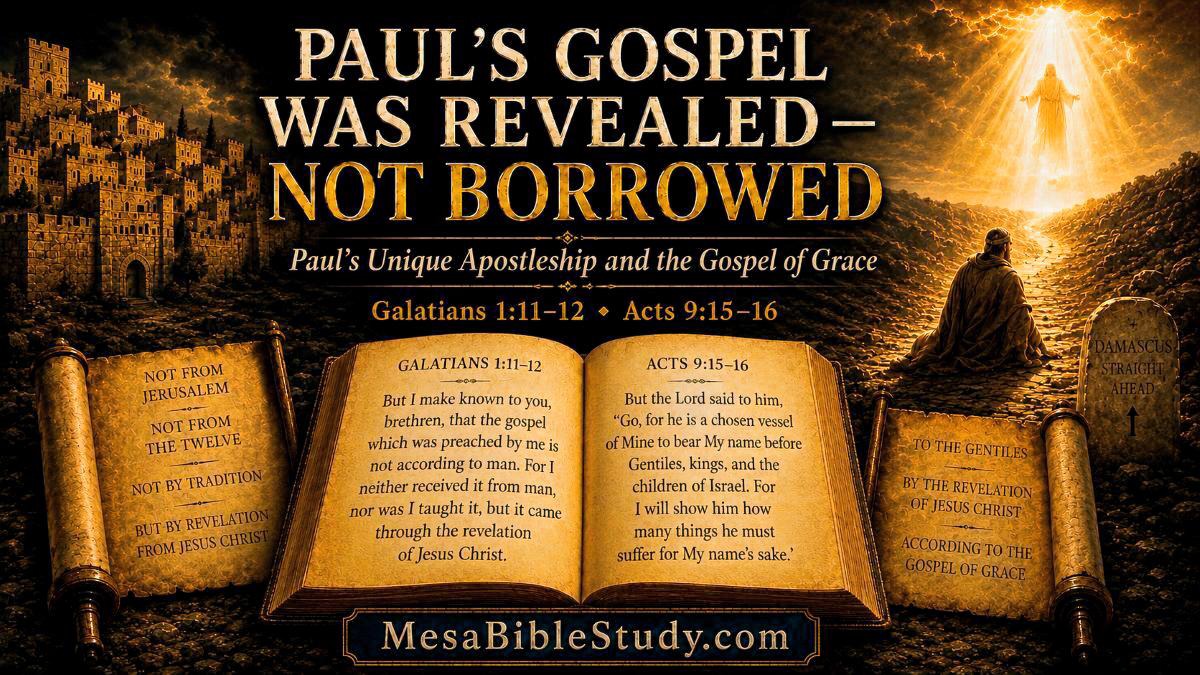
Galatians 1:11–12 and the Timeline of Paul’s Unique Apostleship
One of the most important Bible study principles a believer can learn is this:
Do not read later revelation backward into earlier passages.
It’s called “Retroactive Revelation”.
It’s a man-made framework dreamed up by men long ago that could not and would not take God at His word.
Read more about “Retroactive Revelation” here.
That one principle clears up tremendous confusion.
It helps us understand the difference between Israel and the Body of Christ. It helps us distinguish prophecy from mystery. It helps us see why Paul’s ministry must not be blended into Peter’s ministry as though they were preaching the same message from the beginning.
Galatians 1:11–12 is one of the clearest passages in Scripture on this issue.
Paul wrote:
“But I make known to you, brethren, that the gospel which was preached by me is not according to man.
For I neither received it from man, nor was I taught it, but it came through the revelation of Jesus Christ.”
— Galatians 1:11–12
Paul could not have said it more clearly.
The gospel he preached was not according to man. He did not receive it from man. He was not taught it by man. It came by revelation from Jesus Christ.
That means Paul’s gospel was not borrowed from Peter.
It was not learned from the twelve.
It was not handed down to him by the Jerusalem church.
It was revealed to him by the risen and ascended Lord Jesus Christ.
Christ’s Earthly Ministry Was to Israel
Before we can understand Paul’s unique apostleship, we must understand the timeline.
During His earthly ministry, the Lord Jesus Christ came to Israel.
Paul later wrote:
“Now I say that Jesus Christ has become a servant to the circumcision for the truth of God, to confirm the promises made to the fathers.”
— Romans 15:8
That verse is critical.
Jesus Christ was a minister to the circumcision. He came to confirm the promises made to the fathers. His earthly ministry was not a Gentile mission to reveal the Body of Christ. It was a ministry to Israel in fulfillment of prophecy.
The Lord Himself said:
“I was not sent except to the lost sheep of the house of Israel.”
— Matthew 15:24
And when He sent out the twelve, He told them:
“Do not go into the way of the Gentiles, and do not enter a city of the Samaritans.
But go rather to the lost sheep of the house of Israel.”
— Matthew 10:5–6
That does not sound like Paul’s later Gentile apostleship.
That is because it was not Paul’s Gentile apostleship.
Christ’s earthly ministry was connected to Israel, the kingdom, and the promises made to the fathers.
The Twelve Were Connected to Israel’s Kingdom Program
Peter and the other apostles were called during Christ’s earthly ministry.
They followed Him as He preached the gospel of the kingdom.
“Repent, for the kingdom of heaven is at hand!”
— Matthew 4:17
The kingdom was being offered to Israel. The King was present. The prophetic promises were being confirmed.
Even after the resurrection, the apostles were still thinking in terms of Israel’s kingdom hope.
They asked:
“Lord, will You at this time restore the kingdom to Israel?”
— Acts 1:6
That was not a foolish question. It was a prophetic question.
They understood that Israel had been promised a kingdom. They understood that the Messiah would reign. They understood that the prophets had spoken of national restoration.
What they did not yet understand was the later revelation of the mystery concerning the Body of Christ.
That revelation would be given through Paul.
Early Acts Still Centers on Israel
In Acts 2 and 3, Peter preaches to Israel.
He does not stand up and announce the revelation of the mystery. He does not explain the one new man. He does not preach the Body of Christ as later revealed through Paul. He addresses the men of Israel and calls the nation to repentance.
Peter says:
“Men of Israel, hear these words…”
— Acts 2:22
And again:
“Therefore let all the house of Israel know assuredly…”
— Acts 2:36
In Acts 3, Peter tells Israel:
“Repent therefore and be converted, that your sins may be blotted out, so that times of refreshing may come from the presence of the Lord,
and that He may send Jesus Christ, who was preached to you before.”
— Acts 3:19–20
That is kingdom language.
Peter is speaking to Israel about repentance, national restoration, and the return of Christ in connection with what the prophets had spoken.
He even says:
“Yes, and all the prophets, from Samuel and those who follow, as many as have spoken, have also foretold these days.”
— Acts 3:24
Peter’s message was according to prophecy.
Paul’s later message would include the revelation of the mystery, which had been kept secret since the world began.
Then Saul Appears
Before Paul was Paul, he was Saul of Tarsus.
And Saul was not seeking Christ.
He was not studying under Peter.
He was not being prepared by the twelve.
He was persecuting believers.
Acts 8:3 says:
“As for Saul, he made havoc of the church, entering every house, and dragging off men and women, committing them to prison.”
Acts 9 opens with Saul still breathing threats and murder against the disciples of the Lord.
Then everything changes.
The risen Lord Jesus Christ appears to Saul on the road to Damascus.
“Saul, Saul, why are you persecuting Me?”
— Acts 9:4
This was not a normal conversion.
This was a divine interruption.
The risen Christ appeared from heaven and called Saul directly.
Paul Was a Chosen Vessel
The Lord then spoke to Ananias concerning Saul:
“Go, for he is a chosen vessel of Mine to bear My name before Gentiles, kings, and the children of Israel.”
— Acts 9:15
That verse must not be rushed over.
Paul was a chosen vessel.
Chosen by whom?
By the Lord Himself.
Chosen for what purpose?
To bear Christ’s name before Gentiles, kings, and the children of Israel.
Then the Lord said:
“For I will show him how many things he must suffer for My name’s sake.”
— Acts 9:16
Paul’s apostleship was not self-appointed.
It was not authorized by Jerusalem.
It was not inherited from the twelve.
It was given by Christ.
This agrees perfectly with Paul’s opening words in Galatians:
“Paul, an apostle (not from men nor through man, but through Jesus Christ and God the Father who raised Him from the dead).”
— Galatians 1:1
Paul’s apostleship was heavenly in origin.
His commission came from the risen Christ.
His gospel came by revelation.
Paul Did Not Learn His Gospel From Peter
This is where Galatians 1 becomes so important.
Paul knew people would question his apostleship. He knew false teachers would attempt to undermine his message. He knew some would try to drag believers back under the law.
So Paul makes the origin of his gospel unmistakably clear:
“For I neither received it from man, nor was I taught it, but it came through the revelation of Jesus Christ.”
— Galatians 1:12
Paul did not receive his gospel from Peter.
He did not sit under the twelve and learn what to preach.
He was not discipled into the gospel of grace by the Jerusalem apostles.
In fact, Paul goes on to say:
“I did not immediately confer with flesh and blood,
nor did I go up to Jerusalem to those who were apostles before me…”
— Galatians 1:16–17
That is a major timeline marker.
After Paul was called, he did not immediately go to Jerusalem to receive instruction from those who were apostles before him.
Why?
Because his gospel did not come from them.
It came by revelation of Jesus Christ.
The Gospel of Grace Was Committed to Paul
Paul’s gospel is summarized clearly in 1 Corinthians 15:
“For I delivered to you first of all that which I also received: that Christ died for our sins according to the Scriptures,
and that He was buried, and that He rose again the third day according to the Scriptures.”
— 1 Corinthians 15:3–4
This is the gospel by which believers are saved today.
Christ died for our sins.
He was buried.
He rose again the third day.
Salvation is by grace through faith, apart from works.
Paul writes:
“For by grace you have been saved through faith, and that not of yourselves; it is the gift of God,
not of works, lest anyone should boast.”
— Ephesians 2:8–9
This gospel of grace was not a message of Israel’s national repentance to bring in the kingdom. It was not law-keeping. It was not circumcision. It was not temple worship. It was not covenant performance.
It was Christ’s finished work, freely received by faith.
The Doctrine of the Body of Christ Was Revealed Through Paul
Paul was not only given the gospel of grace. He was also given doctrine concerning the Body of Christ.
In Ephesians 3, Paul writes:
“How that by revelation He made known to me the mystery…”
— Ephesians 3:3
Then he explains:
“Which in other ages was not made known to the sons of men, as it has now been revealed by the Spirit…”
— Ephesians 3:5
And again:
“That the Gentiles should be fellow heirs, of the same body, and partakers of His promise in Christ through the gospel.”
— Ephesians 3:6
This was mystery truth.
It was not the subject of Old Testament prophecy.
It was not revealed during Christ’s earthly ministry.
It was not preached by Peter in Acts 2 and 3.
It was revealed through Paul.
Paul also wrote:
“Now to Him who is able to establish you according to my gospel and the preaching of Jesus Christ, according to the revelation of the mystery kept secret since the world began.”
— Romans 16:25
That phrase matters:
“Kept secret since the world began.”
Peter preached what the prophets had spoken.
Paul preached Christ according to the revelation of the mystery.
Both are true.
But they are not the same revelation.
Why This Helps Believers Study the Bible
When believers fail to see Paul’s unique apostleship, confusion follows.
They mix Israel’s kingdom program with the Body of Christ.
They place believers under parts of the law.
They read the Sermon on the Mount as though it contains the full doctrine of the Body of Christ.
They assume Peter and Paul preached the exact same message from the beginning.
They read later revelation backward into earlier passages.
NOTE: I was there for years. I was taught that Peter and Paul preached the same message. I was taught all through my high school and college years that there has only ever been one gospel. Everyone I’ve ever met believes that after Paul’s conversion he joined the 12 and preached gospel — fulfilling the great commission. The only problem is THERE IS NO BIBLICAL RECORD OF ANY OF THAT EVER HAPPENING.
But Galatians 1:11–12 corrects that confusion.
Paul’s gospel was not according to man.
Paul did not receive it from man.
Paul was not taught it by man.
It came through the revelation of Jesus Christ.
That means we must let Paul’s epistles speak with the authority Christ gave them.
Final Encouragement
This does not diminish Peter.
It does not dishonor the twelve.
It does not divide the Bible against itself.
It simply allows Scripture to say what Scripture says.
Peter had a God-given ministry.
Paul had a God-given ministry.
Peter was connected to Israel and the kingdom program.
Paul was chosen as the apostle to the Gentiles and given the gospel of grace and the doctrine concerning the Body of Christ.
That is why Galatians 1:11–12 is so important.
If believers understand these two verses, they will begin to see the Bible with greater clarity.
Paul’s gospel was revealed, not borrowed.
His apostleship was divine, not human.
His message came from Christ, not Jerusalem.
And the risen Lord chose him as the vessel through whom the gospel of grace would be made known to the nations.
“Go, for he is a chosen vessel of Mine to bear My name before Gentiles, kings, and the children of Israel.”
— Acts 9:15
Companion Passage Breakdown
This post traces the timeline of Paul’s unique apostleship and shows why his gospel was revealed by Christ, not borrowed from Peter or the twelve.
For a phrase-by-phrase study of the key passage itself, read the companion Passage Breakdown on Galatians 1:11–12:
Read the Passage Breakdown:
Galatians 1:11–12 — What Does It Mean?