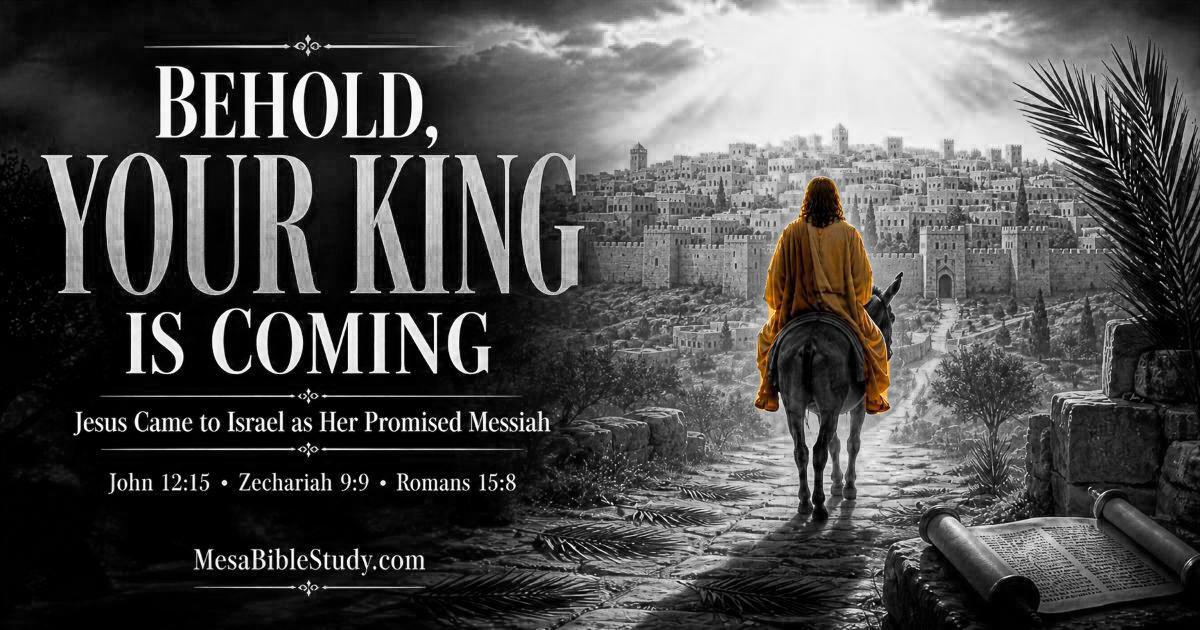
Jesus Came to Israel as Her Promised Messiah
“Fear not, daughter of Zion;
Behold, your King is coming,
Sitting on a donkey’s colt.”
— John 12:15
There are some passages which cannot be understood correctly if we remove Israel from the context.
John 12:15 is one of them.
This verse is not a vague religious statement about Jesus entering Jerusalem. It is not merely a touching scene before the cross. It is not the beginning of the Church. It is not the Body of Christ being formed.
John 12:15 is the public presentation of Jesus as Israel’s promised King.
Jesus came among His people. He entered Jerusalem. He fulfilled the words of the prophet Zechariah. He came as the Messiah promised to Israel hundreds of years earlier.
Zechariah had written:
“Rejoice greatly, O daughter of Zion!
Shout, O daughter of Jerusalem!
Behold, your King is coming to you;
He is just and having salvation,
Lowly and riding on a donkey,
A colt, the foal of a donkey.”
— Zechariah 9:9
John records the fulfillment:
“Fear not, daughter of Zion;
Behold, your King is coming,
Sitting on a donkey’s colt.”
— John 12:15
The King promised to Zion had come to Zion.
The King promised to Jerusalem had entered Jerusalem.
The King promised to Israel stood among His people.
Jesus Came According to Prophecy
John tells us that Jesus found a young donkey and sat on it:
“Then Jesus, when He had found a young donkey, sat on it; as it is written…”
— John 12:14
Those words are important:
“As it is written.”
Jesus was fulfilling written prophecy.
This was not mystery truth hidden in God. This was not the revelation of the one Body later given to Paul. This was not the gospel of the uncircumcision being revealed.
This was prophecy.
It had been written. It had been promised. It had been declared beforehand through Israel’s prophets.
Zechariah said Israel’s King would come:
“Lowly and riding on a donkey,
A colt, the foal of a donkey.”
And that is exactly what happened.
When we read John 12, we are not watching the Church begin. We are watching Israel’s prophetic Scriptures unfold in real time.
Jesus Came to His Own People
John’s Gospel had already prepared us for this moment:
“He came to His own, and His own did not receive Him.”
— John 1:11
That statement is simple but weighty.
Jesus came to His own.
Who were His own?
Israel.
He came as the Son of Abraham.
He came as the Son of David.
He came under the law.
He came to the lost sheep of the house of Israel.
He came as the promised Messiah and King.
Matthew begins his Gospel this way:
“The book of the genealogy of Jesus Christ, the Son of David, the Son of Abraham.”
— Matthew 1:1
That is covenant language. That is kingdom language. That is Israel-in-prophecy language.
Jesus did not appear in history detached from the promises of God. He came through Israel. He came according to prophecy. He came to fulfill what God had promised to Israel’s fathers.
Paul Explains Christ’s Earthly Ministry
Many misunderstand the earthly ministry of Jesus because they read the later revelation of the Church, the Body of Christ, back into Matthew, Mark, Luke, and John. Too many link Paul’s doctrines of grace, the body of Christ to the four gospels by one word—”retroactive”. Horror’s.
Retroactively forcing Paul’s revelation into the four Gospels and Acts 1–2 is a man-made bridge—born of desperation—propped up by eisegesis, not exegesis.
But Paul gives us the doctrinal explanation of Christ’s earthly ministry in Romans 15:8:
“Now I say that Jesus Christ has become a servant to the circumcision for the truth of God, to confirm the promises made to the fathers.”
— Romans 15:8
That verse settles the issue.
Jesus Christ became a servant or a minister to the circumcision.
That means His earthly ministry was directed to Israel.
Why?
“To confirm the promises made to the fathers.”
Which fathers?
Abraham, Isaac, Jacob, David, and the fathers of Israel.
Jesus came to confirm those promises, not cancel them.
He came to fulfill them, not transfer them.
He came as Israel’s Messiah, not as the founder of replacement theology.
This is why John 12:15 matters so much. When Jesus entered Jerusalem riding on the donkey’s colt, He was not acting out a random symbol of humility. He was fulfilling the prophetic promise given to Israel.
The King had come.
The King of Israel
When the multitude heard that Jesus was coming to Jerusalem, they went out to meet Him:
“Took branches of palm trees and went out to meet Him, and cried out:
‘Hosanna!
“Blessed is He who comes in the name of the LORD!”
The King of Israel!’”
— John 12:13
Notice what they called Him:
“The King of Israel.”
Not the King of the Church.
Not the Head of the Body of Christ.
Not the mystery revealed through Paul.
They cried:
“The King of Israel.”
That title is not accidental. It identifies Jesus in connection with Israel’s kingdom hope.
The people were quoting from Psalm 118:
“Blessed is he who comes in the name of the LORD!”
— Psalm 118:26
They were using kingdom language rooted in Israel’s Scriptures.
This scene belongs to Israel’s prophetic hope. The Messiah had come. The King was present. The promises were being confirmed.
The Donkey Did Not Deny His Kingship
Some may see Jesus riding on a donkey and only think of humility. That is true, but it is not the whole point.
The donkey did show His lowliness.
But it also confirmed His kingship.
Zechariah did not say Israel’s King would come first on a war horse. He said:
“Lowly and riding on a donkey.”
Jesus came lowly at His first coming. He came meek. He came offering Himself to Israel. He came with salvation. He came as the King promised by God.
His humility did not make Him less royal.
It proved He was the King Zechariah foretold.
Every detail mattered.
The city mattered.
The animal mattered.
The timing mattered.
The prophecy mattered.
The people mattered.
Jesus came to Jerusalem as Israel’s promised King.
Israel’s Rejection Did Not Cancel God’s Promises
The tragedy of John 12 is that Israel’s King came to His own people, yet the nation did not receive Him.
John 1:11 says:
“He came to His own, and His own did not receive Him.”
The leaders of Israel rejected Him. The nation did not repent. The kingdom was not established at that time.
But Israel’s rejection did not cancel God’s promises.
Paul makes this clear in Romans 11:
“For I do not desire, brethren, that you should be ignorant of this mystery, lest you should be wise in your own opinion, that blindness in part has happened to Israel until the fullness of the Gentiles has come in.”
— Romans 11:25
Israel was blinded in part.
Not permanently.
Not totally.
Not forever.
Then Paul says:
“And so all Israel will be saved, as it is written:
‘The Deliverer will come out of Zion,
And He will turn away ungodliness from Jacob.’”
— Romans 11:26
And then:
“For the gifts and the calling of God are irrevocable.”
— Romans 11:29
That verse is essential.
God did not revoke His gifts and calling to Israel. How can He?
Israel’s unbelief did not make God unfaithful.
Israel’s rejection did not erase the covenants.
The Church did not replace Israel.
The promises made to the fathers still stand because God cannot lie.
Jesus Confirmed the Promises Made to the Fathers
Romans 15:8 must be kept in view:
“Jesus Christ has become a servant to the circumcision for the truth of God, to confirm the promises made to the fathers.”
That is what we see in John 12.
Jesus came to confirm the promises.
He came as Abraham’s promised Seed.
He came as David’s promised Son.
He came as Israel’s promised Messiah.
He came as Zion’s promised King.
This is why we must be careful not to read John 12 through a replacement-theology lens or use a made u. If we remove Israel from the passage, we destroy the context. If we turn Zion into the Church, Jerusalem into a metaphor, and Israel’s King into a generic religious symbol, we are no longer allowing the Scripture to speak plainly. It’s either we believe what God has promised or not.
John 12:15 says:
“Daughter of Zion…”
“Your King…”
“As it is written…”
The passage tells us where we are.
We are in Israel’s prophetic program.
We are in Jerusalem.
We are watching Israel’s King come to His people.
The Mystery Was Not Being Revealed in John 12
This is where rightly dividing the Word of truth becomes essential.
John 12:15 is prophecy.
Paul’s gospel and the revelation of the mystery were not yet revealed.
Paul later wrote:
“Now to Him who is able to establish you according to my gospel and the preaching of Jesus Christ, according to the revelation of the mystery kept secret since the world began.”
— Romans 16:25
He also wrote:
“Which in other ages was not made known to the sons of men, as it has now been revealed by the Spirit…”
— Ephesians 3:5
And again:
“To make all see what is the fellowship of the mystery, which from the beginning of the ages has been hidden in God…”
— Ephesians 3:9
That is not what is happening in John 12.
John 12 is not hidden truth being revealed.
John 12 is written prophecy being fulfilled in time.
Zechariah wrote it.
John records it.
Jesus fulfilled it.
That distinction matters.
Why This Matters
If we misunderstand John 12:15, we will misunderstand the ministry of Christ, the promises to Israel, and the later revelation given to Paul.
Jesus’ earthly ministry must be read in its proper context.
He came to Israel.
He came under the law.
He came to confirm the promises made to the fathers.
He came as King.
He came according to prophecy.
That does not diminish His death, burial, and resurrection. It magnifies the faithfulness of God.
The same Jesus who came lowly on a donkey’s colt will come again in power and glory.
At His first coming, He came meek and lowly.
At His second coming, He will come as King of kings and Lord of lords.
Israel rejected Him, but God is not finished with Israel.
The King will return.
The covenants will be fulfilled.
The gifts and calling of God are irrevocable.
Final Summary
John 12:15 is not merely a Palm Sunday verse. It is a prophetic declaration that Jesus is Israel’s promised King.
Zechariah said He would come.
John records that He came.
Paul explains why He came:
“To confirm the promises made to the fathers.”
Jesus entered Jerusalem as the King of Israel. He came to Zion. He came to His own people. He fulfilled the prophetic Scriptures.
Israel’s rejection did not cancel God’s promises. The Church did not replace Israel. God’s covenant faithfulness remains sure.
The King who came lowly on a donkey’s colt will come again in glory.
And when He does, Israel will finally look upon the One whom they pierced, and the promises made to the fathers will be fulfilled exactly as God said.
Because God does not revoke what He has promised.
“For the gifts and the calling of God are irrevocable.”
— Romans 11:29