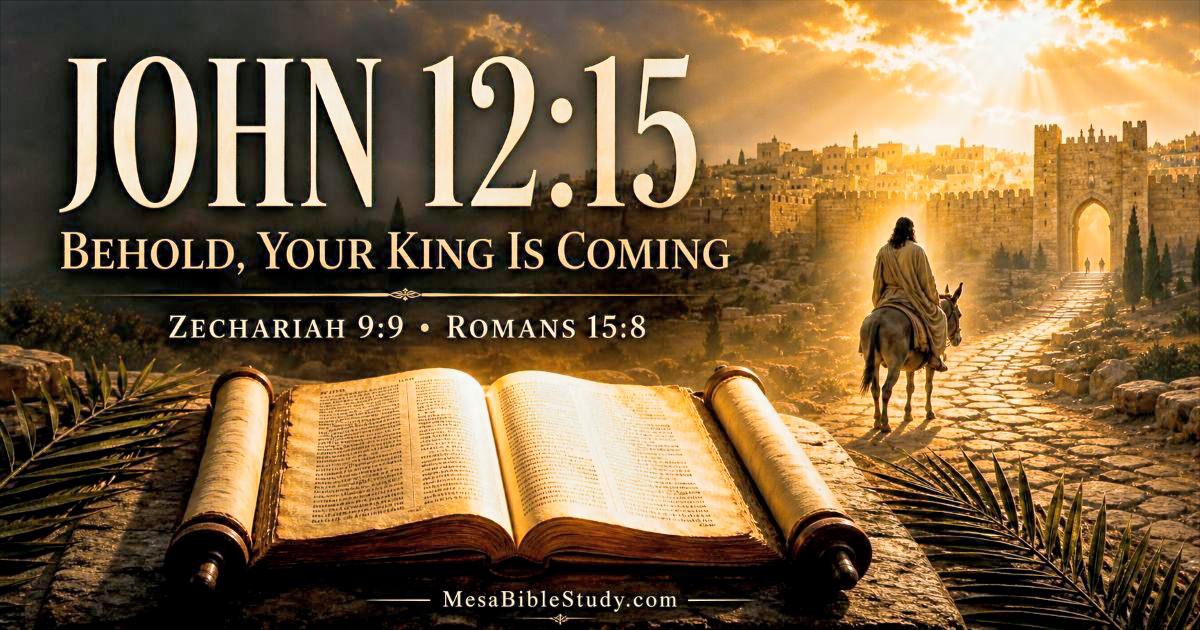
Passage: John 12:12–16
“The next day a great multitude that had come to the feast, when they heard that Jesus was coming to Jerusalem,
took branches of palm trees and went out to meet Him, and cried out:
‘Hosanna!
“Blessed is He who comes in the name of the LORD!”
The King of Israel!’
Then Jesus, when He had found a young donkey, sat on it; as it is written:
‘Fear not, daughter of Zion;
Behold, your King is coming,
Sitting on a donkey’s colt.’
His disciples did not understand these things at first; but when Jesus was glorified, then they remembered that these things were written about Him and that they had done these things to Him.”
— John 12:12–16
Introduction
John 12:15 is one of the clearest passages showing that Jesus entered Jerusalem as Israel’s promised King. He did not enter Jerusalem randomly. He did not arrive as a religious reformer trying to improve Judaism. He came exactly as the prophets said He would come.
Hundreds of years before this event, Zechariah had written:
“Rejoice greatly, O daughter of Zion!
Shout, O daughter of Jerusalem!
Behold, your King is coming to you;
He is just and having salvation,
Lowly and riding on a donkey,
A colt, the foal of a donkey.”
— Zechariah 9:9
John 12:15 is the fulfillment of that prophecy. Jesus came among His people, Israel. He came to Zion. He came to Jerusalem. He came as their King. This is exactly what Paul later confirms in Romans 15:8:
“Now I say that Jesus Christ has become a servant to the circumcision for the truth of God, to confirm the promises made to the fathers.”
— Romans 15:8
That verse is essential. During His earthly ministry, Jesus was a minister to the circumcision. He came to confirm the promises made to Israel’s fathers — Abraham, Isaac, Jacob, David, and the prophets. John 12:15 must be understood in that covenant and prophetic context.
Chapter Theme
John 12 presents Jesus publicly before Israel as the promised Messiah, while also revealing the growing rejection that would lead to His crucifixion. The King came to His own people according to prophecy, but the nation’s leaders did not receive Him.
John had already written:
“He came to His own, and His own did not receive Him.”
— John 1:11
That statement becomes visible in John 12. The King is present. The prophecy is fulfilled. The people cry out. The Scriptures are unfolding before their eyes.
Yet Israel’s full national repentance does not and will not take place.
Background & Flow
In John 12, Jesus comes to Jerusalem shortly before His death. A great multitude had come to the feast, and when they heard Jesus was coming, they took palm branches and went out to meet Him.
They cried:
“Hosanna!
‘Blessed is He who comes in the name of the LORD!’
The King of Israel!”
— John 12:13
This language is not Church language. This is not the revelation of the Body of Christ. This is Israel’s kingdom language. They are identifying Jesus in connection with the promises, covenants, Psalms, and prophets.
The phrase “Blessed is He who comes in the name of the LORD” comes from Psalm 118, a Messianic psalm connected with Israel’s deliverance and kingdom hope.
Then Jesus finds a young donkey and sits upon it, fulfilling Zechariah 9:9. John explains that this happened “as it is written.”
That phrase matters.
Jesus was not introducing something hidden from the foundation of the world. He was fulfilling what had already been written in Israel’s prophetic Scriptures.
Phrase-by-Phrase Breakdown
“Fear not…”
John’s quotation begins:
“Fear not…”
Zechariah 9:9 says:
“Rejoice greatly, O daughter of Zion! Shout, O daughter of Jerusalem!”
John summarizes the prophetic announcement with the words “Fear not.” The coming of Israel’s King should have brought comfort, not terror. The promised King was not coming to destroy His people, but to bring salvation, fulfillment, and deliverance.
This fits the prophecy in Zechariah:
“He is just and having salvation,
Lowly and riding on a donkey…”
Jesus did not come riding on a great white steed and glory. He came lowly. He came meek. He came offering the kingdom. He came in fulfillment of God’s promises.
This was the King coming to His people in grace.
“Daughter of Zion…”
The phrase “daughter of Zion” identifies the people and city connected with God’s covenant promises.
Zion is not a symbol for the Church here. Zion refers to Jerusalem and Israel in the prophetic program of God.
Zechariah wrote:
“Rejoice greatly, O daughter of Zion!
Shout, O daughter of Jerusalem!”
John is deliberately connecting Jesus’ entrance into Jerusalem with Israel’s prophetic expectation. The King is not entering Rome. He is not entering Athens. He is not entering the nations.
He is entering Jerusalem.
He is among His covenant people.
He is presenting Himself to Israel.
This is why Romans 15:8 is so important:
“Jesus Christ has become a servant to the circumcision for the truth of God, to confirm the promises made to the fathers.”
Jesus’ earthly ministry was directed to Israel according to promise. He came as the promised Seed, the Son of David, the Son of Abraham, and the King of Israel.
“Behold…”
The word “behold” calls attention to something of great significance.
This is not ordinary. This is not incidental. This is not merely a public arrival.
The King promised by the prophets has come.
The people of Israel should have recognized the hour of their visitation. The Scriptures had testified of Him. The miracles had identified Him. The prophets had described Him. John the Baptist had prepared the way before Him.
Now, in John 12, Jesus enters Jerusalem exactly as Zechariah said He would.
The nation is being confronted with the identity of Jesus.
This is their Messiah.
This is their King.
“Your King is coming…”
This is the central statement:
“Behold, your King is coming…”
The word “your” matters.
Jesus is Israel’s King.
He is the promised King from David’s line. He is the One who has the rightful claim to David’s throne. Gabriel had announced this before His birth:
“He will be great, and will be called the Son of the Highest; and the Lord God will give Him the throne of His father David.”
— Luke 1:32
That throne is not spiritualized into the Church. It is the throne of David. It belongs to Israel’s kingdom promises.
Jesus came as King because God had promised Israel a King.
He came to fulfill, not cancel, the promises.
Paul confirms this in Romans 15:8. Jesus Christ became a servant to the circumcision “to confirm the promises made to the fathers.”
He did not come to erase those promises.
He did not come to transfer those promises to a different people.
He came to confirm them.
And Romans 11:29 states:
“For the gifts and the calling of God are irrevocable.”
God’s calling of Israel was not revoked because of Israel’s unbelief. Israel’s rejection brought judgment and blindness in part, but it did not cancel the promises of God.
“Sitting on a donkey’s colt.”
Jesus came lowly, riding on a donkey’s colt.
This fulfilled Zechariah 9:9:
“Lowly and riding on a donkey,
A colt, the foal of a donkey.”
The imagery is deliberate. Jesus was not entering Jerusalem on a war horse. He was not coming in military conquest at His first coming. He came meek and lowly.
This shows both His humility and His royal identity.
The donkey did not deny His kingship. It fulfilled His kingship.
He came exactly as Israel’s prophet said the King would come.
This matters because prophecy requires precision. Jesus did not merely fulfill vague ideas. He fulfilled specific Scriptures in specific ways, among a specific people, in a specific city, according to God’s prophetic program.
“As it is written…”
John makes the interpretive point clear:
“As it is written…”
This event belongs to prophecy.
It was written beforehand.
That means John 12:15 is not the revelation of the mystery later given to Paul. It is not the formation of the one Body. It is not Jew and Gentile being reconciled in one new man apart from Israel’s covenants.
This is prophecy being fulfilled.
Paul’s later revelation of the mystery concerns truth that was “kept secret since the world began”:
“Now to Him who is able to establish you according to my gospel and the preaching of Jesus Christ, according to the revelation of the mystery kept secret since the world began.”
— Romans 16:25
But John 12:15 is not secret truth.
It was written.
It was prophesied.
It was promised.
It concerned Israel, Jerusalem, Zion, and the King.
The Disciples Did Not Understand at First
John 12:16 says:
“His disciples did not understand these things at first…”
This is an important detail. Even the disciples did not fully understand the prophetic significance of what was happening at the time.
They were participating in events written in Scripture, but they did not fully grasp them until after Jesus was glorified.
This helps us avoid reading later revelation backward into the passage. We must not assume the disciples understood everything that would later be revealed through Paul. They did not even fully understand the prophetic meaning of this event at first.
Progressive revelation matters.
God revealed truth in order, in time, and according to His purpose.
Doctrinal Summary
John 12:15 shows Jesus entering Jerusalem as Israel’s promised King in fulfillment of Zechariah 9:9.
This passage belongs to Israel’s prophetic program. Jesus is among His people. He is entering Zion. He is being presented as King. He is fulfilling what was written by the prophets concerning Israel’s Messiah.
Romans 15:8 gives the doctrinal explanation of Christ’s earthly ministry:
“Jesus Christ has become a servant to the circumcision for the truth of God, to confirm the promises made to the fathers.”
Jesus came to confirm the promises made to Israel’s fathers. He came as the promised Seed, the Son of David, and King of Israel.
Romans 11:29 further confirms that God’s gifts and calling are irrevocable. Israel’s unbelief did not cancel God’s promises. The nation’s rejection of Christ brought judgment and temporary blindness, but God’s covenant promises remain sure.
John 12:15 is not a Church passage in the Pauline mystery sense. It is a kingdom passage. It is prophetic. It concerns Israel, Zion, Jerusalem, and the King promised long before by Zechariah.
Final Summary
John 12:15 is a powerful reminder that Jesus came exactly as Scripture said He would.
He came to Israel.
He came to Jerusalem.
He came as the promised King.
He came lowly, riding on a donkey’s colt.
He came to confirm the promises made to the fathers.
The tragedy is that Israel’s King stood among His people, yet the nation did not receive Him. But their rejection did not make God unfaithful. God’s promises to Israel remain because “the gifts and the calling of God are irrevocable.”
Jesus is the King Zechariah wrote about.
He is the King John identified.
He is the King Israel rejected.
And He is the King who will come again to reign.